CCSD Code B2710: Radical mastectomy including block dissection
CCSD Code B2710: Definition and clinical scope CCSD Code B2710 is the UK private...

Last Updated: Nov 13, 2026
L1700 is the HCPCS Level II code for a Legg perthes orthosis, Toronto type, custom fabricated. It is a hip containment brace built for one child with Legg-Calvé-Perthes disease. The brace holds both legs in abduction and slight internal rotation, so the femoral head stays in the hip socket while the child walks.
L1700 opens the L1700-L1755 family of Legg Perthes orthoses. Each code in that family is custom fabricated, so the prescribed design decides which one you bill.
Let Pabau's smart automation suggest the right codes, reduce claim denials, and keep your practice compliant—effortlessly.
Automate repetitive tasks and focus on what matters most—your patients.
Reduce coding errors and ensure compliance with the latest regulations.
Clean claims, fewer denials, and faster reimbursements.
Powerful insights and reporting to help your practice thrive.
HIPAA compliant SOC 2 certified GDPR-compliant Trusted by 4,000+ clinics worldwide

HCPCS Code L1700 is a Legg perthes orthosis, Toronto type, custom fabricated. It is a pediatric hip containment device, although some online listings describe it as a knee orthosis.
The Toronto design holds both hips in abduction and slight internal rotation, while still letting the child stand, walk and sit.
Most patients are children, so Medicaid and commercial plans pay far more L1700 claims than Medicare does.
L1700 is on the CMS Master List but on neither Required List, so Medicare asks for no prior authorization or face-to-face encounter.
Support the claim with M91.11 or M91.12 for Legg-Calvé-Perthes disease, coded to the side the record documents.
HCPCS Code L1700 is the permanent national Level II code for a Legg perthes orthosis, Toronto type, custom fabricated. CMS lists it with that exact wording on its DMEPOS Master List. The code describes a hip orthosis for children with Legg-Calvé-Perthes disease, built from scratch for one patient.
The descriptor names only the Toronto design and the custom fabrication. It does not mention fitting, adjustment or replacement parts, so none of those can be assumed to sit inside the code.
The Toronto orthosis was described by W. P. Bobechko and colleagues in a 1968 paper in Artificial Limbs. It replaced plaster abduction casts, which kept children immobile for months and stiffened their knees and ankles.
The brace holds the legs at 90 degrees of abduction to each other, with the feet turned slightly inward. Two thigh cuffs sit on a rigid frame. Tie rods with ball joints connect that frame to foot blocks, and the child’s shoes are fixed to those blocks.
Because of the ball joints, the child can still stand, walk and sit in the device. That weight-bearing movement, with the femoral head held deep in the acetabulum, is what the design was built to allow.
Custom fabricated means the orthosis is made for one named patient, from that patient’s measurements, tracings or a model. A prefabricated device is made in advance and then fitted, and it belongs on a different code.
Every code from L1700 to L1755 is custom fabricated. So fabrication level never decides which code in this family you bill. The design does.
Custom fabrication still has to be justified in the record. Ask the ordering orthopedic surgeon to note why a prefabricated hip abduction orthosis would not hold this child’s hips in the position the treatment needs.
Legg-Calvé-Perthes disease is a childhood condition, so the payer on an L1700 claim is rarely Medicare. Medicare covers children only in narrow cases, such as end-stage renal disease. Most L1700 claims go to a state Medicaid program, a Children’s Health Insurance Program (CHIP) plan or a commercial insurer.
That changes where you look for the rules. A Medicare-only checklist will miss the prior authorization, age limits and replacement rules that a Medicaid plan sets for pediatric orthoses.
Verify the payer and its policy before the fitting appointment. A custom device made for one child cannot be resold or reissued if the claim fails.
Medicare pays L1700 from the CMS DMEPOS fee schedule, which is updated every January. Pricing indicator 38 means the state fee amounts are held between a national floor and ceiling. Your DME MAC pays the lower of the billed charge and the fee schedule amount.
Medicaid and commercial payers set their own rates for L1700, and many publish them in a separate orthotic fee schedule. Third-party aggregators often lag behind those files, so price from the payer’s own document.
L1700 sits on the CMS Master List of DMEPOS items potentially subject to conditions of payment. It is not on the Required Prior Authorization List or the Required Face-to-Face Encounter and Written Order Prior to Delivery List. So Medicare’s standard order and delivery rules apply, with no extra pre-delivery steps.
Those standard rules still need a complete file. Build it from these records:
Medicaid and commercial plans often add their own conditions, such as prior authorization or a prescription from a named specialty. Add those to the file before fabrication starts, while a missing item can still be fixed.
Put the affected side in three places: the order, the clinical note and the claim. Picture a note that says left hip and a diagnosis code that says right leg. That mismatch is one of the fastest ways to get an L1700 claim pulled for review.
Each payer sets its own modifier rules for L1700. Check your DME MAC policy articles and each plan’s billing manual before you add one.
The Toronto orthosis is one device that spans both legs, so it bills as one unit of L1700. Ask the payer how it wants a single bilateral device reported before you add RT or LT. Some plans want no laterality modifier at all on this code.
Orthoses are purchased items, so rental modifiers such as RR do not belong on an L1700 claim.
A clean L1700 claim follows the order of the records. Most denials on custom orthoses trace back to a step done out of sequence. The sequence below splits at the start of fabrication, the point after which a missing item can no longer be fixed.
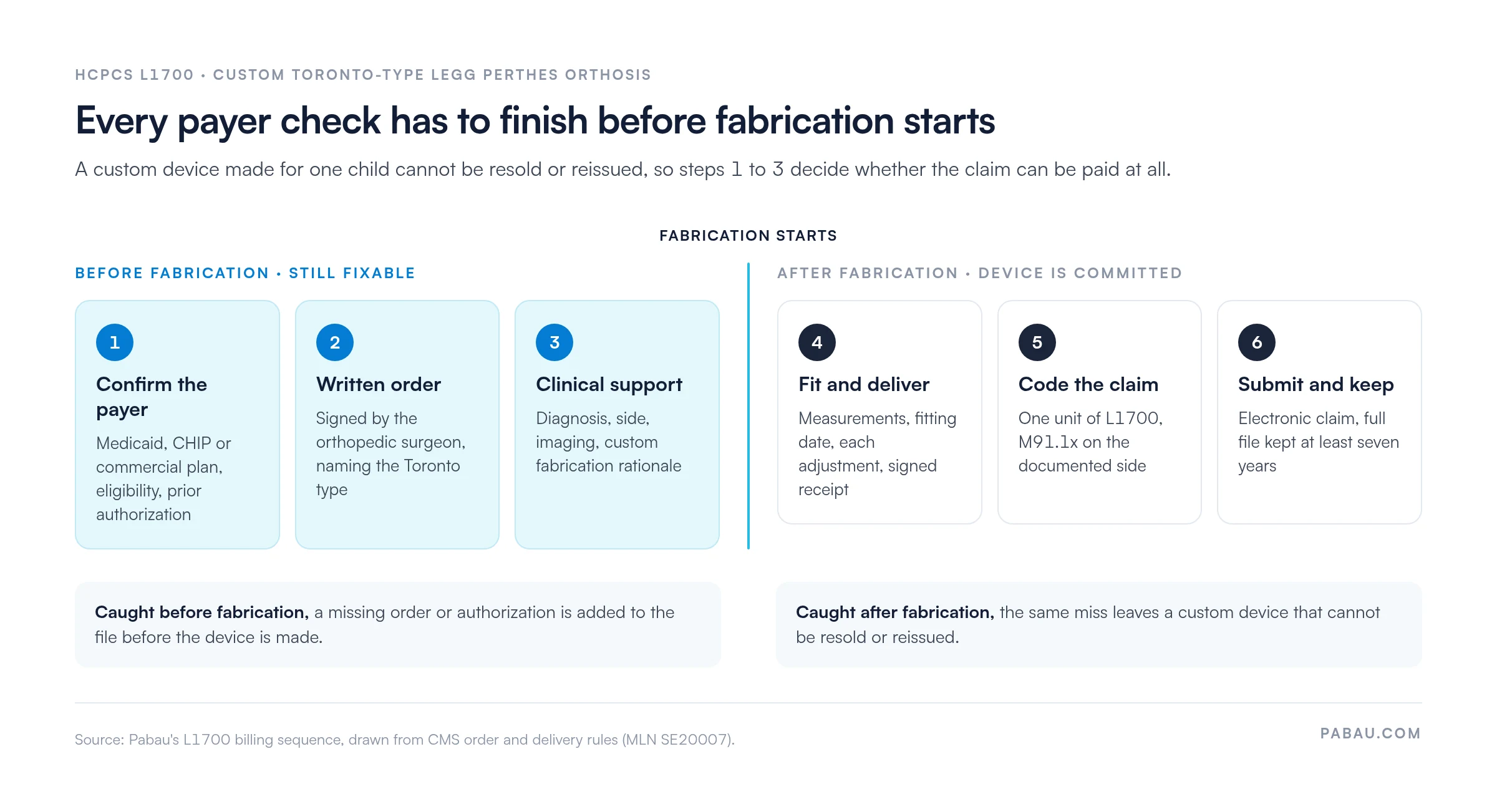
Every field has to match across the file before the claim leaves your system. That means the diagnosis code, the side, the order date, the delivery date and the patient details.
HCPCS Code L1700 opens a five-code family of Legg Perthes orthoses. All five are custom fabricated hip containment devices, so the prescribed design alone decides which one applies.
L1710 and L1720 are not upgraded versions of L1700. Each one is a separate hip orthosis design with its own base code.
Billing L1700 for a Newington or Scottish Rite device is a coding error, whatever the diagnosis. A Scottish Rite brace bills as L1730, and a patten bottom brace as L1755.
L1700 is also unrelated to the knee orthosis codes. An elastic knee brace with condylar pads and joints is billed with L1820 or L1821, depending on how it was fitted. Some online listings mix the two up, so check the CMS descriptor before you code.
Confirm current code status in the CMS HCPCS overview and its quarterly update files.
The diagnosis on an L1700 claim is almost always Legg-Calvé-Perthes disease. ICD-10-CM classifies it as juvenile osteochondrosis of the head of the femur, category M91.1, coded to the affected leg.
M91.1 has no bilateral code. When both hips are involved, report M91.11 and M91.12 together.
An unspecified code such as M91.10 invites a records request on a custom device, because the payer cannot see which hip the orthosis treats. Ask the surgeon to state the side in the note. Our ICD-10-CM code reference holds the guides for the diagnosis codes behind these claims.
Check the diagnosis against the payer’s policy before the claim goes out. A policy that lists only M91.1x codes will reject a claim built on a general hip pain code, even when the notes describe Legg-Calvé-Perthes disease.
Denials on this code cluster around a few repeatable mistakes. Each one can be caught at intake or fitting.
Most orthotic suppliers build a custom orthosis file by hand. The order arrives by fax, the imaging report sits in the hospital chart, and the fitting notes are on paper. Nobody sees the whole file until a payer asks for it.
Pabau, our practice management platform, keeps those records on one patient timeline. The written order, the prior authorization, the fitting history and the signed delivery receipt all sit together, each with its date. Our claims management software then carries the code, the diagnosis and any modifier onto the claim.
Your billing team can check the side, the order date and the delivery date in seconds, before the claim leaves. Fewer L1700 claims come back for records, and more of them pay on the first pass.
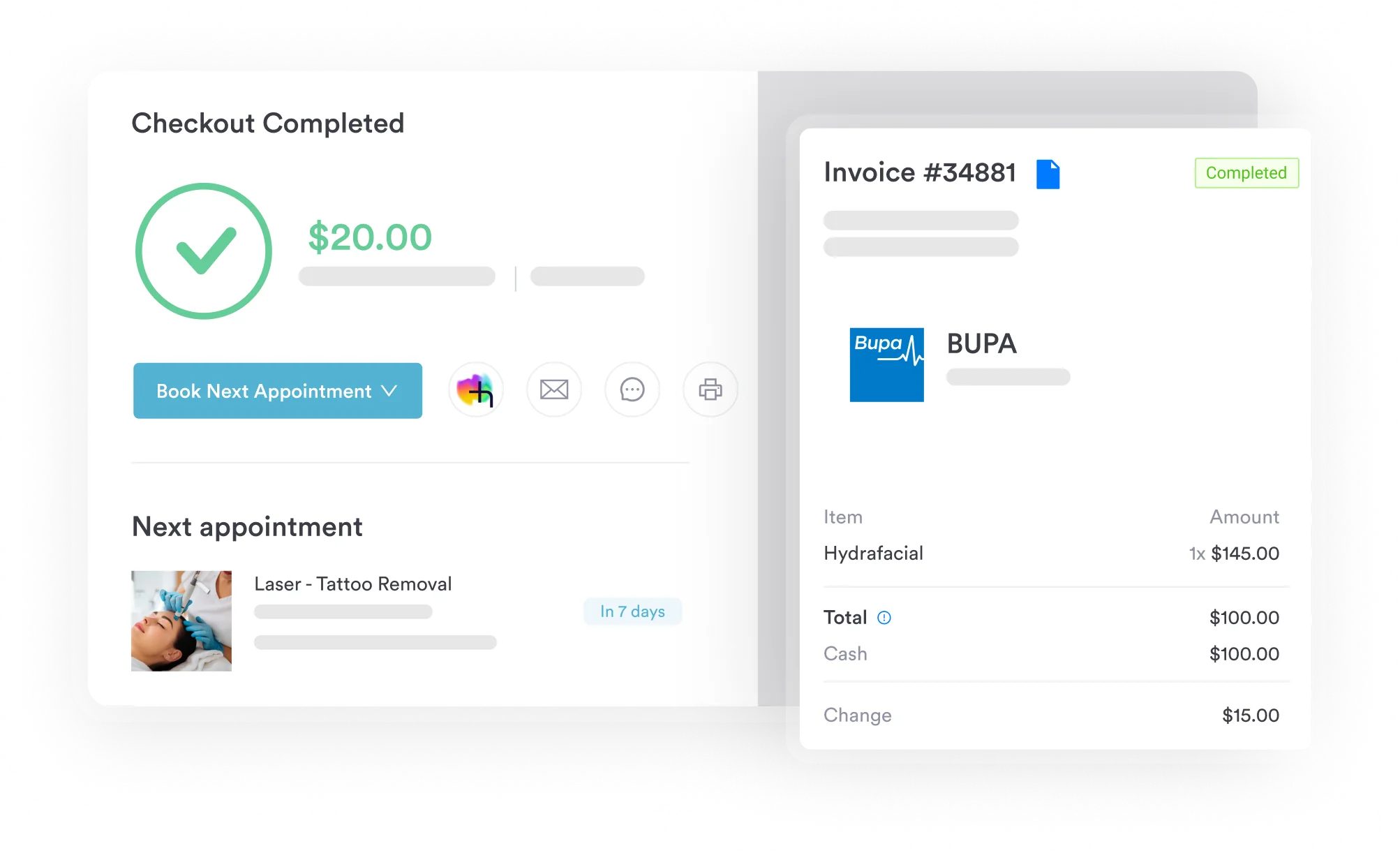

Pabau keeps written orders, fitting notes and delivery receipts on one patient record, then carries the code and diagnosis onto the claim.

HCPCS Code L1700 pays for one specific device: a custom fabricated Toronto-type orthosis for a child with Legg-Calvé-Perthes disease. The descriptor says little, so the claim stands on the file behind it.
Bill the design that was prescribed and code the side the surgeon documented. Then price the claim from the child’s own payer, not the Medicare schedule. Book a demo to see how Pabau keeps the order, the fitting and the claim on one record.

Need guidance on orthotic denial patterns? Denial management in healthcare covers ways to find and fix the most common claim rejection reasons.
Wondering what makes a claim pay on the first pass? What is a clean claim sets out the data elements a payer checks before it accepts a submission.
Looking at the wider compliance picture? Medical billing compliance outlines the rules DMEPOS suppliers follow to stay audit-ready.
Want to tighten the whole billing workflow? Revenue cycle management explains the path from order intake through payment posting.
HCPCS Code L1700 is used to bill a Legg perthes orthosis, Toronto type, custom fabricated. It is a hip containment device for children with Legg-Calvé-Perthes disease. The brace holds both hips in abduction and slight internal rotation while the child walks.
No. L1700 is a Legg Perthes hip orthosis code. An elastic knee orthosis with condylar pads and joints is billed with L1820 or L1821. Some online listings attach knee brace wording to L1700 in error.
Both codes describe a custom fabricated Legg Perthes orthosis, so the difference is the design. L1700 is the Toronto type and L1710 is the Newington type. L1710 is a separate base code, not a higher-spec version of L1700.
No. L1700 is on the CMS Master List but not on the Required Prior Authorization List. Medicaid and commercial plans often require prior authorization for custom pediatric orthoses, so check the child’s own plan.
The main codes are M91.11 and M91.12, juvenile osteochondrosis of the head of the femur in the right or left leg. Use M91.10 only when the record does not state the side. Report both M91.11 and M91.12 when both hips are involved.
You need a standard written order on file before submission, plus clinical notes that give the diagnosis, the side and the imaging. Add the reason for custom fabrication, the fitting records and a signed proof of delivery. Keep the file for at least seven years.
Most L1700 patients are children, so Medicaid, CHIP and commercial plans pay most claims. Medicare covers children only in narrow cases, such as end-stage renal disease. Check the plan’s orthotic policy and fee schedule before fabrication.