HCPCS code S0139: Billing guide for Medicaid and commercial payers
HCPCS code S0139: Official descriptor and quick-reference details HCPCS code S01...

Last Updated: Nov 13, 2026
L1630 is the HCPCS Level II code for a semi-flexible hip abduction orthosis of the Von Rosen type, custom-fabricated for one patient. The device controls abduction of both hip joints.
The splint holds an infant's hips flexed and abducted so the femoral heads stay seated in the hip sockets. It treats developmental dysplasia and subluxation of the hip, paired with a Q65 diagnosis code. L1630 is not an ankle-foot orthosis, and it is not the prefabricated Pavlik harness billed under L1620.
Let Pabau's smart automation suggest the right codes, reduce claim denials, and keep your practice compliant—effortlessly.
Automate repetitive tasks and focus on what matters most—your patients.
Reduce coding errors and ensure compliance with the latest regulations.
Clean claims, fewer denials, and faster reimbursements.
Powerful insights and reporting to help your practice thrive.
HIPAA compliant SOC 2 certified GDPR-compliant Trusted by 4,000+ clinics worldwide

L1630 describes a custom-fabricated, semi-flexible Von Rosen type splint that holds an infant’s hips flexed and abducted.
It treats developmental dysplasia and subluxation of the hip, so the supporting diagnosis comes from the Q65 family.
L1630 is a hip orthosis, not an ankle-foot orthosis, so a foot drop or flat foot diagnosis on the claim signals a coding error.
The custom-fabricated element sets it apart from the Pavlik harness (L1620) and the Frejka pillow (L1600), which are prefabricated.
Most L1630 patients are infants, so Medicaid or a commercial plan is usually the payer and its authorization rules come first.
HCPCS code L1630 is a Level II code for a Von Rosen type hip abduction orthosis. CMS’s quarterly HCPCS release lists it as a semi-flexible hip orthosis that controls abduction of the hip joints and is custom fabricated.
Its official long descriptor reads “Hip orthosis (HO), abduction control of hip joints, semi-flexible (Von Rosen type), custom-fabricated.”
The code sits in the L-series of HCPCS Level II, which CMS maintains and updates each year. Within that series, L1630 belongs to the hip orthosis range, L1600 to L1690.
The Von Rosen splint is an H-shaped frame, padded and shaped to the infant. It holds both hips flexed and abducted, so the femoral heads stay seated in the hip sockets while the joint develops. Each of the four descriptor elements below should match the device the infant received.
Medicare classes L1630 as an orthotic, in the benefit for leg, arm, back, and neck braces. That makes it a DMEPOS item billed to a DME MAC by an enrolled supplier. Payers generally treat measurement, fabrication, and fitting as part of the device payment, so no separate fitting code goes on the claim.
Developmental dysplasia of the hip (DDH) is the main indication for L1630. In DDH the hip socket is shallow, or the femoral head sits partly or fully out of it. A Von Rosen splint is typically used in newborns and young infants, while the joint can still remodel around a well-seated femoral head.
Coverage turns on abduction control of the hip joints. The record should show why the hips need to be held in abduction. It should also say why a custom-fabricated, semi-flexible splint suits this infant better than a stock harness or pillow.
Typical support is a hip exam with Ortolani or Barlow findings, plus imaging, usually a hip ultrasound at this age.
Every L1630 claim needs a supporting ICD-10-CM code, and for DDH that code usually comes from category Q65, congenital deformities of hip.
Code the type the record documents, whether full dislocation, partial dislocation (subluxation), instability, or dysplasia, along with the laterality. Payer acceptance varies, so confirm each code against the plan’s policy before submitting.
Foot and ankle diagnoses such as foot drop or flat foot have no place on an L1630 claim. Neither does Legg-Calvé-Perthes disease, coded to M91.1-, which affects older children and has brace codes of its own. Those run from L1700 to L1755.
The hip orthosis group describes several similar-sounding abduction devices. Three facts decide between them: the design the descriptor names, the type of control, and whether the device is prefabricated or custom-fabricated. The table follows the CMS long descriptors.
Sorting the same codes by control type and fabrication shows why the device record matters. L1630 is the only code in its cell of the grid below.
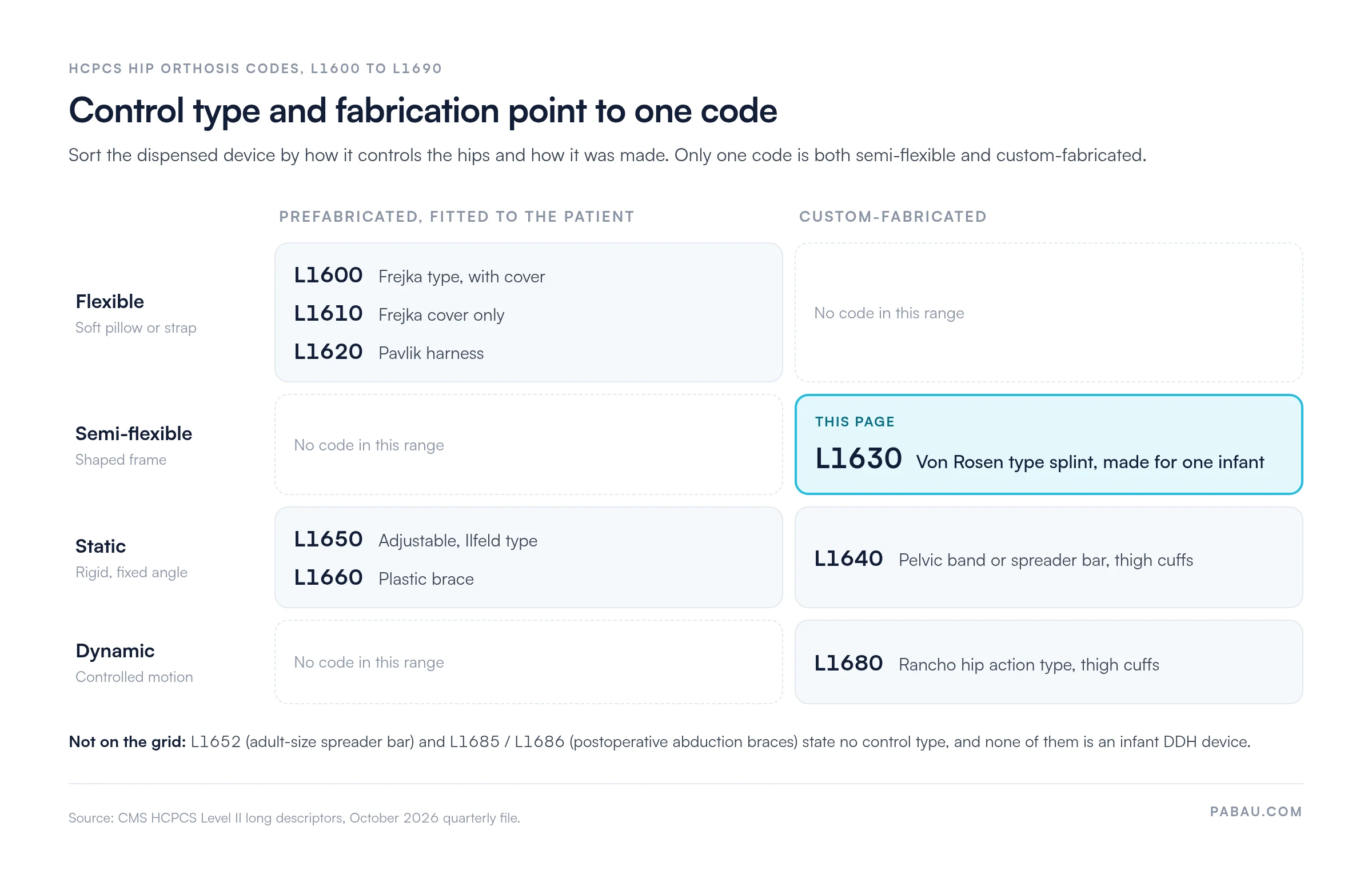
The custom-fabricated element is what most often goes wrong. If the infant received a stock splint that was bent to fit at the visit, it does not meet the L1630 descriptor. A Pavlik harness belongs under L1620, and a custom-made spreader bar with thigh cuffs belongs under L1640.
Check the product’s coding with the manufacturer, or with the PDAC, before billing. If the order names a different device than the one dispensed, fix the order first. A mismatch between order, device, and code is a frequent denial code trigger in DMEPOS reviews.
Medicare Part B can cover L1630 under its orthotic benefit when the splint is reasonable and necessary and the record supports it. Claims go to the DME MAC that serves the beneficiary’s state.
Few Medicare beneficiaries are infants, so Medicare rarely pays for a Von Rosen splint. Its documentation rules still shape what Medicaid and commercial plans ask for.
L1630 is priced on the DMEPOS fee schedule, not the physician fee schedule. The allowed amount varies by state and updates each January. Check the current file on the CMS DMEPOS fee schedule page before quoting a figure. Plans that do not follow Medicare pricing publish their own orthotic rates.
Medicaid is the main payer for L1630 because the patients are infants. Under the EPSDT benefit, states must cover medically necessary care for enrollees under 21, including orthoses like this splint.
Criteria, fee schedules, and authorization thresholds still vary by state. Verify insurance eligibility before measuring, because a newborn’s coverage may not be active in the payer’s system yet.
Prior authorization for L1630 depends on the payer. For a Medicare claim, check the current CMS Required Prior Authorization List for DMEPOS items.
Many Medicaid and commercial plans require authorization for custom-fabricated orthoses. Build the check into a standard prior authorization process at intake, because the splint is made to order and should not wait on paperwork.
Track prior authorization expiry dates next to the planned delivery date. A custom splint delivered one day after the authorization lapses can be denied, and few plans grant retroactive authorization for orthoses.
Auditors reviewing L1630 claims look for a specific set of records. A custom-fabricated orthosis needs more support than a stock device, because the supplier must show why a made-to-measure splint was necessary.
Missing any item below can lead to a recoupment demand in a post-payment review, so treat it as part of your medical billing compliance routine.
Certificates of medical necessity (CMNs) were discontinued for Medicare dates of service from January 1, 2023, so the order and medical record carry the proof. Records are generally kept for seven years from the date of service, and some state Medicaid programs require longer. Check your state’s retention rule before setting a schedule.
L1630 is billed on the CMS-1500 claim form, or the 837P electronic transaction, by an enrolled DMEPOS supplier. The supplier needs an active National Provider Identifier (NPI) and, for Medicare, DMEPOS supplier enrollment. Many states also require a licensed or certified orthotist to fabricate and fit a custom orthosis.
For electronic submission, the 837P transaction carries the same data and routes through the supplier’s clearinghouse before reaching the payer. Confirm the clearinghouse passes HCPCS L-codes and modifiers through correctly, and run each claim against a clean claim checklist first.
Modifiers on an L1630 claim mostly signal financial liability for a Medicare claim. The splint controls both hip joints as one device, so follow each plan’s own rule on whether it wants a side modifier. Apply only the modifier that matches the documentation on file.
L1630 denials follow predictable patterns. Effective denial management starts with finding which record triggered the rejection, so the fix targets the right document. The table below maps each denial to its root cause and resolution.
When a denial arrives, the electronic remittance advice (ERA) carries CARC and RARC codes that identify the reason. Mapping those codes to the table above tells the billing team which document to correct or what to address in the appeal.
Scan or file the measurement sheet for every L1630 splint on the day it is taken. That record is the first document an auditor asks for when the custom-fabricated element is questioned.
Most L1630 errors start before anyone opens the claim form. A foot code is copied from an old template, an order names the wrong device, or the measurements never make it into the record.
Pabau, the practice management and billing platform we build, keeps the order, the exam notes, and the fabrication record on one patient record. Its claims management software pulls that record data into a pre-filled claim. It then submits and tracks the claim through Claim.MD and posts the remittance when it arrives.
Denial reasons stay visible across claim batches. A team billing several hip orthoses a month can see which step keeps failing. The fix then goes into the intake workflow instead of another appeal.

Pabau keeps the written order, fabrication and fitting notes, and claim status on one patient record. Your team submits L1630 claims with the documentation already in place.

L1630 is a custom-made Von Rosen splint for an infant with hip dysplasia or subluxation, and every part of the claim should say so. The diagnosis comes from Q65, the device matches the semi-flexible, custom-fabricated descriptor, and the fabrication is on record.
If a chart or order mentions an ankle-foot orthosis, foot drop, or Legg-Calvé-Perthes disease, stop and recheck the code before billing. Those belong to other code families, and a claim that mixes them is hard to defend on audit.
Book a demo to see how Pabau keeps orders, fabrication notes, and claim status together for your orthotic billing team.

Need guidance on managing medical billing compliance? Medical billing compliance best practices covers documentation retention, audit readiness, and HIPAA-aligned record-keeping.
Want to understand how the revenue cycle works for orthotic practices? What is revenue cycle management breaks down the claim lifecycle from eligibility to payment posting.
HCPCS code L1630 covers a hip orthosis that controls abduction of the hip joints. It is semi-flexible, of the Von Rosen type, and custom-fabricated for one patient. It is used mainly for infants with developmental dysplasia or subluxation of the hip.
No. L1630 is a hip orthosis. Ankle-foot orthoses have their own codes, starting at L1900. A foot drop or flat foot diagnosis does not support an L1630 claim.
L1620 is the Pavlik harness, a flexible strap device that is prefabricated and then customized to fit. L1630 is a semi-flexible Von Rosen type splint that is custom-fabricated for one infant. Bill the code that matches the device delivered.
Most L1630 claims pair with a Q65 code for congenital dislocation, partial dislocation, instability, or dysplasia of the hip. Code the type and laterality the record documents, and avoid the unspecified codes when a precise one fits.
It depends on the payer. For Medicare, check the current CMS Required Prior Authorization List for DMEPOS items. Many Medicaid and commercial plans require authorization for custom orthoses, so verify with the plan before fabrication starts.
Common reasons are a foot or Perthes diagnosis paired with L1630, a prefabricated device billed under the code, and an incomplete written order. Missing prior authorization is another. The CARC and RARC codes on the remittance advice identify the specific reason.