HCPCS Code A4648: Implantable tissue marker billing guide
HCPCS Code A4648: Official descriptor and device description HCPCS Code A4648 is...

Last Updated: Oct 15, 2026
L1620 is the HCPCS Level II code for a flexible hip abduction orthosis, the Pavlik harness. The official descriptor covers a prefabricated harness that an individual with expertise has trimmed, bent, molded, assembled, or otherwise customized to fit one patient.
The harness holds an infant's hips flexed and abducted so the femoral heads stay seated in the hip sockets. It is the usual first-line treatment for developmental dysplasia of the hip, paired with a Q65 diagnosis code. L1620 is not a Legg-Calvé-Perthes orthosis, since those devices bill under L1700-L1755.
Let Pabau's smart automation suggest the right codes, reduce claim denials, and keep your practice compliant—effortlessly.
Automate repetitive tasks and focus on what matters most—your patients.
Reduce coding errors and ensure compliance with the latest regulations.
Clean claims, fewer denials, and faster reimbursements.
Powerful insights and reporting to help your practice thrive.
HIPAA compliant SOC 2 certified GDPR-compliant Trusted by 4,000+ clinics worldwide

L1620 describes a flexible Pavlik harness that holds an infant’s hips flexed and abducted to treat developmental dysplasia of the hip.
Pair L1620 with a congenital hip code from the Q65 family, coded to the type and laterality the record documents.
Legg-Calvé-Perthes orthoses are a separate family, L1700-L1755, so a Perthes diagnosis on an L1620 claim signals a coding error.
The descriptor requires customization by an individual with expertise, so the record should name the fitter and each adjustment made.
Most L1620 patients are infants, so Medicaid or a commercial plan is usually the payer and its authorization rules come first.
HCPCS code L1620 belongs to the L-series of the Healthcare Common Procedure Coding System (HCPCS Level II), which CMS maintains and updates annually. L-series codes cover orthotic and prosthetic devices and services. L1620 sits in the hip orthosis group, which runs from L1600 to L1690.
L1620 is the Pavlik harness. Its chest and leg straps hold an infant’s hips flexed and abducted. That position keeps the femoral heads seated in the hip sockets while the joint develops. The official descriptor has five elements, quoted in order in the table below. All five should match the device the infant received.
Medicare classes L1620 as an orthotic, in the benefit for leg, arm, back, and neck braces. That makes it a DMEPOS item billed to a DME MAC by an enrolled supplier. Payers generally treat the fitting as part of the device payment, so no separate fitting code goes on the claim.
Developmental dysplasia of the hip (DDH) is the clinical indication for L1620. In DDH the hip socket is shallow or the femoral head sits partly or fully out of it. The Pavlik harness is the usual first-line treatment for infants under about six months, while the joint can still remodel.
Every L1620 claim needs a supporting ICD-10-CM code, and for DDH that code usually comes from category Q65, congenital deformities of hip. Code the type the record documents, whether full dislocation, partial dislocation, instability, or dysplasia, and the laterality. Payer acceptance varies, so confirm each code against the plan’s policy before submitting.
Legg-Calvé-Perthes disease is coded to M91.1- and is a different condition in older children. It is not an indication for L1620, and a Perthes code on an L1620 claim is a mismatch a reviewer will catch.
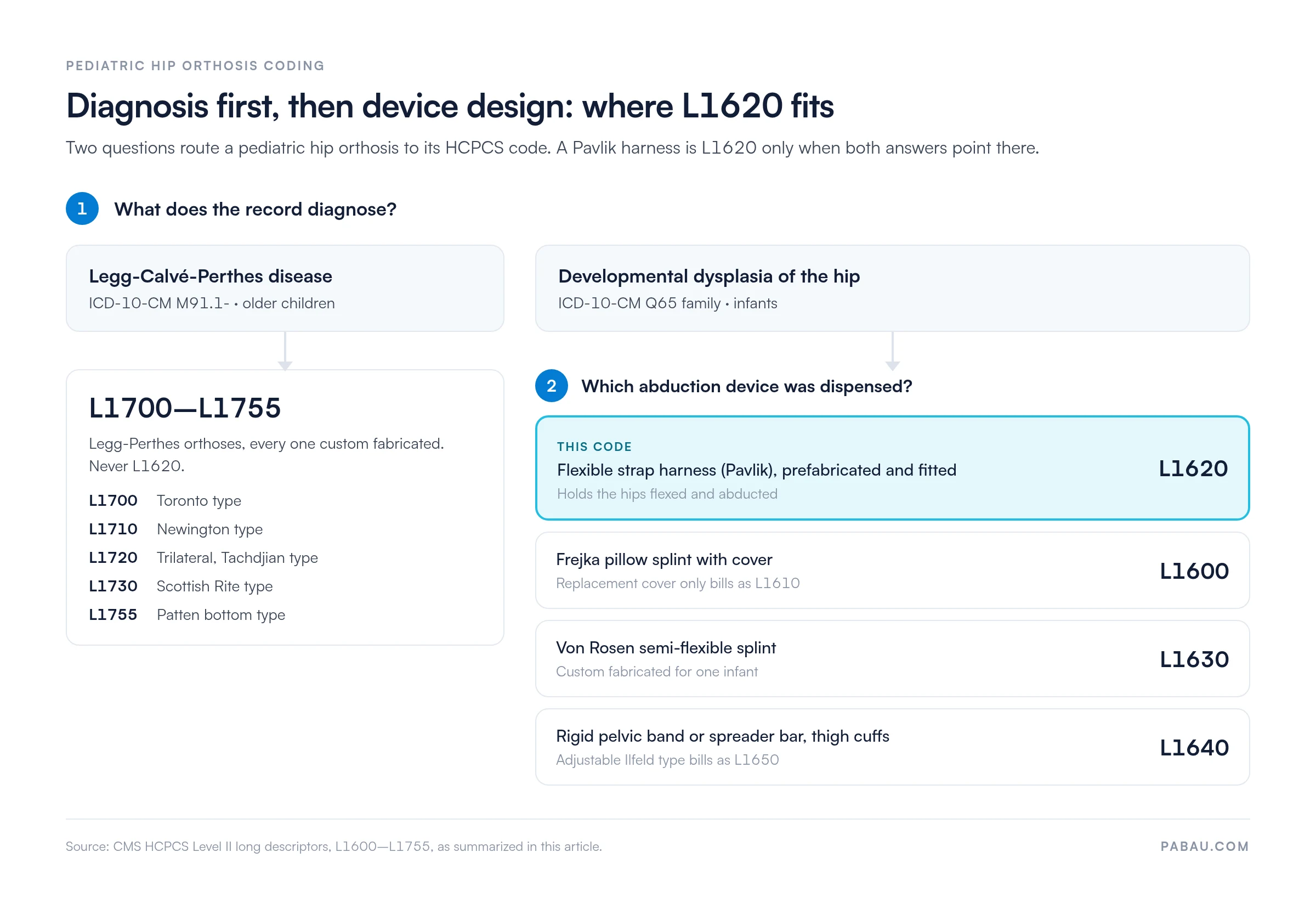
The first seven codes in the hip orthosis group describe similar-sounding abduction devices. Two facts decide between them: the design the descriptor names, and whether the device is prefabricated or custom fabricated. The table follows the CMS long descriptors.
The rest of the group, L1660 to L1690, covers rigid plastic, dynamic, postoperative, and combination lumbo-sacral hip designs. None of them is a harness. If the order names a different device than the one dispensed, fix the order before billing. A mismatch between order, device, and code is a frequent denial code trigger in DMEPOS post-payment reviews.
Orthoses for Legg-Calvé-Perthes disease have their own code family, and every code in it is custom fabricated. Bill one of these when the diagnosis is Perthes disease:
The two families treat different patients. A Pavlik harness is fitted to an infant with DDH. Perthes orthoses are built for older children whose femoral head has lost its blood supply. So the diagnosis settles the code family first, and the device design then settles the code, as the path below shows.
Medicare Part B can cover L1620 under its orthotic benefit when the harness is reasonable and necessary and the record supports it. Claims go to the DME MAC that serves the beneficiary’s state. Few Medicare beneficiaries are infants, so Medicare rarely pays for a Pavlik harness. Its documentation rules still shape what Medicaid and commercial plans ask for.
L1620 is priced on the DMEPOS fee schedule, not the physician fee schedule. The allowed amount varies by state and updates each January. Check the current file on the CMS DMEPOS fee schedule page before quoting a figure. Plans that do not follow Medicare pricing publish their own orthotic rates.
Medicaid is the main payer for L1620 because the patients are infants. Under the EPSDT benefit, states must cover medically necessary care for enrollees under 21, including devices like the harness. Criteria, fee schedules, and authorization thresholds still vary by state. Verify insurance eligibility before the fitting, because a newborn’s coverage may not be active in the payer’s system yet.
Prior authorization for L1620 depends on the payer. For a Medicare claim, check the current CMS Required Prior Authorization List for DMEPOS items. Many Medicaid and commercial plans require authorization for orthoses, and a harness is usually fitted within days of diagnosis. Building the authorization check into a standard prior authorization process at intake keeps the fitting on schedule.
Track prior authorization expiry dates in your billing system next to the fitting date. A harness fitted one day after the authorization lapses can be denied. Few plans grant retroactive authorization for orthoses.
Auditors reviewing L1620 claims look for a specific set of records. A clean claim for an orthotic device needs more support than an office visit, because the supplier must show medical necessity and proper fitting. Missing any item below can lead to a recoupment demand in a post-payment review.
Certificates of medical necessity (CMNs) were discontinued for Medicare dates of service from January 1, 2023, so the order and medical record carry the proof. Records are generally kept for seven years from the date of service, and some state Medicaid programs require longer. Check your state Medicaid program’s retention rule before setting a schedule.
L1620 is billed on the CMS-1500 claim form, or the 837P electronic transaction, by an enrolled DMEPOS supplier. The supplier needs an active National Provider Identifier (NPI) and, for Medicare, DMEPOS supplier enrollment.
For electronic submission, the 837P transaction carries the same data. The 837 file routes through the supplier’s clearinghouse before reaching the payer. Confirm the clearinghouse passes HCPCS L-codes and modifiers through correctly.
Modifiers on an L1620 claim mostly signal financial liability for a Medicare claim. Apply the one that matches the documentation on file, and follow each commercial or Medicaid plan’s own modifier rules.
L1620 denials follow predictable patterns. Effective denial management starts with finding which record triggered the rejection, so the fix targets the right document. The table below maps each denial to its root cause and resolution.
When a denial arrives, the electronic remittance advice (ERA) carries CARC and RARC codes that identify the reason. Mapping those codes to the table above tells the billing team which document to correct or what to address in the appeal.
Log the strap settings at every harness check for each active L1620 patient. That fitting history is the first record an auditor asks for when a larger replacement harness is billed.
Most L1620 errors start before anyone opens the claim form. A Perthes code gets copied from an old template, an order leaves out the item, or a fitting never gets written down.
Practice management software like Pabau keeps the order, the exam notes, and the fitting record on the same patient record. Its claims management software pulls that existing record data into a pre-filled claim. It then submits and tracks the claim through Claim.MD and posts the remittance when it arrives.
Denial reasons stay visible across claim batches. A team billing several harnesses a month can see which step keeps failing. The fix then goes into the intake workflow instead of another appeal.

Pabau keeps the written order, fitting notes, and claim status on one patient record. Your team submits L1620 claims with the documentation already in place.

L1620 is a Pavlik harness for an infant with hip dysplasia, and every part of the claim should say so. The diagnosis comes from Q65, the device matches the flexible harness descriptor, and the fitting is on record.
If a chart or order mentions Legg-Calvé-Perthes disease, stop and recheck the code before billing. That diagnosis belongs with the L1700-L1755 orthoses, and a claim that mixes the two families is hard to defend on audit.
Book a demo to see how Pabau keeps orders, fitting notes, and claim status together for your orthotic billing team.

Need guidance on managing medical billing compliance? Medical billing compliance best practices covers documentation retention, audit readiness, and HIPAA-aligned record-keeping.
Confused by the denial codes on your remittance? Denial codes in medical billing explains CARC and RARC codes and how to use them to prioritize appeals.
Checking coverage for a newborn before the fitting? Insurance eligibility verification walks through what to confirm with the payer before the visit.
Want fewer claims bounced back for missing details? What makes a clean claim lists the elements a payer checks before it accepts a claim.
Want to understand how the revenue cycle works for orthotic practices? What is revenue cycle management breaks down the end-to-end claim lifecycle from eligibility to payment posting.
HCPCS code L1620 covers a flexible hip abduction orthosis, the Pavlik harness, prefabricated and then customized to fit the patient by an individual with expertise. It is used mainly for infants with developmental dysplasia of the hip.
No. L1620 is a Pavlik harness for infant hip dysplasia. Orthoses for Legg-Calvé-Perthes disease have their own codes, L1700 through L1755, and all of them are custom fabricated.
It depends on the payer. For Medicare, check the current CMS Required Prior Authorization List for DMEPOS items. Many Medicaid and commercial plans require authorization for orthoses, so verify with the plan before the harness is fitted.
L1620 is priced on the DMEPOS fee schedule, which varies by state and updates each January. CMS does not publish one national rate, so check the current CMS DMEPOS fee schedule file for your state. Medicaid and commercial plans set their own rates.
Common reasons are a Legg-Calvé-Perthes diagnosis paired with L1620, a different hip device billed under the code, and an incomplete written order. Missing prior authorization is another. The CARC and RARC codes on the remittance advice identify the specific reason.