CPT code 44625: Enterostomy closure with resection
CPT code 44625 needs three things in one operation CPT code 44625 reports an ope...

Last Updated: Oct 8, 2026
HCPCS Code S0161 is a deleted HCPCS Level II S-code for calcitriol 0.25 mcg. Calcitriol is the active form of vitamin D used in dialysis and renal care. CMS deleted S0161 effective October 1, 2010 and cross-references it to S0169, “Calcitrol, 0.25 microgram”, which carries the same drug at the same strength.
Injectable calcitriol is a separate code, J0636. Any claim submitted with S0161 today is rejected at the payer level before clinical review. A superbill template that still carries it needs the replacement loaded in its place.

HCPCS Code S0161 described calcitriol 0.25 mcg and was deleted from the HCPCS Level II code set effective October 1, 2010
S0169 (Calcitrol, 0.25 microgram) is the direct one-to-one replacement CMS points billers to in place of S0161
Injectable calcitriol is billed with J0636 (injection, calcitriol, 0.1 mcg), a permanent code for a different route and a different unit
S0169 sits in the non-Medicare S-code range, so commercial and Medicaid plans set their own coverage and some ask for J3490 with an invoice instead
Practice management software like Pabau flags deleted and inactive codes before submission, so rejections get caught before the claim leaves the practice
HCPCS Code S0161 was the HCPCS Level II descriptor for calcitriol at the 0.25 mcg strength. It sat in the temporary national S-code range maintained by the Centers for Medicare and Medicaid Services (CMS). The official CMS descriptor read “Calcitrol, 0.25 mg”.
Its replacement, S0169, states the strength as 0.25 microgram, which matches the dispensed oral product. S-codes cover drugs and services that have no permanent code in CPT or in the permanent Level II ranges.
The table below summarizes the core code data for S0161 before deletion, plus the code that took its place.
The history still matters at practices that treat renal or dialysis patients. Many of them carry legacy code sets from earlier fiscal years. An outdated superbill template referencing S0161 produces a rejection the moment the claim reaches the clearinghouse or payer.
HCPCS Code S0161 is deleted and cannot be used for billing. It was terminated effective October 1, 2010. The AAPC coding database and the CMS HCPCS Level II annual code files both list S0169 as the code to use instead.
Submitting a claim with a deleted HCPCS code triggers an automatic rejection at adjudication. Payers do not evaluate the clinical documentation when the code itself is invalid.
There is no grace period. CMS and commercial payers treat deleted codes the same way, so the claim fails at the front end of adjudication before any medical necessity review. The denial arrives as a technical rejection rather than a clinical one. Resubmission means correcting the code, not the supporting documentation.
Practices running older EHR or billing software with infrequent code set updates are most at risk. A code loaded into a charge capture template during an earlier year can persist unnoticed through multiple billing cycles. A yearly audit of active procedure codes against the current CMS HCPCS file catches those entries before they cost a cycle.
HCPCS Level II S-codes are temporary national codes used to describe drugs, supplies, and services that the permanent CPT code set does not cover. CMS assigns and maintains S-codes for billing situations where no permanent Level I or Level II code exists. That makes them a flexible but provisional category.
Several characteristics define how S-codes behave in practice:
S0161 followed the typical S-code lifecycle. It was issued to address a specific drug billing need, maintained while relevant, then deleted and superseded by a corrected descriptor. The AAPC Codify HCPCS lookup flags S0161 as a deleted code alongside its last-known descriptor.
One point carries over to the replacement. S0169 is also an S-code, so the non-Medicare limitation and the payer-by-payer coverage rules above apply to it too.
Calcitriol is 1,25-dihydroxyvitamin D3, the biologically active form of vitamin D produced by the kidneys. Dietary vitamin D and cholecalciferol supplements need renal conversion before they work. Calcitriol does not, which makes it the preferred therapeutic form for patients whose kidneys can no longer perform that conversion.
Clinical prescribing of calcitriol is concentrated in settings where calcium regulation is impaired. The primary indications, according to FDA prescribing information, include:
Every administration has to be coded for both the drug and the route. S0161 covered the oral 0.25 mcg capsule formulation while it was active, and S0169 covers it now. Calcitriol given by injection has always billed under a separate code and follows a different payer pathway.
S0169 is the direct replacement for S0161. CMS retired S0161 on October 1, 2010 and cross-references it to S0169. That code describes the same drug at the same 0.25 microgram strength, so the crosswalk is one to one. Two further codes matter, depending on how the calcitriol reaches the patient and which payer is being billed.
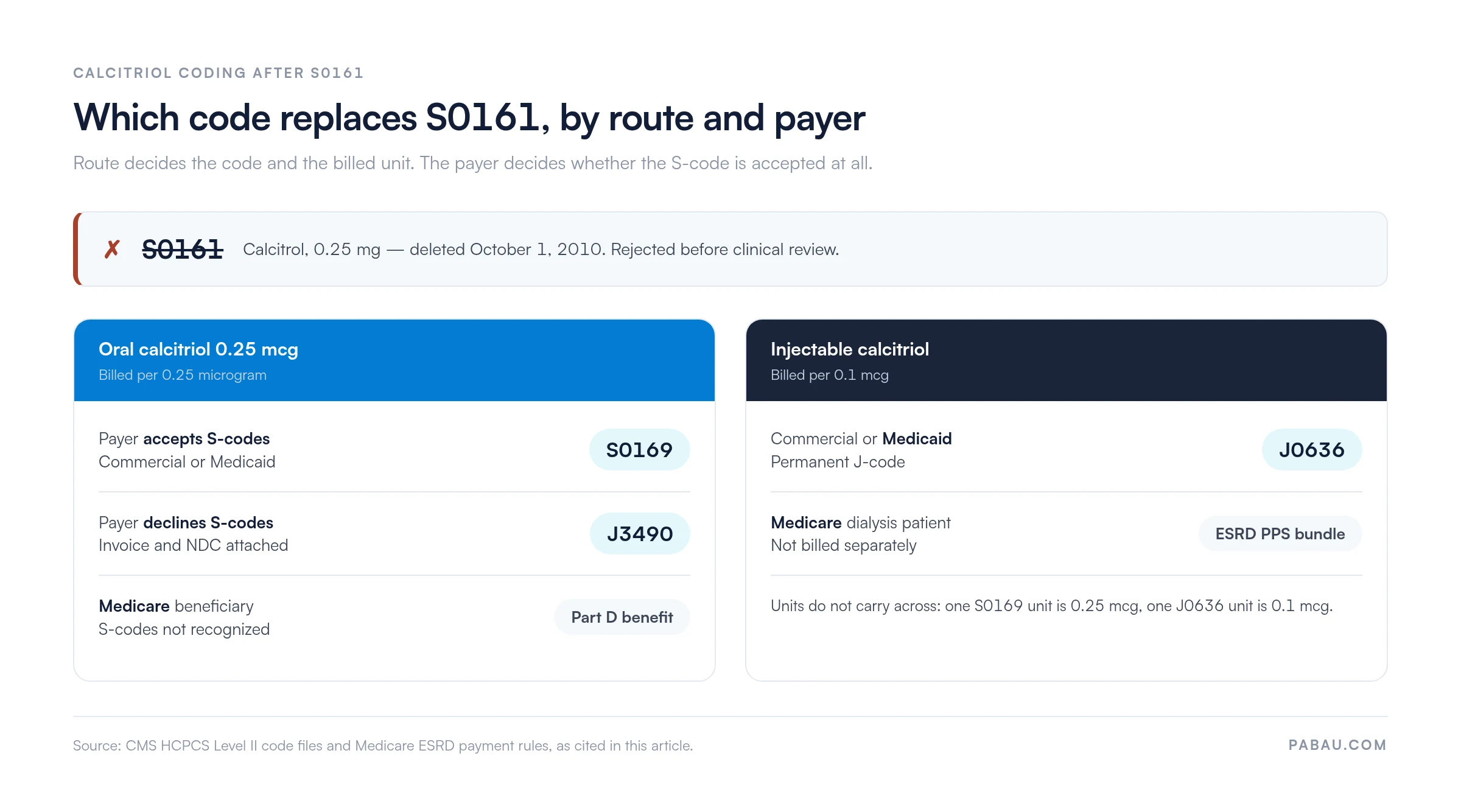
Route of administration decides between the first two codes. Oral calcitriol capsules or solution map to S0169 and bill per 0.25 microgram. Calcitriol given by injection maps to J0636 and bills per 0.1 mcg, so the units are not interchangeable.
Because S0169 sits in the non-Medicare S-code range, some commercial plans and Medicaid programs decline it. They ask for J3490 with an invoice instead. Checking the denial codes on the remittance tells you which situation applies, because the reason code separates code validity from coverage policy.
Between the two routes and the payer rules, four codes are in play at once. The chart below shows which one applies in each situation.
Before billing any code listed here, verify its current status. The CMS HCPCS Level II file via PGM Billing and the NLM Clinical Tables HCPCS API both carry it. HCPCS codes are updated annually and coverage policies change. The codes above are the standard alternatives, and they are not billing advice for a specific payer or clinical scenario.
The switch from S0161 to S0169 is a code-set maintenance task rather than a clinical one, and it takes six steps to close out properly.
When a payer sends you to J3490 instead of S0169, attach the NDC in the loop 2410 segment of the 837P claim file. Practices routinely omit the NDC on oral drug claims, and that single omission is the most common reason a J3490 line returns a technical rejection. Your billing system or clearinghouse should have an NDC field reserved for unclassified drug codes.
Calcitriol claims require a supporting ICD-10-CM diagnosis code that establishes medical necessity. The diagnosis code has to reflect the condition being treated rather than defaulting to vitamin D deficiency.
The table below lists ICD-10-CM codes commonly paired with calcitriol billing. Verify each one against the current-year CMS ICD-10-CM code file before use.
Payers reviewing medical necessity for calcitriol claims will check the ICD-10-CM code against the FDA-approved indications. That review is tightest on oral claims routed through an unclassified code. Code to the highest level of specificity the chart documents. Choosing N25.81 over E55.9 cuts the risk of a medical necessity denial.
Coverage for calcitriol varies by payer type and clinical setting, and the replacement code inherits that variation from S0161. The framework below reflects general industry guidance. Individual payer contracts and local coverage determinations (LCDs) always take precedence over general rules.
Audit your superbill and charge-capture templates against the CMS HCPCS Level II annual file every January. Flag any code marked deleted or revised. For oral calcitriol, go one step further and record which of S0169 or J3490 each commercial payer accepts. Settling that before the first claim of the year beats discovering it from a rejection mid-cycle.
Medicare does not recognize HCPCS Level II S-codes, so neither S0161 nor its replacement S0169 was ever billable to Medicare. For dialysis patients, calcitriol given intravenously as part of ESRD treatment falls under the Medicare ESRD bundled payment system (ESRD PPS).
It is paid inside the facility’s per-treatment rate rather than billed separately under J0636. Oral calcitriol for ESRD patients may instead be covered under Medicare Part D, the prescription drug benefit, rather than Part B.
Commercial insurers and state Medicaid programs decide for themselves whether they accept S0169. The plans that do treat it as the straight successor to S0161 and price it from the contract. Where a plan declines S-codes, practices bill oral calcitriol through J3490 instead.
The claim needs an itemized invoice listing the drug name, strength, National Drug Code (NDC), units dispensed, and wholesale acquisition cost. Without that documentation, the unclassified drug claim denies. A standing checklist for unclassified drug submissions keeps the paperwork consistent across every claim.
Prior authorization is common for calcitriol, particularly for the oral formulation billed to commercial payers. Verifying coverage at the time of prescription beats doing it at claim submission. That avoids the most common delay, where the prior auth requirement surfaces only after the claim comes back denied.
Add a field to your superbill that flags drug claims needing prior authorization. Front-desk and billing staff can then start the process before the drug is dispensed.
Managing HCPCS code changes across an annual update cycle is one of the quieter operational risks in a busy practice. A deleted code like S0161 sitting in a billing template can generate rejections for months before anyone connects the pattern to a code status issue.
Pabau, practice management software for clinical and billing teams, catches that at entry instead. It runs claims management that validates every line against the current HCPCS set before submission.
Practices using Pabau for billing workflows get pre-submission claim validation that checks code combinations, flags missing documentation, and routes claims through a structured review. Drug code billing makes that matter more than usual. An S0169 line can be refused by one payer and accepted by the next, and a J3490 line needs an attached invoice and NDC.
Holding the billing record and the clinical documentation on one platform changes that. The billing team has the supporting information at claim time instead of chasing it across disconnected systems.
Practices managing renal care, dialysis referral billing, or IV therapy involving vitamin D analogs can run all of it in one place. Pabau standardizes drug billing workflows, keeps code sets current, and cuts the overhead of annual HCPCS updates.

Pabau’s claims workflow validates HCPCS codes before submission, flags missing documentation on drug claims, and keeps your billing team ahead of annual code updates. See how it works for your practice.

S0161 has been dead for more than a decade, so what remains is maintenance rather than coding judgment. Pull it out of every superbill, charge-capture screen, and imported fee schedule, then load S0169 and J0636 in its place.
Route decides the code, and the payer decides whether the S-code is accepted at all. Confirm both on each commercial and Medicaid drug fee schedule before the first claim of the year. A practice that settles it in January stops paying for it one rejection at a time.
Pabau’s billing tools validate code combinations before claims leave the system, which lowers the cost of catch-and-correct billing cycles. If your team manages drug billing alongside a broader practice workflow, book a demo. We will walk through how the code checks fit your setup.

Need to understand how drug claim denials get resolved? Denial management in healthcare covers the structured approach to identifying, appealing, and preventing claim denials across drug and procedure codes.
Looking for a structured overview of HCPCS billing requirements? Superbill documentation guide explains what a compliant superbill must contain for drug and procedure billing, including unclassified drug code requirements.
Want to see how prior authorization fits into the billing workflow? Insurance eligibility verification outlines when and how to check coverage before prescribing or dispensing a drug.
HCPCS Code S0161 is a deleted HCPCS Level II S-code for calcitriol at the 0.25 mcg strength. Calcitriol is the active form of vitamin D used in renal and dialysis care. Its official CMS descriptor read Calcitrol, 0.25 mg. CMS deleted the code effective October 1, 2010 and replaced it with S0169. Claims submitted with S0161 are now rejected.
S0161 has been deleted, effective October 1, 2010. It is no longer in the HCPCS Level II code set and cannot be used for billing. There is no grace period. Any claim carrying it is rejected at the payer’s adjudication system, whatever the date of service or the clinical documentation. Use S0169 for the oral 0.25 mcg strength instead.
S0169 (Calcitrol, 0.25 microgram) is the direct replacement. CMS cross-references the deleted S0161 to S0169, which carries the same drug at the same strength, so the crosswalk is one to one. Injectable calcitriol uses a different active code, J0636 (injection, calcitriol, 0.1 mcg). Because S0169 is a non-Medicare S-code, some commercial payers and Medicaid programs ask for J3490 with an attached invoice and NDC instead.
Route of administration and billed unit. S0169 describes oral calcitriol at 0.25 microgram and sits in the non-Medicare S-code range, so coverage is set payer by payer. J0636 describes injectable calcitriol at 0.1 mcg and is a permanent J-code that Medicare recognizes. The units are not interchangeable, so a claim built on the wrong one reports the wrong quantity even when the drug is right.
The most commonly paired ICD-10-CM codes are N25.81 (secondary hyperparathyroidism of renal origin), E83.51 (hypocalcemia), and N18.6 (end-stage renal disease). E55.9 (vitamin D deficiency, unspecified) and E20.0 (idiopathic hypoparathyroidism) also appear. Choose the code that most specifically reflects the documented clinical condition rather than defaulting to the general vitamin D deficiency code.
Deleted HCPCS codes remain searchable in historical code databases. The AAPC Codify HCPCS lookup and PGM Billing’s HCPCS tool both display deleted codes with their last-known descriptor, deletion date, and replacement code. That helps when auditing legacy billing templates or tracing historical claims. The CMS HCPCS Level II annual code files also archive deleted codes in the deleted-codes supplement released each January.
Medicare does not recognize S-codes, so S0169 is not billable to Medicare. Injectable calcitriol for ESRD patients is paid inside the ESRD bundled payment (ESRD PPS) rather than separately under J0636. Oral calcitriol for Medicare beneficiaries typically falls under Part D instead. Commercial payers and state Medicaid programs vary. Most require prior authorization plus documentation of medical necessity aligned with FDA-approved indications.