

CCSD code G5100: Bypass of duodenum billing guide
CCSD code G5100 bills a bypass that leaves the duodenum in place CCSD code G5100...

Last Updated: Oct 16, 2026
S0160 is the HCPCS Level II code for dextroamphetamine sulfate, 5 mg.
Each unit billed under S0160 corresponds to one 5 mg dose of dextroamphetamine sulfate. The drug is a DEA Schedule II controlled substance, so claims must reflect valid prescribing authority.
Let Pabau's smart automation suggest the right codes, reduce claim denials, and keep your practice compliant—effortlessly.
Automate repetitive tasks and focus on what matters most—your patients.
Reduce coding errors and ensure compliance with the latest regulations.
Clean claims, fewer denials, and faster reimbursements.
Powerful insights and reporting to help your practice thrive.
HIPAA compliant SOC 2 certified GDPR-compliant Trusted by 4,000+ clinics worldwide

HCPCS code S0160 describes dextroamphetamine sulfate, 5 mg, and applies to Medicaid and commercial payer claims, not Medicare fee-for-service.
Each billing unit equals 5 mg of dextroamphetamine sulfate dispensed, so the units must match the quantity provided.
Dextroamphetamine is a DEA Schedule II controlled substance, so prescribing restrictions apply before any claim can be submitted.
S-codes near S0160 describe unrelated drugs, so never assume a neighboring code covers a similar stimulant.
Pabau’s claims management software supports HCPCS Level II drug code entry and payer-rule tracking for practices billing S-series codes.
HCPCS code S0160 is the Level II national drug code for dextroamphetamine sulfate, 5 mg. It is a temporary S-series code maintained by the Centers for Medicare and Medicaid Services (CMS). Practices that dispense dextroamphetamine to ADHD patients meet this code on every drug claim line.
The code sits within the S0100-S0199 range of the S-series, which CMS designates for temporary use by Medicaid and commercial payers. J-series codes cover drugs given by injection and Q-codes cover temporary Medicare-assigned drugs. S-codes cover oral and other dispensed formulations for non-Medicare populations.
Dextroamphetamine sulfate is a central nervous system (CNS) stimulant approved by the FDA for the treatment of attention deficit hyperactivity disorder (ADHD) and narcolepsy. The DEA’s Controlled Substances Act classifies it as a Schedule II substance. That carries a high potential for dependence and requires a written prescription from a licensed prescriber with DEA registration.
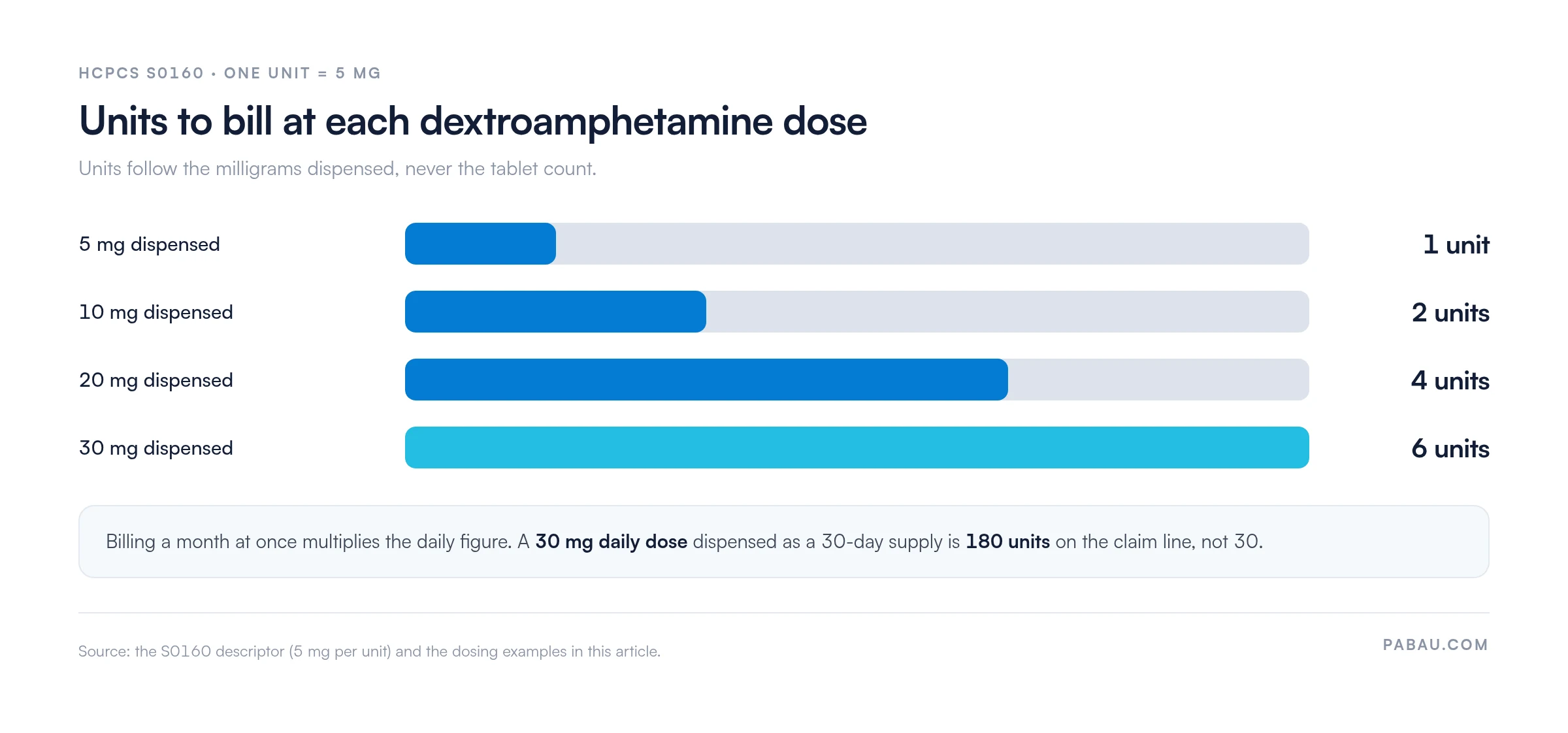
Each unit billed under S0160 represents exactly 5 mg of dextroamphetamine sulfate dispensed. A 10 mg dose is 2 units and a 20 mg dose is 4 units. The quantity submitted on the claim must match the milligrams dispensed, not the number of tablets or capsules.
Billing the wrong unit count is a common source of claim adjustments and post-payment audits on Schedule II drug claims. The conversion below covers the doses practices dispense most often.
Medicaid and commercial plans that require NDC reporting expect the National Drug Code on the same claim line as S0160. The NDC identifies the manufacturer lot and the formulation dispensed. CMS guidance requires the NDC printed on that package, not a representative or default code.
Practices should use an 11-digit NDC formatted as 5-4-2 when submitting on electronic claims.
Verify the NDC on the dispensed package before claim submission. Substituting a default or formulary NDC for the one printed on that package is a frequent cause of Medicaid drug claim rejections. It also raises compliance flags during Schedule II billing audits.
S0160 is not covered under Medicare fee-for-service. The S-series was created specifically for Medicaid and commercial payer use, so submitting S0160 to traditional Medicare produces a denial. That distinction sits at the center of medical billing compliance for practices treating ADHD and narcolepsy across mixed payer populations.
State Medicaid programs set their own reimbursement rates and prior authorization rules for S0160. A practice in Texas may face different coverage criteria than one in California. Pull the current state fee schedule and prior authorization list before assuming coverage, because those amounts are updated regularly.
Correct billing of S0160 requires matching units to milligrams dispensed, including a valid diagnosis code, and following payer rules for controlled substance claims. Schedule II substances add a compliance layer on top of standard HCPCS drug billing.
Modifiers for S0160 depend on payer requirements and the clinical circumstances of the dispensing event. Not all payers require or accept modifiers on S-series drug codes, so verify the payer’s modifier policy before appending.
Dextroamphetamine sulfate is FDA-approved for ADHD and narcolepsy, and claims for S0160 require a supporting ICD-10 diagnosis. The codes below reflect the most clinically common pairings. Where a second condition co-presents, document and code it separately per ICD-10-CM guidelines.
Our ICD-10-CM code index lists the full set, including the subtype codes that payers expect on a stimulant claim.
S-series codes are temporary Level II HCPCS codes maintained by CMS for use by Medicaid and commercial payers. They exist because some drugs and services carry no permanent HCPCS code. Payers still need a consistent way to track and reimburse items outside the Medicare benefit.
Knowing which series a code belongs to tells you immediately who is likely to pay it. An S-code sent to Medicare fee-for-service is a denial before a reviewer ever looks at the documentation.
The S-series is updated through CMS’s quarterly HCPCS process. A code active in one quarter may be terminated in the next if a permanent code is assigned. Psychiatry and behavioral health practices meet S-codes like S0160 often, because their payer mix leans away from Medicare.
Check the CMS list of HCPCS codes quarterly to confirm the code is still valid.
Set a calendar reminder to review CMS quarterly HCPCS updates in January, April, July, and October. S-series codes can be terminated or replaced without widely publicized notice. Catching a termination before your next claim run prevents a wave of avoidable denials.
Coders often assume the S-codes numerically next to S0160 cover related stimulants. They do not. CMS assigned the S0100-S0199 block in issue order rather than by drug class, so an adjacent code can describe a completely different therapy.
The table below shows what those neighboring codes actually describe. Before billing a different amphetamine product, match its NDC against the current HCPCS file rather than reaching for a nearby S-code. The AAPC HCPCS code lookup lists the full non-Medicare drug range.
When billing mixed amphetamine salts, such as amphetamine and dextroamphetamine combination products, confirm the formulation’s own HCPCS assignment before defaulting to S0160. Coding the wrong drug on a controlled substance claim can trigger a payer audit.
Practices billing S0160 and other S-series drug codes face one recurring problem. Different payers set different coverage policies, NDC requirements, and prior authorization rules for the same drug, and a coder has to remember which is which.
Practice management software like Pabau keeps those rules attached to the payer instead. Pabau’s claims management software supports HCPCS Level II code entry, payer-specific rule tracking, and electronic claim submission.
Clinicians record the dispensing event and the matching diagnosis codes at the point of care. Fewer transcription errors reach the clearinghouse, which matters most on Schedule II claims that draw post-payment review.
For practices running mixed ADHD and psychiatry caseloads, some patients fall under Medicaid and others under commercial plans. Consistent S0160 coding inside a structured billing workflow reduces the payer-specific denials that follow.

Pabau’s claims management tools help practices track payer rules, submit HCPCS Level II drug claims, and reduce denials on controlled substance billing. See how it works.

S0160 does one job and does it narrowly. It covers a single drug at a single dosage unit, for payers outside Medicare fee-for-service. The Schedule II status of dextroamphetamine then tightens documentation on every claim submitted under it.
Three steps prevent most S0160 errors. Match the unit count to the milligrams dispensed, pair the claim with a covered ICD-10 code, and confirm state Medicaid coverage before submission. Build them into the workflow once and the code stops costing you rework.
Pabau’s claims management software brings code entry, payer rule tracking, and electronic submission into one workflow. If your practice bills dextroamphetamine sulfate across Medicaid and commercial populations, book a demo to see how those claims are handled.

Need the wider HCPCS picture? Our HCPCS code index covers the Level II series beyond the temporary S-codes.
New to drug claim submission? What is medical billing follows a claim from the encounter through to payment.
Want to reduce claim denials on drug codes? Denial management in healthcare outlines the most common denial triggers and resolution workflows.
Looking for a billing compliance checklist? Medical billing compliance covers the regulatory requirements for clean claim submission across payer types.
HCPCS code S0160 is a Level II temporary S-series code for dextroamphetamine sulfate, 5 mg. Medicaid programs and commercial payers use it to pay for this dispensed CNS stimulant. It is not covered under Medicare fee-for-service.
No. HCPCS code S0160 is not covered under traditional Medicare fee-for-service. S-series codes are designated for Medicaid and commercial payer use. Some Medicare Advantage plans may accept S-codes, but this varies by plan and should be verified directly.
One billing unit under S0160 equals 5 mg of dextroamphetamine sulfate dispensed. A 30 mg dose requires 6 units. Always match the units billed to the milligrams dispensed, not the number of tablets or capsules.
The most common pairings are F90.0 (ADHD, predominantly inattentive), F90.1 (predominantly hyperactive), F90.2 (combined type), G47.419 (narcolepsy without cataplexy), and G47.411 (narcolepsy with cataplexy). These reflect the FDA-approved indications for dextroamphetamine sulfate.
An S-series HCPCS code is a temporary Level II code (range S0000-S9999) maintained by CMS for Medicaid and commercial payers. S-codes cover drugs, services, and supplies outside the Medicare fee-for-service benefit that still need a consistent billing mechanism.
Bill dextroamphetamine sulfate under Medicaid using HCPCS code S0160, with units reflecting the milligrams dispensed. Include the 11-digit NDC, a covered ICD-10 diagnosis code, and the prescribing provider’s DEA number. Check your state Medicaid fee schedule for current rates and prior authorization rules.



