L0467 is the HCPCS Level II code for tlso, sagittal control, rigid posterior frame and flexible soft anterior apron with straps, closures and padding, restricts gross trunk motion in sagittal plane, produces intracavitary pressure to reduce load on intervertebral disks, prefabricated, off-the-shelf.
Fabrication method decides most L0467 claims. The device ships in standard sizes, so nobody casts or molds it for the patient. Reach for the wrong sibling code and the claim either underpays or reads as upcoding on audit.
Related Information
Level
Level II
Category
L — Orthotic and prosthetic procedures
Save time. Improve accuracy. Get paid faster.
Automate coding with Pabau
Let Pabau's smart automation suggest the right codes, reduce claim denials, and keep your practice compliant—effortlessly.
Automate repetitive tasks and focus on what matters most—your patients.
Improve accuracy
Reduce coding errors and ensure compliance with the latest regulations.
Get paid faster
Clean claims, fewer denials, and faster reimbursements.
Grow with confidence
Powerful insights and reporting to help your practice thrive.
HIPAA compliant•SOC 2 certified•GDPR-compliant•Trusted by 4,000+ clinics worldwide
Key takeaways
HCPCS code L0467 describes a prefabricated, off-the-shelf TLSO with sagittal control, a rigid posterior frame, and a soft anterior apron.
CMS added L0467 effective January 1, 2014, as one of 22 new off-the-shelf orthotic codes.
Modifier KX confirms that coverage criteria are met, while GA, GY, and GZ cover the exceptions.
Medicare now expects a Standard Written Order plus supporting clinical notes, because CMNs and DME Information Forms ended on January 1, 2023.
Practice management software like Pabau keeps the code, the order, and the delivery record on one patient file.
L0467 covers one brace, and the descriptor decides it
L0467 is a Level II HCPCS code for a prefabricated, off-the-shelf TLSO with sagittal control. The official CMS long descriptor runs to one unbroken line. Split in half, it reads:
TLSO, sagittal control, rigid posterior frame and flexible soft anterior apron with straps, closures, and padding.
Restricts gross trunk motion in the sagittal plane, produces intracavitary pressure to reduce load on intervertebral disks, prefabricated, off-the-shelf.
Every phrase in that descriptor does work at claim time. Read it element by element and the most common coding error, billing a custom code for an off-the-shelf brace, becomes hard to make.
Descriptor element
What it means for billing
TLSO
Thoracic-lumbar-sacral orthosis, spanning T1 to S1
Sagittal control
Limits forward and backward trunk flexion, not lateral motion
Rigid posterior frame
Structural support at the back, which rules out flexible-only designs
Flexible soft anterior apron
The front panel is soft, which separates L0467 from the shelled triplanar codes
Prefabricated, off-the-shelf
Made in standard sizes, with no casting and no expert fitting
Intracavitary pressure
Reduces load on the intervertebral disks, which supports medical necessity for lumbar conditions
L0467 sits in the HCPCS Level II L-code range for orthotic procedures and devices, administered by CMS. The code took effect on January 1, 2014, as one of 22 new off-the-shelf orthotic codes, and it remains active on the 2026 fee schedule.
Medicare covers L0467 only when five conditions line up
Medicare covers L0467 under the Part B durable medical equipment benefit, but coverage is never automatic. The supplier has to show that each condition was satisfied before the brace was handed over, not after a payer asks.
Five conditions decide the claim:
Medical necessity: the beneficiary needs a documented condition for which a prefabricated TLSO with sagittal control is clinically indicated. Spinal fracture, post-surgical stabilization, and degenerative disk disease with functional impairment are the usual ones.
A practitioner order before dispensing: the treating practitioner issues a written order that names the diagnosis, the device, and the clinical rationale. It has to exist before the brace leaves the shelf.
DMEPOS supplier enrollment: the supplier must hold an active CMS DMEPOS supplier number. Billing Medicare without one is a compliance violation, not a paperwork slip.
LCD alignment: each Medicare Administrative Contractor publishes a Local Coverage Determination setting out allowable diagnoses and clinical criteria. Those criteria vary by jurisdiction, so check the LCD that governs your area.
Beneficiary eligibility: Part B is what covers durable medical equipment. Confirm the beneficiary holds active Part B coverage on the date of service.
Medicare Advantage plans often add criteria of their own, and commercial payers write their own rules entirely. Assume nothing carries across. Once coverage is settled, the file behind it becomes the thing that decides whether you keep the payment.
Documentation is where most L0467 claims fall apart
Incomplete documentation causes more L0467 denials than any other problem. The package gets assembled before the claim goes out, because rebuilding it after a records request rarely goes well.
A Medicare L0467 claim needs all of the following:
A Standard Written Order (SWO): CMS discontinued Certificates of Medical Necessity and DME Information Forms on January 1, 2023, and the SWO replaced them. It names the beneficiary, the order date, the item, the quantity, and the treating practitioner, and it carries that practitioner’s signature. It has to be in hand before delivery, and a backdated order will not do.
Supporting clinical documentation: progress notes, imaging reports, operative records, or functional assessments that justify a prefabricated TLSO with sagittal control. “Patient has back pain” does not survive a review.
A treating practitioner enrolled in Medicare: the ordering practitioner needs active enrollment or a valid opt-out agreement. Unsigned and improperly executed orders remain a standard audit trigger.
Proof of delivery: a signed delivery receipt showing the beneficiary received the brace. File it carefully, because auditors tend to ask for it first.
A face-to-face encounter, where the LCD requires one: some jurisdictions want documentation of an in-person encounter before the brace is prescribed. Check the policy that applies to you.
Retain the whole file for at least seven years. Audits reach back years, and one missing delivery ticket can trigger recoupment on a claim Medicare already paid.
Modifier KX carries most L0467 claims
Modifier KX goes on the claim when the LCD coverage criteria are met and the medical record proves it. Without KX, Medicare auto-denies. Three other modifiers cover the situations where coverage is doubtful or absent.
Modifier
Meaning
When to use it with L0467
KX
Coverage criteria are met and documented in the medical record
The routine Medicare claim, once every LCD criterion is satisfied. Payment depends on it
GA
A waiver of liability statement is on file
Coverage is uncertain and the beneficiary signed an Advance Beneficiary Notice accepting liability
GY
The item is statutorily excluded or falls outside the Medicare benefit
The brace is non-covered by statute and you need the denial for secondary payer billing
GZ
The item is expected to be denied as not reasonable and necessary
You expect a medical necessity denial and no ABN was signed. It carries no liability protection
Appending KX when the criteria are not met is as serious as omitting it when they are. Either way the modifier is a statement about the medical record, so read the record before choosing one.
Reimbursement follows the DMEPOS fee schedule, not the physician fee schedule
CMS sets the L0467 allowable through the DMEPOS fee schedule, revised every January. That is a different file from the physician fee schedule, and the two adjust for geography in different ways. Confusing them is how a supplier ends up quoting a rate nobody will pay.
National amounts, adjusted locally: CMS publishes a national fee schedule amount for L0467. What a supplier actually collects reflects competitive bidding area and rural blended-rate adjustments. Geographic practice cost indices do not apply here, because those belong to the physician fee schedule.
Medicare pays 80%: after the deductible, Medicare pays 80% of the allowable amount. The beneficiary owes the remaining 20%, unless a supplemental plan picks it up.
Competitive bidding: off-the-shelf orthotics, L0467 among them, fall under competitive bidding program rules in some jurisdictions. Confirm whether your area participates before you assume the standard rate.
Annual updates: pull the figure from the current CMS DMEPOS fee schedule each January rather than reusing last year’s number.
Watch the remittance advice at posting, too. Systematic underpayment on an L-code usually traces back to a fee schedule revision nobody loaded, rather than to a coding error.
How an L0467 claim moves, from order to payment
The workflow below covers Medicare claims. Commercial payers follow a similar path, though each one adds its own requirements, so confirm them at the equivalent stage.
Get the written order before dispensing. The treating practitioner issues a Standard Written Order describing the brace and the diagnosis. Its date has to precede the date of service.
Verify eligibility and LCD criteria. Confirm active Part B coverage, then check the clinical indication against your MAC’s LCD for spinal orthoses.
Complete the documentation package. Record the ICD-10-CM diagnosis, the device description, and the practitioner’s signature. Nothing leaves the shelf until the file is complete.
Dispense and confirm delivery. Take a signed proof of delivery, and note the manufacturer, model, and size in the patient file.
Choose the code and the modifier. Match the dispensed brace against the L0467 descriptor. Add KX where the criteria are met, or GA where an ABN is on file and coverage is doubtful.
Submit the claim. Bill L0467 on a CMS-1500 form or its 837P electronic equivalent, with the diagnosis codes that justify the brace.
Post the remittance and work the denials. Read the adjustment reason codes. CO-50 points at medical necessity, and CO-4 points at a modifier problem.
Before you submit: The 60-second check
Five questions catch nearly every avoidable L0467 denial. Run them on each claim before it leaves:
Is the SWO signed, and is its date earlier than the delivery date?
Does the ICD-10-CM code on the claim appear on your MAC’s covered list for spinal orthoses?
Was modifier KX added, or was a different modifier chosen deliberately?
Has the proof of delivery been signed and filed?
Is the manufacturer’s model number recorded, so an off-the-shelf brace can be shown to be one?
Pro Tip
Write the manufacturer and model number on the delivery ticket, not just in the chart note. It is the fastest way to show a reviewer that an off-the-shelf brace was billed as one. It also settles an L0466 versus L0467 question in seconds.
Prefabricated or custom-fabricated decides the code, and the money
Two braces can look alike on the patient and pay very differently on the claim. The line between them is physical. One is built from a cast or model of this patient, and the other comes out of a box.
Feature
Prefabricated, off-the-shelf (L0467)
Custom-fabricated TLSO
Manufacturing
Mass-produced in standard sizes, with no individual casting
Fabricated from a model or cast of the individual patient
Fitting
Minor adjustment only, handed over off the shelf
Requires skilled fabrication and fitting by an orthotist
Higher allowable, reflecting fabrication and fitting labor
Audit risk
Billing a custom code for a prefabricated brace is a false claims risk
The claim has to be backed by records of casting, fitting, and fabrication
Take a familiar scenario. A patient leaves with a stock lumbar brace in size large, and the orthotist trims a panel edge and sets the straps. The brace is still prefabricated. Expert fitting moves the claim to L0466, the customized-fit sibling of L0467, and none of it justifies a custom-fabricated code.
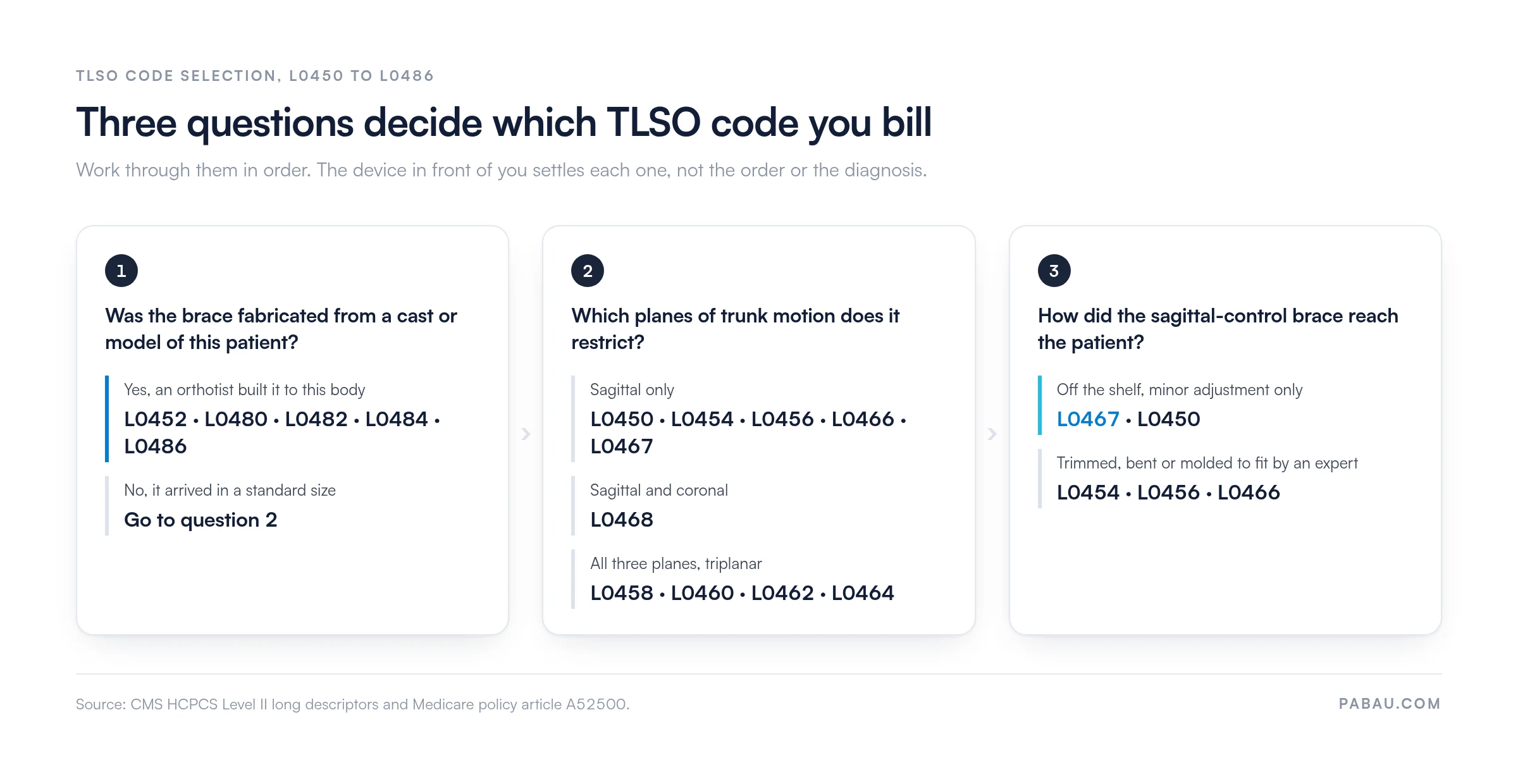
Every TLSO sibling code differs by one design element
Sibling codes in this range separate on two features. The first is the planes of motion the brace controls. The second is how the brace reached the patient. Work through both in order and the right code falls out.
Fabrication route eliminates the most codes fastest, which is why it belongs first. Built from the CMS HCPCS Level II long descriptors and Medicare policy article A52500.
The table below carries the descriptors in full. Our HCPCS code index covers the other Level II families, for the days the device is not a spinal orthosis. The AAPC HCPCS lookup is handy for checking exact descriptor wording.
Code
Description (summary)
Key differentiator
L0450
TLSO, flexible trunk support with rigid stays or panels and a soft anterior apron, prefabricated, off-the-shelf
Also prefabricated and off-the-shelf, but a flexible support with stays rather than a rigid posterior frame
L0454
TLSO, sagittal control with rigid stays or panels, prefabricated and customized to fit by an expert
Prefabricated, then trimmed, bent, or molded to the patient, so it is not off-the-shelf like L0467
L0456
TLSO, sagittal control, rigid posterior panel and soft anterior apron, prefabricated, customized fit
Rigid at the back and soft at the front, much like L0467, but supplied with expert fitting
L0458
TLSO, triplanar control, modular segmented system with two rigid shells, prefabricated, includes fitting
Controls sagittal, coronal, and transverse motion, where L0467 controls the sagittal plane only
L0460
TLSO, triplanar control, two rigid shells with an anterior shell extending to the sternal notch, prefabricated, customized fit
The customized-fit counterpart to L0458. It has an anterior shell, not an apron and not a bare back
L0462
TLSO, triplanar control, modular segmented system, full shell design, prefabricated
Full-shell construction and triplanar control, well beyond the sagittal-only frame and apron of L0467
L0464
TLSO, triplanar control, modular segmented system with four rigid shells, prefabricated
A four-shell triplanar device. It sits outside the sagittal frame and apron family entirely
L0466
TLSO, sagittal control, rigid posterior frame and soft anterior apron, prefabricated, customized fit
The same design as L0467, supplied with expert fitting instead of straight off the shelf
The target code. Sagittal control, off the shelf, minor adjustment only
L0468
TLSO, sagittal-coronal control, rigid posterior frame and soft anterior apron, prefabricated, customized fit
Adds coronal control, and it is fitted by an expert rather than supplied off the shelf
Match the code to the device, never to the diagnosis or to the allowable. Whatever you bill, the fabrication and fitting records have to support it.
Where L0467 claims go wrong, and how to stop it
These five account for the bulk of L0467 denials and audit findings. Each has a fix that lives in the workflow rather than in the appeal.
Billing a custom code for a prefabricated brace. Dispensing an off-the-shelf TLSO and billing a custom-fabricated code is upcoding, and expert fitting does not change that. Fix: record the manufacturer, model, and size. If it ships in standard sizes, the code is L0467 or L0466.
Leaving modifier KX off the claim. Medicare auto-denies an L0467 claim with no KX unless another modifier applies. Strong clinical notes do not substitute for it, because the modifier is the signal the payer reads first. Fix: build KX into the default L0467 billing template, and require a clinical review to override it.
An incomplete Standard Written Order. An SWO missing the signature, the order date, or the item description counts as no order at all. Fix: run a field-by-field check before the brace leaves the building, not at claim entry.
Billing Medicare without DMEPOS enrollment. A supplier with no active enrollment number risks false claims liability on every line. Fix: confirm the number is active in the National Supplier Clearinghouse before accepting Medicare orders.
Weak diagnosis linkage. An ICD-10-CM code that is absent from your MAC’s covered list produces a medical necessity denial, however good the brace fit. Fix: cross-reference the dispensing diagnosis against the LCD before you submit.
Denied orthotic claims cluster around those five, so a structured denial management routine pays for itself quickly. Work the adjustment reason code first, then go to the document that produced it.
How claims software keeps L0467 documentation together
DMEPOS billers often assemble an L0467 claim out of three separate places. The order sits in the clinical record, the delivery ticket sits in a folder, and the code goes in by hand at claim entry.
Practice management software like Pabau closes that loop. The HCPCS code is looked up and stored against the patient record, and the order and the delivery confirmation attach to the same file. By the time the claim is built, its evidence is already sitting with it.
That matters most when a records request lands. A biller working in claims software for suppliers pulls the order, the notes, and the proof of delivery off one file. The response takes minutes instead of an afternoon.
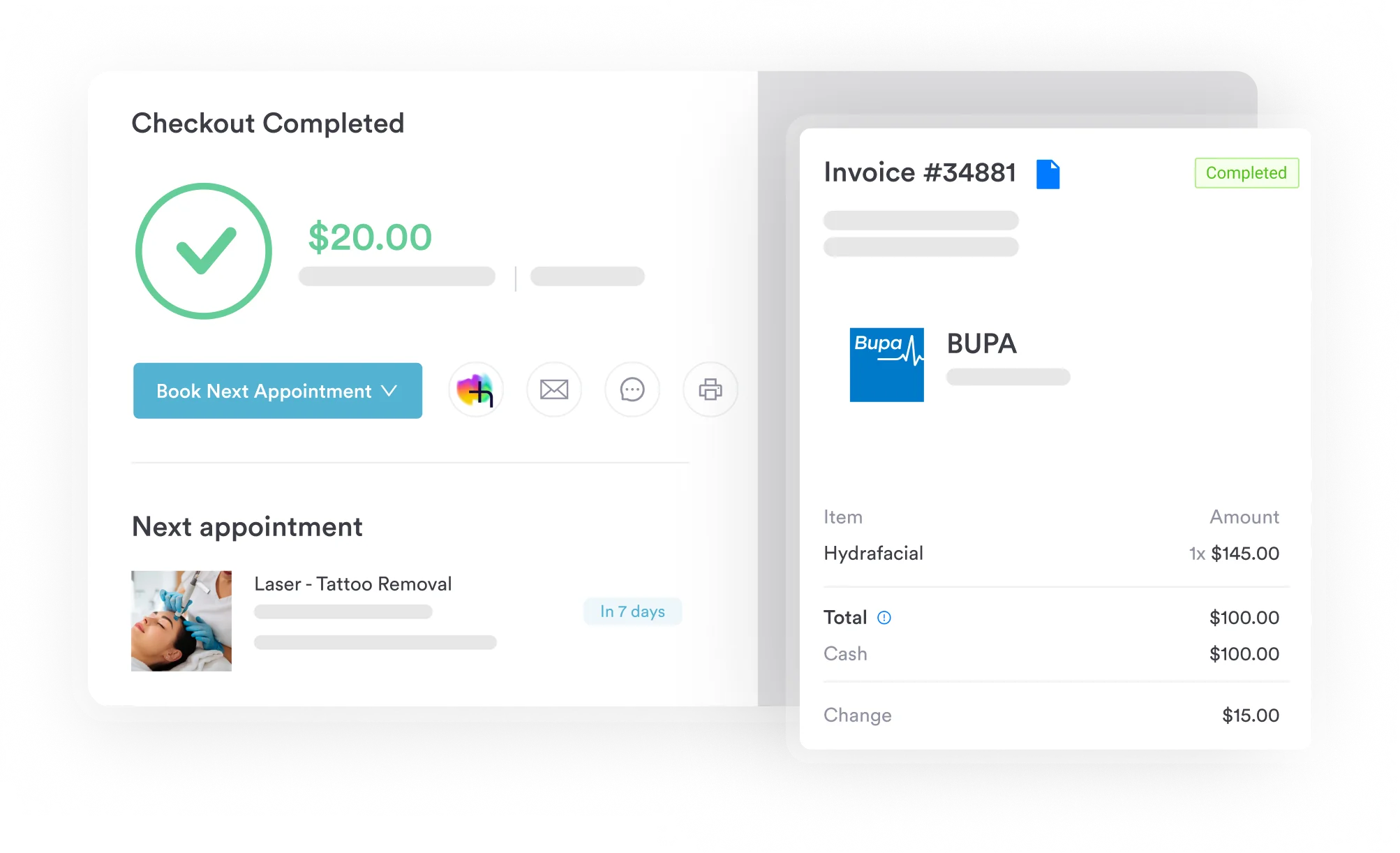
Pabau closes each visit into an invoice billed to the payer. The charge a claim is built from already sits on the patient record.
Keep the code and its documentation on one file
Pabau’s claims management tools let practices look up HCPCS codes and attach orders, notes, and delivery confirmations to the patient record. Claims go out with their evidence already assembled.
L0467 is not a difficult code to bill correctly, though it is an easy one to bill carelessly. The brace in front of you settles the code, and the medical record settles the modifier. The order date settles whether the claim survives a review.
The change worth carrying away is the documentation one. CMNs and DME Information Forms are gone, so a Standard Written Order plus clinical notes is now the package Medicare expects. Any supplier still working from a CMN template is quietly building denials.
Keep the code, the order, and the delivery record on a single patient file and the rest of the workflow gets much simpler. Book a demo to see how Pabau keeps DMEPOS documentation attached to the claim it supports.
Continue your research
Want to understand how clean claims reduce denials?Submitting a clean claim covers the elements that prevent auto-denials in DMEPOS and medical billing workflows.
Need a primer on what the full billing cycle involves?Revenue cycle management explained walks through how practices move from order to payment, including DMEPOS-specific considerations.
Dealing with repeated denials on orthotic claims?Denial management in healthcare covers structured workflows for appealing and resubmitting denied HCPCS claims.
Worried about how an audit would read your files?Medical billing compliance sets out the record-keeping standards that hold up when a payer asks for documentation.
Checking coverage before you dispense?Insurance eligibility verification explains how to confirm a plan and its benefits before the device leaves the shelf.
Frequently asked questions
Does Medicare rent or purchase an L0467 brace?
Medicare buys it. Spinal orthoses are paid under the prosthetics and orthotics category as a lump-sum purchase, so there is no rental period and no capped rental modifier. Bill the item once, on the date of delivery.
When will Medicare pay for a replacement L0467?
Replacement is covered when the brace is lost, stolen, or irreparably damaged, or when the patient’s condition changes enough to need a different device. Normal wear over the item’s reasonable useful lifetime can also qualify. Document the reason on the new order, because a replacement claim without one is denied.
Is DMEPOS accreditation needed as well as enrollment?
Usually, yes. Most suppliers need accreditation from a CMS-approved organization and a $50,000 surety bond on top of an active supplier number. Certain licensed professionals are exempt when they furnish the brace as part of their own service.
Does L0467 take an RT or LT modifier?
No. RT and LT identify paired body parts, and a spinal orthosis sits on the midline, so neither applies. Use KX, GA, GY, or GZ instead, and bill one unit for one brace.