CCSD code H4430: Examination of rectum under anaesthetic
CCSD code H4430 pays for the examination alone CCSD code H4430 is the UK private...

Last Updated: Oct 20, 2026
K0880 is the HCPCS Level II code for power wheelchair, group 4 very heavy duty, single power option, sling/solid seat/back, patient weight 451 to 600 pounds.
As maintained by the Centers for Medicare and Medicaid Services (CMS), K0880 sits in the Durable Medical Equipment (DMEPOS) category. Only CMS-accredited DMEPOS suppliers may submit claims under it.
The "group 4 very heavy duty" classification is what separates K0880 from the standard and heavy-duty power wheelchair codes. Group 4 marks a chair built to higher weight and durability standards.
The "single power option" component means the chair includes one powered accessory function, such as a power seat elevator or tilt. That option is reflected in the pricing indicator CMS assigns to the code.
Let Pabau's smart automation suggest the right codes, reduce claim denials, and keep your practice compliant—effortlessly.
Automate repetitive tasks and focus on what matters most—your patients.
Reduce coding errors and ensure compliance with the latest regulations.
Clean claims, fewer denials, and faster reimbursements.
Powerful insights and reporting to help your practice thrive.
HIPAA compliant SOC 2 certified GDPR-compliant Trusted by 4,000+ clinics worldwide

HCPCS Code K0880 covers a power wheelchair, group 4 very heavy duty, single power option, with a sling or solid seat and back.
The code applies to patients weighing 451 to 600 pounds, which is what separates it from the Group 2 codes beneath it.
Medicare requires prior authorization before a K0880 claim is submitted, and a missing approval is the leading cause of denial.
Allowable amounts vary by geographic locality and competitive bidding area, so never apply one national rate to every claim.
Practice management software like Pabau tracks prior authorization status and DMEPOS documentation, so K0880 claims go out complete.
Medicare Part B covers K0880 as a DMEPOS item when medical necessity is established and every coverage criterion is met. Coverage is not automatic. The beneficiary must satisfy the clinical eligibility requirements, the treating physician must document necessity, and the supplier must be CMS-accredited.
To qualify for K0880, a beneficiary must meet all of the following criteria. Partial documentation will not carry the claim, because Medicare Administrative Contractors (MACs) apply these requirements in full.
The weight threshold is the clearest differentiator for Group 4 VHD classification. Weight alone does not establish medical necessity, though. The mobility impairment, the home environment, and the patient’s ability to operate the device have to be documented together. An unaccredited supplier billing K0880 receives an automatic denial regardless of clinical eligibility.
Prior authorization for HCPCS Code K0880 is mandatory under Medicare’s DMEPOS Prior Authorization Program. Claims submitted without an approved prior authorization decision are denied. The requirement applies in every MAC jurisdiction, and it is not discretionary.
One change is worth checking before you build another request. In December 2025, CMS finalized an exemption process for DMEPOS suppliers that demonstrate billing compliance. A supplier holding a provisional affirmation rate of 90% or higher can be exempted from submitting prior authorization requests.
DME MACs notified qualifying suppliers of their status by April 2, 2026, and the first exemption cycle opened on June 1, 2026. Check your own affirmation rate against that threshold on the CMS DMEPOS prior authorization page. Also confirm submission mechanics with your MAC, since those change between contract periods.
Incomplete documentation is the second most common reason K0880 claims are denied, behind missing prior authorization. Every required document belongs in the patient file before the claim is submitted, not assembled after a request for additional documentation lands. The practical fix is building the checklist into the intake and ordering workflow.
Cross-check every documentation requirement against the applicable MAC’s Local Coverage Determination (LCD) for power wheelchairs. Different MACs carry supplemental requirements beyond the CMS baseline.
The Pricing, Data Analysis and Coding (PDAC) contractor also provides coding verification when it is unclear whether a device meets the K0880 product criteria.
Build a K0880 prior authorization packet template with pre-populated checklists for each required document. Brief the treating physician on what the exam notes need to include, then assemble the documentation before the face-to-face exam. Suppliers who work that way submit far fewer incomplete requests. Track each prior auth request in your billing workflow so none sits unanswered past the MAC’s 5-business-day window.
There is no single national Medicare allowable amount for HCPCS Code K0880. Payment rates vary by geographic locality based on MAC region. Competitive bidding program areas apply contract rates that differ from the standard fee schedule. What a supplier bills and what it collects can diverge sharply.
The CMS DMEPOS fee schedule publishes current allowable amounts by HCPCS code and geographic locality. Always pull rates for the specific year and location before estimating reimbursement. Rates for 2025 and 2026 reflect annual CMS updates and should not be extrapolated from prior years.
CMS administers the DMEPOS Competitive Bidding Program (CBP), which sets contract supplier payment rates in designated Competitive Bidding Areas (CBAs). Inside a CBA, only contract suppliers may furnish K0880 to Medicare beneficiaries, and payment is made at the competitive bid rate. Suppliers outside CBAs use the non-competitive-bidding fee schedule.
A DMEPOS claim record should capture three things before it is priced. Those are the locality code, the supplier’s contract status, and the allowable amount at the beneficiary’s location. Capturing them up front prevents billing the wrong rate and absorbing a payment adjustment after the claim has processed.
K0880 is billed by the DMEPOS supplier on a CMS-1500 claim form, or on its electronic equivalent, the 837P transaction. The code can be billed as a purchase or a rental, depending on Medicare’s coverage determination for the specific item.
Knowing what makes a clean claim for DMEPOS codes cuts rejections at the clearinghouse, before the claim ever reaches the MAC.
Modifiers communicate the billing scenario to Medicare and have to be accurate. A wrong modifier, or an omitted one, produces a denial. The table below covers the modifiers most commonly applied to K0880 claims.
The KX modifier matters most on K0880. Most MACs require it on every claim as certification that the supplier holds all the required documentation. Omitting KX on an initial K0880 claim is a common and easily avoided denial reason. The AAPC HCPCS code reference is a quick way to check current modifier requirements and LCD applicability.
K0880 sits inside the K08xx power wheelchair range, and picking the wrong code within that range is a common billing error. Weight capacity sets the band, then group and seating type decide which code inside the band applies. The chart below lays the bands out side by side.
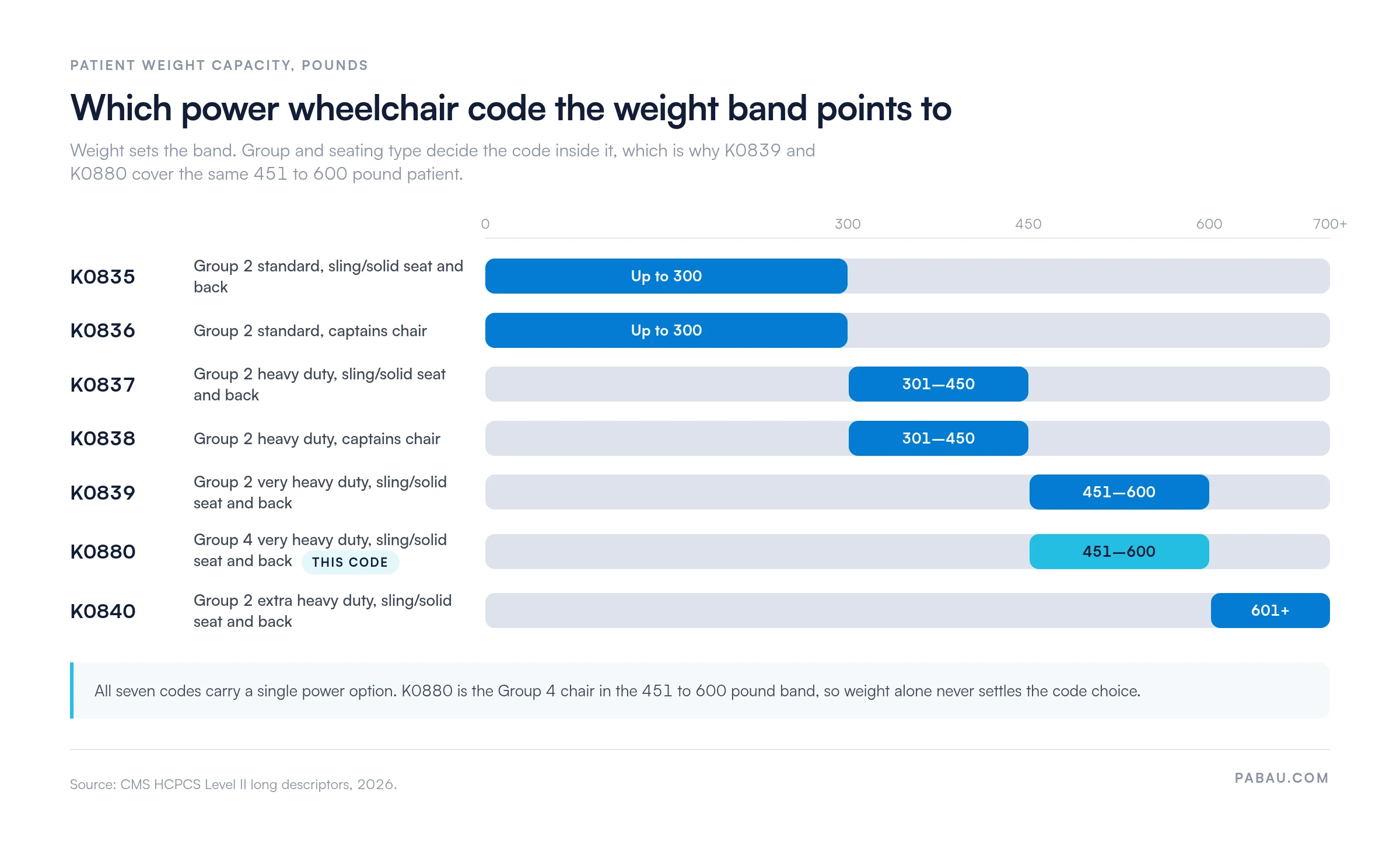
The most frequent code-selection mistake on power wheelchair claims is billing a Group 2 code when the supplied chair is Group 4. The reverse happens too, with K0880 billed for a patient who does not meet the weight or durability criteria. Both errors generate denials, and upcoding can trigger audit activity. The PDAC contractor provides free product classification guidance before a claim goes out.
K0880 carries one of the higher denial rates among complex rehabilitation technology codes. A single claim has to satisfy prior authorization, strict documentation, competitive bidding, and modifier rules at once. Most denials fall into five predictable categories. Knowing which denial codes keep coming back tells a supplier which of the five is costing it money.
Tracking denial patterns across K0880 claims surfaces systemic documentation and modifier problems that single-claim reviews never catch. When one denial reason keeps repeating, the cause is almost always the workflow rather than an isolated mistake.
Denial-reducing claims management software flags K0880 prior auth status and incomplete documents before submission, so the fix happens upstream.
Run a monthly audit of every K0880 claim submitted in the prior 90 days. Filter by denial reason code and check whether the same denial type appears across several claims. A cluster of KX modifier omissions points to a workflow problem, not a clinician documentation problem. Fix that one at the order-entry stage rather than the claims stage.
Most DMEPOS suppliers track K0880 prior authorizations in a spreadsheet that sits apart from the patient file. The face-to-face notes live in one system, the written order in another, and the prior auth reference number in a third. Nobody sees the full packet until a denial arrives.
Practice management software like Pabau keeps the order, the clinical notes, and the claim on a single patient record. Its claims tools show which documents are attached and which are still outstanding, while there is time to chase them.
The outcome is fewer K0880 claims leaving the building incomplete, and less time spent rebuilding a packet after a denial. Billing staff can read prior authorization status themselves, without asking the clinical team to re-send the exam notes.

Pabau’s claims management software helps DMEPOS suppliers track K0880 prior authorization status, organize required documentation, and submit clean claims. See how it fits your billing workflow.

K0880 claims fail most often because of how the packet was assembled, not because the patient was ineligible. Prior authorization obtained after delivery, a missing KX modifier, or the wrong group code will each sink a claim that was clinically justified.
Order entry is where a K0880 claim is won or lost. That is the last point at which the documentation is still cheap to correct. Move the checks there and the denial rate follows, without adding a single appeal to the queue.
Pabau’s claims tools help DMEPOS billing teams track prior authorization status and keep K0880 documentation in one place. Book a demo to see how it handles complex power wheelchair billing.

Need a foundation in DMEPOS billing workflows? What is medical billing covers how DMEPOS claims move from order to payment, including the points where K0880 claims are most likely to stall.
Seeing repeated K0880 denials? Denial management in healthcare sets out a framework for categorizing denial reasons, tracking patterns, and correcting the workflow behind them.
Want to see how Medicare revenue flows from claim to payment? Revenue cycle management for healthcare practices explains the full billing cycle, from eligibility verification through remittance posting.
HCPCS Code K0880 is a Level II HCPCS code for a group 4 very heavy duty power wheelchair. It has a single power option and a sling or solid seat and back, and covers patients weighing 451 to 600 pounds. It is billed to Medicare Part B by CMS-accredited DMEPOS suppliers. The beneficiary must meet the clinical eligibility and documentation requirements for a Group 4 VHD power wheelchair.
Yes, prior authorization is mandatory for HCPCS Code K0880 under Medicare’s DMEPOS Prior Authorization Program. The supplier must obtain an approved decision before delivering the power wheelchair. Claims submitted without prior authorization are automatically denied. Suppliers with a provisional affirmation rate of 90% or higher may qualify for the CMS exemption process finalized in December 2025.
K0880 allowable amounts vary by geographic locality and by whether the supplier sits in a competitive bidding area. CMS publishes updated DMEPOS fee schedules annually, so use the CMS DMEPOS fee schedule to find the rate for the beneficiary’s location. Do not apply one national rate across every claim.
The most important modifier for K0880 is KX, which certifies that LCD coverage criteria were met. Most MACs require it on every claim. NU marks a purchase and RR marks a rental. KH, KI and KJ mark the first, second-to-third, and fourth-onward rental months. GA and GZ are used when an advance beneficiary notice is or is not on file.
K0835 describes a Group 2 standard power wheelchair with a single power option and a sling or solid seat and back. Its weight capacity runs up to 300 pounds. K0880 describes a Group 4 very heavy duty chair for patients weighing 451 to 600 pounds. The distinction is weight capacity and frame classification, and billing K0835 when K0880 is indicated produces a code mismatch denial.
K0880 may be subject to the DMEPOS Competitive Bidding Program, depending on the supplier’s location. In competitive bidding areas, only CMS contract suppliers may furnish K0880 and be paid at the contract bid rate. Suppliers outside those areas use the standard locality-adjusted fee schedule. Verify current CBA boundaries and contract supplier status at CMS.gov before accepting orders.