CCSD code H4430: Examination of rectum under anaesthetic
CCSD code H4430 pays for the examination alone CCSD code H4430 is the UK private...

Last Updated: Oct 20, 2026
K0878 is the HCPCS Level II code for power wheelchair, group 4 standard, single power option, captains chair, patient weight capacity up to and including 300 pounds.
K-series codes are temporary HCPCS Level II codes that CMS assigns to durable medical equipment (DME) and related supplies. DME items are not described by CPT codes, so a K-code is never a placeholder for one.
Medicare pays for K0878 as a 13-month capped rental or as an outright purchase.
Let Pabau's smart automation suggest the right codes, reduce claim denials, and keep your practice compliant—effortlessly.
Automate repetitive tasks and focus on what matters most—your patients.
Reduce coding errors and ensure compliance with the latest regulations.
Clean claims, fewer denials, and faster reimbursements.
Powerful insights and reporting to help your practice thrive.
HIPAA compliant SOC 2 certified GDPR-compliant Trusted by 4,000+ clinics worldwide

HCPCS code K0878 describes a power wheelchair, group 4 standard, single power option, captains chair. It is an HCPCS Level II K-series code maintained by CMS for DME billing.
Medicare may cover K0878 under LCD L33789 when a physician documents significant functional limitations that prevent safe use of a manual or lower-group power wheelchair.
Missing prior authorization, incorrect modifier use, or incomplete face-to-face evaluation documentation are the most common reasons K0878 claims are denied.
Practice management software like Pabau streamlines DME claim submission, modifier tracking, and denial follow-up for suppliers billing HCPCS codes.
Use this quick-reference table to confirm the essential billing attributes before submitting a K0878 claim.
Medicare coverage for HCPCS code K0878 is governed by LCD L33789, the Local Coverage Determination for Power Mobility Devices. Coverage is not automatic. The beneficiary must meet all of the following conditions for Medicare to consider the claim payable.
Group 4 power wheelchairs are reserved for patients with the most severe functional limitations. Substantiating that the patient cannot manage with a Group 2 or Group 3 device takes specific clinical language in the physician’s notes. A general reference to the diagnosis will not carry the claim.
Each criterion also has to be in the medical record before the order is placed. Documentation added after the fact rarely survives a review.
CMS operates a Prior Authorization Program for certain DMEPOS items. Group 4 power wheelchairs may fall under it, depending on the DME MAC jurisdiction and the competitive bidding area.
Before submitting a K0878 claim, confirm the current requirement with the DME MAC that covers the supplier. Noridian Healthcare Solutions administers Jurisdictions A and D. CGS Administrators administers Jurisdictions B and C.
Checking the patient’s coverage before the order goes out catches the most common prior authorization failure. The plan or the jurisdiction required approval, and nobody obtained it. Retroactive authorization is rarely granted on power wheelchair claims.
Incomplete documentation is responsible for the majority of K0878 denials. Every element below must be in the patient’s record before the item is delivered.
Keeping these records together from evaluation through delivery creates the audit trail CMS expects on review. For a supplier running several DME orders at once, a documentation checklist per device type stops single items from slipping through.
Completeness matters before the claim is assembled, because a missing element cannot be back-dated later.
Medicare reimburses HCPCS code K0878 through the DMEPOS fee schedule, which CMS updates annually. Rates vary depending on whether the supplier operates in a competitive bidding area (CBA) or a non-competitive bidding area (non-CBA).
Specific dollar amounts are not published here because DMEPOS rates change annually and vary by jurisdiction. Billing last year’s amounts creates underpayment risk on a device this expensive. Pull the current figures from the CMS DMEPOS fee schedule file before the claim goes out.
Comparing each payment against the fee schedule after the remittance arrives shows whether an underpayment is a one-off or a pattern.
Billing HCPCS code K0878 correctly requires accurate modifier application, proper claim form completion, and documentation that directly supports the code descriptor. The claim form is the CMS-1500 (or its electronic equivalent, the 837P).
Modifier selection depends on whether the transaction is a rental or purchase and where the claim falls in the rental cycle. Using the wrong modifier is one of the fastest ways to trigger a denial or create a billing compliance issue.
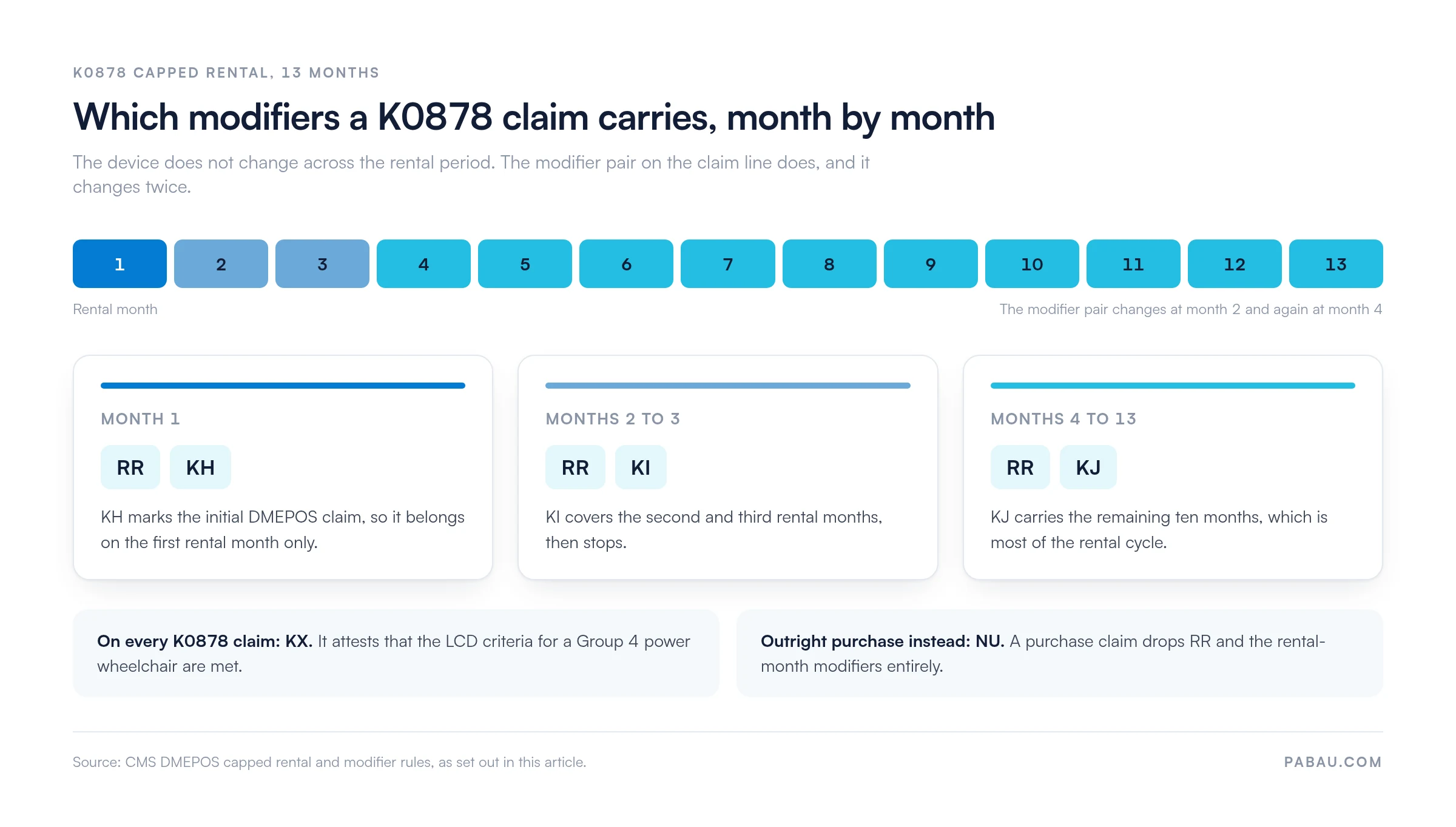
The KX modifier is not optional. CMS requires it on power wheelchair claims as the supplier’s attestation that all LCD criteria are satisfied. Missing KX typically returns denial code CO-4, which flags a procedure code inconsistent with the modifier.
The rental modifiers move with the billing month, so the same chair carries a different pair in month 1, month 3, and month 9. The timeline below maps each pair to the months it belongs to.
Using claims management software that enforces modifier rules at the point of claim creation prevents these avoidable rejections. A DME claim that leaves complete on the first pass also skips the rework cycle a rejection sets off.
Group 4 power wheelchairs span a family of K-codes separated by seating type and patient weight capacity. Selecting the wrong one is a common error. The confusion usually sits between the captains chair and the sling or solid seat variants.
Neighboring K-codes are easy to mix up when the delivered chair differs from the one on the order. The HCPCS code directory lists the rest of the K-series if you need to confirm a sibling code before submitting.
Power-option count separates these codes as well as seat type and weight class. A captain’s chair delivered with multiple power options is billed under HCPCS code K0885, the group 4 standard code for that configuration.
The diagnosis code on the claim must reflect the underlying condition causing the patient’s functional limitations. Most Group 4 power wheelchair approvals pair with diagnoses documenting severe mobility impairment. The ICD-10-CM codes below are commonly accepted, and the list is not exhaustive. The physician still has to document clinical justification specific to the patient.
Refer to the AAPC HCPCS code lookup tool to cross-reference K0878 against additional diagnosis codes and verify current code pairing guidance. Always confirm with the applicable LCD before billing.
Group 4 power wheelchair claims carry higher audit risk than most DME codes. The device cost is significant and the medical necessity threshold is strict. These are the denial patterns DME suppliers and billers encounter most often.
Systematic denial management workflows catch these patterns before they turn into recurring losses. Tracking denial reasons by code shows whether one error type, such as a missing KX, drives most of your K0878 rejections.
The reason codes on the remittance also separate a documentation problem from a modifier problem. That distinction decides who fixes it, the clinical team or the biller.
Audit your K0878 claims quarterly. Pull every denial by reason code, group them by root cause, and trace each one back to the step that produced it. In most DME operations, one or two recurring issues account for the majority of Group 4 power wheelchair denials. A missing KX or a late physician order is usually one of them. Fixing the process at the source recovers far more revenue than appealing claims one by one.
A supplier billing K0878 usually holds the claim in pieces. The signed order is a scan. The face-to-face note sits with the referring practice, and the rental month lives in a spreadsheet the biller keeps open.
Practice management software like Pabau puts the insurer details on the patient record and every claim on one dashboard. Missing details get caught before submission, so a K0878 line short a modifier or an order date is flagged rather than denied. US suppliers submit through Claim.MD without leaving Pabau.
Billing and claims stay in sync, so each month of the capped rental bills from one record. That record also holds the evaluation and the proof of delivery. Reporting then shows which denial reason keeps coming back, which is where the process fix belongs.

Pabau keeps HCPCS codes, modifiers, and prior authorization status on one claims dashboard. Fewer errors leave the queue, so payment arrives sooner.

K0878 is one of the few DME codes where the paperwork decides the payment. The chair either qualifies or it does not, and the medical record is the only place a reviewer can see which.
So put the checks in the order process rather than the appeal process. Three of them settle most K0878 claims on the first submission. Sign the order before delivery. Name the tasks the patient cannot perform in the face-to-face note. Match the rental modifier to the billing month.
Pabau keeps those checks on the same record as the claim itself. Book a demo to see how a DME supplier runs K-code billing from order to remittance.

Need to understand how DME billing fits into the broader revenue cycle? Revenue cycle management fundamentals covers the end-to-end process from patient intake through payment reconciliation.
Getting repeated claim denials and unsure where to start? Denial management in healthcare outlines a structured approach to categorizing, appealing, and preventing claim rejections.
Want the documentation standards that keep a claim payable? Medical billing compliance guidance explains what a payer expects to find in the record on review.
Wondering what separates a claim that pays on the first pass? What a clean claim is walks through the fields and checks that keep a submission out of the rework queue.
Need to hand a patient an itemized record of what was billed? Superbills explained covers what the document contains and when a practice issues one.
HCPCS code K0878 describes a power wheelchair, group 4 standard, single power option, captains chair. It is an HCPCS Level II K-series code maintained by CMS. DME suppliers use it to bill Medicare and other payers for that specific configuration.
Medicare may cover K0878 when the criteria in LCD L33789 are met. The patient needs a mobility-limiting condition expected to last at least 12 months. They must be unable to use a lower-group device safely. A treating physician must document the specific functional limitations within the past 6 months.
You need a physician order signed before delivery, a face-to-face evaluation completed within 6 months, and a Detailed Written Order with every required element. Add a functional mobility assessment that rules out lower-group devices, proof of delivery, and a seating evaluation for the captains chair.
It depends on the DME MAC jurisdiction and the competitive bidding area. CMS runs a Prior Authorization Program covering certain DMEPOS items, including Group 4 power wheelchairs. Confirm the current requirement before ordering with Noridian Healthcare Solutions for Jurisdictions A and D, or CGS Administrators for B and C.
Group 4 power wheelchairs are power mobility devices for patients whose limitations cannot be met by a Group 2 or Group 3 device. They support more complex seating and power configurations. Coverage under LCD L33789 carries a higher medical necessity threshold as a result.
LCD L33789, “Power Mobility Devices,” is the applicable Local Coverage Determination for K0878. It sets the medical necessity criteria, the documentation requirements, and the coverage conditions. Medicare contractors apply it to power wheelchair claims across every group level, K0878 included.
Both describe a Group 4 standard power wheelchair with a single power option. K0878 specifies captains chair seating, while K0877 specifies a sling or solid seat and back. Bill the code that matches the seating configuration actually delivered.