CCSD code H4430: Examination of rectum under anaesthetic
CCSD code H4430 pays for the examination alone CCSD code H4430 is the UK private...

Last Updated: Oct 20, 2026
K0858 is the HCPCS Level II code for power wheelchair, group 3 heavy duty, single power option, sling/solid seat/back, patient weight 301 to 450 pounds.
The official long descriptor reads: Power wheelchair, group 3 heavy duty, single power option, sling/solid seat/back, patient weight capacity 301 to 450 pounds. Every element of that descriptor is a billing specification. A chair with a second power option belongs to K0862, and a patient under 301 pounds moves the claim to a standard-weight code.
Let Pabau's smart automation suggest the right codes, reduce claim denials, and keep your practice compliant—effortlessly.
Automate repetitive tasks and focus on what matters most—your patients.
Reduce coding errors and ensure compliance with the latest regulations.
Clean claims, fewer denials, and faster reimbursements.
Powerful insights and reporting to help your practice thrive.
HIPAA compliant SOC 2 certified GDPR-compliant Trusted by 4,000+ clinics worldwide

HCPCS code K0858 describes a power wheelchair, Group 3 heavy duty, single power option, sling or solid seat/back, for patients weighing 301 to 450 pounds.
Medicare Part B covers K0858 when medical necessity is established, but prior authorization is required before the claim can be submitted.
Suppliers must hold DMEPOS accreditation and retain a face-to-face evaluation, written order, and functional mobility assessment in the patient record.
Practice management software like Pabau shows the live status of every insurance claim and blocks submission while a required field is missing.
Medicare Part B covers power wheelchairs as durable medical equipment. The physician or treating practitioner has to document that the chair is medically necessary for use in the patient’s home. For K0858 specifically, coverage hinges on four conditions being met simultaneously.
Coverage criteria sit in the applicable Local Coverage Determination issued by the patient’s Medicare Administrative Contractor (MAC). LCDs vary by MAC jurisdiction. Confirm the exact clinical criteria with the relevant MAC before billing. CMS Medicare Coverage Database article A52504 governs wheelchair options and accessories nationally.
Group 3 power wheelchairs, including K0858, are on the CMS prior authorization required list for Medicare. This means the supplier must receive a provisional affirmation from CMS before delivering the chair and submitting the claim. Delivering the chair without prior authorization and then submitting the claim will almost always result in denial.
The prior authorization process works as follows:
Prior authorization requirements for DME codes can change with CMS policy updates. Verify current requirements through your MAC’s provider portal. K0858 is priced under the CMS DMEPOS payment rules, not the physician fee schedule that covers professional services. Requirements may also differ in competitive bidding areas (CBAs) versus non-CBA localities.
Track your prior authorization submission date, reference number, and affirmation date in your billing system before delivering any K0858 unit. A missing prior authorization number on a submitted claim is one of the top reasons this code is denied. Correcting it after the fact delays payment by weeks.
Documentation errors account for a large share of K0858 denials. Medicare requires specific records from both the ordering practitioner and the DMEPOS supplier. Missing even one element gives the MAC grounds to deny the claim on audit. These record-keeping standards are not unique to DME, and our guide to medical billing compliance covers the rules that apply across Medicare Part B.
Ordering practitioner must provide:
DMEPOS supplier must retain:
Suppliers billing K0858 must be enrolled in Medicare as DMEPOS suppliers and hold current DMEPOS accreditation. Billing without accreditation is a compliance violation. Keep the clinical file in the patient record, where the practitioner and the supplier can both reach it. Practice management software like Pabau covers both sides of that. Its claims management software pulls the insurer and policy details straight off the patient record and onto the outgoing claim.
Medicare reimbursement for K0858 is set through the DMEPOS fee schedule, which CMS updates annually. Rates vary by geographic locality, and competitive bidding area (CBA) pricing differs from non-CBA rates. Dollar amounts quoted by secondary sources are often out of date. Read the current figure in the CMS DMEPOS fee schedule files, or ask your DME MAC.
Key reimbursement variables to understand for K0858:
Suppliers operating in competitive bidding areas should confirm their bid contract status and approved product categories before billing. Billing a non-contract item in a CBA when a contract supplier is available can result in full claim denial. The AAPC HCPCS code reference is a quick way to check the descriptor before you look up the rate.
Every K0858 claim needs a supporting ICD-10-CM diagnosis code that establishes why the patient requires a heavy duty power wheelchair. The table below lists commonly accepted diagnosis codes. This is not an exhaustive list. Always check your MAC’s current LCD for the definitive set of covered diagnoses in your jurisdiction.
Where the patient’s weight is the distinguishing clinical factor, coders often pair a primary mobility diagnosis with a code from the E66 obesity range. One example is E66.01, morbid obesity due to excess calories. The obesity code alone does not establish medical necessity for a power wheelchair. The primary diagnosis has to reflect the functional mobility limitation.
The K08xx power wheelchair family covers Group 3 chairs across different weight bands, power option counts, and seat types. Selecting the wrong code within this family is one of the most common K0858 billing errors. Three attributes decide the code, and they resolve in a fixed order.
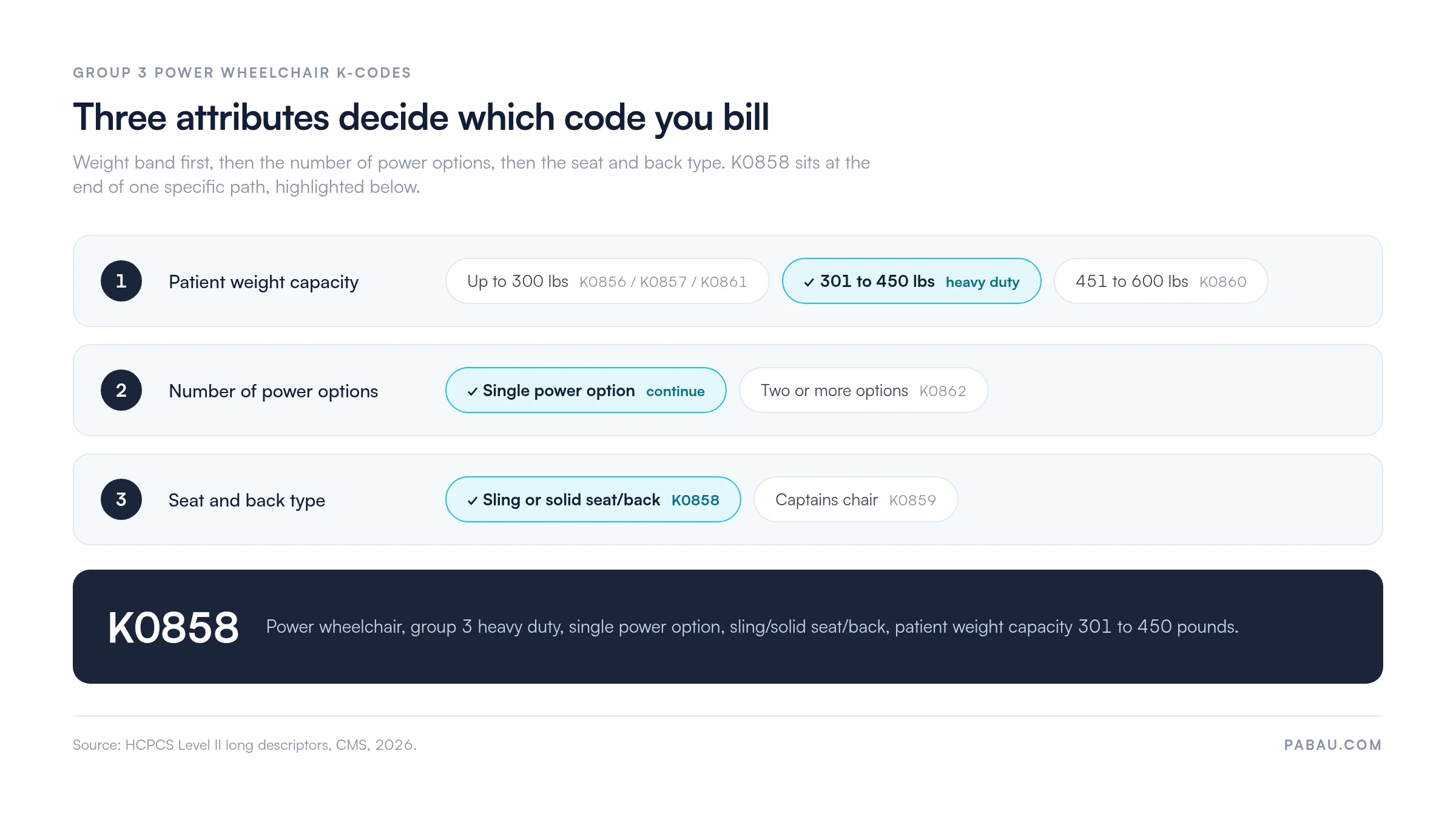
The selection rule runs in three steps. Start with the weight band, because 301 to 450 pounds is what makes the chair heavy duty rather than standard or very heavy duty. Then count the power options. One option keeps the claim on K0858, and two or more move it to K0862. Finally check the seat, since a captains chair moves the claim to K0859. Billing K0858 for a chair with two power options is a coding error, and so is billing K0862 for a single-option chair. Read the supplier’s product specification sheet against the practitioner’s clinical notes before you pick the code.
Billing K0858 correctly requires coordinating documentation from the ordering practitioner, the prior authorization team, and the delivery team. A breakdown at any stage produces a denial. These are the denial patterns suppliers report most frequently for Group 3 heavy duty power wheelchairs.
When a claim is denied, suppliers have the right to appeal through the Medicare appeals process. Gathering the complete documentation package first beats appealing with the same incomplete record that triggered the denial. Keeping the signed order, the proof of delivery, and the affirmation notice together for each unit makes that package quick to assemble.
HCPCS code K0858 is used beyond Medicare. Medicaid programs in most states cover power wheelchairs as DME, but coverage criteria, prior authorization processes, and reimbursement rates vary by state.
A supplier billing K0858 under a state Medicaid program should read that state’s Medicaid DME policy manual first. Clinical necessity thresholds, the list of covered diagnoses, and documentation requirements often differ from Medicare’s LCD.
Private commercial payers generally follow CMS coding conventions and use HCPCS K0858 for this product category. Their coverage policies are not bound by Medicare’s medical necessity criteria.
Some commercial plans require a letter of medical necessity alongside the written order. Others require the ordering provider to be in-network. A few treat power wheelchairs as a rental benefit rather than a purchased item, which changes the billing cadence.
Suppliers billing across several payer types should keep payer-specific rules in their practice management system. What clears a Medicare audit for K0858 will not always satisfy a commercial payer. Record each payer’s authorization rule, documentation checklist, and appeal deadline where the billing team will see it.
Build a payer matrix for K0858 in your billing system. Give every payer its own row: Medicare, Medicaid by state, and each commercial plan. Add columns for the prior authorization requirement, the documentation checklist, the rate, and the appeal deadline. Updating it quarterly takes less time than unpicking one denial caused by a rule change.
Most suppliers track a K0858 unit in two disconnected places. The evaluation, the order, and the mobility assessment sit with the practitioner. The claim sits in a separate billing tool, and nobody compares the two until a remittance comes back short.
Pabau keeps the insurer, the policy, and the invoice on the patient record, so an insured patient has one source of truth. Claims then move through named stages of pending, submitted, processing, paid, or error. A billing coordinator can filter by date, insurer, or invoice ID and see which K0858 claims are still open.
Validation checks run in the background every time someone goes to send a claim. Where a detail the payer needs is missing, the Send button stays disabled until it is filled in. That turns a rejection you would have found weeks later into a two-minute fix before submission.
In the US, Pabau connects to Claim.MD for electronic submission, real-time eligibility checks, claim status, and ERA remittance posting. When payment lands, the amount posts against the original invoice from the same dashboard. Your accounts receivable picture for DME billing stays current without a separate spreadsheet.

Pabau’s claims management software shows the live status of every insurance claim and holds submission while a required detail is missing. Payments post against the right invoice from the same dashboard.

K0858 describes one narrowly defined product. It is a Group 3 heavy duty power wheelchair with a single power option, for patients weighing 301 to 450 pounds. Almost every denial this code generates traces back to a specification mismatch, a missing prior authorization, or an incomplete record.
The order of operations is what protects the claim. Confirm the weight band, count the power options, check the seat type, then wait for the provisional affirmation before the chair leaves the warehouse. Suppliers who work in that sequence spend their week on deliveries instead of appeals. Book a demo to see how Pabau tracks each insurance claim from submission through to payment.

Need a framework for reducing claim denials across all DME codes? Denial management in healthcare walks through the most common rejection patterns and how to build a systematic appeal process.
Unsure whether your billing records would survive a Medicare audit? Medical billing compliance covers the documentation standards that apply across DME and other Medicare Part B claims.
Looking for guidance on the revenue cycle beyond individual codes? What is revenue cycle management explains how prior authorization, claim submission, and denial resolution fit into a complete RCM workflow.
Not sure what belongs on the billing document itself? What is a superbill breaks down each field a payer expects to see, and how the document is assembled.
New to the billing side of a practice? What is medical billing covers the full path from encounter to payment, which is useful context before you work a DME claim.
HCPCS code K0858 is a power wheelchair, Group 3 heavy duty, with a single power option and a sling or solid seat/back. It applies to patients weighing 301 to 450 pounds. It is billed as durable medical equipment under Medicare Part B when the patient meets the medical necessity criteria for power mobility in the home.
Yes. Group 3 power wheelchairs including K0858 require prior authorization under the CMS prior authorization program for certain DME. The supplier must receive a provisional affirmation from the MAC before delivering the chair and submitting the claim. Delivering without prior authorization will typically result in full claim denial.
The Medicare reimbursement rate for K0858 varies by geographic locality and differs between competitive bidding areas (CBAs) and non-CBA localities. CMS updates the rates through the DMEPOS fee schedule. Read the current figure in the CMS DMEPOS fee schedule files, or ask your DME MAC. Confirm as well whether your service area falls under competitive bidding pricing.
K0856 covers a Group 3 standard power wheelchair with a single power option and a sling or solid seat, for patients up to 300 pounds. K0857 is the same chair with a captains chair seat. K0858 is the heavy duty version for 301 to 450 pounds with one power option. K0859 is its captains chair equivalent. K0862 is the multiple power option code for that same weight band. K0860 covers 451 to 600 pounds.
Commonly accepted ICD-10-CM codes include G35 for multiple sclerosis, G82.50 for quadriplegia, and G80.0 for spastic quadriplegic cerebral palsy. Codes for severe rheumatoid arthritis and other conditions that prevent manual wheelchair propulsion also apply. The definitive list sits in the Local Coverage Determination issued by the patient’s MAC, so confirm against the current LCD.
Yes. Most state Medicaid programs cover power wheelchairs as DME and use HCPCS K0858 for this product category. Coverage criteria, prior authorization requirements, and reimbursement rates vary by state. Read the applicable state Medicaid DME policy manual rather than applying Medicare rules directly to a Medicaid claim.