

CCSD code G5100: Bypass of duodenum billing guide
CCSD code G5100 bills a bypass that leaves the duodenum in place CCSD code G5100...

Last Updated: Oct 16, 2026
K0815 is the HCPCS Level II code for power wheelchair, group 1 standard, sling/solid seat and back, patient weight capacity up to and including 300 pounds.
Two rules decide most K0815 claims. Medicare pays the code as a 13-month capped rental, never as an outright purchase. Prior authorization must also come back affirmed before the chair reaches the patient.
Miss either one and the claim denies, however complete the clinical record is.
Let Pabau's smart automation suggest the right codes, reduce claim denials, and keep your practice compliant—effortlessly.
Automate repetitive tasks and focus on what matters most—your patients.
Reduce coding errors and ensure compliance with the latest regulations.
Clean claims, fewer denials, and faster reimbursements.
Powerful insights and reporting to help your practice thrive.
HIPAA compliant SOC 2 certified GDPR-compliant Trusted by 4,000+ clinics worldwide

K0815 describes a group 1 standard power wheelchair with a sling or solid seat and back, for patients up to 300 pounds.
All four codes in the K0813 to K0816 family share that 300-pound cap, so seat type and portability are what separate them.
Medicare pays K0815 as a capped rental only, because the purchase option for standard power wheelchairs ended in 2011.
Prior authorization is required nationwide, and an affirmative decision has to arrive before the chair is delivered.
Practice management software like Pabau can build the claim from the patient record, check required fields, and submit it electronically.
K0815 is an active, billable code in HCPCS Level II, the code set the Centers for Medicare and Medicaid Services maintains for supplies and equipment. It describes a group 1 standard power wheelchair with a sling or solid seat and back. The chair is not portable, and the patient weight capacity stops at 300 pounds.
Claims route to a DME MAC rather than the Part B contractor that pays physician services. Coverage rules come from a Local Coverage Determination, not from general Part B policy.
The seating description does most of the work in that descriptor. A sling seat is the hammock-style fabric seat fitted to basic power chairs. Solid seats sit on a rigid base, usually under a cushion. Both belong to K0815 on a group 1 standard chair. Fit a captain’s chair instead and the claim becomes K0816.
Two variables split the group 1 family, and patient weight is not one of them. K0813 through K0816 all cap at the same 300 pounds. Choosing between them comes down to the seat and to whether the chair breaks down for transport.
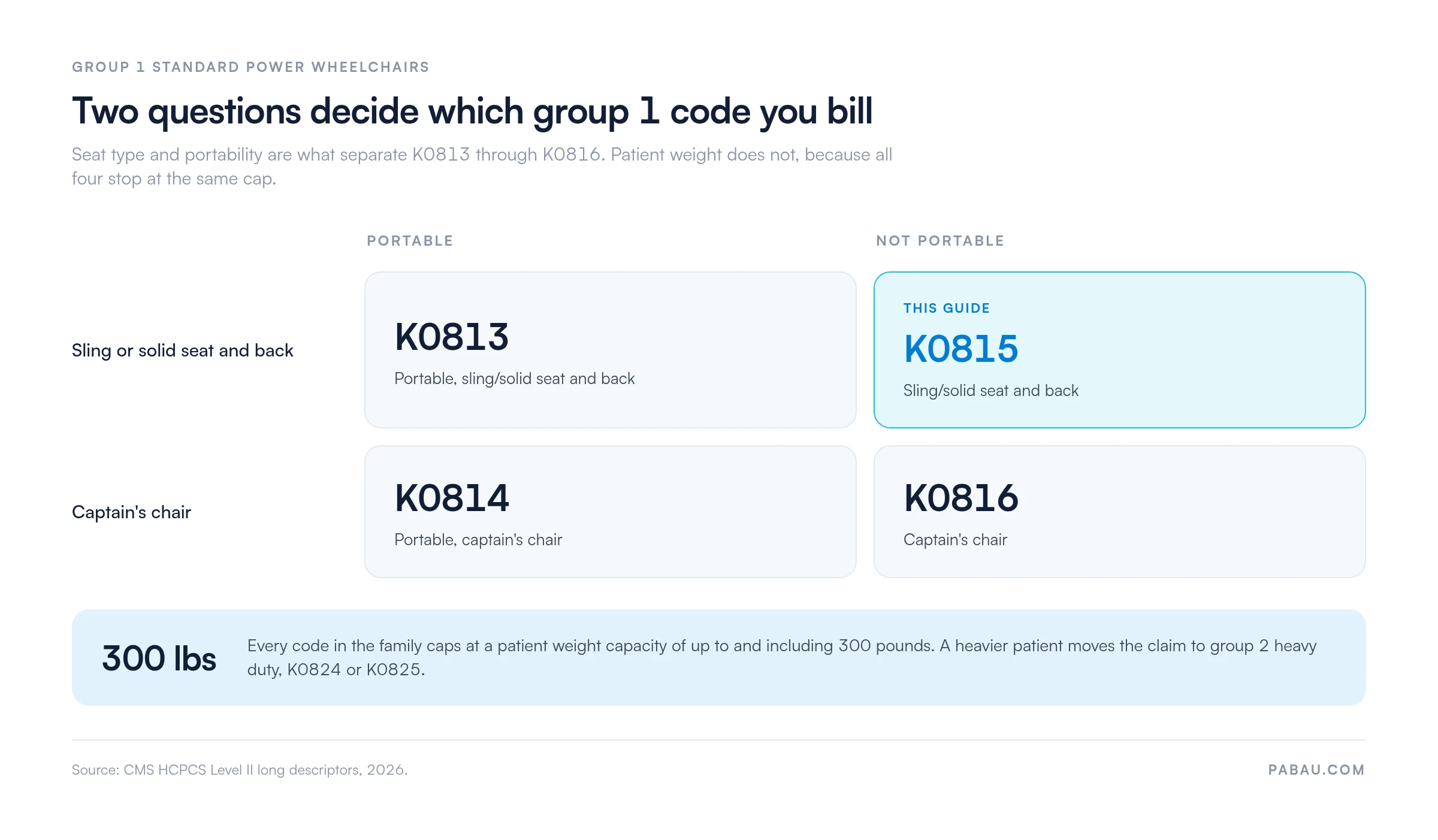
The rule reads simply enough. A non-portable chair with a sling or solid seat is K0815. Give that same chair a captain’s chair seat and it becomes K0816. If the chair folds or breaks down for transport, the codes shift to K0813 and K0814.
Here is where it goes wrong in practice. A supplier delivers a non-portable chair with a captain’s chair seat to a 280-pound patient. The order says group 1 standard, so the biller reaches for K0815. Weight is fine, but the seat descriptor does not match, and the claim is a coding error.
No group 1 code covers a patient above 300 pounds. K0815 has no heavy duty variant, and none of its siblings takes over at a higher weight. A heavier patient moves the claim to group 2 heavy duty instead.
That family starts at K0824 for a sling or solid seat and K0825 for a captain’s chair, both covering 301 to 450 pounds. Above 450 pounds, K0826 and K0827 take over. Billing K0815 for a 320-pound patient is a coding error, not a rounding decision.
Medicare pays K0815 from the DMEPOS fee schedule as a capped rental. The purchase option for standard power wheelchairs ended on January 1, 2011, under Section 3136 of the Affordable Care Act.
That change covers K0813 through K0831 and K0898. So there is no lump-sum claim to file for K0815, and no NU modifier to add.
The rental itself runs across 13 months of continuous use. Months 1 through 3 pay the full capped rental allowance. Payment then drops to 75% of that amount for months 4 through 13. Title then transfers to the beneficiary, and no further rental payment is made.
Allowed amounts come from the adjusted DMEPOS fee schedule and vary by state. Competitive bidding does not set the K0815 figure.
Power wheelchair contracts lapsed when the program paused in 2018 and 2019, and CMS left wheelchairs out of the round it revived for 2026. Pull the current quarter’s fee schedule file for your jurisdiction before quoting a number.
CMS publishes Medicare’s paid claim totals for every code, year by year. The 2024 file carries no national row for K0815 at all. K0813 drew 31 claims, K0814 drew 347, and K0816 drew 682. The group 2 standard equivalent, K0823, carried 105,391.
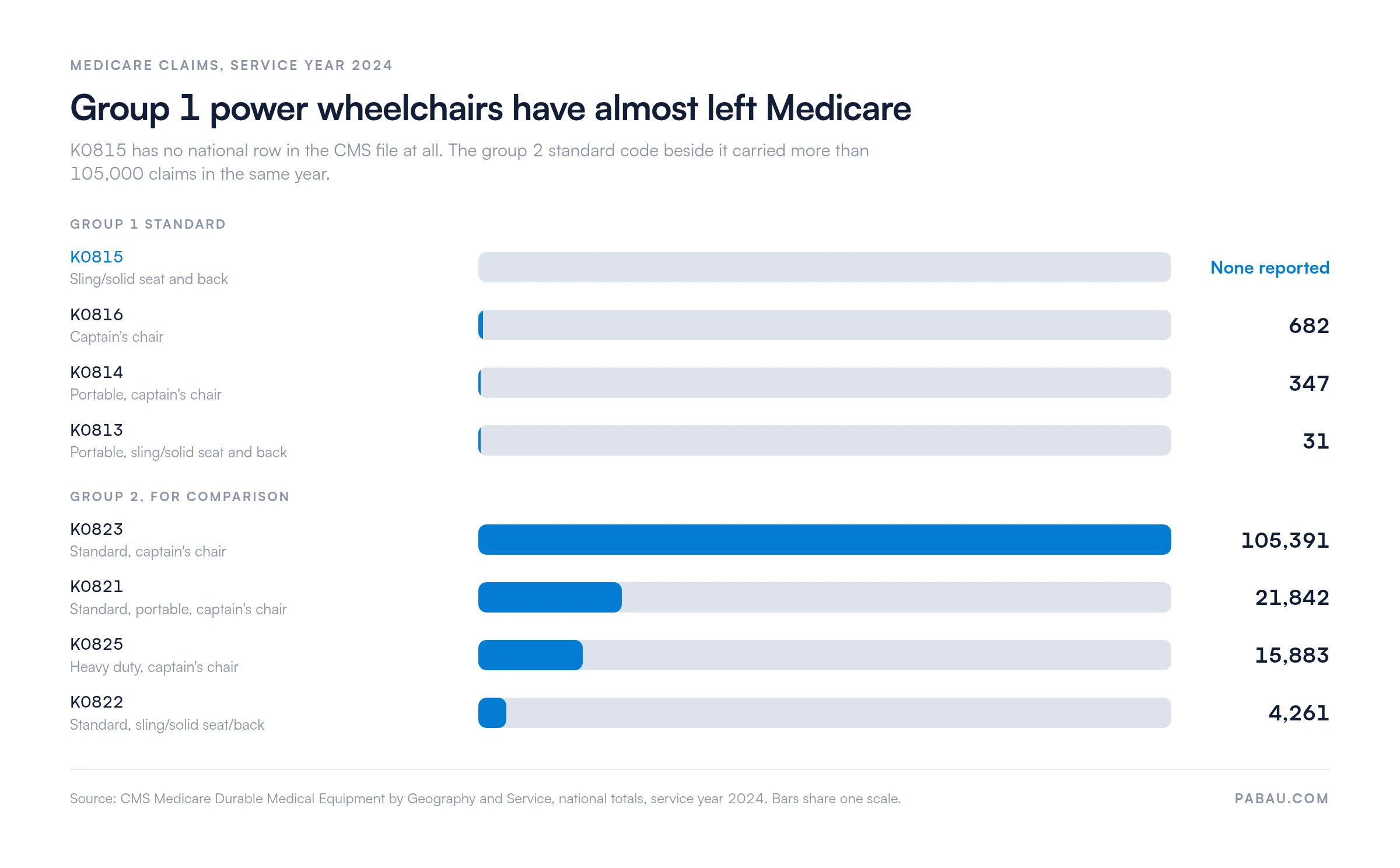
That pattern is worth knowing before you code, not after the denial. Almost every power wheelchair Medicare pays for sits in group 2. When a K0815 line lands on your desk, check the manufacturer’s specification sheet first. The chair on the delivery ticket may belong in a different group.
A CMS utilization file is only as complete as the codes facilities put on their claims. HCPCS code C1751 is typically packaged into the procedure’s APC payment. Hospitals report it anyway, since CMS uses that cost data to set future rates.
Yes, K0815 requires prior authorization. CMS added K0813 through K0816 to the required list on September 1, 2018, nationwide. The request goes to the DME MAC, and an affirmative decision has to be in hand before the chair is delivered.
Deliver first and the claim is denied. That denial is still an initial payment determination, so the standard Medicare appeal rights apply to it. The authorization decision works differently. A non-affirmed request is not an initial determination and cannot be appealed, but resubmission is unlimited.
CMS opened a prior authorization exemption in 2026 under the CMS-1828-F rule. A supplier whose initial requests reach an affirmation rate of at least 90% can be exempted for a year.
Written notices went out by the first business day on or after April 2, 2026, and the first cycle began on June 1, 2026.
Exempt suppliers stop filing. A request sent during an exemption period is rejected rather than reviewed, so filing out of habit only costs time. Exemption status is set separately for each jurisdiction, and CMS pulls a 10-claim sample afterwards to confirm it was earned.
An audit of a K0815 claim is an audit of the file behind it. DME MACs look for a fixed set of records, and one missing item can take back money that has already been paid.
Power wheelchairs have stayed a CMS enforcement priority for years, so the file gets read closely.
Coverage criteria sit in LCD L33789, Power Mobility Devices. A beneficiary qualifies when a neurological or musculoskeletal condition limits their mobility. They must also be unable to propel a manual wheelchair safely or adequately.
At least one MRADL has to be out of reach in the home without a power chair. The home itself is assessed for safe use as well.
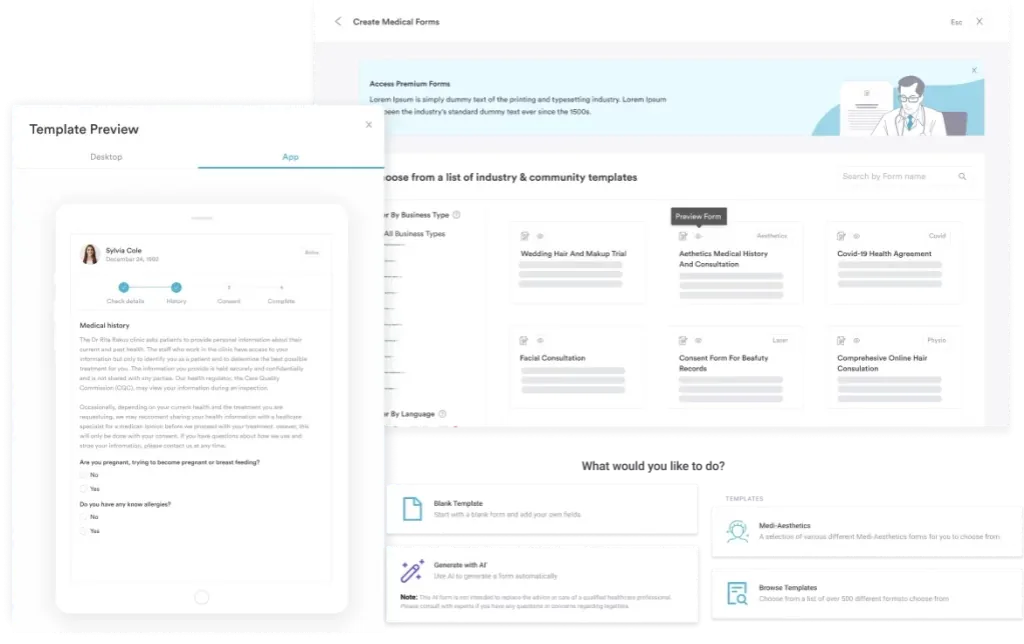
Capturing those findings at the point of care is what keeps the file defensible later. When the prescriber records MRADL findings in a structured template rather than free text, an auditor can match each criterion to a specific entry.
Two modifiers appear on almost every K0815 line. KX states that the coverage criteria are met and the documentation is on file. RR states that the item is rented, which for K0815 is the only payment method available.
KX and RR travel together on a rental claim. GA and GY never do, because GA says an ABN is on file while GY says the item was never a Medicare benefit. Check your DME MAC’s policy article before filing, since modifier guidance is published there rather than in the LCD.
Pull your last 30 K0815 claims and check two fields. Claims missing KX where the documentation exists are recoverable money. Claims carrying GY without a genuinely non-covered item behind them are a compliance problem. Fix the claim template before the next billing cycle rather than after an audit.
Power wheelchair claims sit near the top of every CMS audit program, and the denial reasons repeat. Five causes account for most of them. Each one has a process fix behind it rather than a clerical one.
Remittance data is what turns those patterns into a fix. Reading the denial codes across a month of submissions shows whether one reason is driving a run of rejections.
When the same code lands on 15 claims, the cause sits upstream in the workflow. Reworking those 15 claims individually clears the denials but leaves the cause in place.
Each line on that list is part of what a clean claim standard means for durable medical equipment. Clear all eight and a K0815 submission has very little left to trip on.
Most of the work on a K0815 claim happens before anyone opens a claim form. The examination note, the written order, the MRADL assessment and the delivery receipt all start in different places. By the time the biller builds the claim, those pieces are spread across an inbox, a shared drive and a fax tray.
Pabau has claims management built in, so the claim is assembled from the patient record rather than typed again. Codes already attached to the service land on the charge line, and ICD-10 slots are seeded from the recorded problem list. Lookup libraries for HCPCS and ICD-10 sit behind a search icon, so a code is confirmed without leaving the form.
Required fields are checked before the send button unlocks. In the US, claims go out through Claim.MD, which also handles eligibility checks, claim status tracking and electronic remittance posting. So a denial reason arrives in the same system as the documentation behind it.
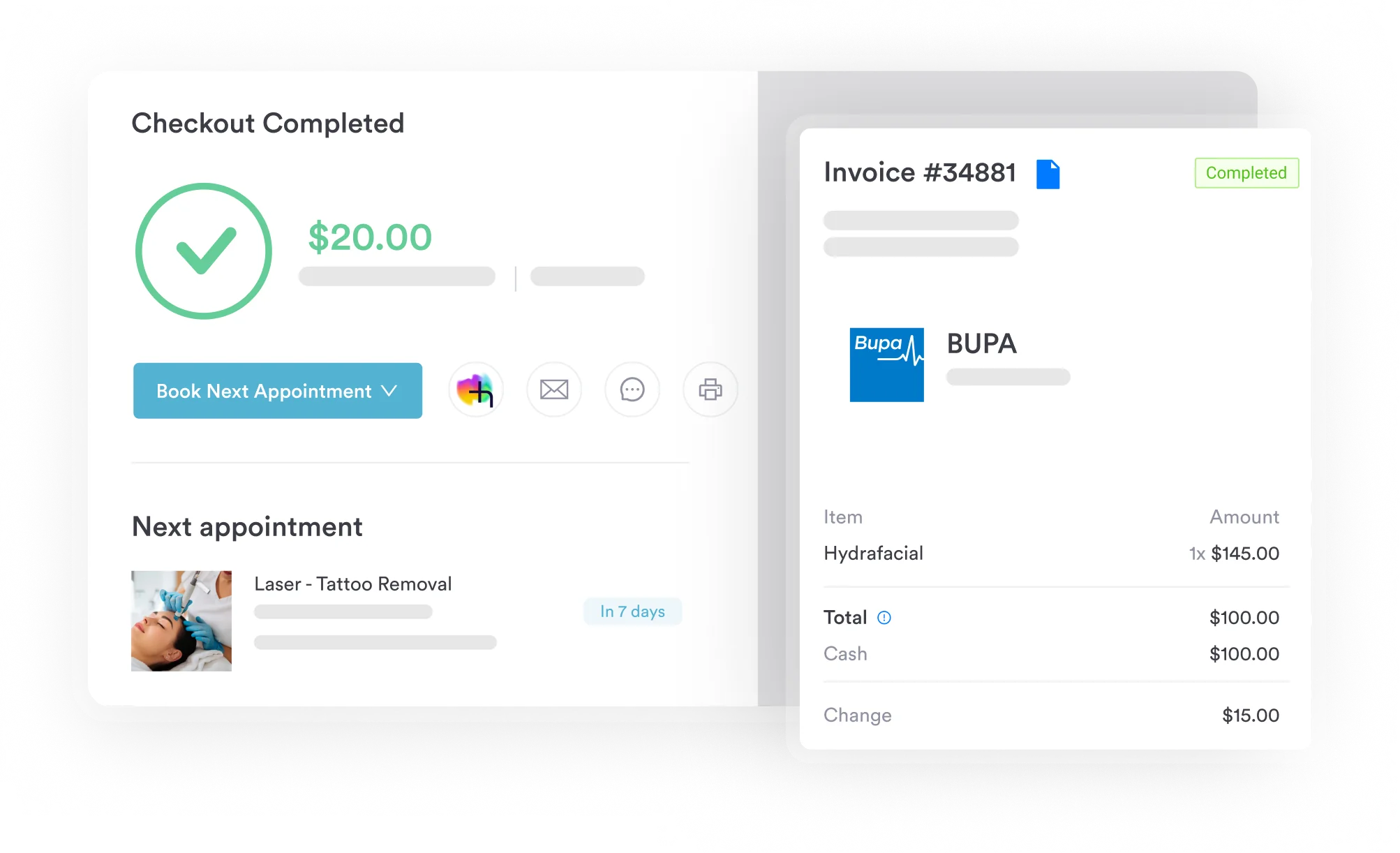

Pabau pre-fills claim forms from the patient record, checks the required fields before submission, and sends claims electronically. Remittances and claim status come back to the same place.

Record MRADL limitations as a structured checklist during the face-to-face examination, not as a narrative paragraph. An auditor has to match specific coverage criteria to specific entries. A line reading ‘patient has difficulty ambulating’ is far weaker than a completed assessment form with functional findings against each criterion.
K0815 is a narrow code with two hard rules attached to it. The chair has to match the descriptor exactly, and the authorization has to arrive before the wheels do. Neither one can be fixed after delivery.
So the work sits upstream. Code from the specification sheet, and hold the delivery until the affirmative decision lands. Keep the examination note, the order and the delivery receipt in one file. Suppliers who do that consistently can now earn their way out of prior authorization altogether.
Book a demo to see how Pabau keeps clinical records and Medicare claims in one system, so submissions leave the practice fully documented.

New to the revenue cycle behind DME claims? What is medical billing walks through the process a power wheelchair claim travels, from encounter to payment.
Checking coverage before you order equipment? Insurance eligibility verification sets out what to confirm with the payer before anything is delivered.
Worried about a post-payment audit? Medical billing compliance covers the documentation and coding standards that protect a practice when records are requested.
Seeing the same denials month after month? Denial management in healthcare explains how to work a denial queue and stop the same reason recurring.
Medicare sets the reasonable useful lifetime for durable medical equipment at five years, counted from the delivery date. Replacement before then is covered only for loss, theft, irreparable damage, or a change in the patient’s condition. Normal wear does not qualify.
No. Part B covers durable medical equipment for use in the beneficiary’s home. A hospital or skilled nursing facility does not count as a home. A chair delivered to a resident in that setting is denied.
Not always. Advantage plans set their own prior authorization criteria, forms and portals, and some route power mobility through a delegated vendor. Check the plan’s own medical policy before delivery, because the DME MAC process does not apply.
Yes. CMS allows unlimited resubmissions before delivery, and each one is reviewed on the same timeline as the original request. Use the decision letter to identify what was missing, then resubmit with the corrected documentation.
No. Coverage is tied to mobility-related activities of daily living inside the home. A patient who moves safely indoors but struggles outside does not meet the criteria, and this remains a frequent denial reason.



