CCSD code H4430: Examination of rectum under anaesthetic
CCSD code H4430 pays for the examination alone CCSD code H4430 is the UK private...

Last Updated: Oct 20, 2026
K0730 is the HCPCS Level II code for controlled dose inhalation drug delivery system.
The code is also easy to misfile. It sits in the miscellaneous durable medical equipment range K0669–K0746, near the power wheelchair codes. Coders sometimes treat it as mobility equipment, and it is not a mobility code.
Let Pabau's smart automation suggest the right codes, reduce claim denials, and keep your practice compliant—effortlessly.
Automate repetitive tasks and focus on what matters most—your patients.
Reduce coding errors and ensure compliance with the latest regulations.
Clean claims, fewer denials, and faster reimbursements.
Powerful insights and reporting to help your practice thrive.
HIPAA compliant SOC 2 certified GDPR-compliant Trusted by 4,000+ clinics worldwide

HCPCS code K0730 describes a controlled dose inhalation drug delivery system, not a wheelchair or mobility item.
Medicare Part B covers K0730 for one use only: delivering iloprost (Q4074) to a beneficiary with pulmonary hypertension.
Only five ICD-10-CM codes support medical necessity for K0730, and they sit in Group 14 of Policy Article A52466.
Every K0730 claim line needs a KX, GA, or GZ modifier, or the DME MAC rejects it as missing information.
Practice management software like Pabau helps billing teams track K0730 orders, refill timing, and documentation dates in one place.
K0730 is a HCPCS Level II code maintained by the Centers for Medicare and Medicaid Services (CMS). K-codes are assigned to durable medical equipment, prosthetics, orthotics, and supplies (DMEPOS) items that no permanent code describes. CMS added K0730 on July 1, 2005, and the descriptor has not been revised since.
Policy Article A52466 describes the device in two sentences. Aerosol is delivered in pulses during inspiration, and the duration of each pulse adapts to the patient’s breathing pattern. That pulsed, breath-actuated delivery is what separates K0730 from a standard jet nebulizer. A jet nebulizer runs continuously and loses drug on every exhalation.
Dose control matters here because of the drug. Iloprost is inhaled in microgram doses, six to nine times a day during waking hours. A delivery system that cannot meter each dose reliably is not clinically equivalent, which is why CMS created a separate code for it.
Medicare covers K0730 only when it is reasonable and necessary to administer iloprost (Q4074) to a beneficiary with pulmonary hypertension. The Nebulizers LCD (L33370) states this in a single line and allows no other indication. Claims for K0730 used with any other inhalation solution are denied as not reasonable and necessary.
Coverage of the device is bound to coverage of the drug. If iloprost fails the criteria below, the DME MAC denies K0730 with it. Reviewing the device criteria on their own will not tell you whether a claim is payable.
Iloprost (Q4074) is considered for coverage when all three of the following criteria are met.
Where one of those secondary causes applies, the record must also show all four of the following.
The second criterion drives most medical necessity denials. Pulmonary hypertension caused by left heart disease or by lung disease is common, and it is exactly what the LCD excludes. The referring physician’s note has to show which type of pulmonary hypertension the beneficiary has, not simply that pressures are elevated.
K0730 appears on the CMS Master List of DMEPOS items potentially subject to conditions of payment. Being on that list is not the same as being subject to them. CMS currently shows no prior authorization requirement and no face-to-face or written-order-prior-to-delivery requirement for K0730. Check the master list entry before you build a prior authorization step into your workflow. Re-check it each year, because CMS can activate those conditions at any time.
Policy Article A52466 lists exactly five ICD-10-CM codes for K0730 and Q4074, grouped together as Group 14. A diagnosis outside this list will not support the claim, however well the clinical narrative reads.
Two nearby codes are deliberately absent. I27.23, pulmonary hypertension due to lung diseases and hypoxia, describes the respiratory-system cause that criterion two rules out.
I27.24, chronic thromboembolic pulmonary hypertension, is not among the secondary causes the LCD names for iloprost. Both sit in the same I27 block, which our ICD-10-CM code library lists in full.
Group 14 is also newer than many billing templates. Before June 5, 2022, K0730 and Q4074 shared a diagnosis group with other nebulizer drugs. If your code set was built before that revision and has not been refreshed, it may still carry diagnoses the DME MAC no longer accepts.
K0730 is a capped rental item. CMS assigns it pricing indicator 36, capped rental DME subject to floors and ceilings, and type of service R, rental of durable medical equipment. Suppliers bill it monthly rather than as a one-time purchase.
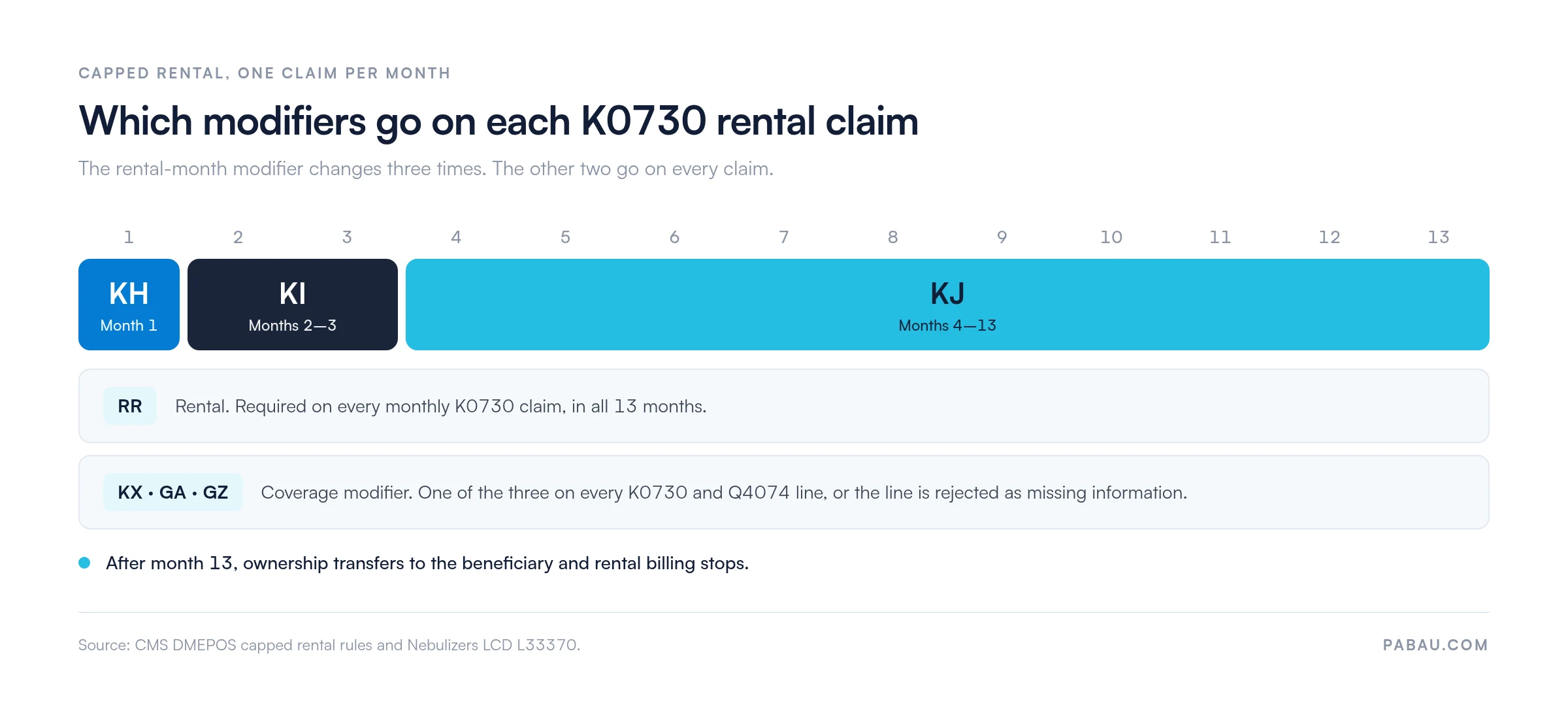
Capped rental runs for a maximum of 13 months of continuous use. Ownership then transfers to the beneficiary, and the supplier stops billing rental months. Each rental claim carries the RR modifier plus the rental-month modifier that matches its position in the sequence. The map below shows which modifier belongs to which month.
Allowed amounts vary by state and are updated at least annually, so a fixed dollar figure goes stale quickly. Look up the current amount in the CMS DMEPOS fee schedule for your jurisdiction. Medicare pays 80% of the allowed amount after the Part B deductible, and the beneficiary or a secondary payer covers the remaining 20%.
The drug is paid separately from the device. Iloprost billed under Q4074 is priced through the Part B average sales price methodology, not the DMEPOS fee schedule. A denial on the device does not automatically reverse payment on the drug. In practice the DME MAC denies both together when coverage criteria fail.
K0730 is billed on a DMEPOS claim to the DME MAC for the beneficiary’s jurisdiction, not to the local Part B carrier. Work through the sequence below before each batch goes out.
A mismatch between the two lines is a common and avoidable error. If the device line carries KX and the drug line carries GZ, the contractor sees a supplier attesting and not attesting to the same criteria.
One rule catches more claims than any other. A K0730 or Q4074 claim line submitted without KX, GA, or GZ is rejected as missing information, not denied on medical necessity. A rejection does not carry appeal rights, so the line has to be corrected and resubmitted.
The unit dose modifiers behave differently here. KO, KP, and KQ apply to inhalation drug codes rather than to the device, and the policy article specifically excludes Q4074 from the KO modifier. A Q4074 line billed with KP or KQ is rejected as invalid for claim submission.
The file has to prove two points at once. The beneficiary needs iloprost, and the beneficiary needs this device to take it. Build the supporting documentation package around the items below.
Keep the drug order on file even when your company supplies only the device. The nebulizer drug policy does not require it, but auditors ask for the Standard Written Order for the drug when they review the device. Suppliers who cannot produce it lose the claim.
Retain the full record for at least seven years from the date of service, in line with the DMEPOS supplier standards. A structured compliance workflow makes expiring orders and overdue continued-need checks visible before they turn into denials.
LCD L33370 pairs K0730 with a single accessory code. That code is A7005, an administration set with a small volume nonfiltered pneumatic nebulizer, non-disposable. Any other compressor and accessory combination is treated as not reasonable and necessary.
The replacement frequency is where supply revenue quietly leaks. A7005 is normally allowed once every six months. Used with K0730, the usual maximum rises to once every three months. Billing the six-month frequency on a K0730 patient leaves payable supply claims unbilled. Our full guide to A7005 covers the rest of that code’s rules.
Set the A7005 refill interval per patient, not per code. A supplier billing system that stores one global frequency for A7005 defaults to the six-month rule. That quietly under-bills every K0730 patient on the panel. Flag those patients at setup, tie them to the three-month interval, and reconcile A7005 claim counts against active K0730 rentals each quarter.
K0730 rarely appears on a claim by itself. The codes below are the ones it is billed with, mistaken for, or compared against.
This is worth stating plainly, because third-party code lists get it wrong. K0730 has nothing to do with wheelchairs, joysticks, or drive controls. No HCPCS code carries the descriptor “controlled power module”, and the phrase appears in no CMS policy.
Power wheelchair bases live in the range K0813 to K0899. Drive control interfaces are E-codes, including E2312 for a mini-proportional remote joystick and E2373 for a compact remote joystick. K0740, the code nearest to K0730, covers repair labor on oxygen equipment and is unrelated to both.
K0730 denials cluster around a short, predictable list. Mapping each remittance message to a fix beats reworking claims one at a time.
A structured denial management workflow sorts these by cause and routes each one to the team that can fix it. Documentation denials go back to intake, and modifier rejections go back to the claim template.
Most K0730 problems are calendar problems in disguise. A refill contact made a day too early, a continued-need check that slipped past 12 months, an A7005 supply line billed on the wrong interval. Teams working from spreadsheets and inbox reminders catch these late, usually when the remittance arrives.
Pabau, our practice management software, keeps the clinical record, the order, and the billing timeline in one place. Coverage evidence for each criterion lives on the patient record where the biller can see it. Recurring tasks handle the refill window and the annual continued-need check, so nobody is tracking dates in a side file.
The result is a shorter path from referral to paid claim. Your team spends its time on the criteria that genuinely need a clinical judgment, instead of chasing documentation that should have been filed at intake.

Pabau keeps orders, coverage evidence, refill dates, and billing on one record, so your team submits clean K0730 and Q4074 claims the first time. See how it fits your workflow.

K0730 rewards a supplier who front-loads the work. Almost every failure on this code is decided at intake, when the referral is accepted and the record is assembled.
Once the type of pulmonary hypertension, the drug, and the calcium channel blocker history are on file, the monthly claims are close to mechanical. Get that file wrong and resubmission will not save it, because a missing coverage modifier is a rejection with no appeal rights.
The trade-off worth remembering is volume. K0730 is a low-volume code, so it rarely earns a dedicated process. That is exactly why it fails. A three-month supply interval and a 13-month rental clock do not survive manual tracking.
Pabau’s audit-ready claims management keeps the order, the coverage evidence, and the refill dates on one record. To see how it fits your billing workflow, book a demo.

Want to cut rework on DMEPOS denials? Denial management in healthcare explains how to categorize, appeal, and prevent repeat denial patterns.
Need to tighten your audit readiness? Medical billing compliance outlines the documentation and retention standards that apply to DMEPOS suppliers.
Building the claim itself? Key components of a clean claim covers the fields a payer checks before a line is ever adjudicated.
Decoding a K0730 remittance? Denial codes in medical billing maps the common remark codes to the fix each one needs.
HCPCS code K0730 covers a controlled dose inhalation drug delivery system. The device delivers aerosol in pulses during inspiration, and the length of each pulse adapts to the patient’s breathing pattern. Medicare Part B covers it only when it is used to administer iloprost (Q4074) to a beneficiary with pulmonary hypertension. It is not a wheelchair, mobility, or drive control code.
Yes, but for one indication only. Nebulizers LCD L33370 covers K0730 when it is reasonable and necessary to deliver iloprost (Q4074) to a beneficiary with pulmonary hypertension. Claims for K0730 used with any other inhalation solution are denied as not reasonable and necessary. If iloprost itself fails the coverage criteria, the device is denied alongside the drug.
The two codes are unrelated apart from sitting near each other in the K-code range. K0730 is a controlled dose inhalation drug delivery system used with iloprost. K0740 is repair or nonroutine service for oxygen equipment requiring the skill of a technician, billed as a labor component per 15 minutes. K0740 took effect on April 1, 2009 and applies to oxygen equipment only.
Policy Article A52466 lists five ICD-10-CM codes in Group 14 for K0730 and Q4074. They are I27.0 primary pulmonary hypertension, I27.20 pulmonary hypertension unspecified, I27.21 secondary pulmonary arterial hypertension, I27.83 Eisenmenger’s syndrome, and I27.89 other specified pulmonary heart diseases. Codes outside that group, including I27.23 and I27.24, do not support the claim.
Every K0730 line needs KX, GA, or GZ. Use KX when all coverage criteria are met and documented. Use GA when they are not and a valid Advance Beneficiary Notice is on file, and GZ when no ABN was obtained. A line submitted without one of the three is rejected as missing information. Because K0730 is capped rental, each monthly claim also carries RR plus KH, KI, or KJ.
K0730 is a capped rental item. CMS assigns it pricing indicator 36, which is capped rental DME subject to floors and ceilings. Suppliers bill it monthly for up to 13 months of continuous use. Ownership then transfers to the beneficiary. Current allowed amounts vary by jurisdiction and are published in the CMS DMEPOS fee schedule.
No. K0730 appears on the CMS Master List of DMEPOS items potentially subject to conditions of payment. That listing is often misread as a prior authorization requirement. CMS currently shows no prior authorization and no face-to-face or written-order-prior-to-delivery requirement for the code. Check the master list entry periodically, since CMS can activate those conditions later.
The most common causes are a missing KX, GA, or GZ modifier, or use of the device with a drug other than iloprost. Diagnosis codes outside the Group 14 list also fail, as does pulmonary hypertension secondary to left heart disease or lung disease. Refill contacts made outside the 30-day window and continued medical need that was not verified within 12 months round out the list.