CCSD code H4430: Examination of rectum under anaesthetic
CCSD code H4430 pays for the examination alone CCSD code H4430 is the UK private...

Last Updated: Oct 20, 2026
K0601 is the HCPCS Level II code for replacement battery for external infusion pump owned by patient, silver oxide, 1.5 volt, each.
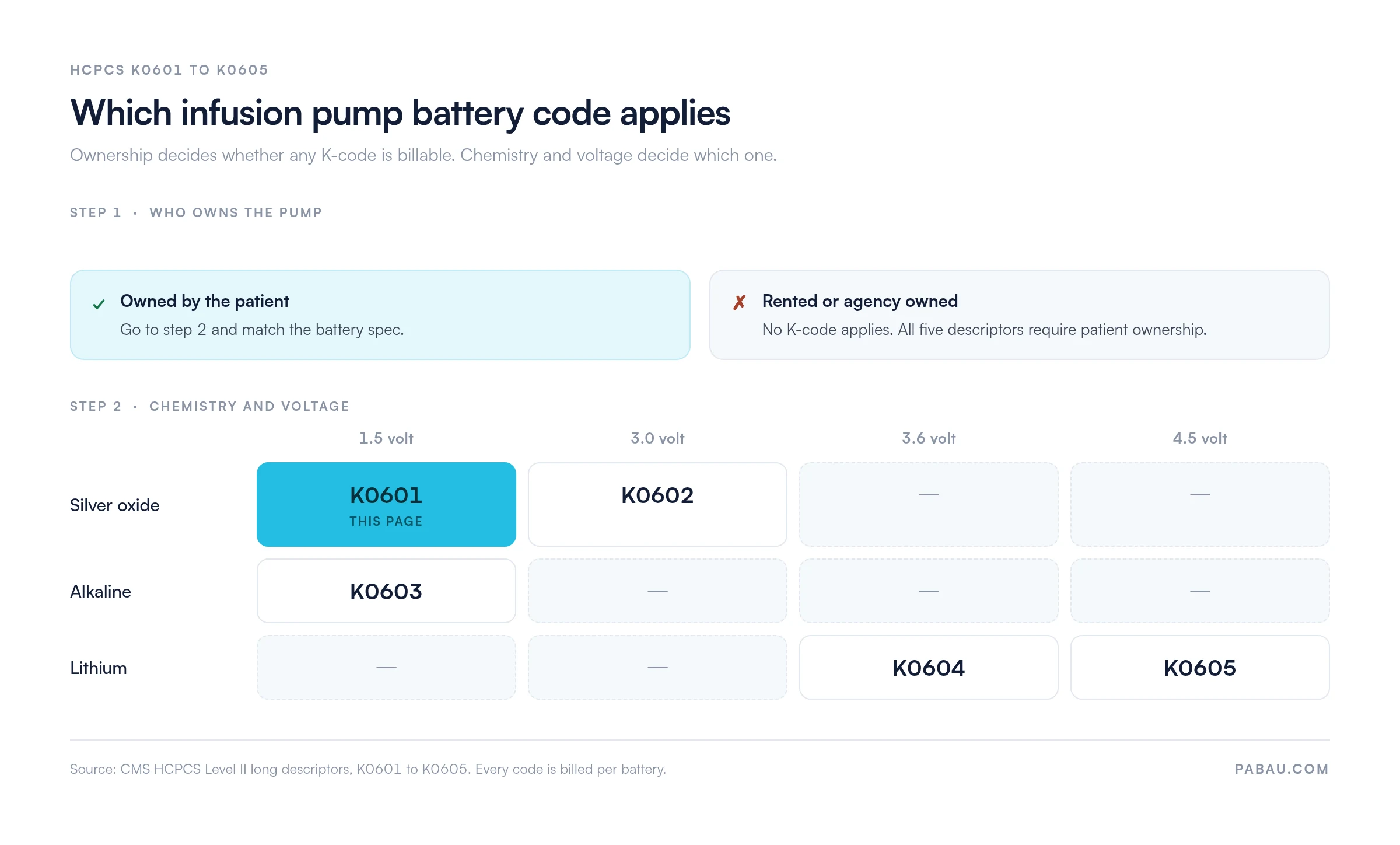
Billers also lose money on the sibling codes, because K0602 through K0605 differ only by chemistry and voltage. Get either detail wrong and the DME MAC denies on the first pass.
Let Pabau's smart automation suggest the right codes, reduce claim denials, and keep your practice compliant—effortlessly.
Automate repetitive tasks and focus on what matters most—your patients.
Reduce coding errors and ensure compliance with the latest regulations.
Clean claims, fewer denials, and faster reimbursements.
Powerful insights and reporting to help your practice thrive.
HIPAA compliant SOC 2 certified GDPR-compliant Trusted by 4,000+ clinics worldwide

HCPCS code K0601 covers a silver oxide 1.5 volt replacement battery for a patient-owned external infusion pump.
Patient ownership is absolute, so a rented pump or an agency-owned pump rules out the whole K-code series.
Sibling codes K0602 through K0605 differ by chemistry and voltage, and picking the wrong one drives most denials.
CMS retired the Certificate of Medical Necessity for dates of service from January 1, 2023, and claims carrying one are rejected.
Practice management software like Pabau keeps HCPCS libraries current and validates claim fields before submission.
K0601 is a Level II alphanumeric code maintained by the Centers for Medicare and Medicaid Services. It describes one narrow supply item.
That item is a silver oxide battery, rated at 1.5 volts, that replaces the power source in an external infusion pump the patient owns.
Every word in that descriptor carries billing weight:
Misread one qualifier and the line denies before a human at the MAC ever sees it.
Five codes cover replacement batteries for patient-owned external infusion pumps, and K0601 is the first of them. Each code maps to one chemistry at one voltage.
The pump manufacturer’s specification decides which code you bill, not the label on the battery packaging.
Silver oxide and alkaline cause the most confusion, because both come in 1.5 volt form. K0601 and K0603 are still not interchangeable.
Silver oxide holds a flatter discharge curve and a longer shelf life, which is why some pump models require it. Treat the manufacturer’s documentation as the tie-breaker.
The grid below folds the ownership test and the chemistry test into one path, so you land on the right code in two steps. If the pump takes a different accessory altogether, the wider HCPCS code directory is the faster place to start.
Medicare Part B covers K0601 under the DME benefit, and all six conditions below must hold at the same time. The DME MAC for the patient’s jurisdiction adjudicates the claim.
Ownership deserves a second look at every resupply. K0601 is not billable when the pump is rented from a supplier or belongs to a home health agency.
When a patient moves from a rented pump to a purchased one, battery coverage starts only once the purchase date sits in the record.
Medicaid programs may also cover K0601 under their own DME policies, though criteria and rates vary by state. Commercial payers generally mirror Medicare’s medical necessity rules.
Many of them add prior authorization on top, so read the plan’s external infusion pump policy before delivery.
Medical necessity for K0601 comes from CMS policy and the DME MAC’s Local Coverage Determination for external infusion pumps.
Assemble the proof before you submit. A file built after a denial rarely survives redetermination, because the dates on the documents give it away.
LCDs vary by jurisdiction, so Noridian, CGS, and Palmetto GBA can each read the same file differently. Pull the LCD for the patient’s state before you build the claim, not after the remittance arrives.
Documentation failures are the second biggest cause of K0601 denials, right behind wrong code selection. Office-visit habits do not carry over here.
On a DME claim, the proof of ownership and the proof of delivery weigh as much as the clinical order.
Keep every document for at least seven years. Post-payment audits and RAC reviews target high-frequency supply codes, and a single missing delivery record can trigger a recoupment demand.
A K0601 claim travels on the CMS-1500 form, or on the 837P transaction if you submit electronically. The path from order to remittance runs through five checkpoints, and each one has its own failure mode.
KX is worth its own note. Appending it to K0601 attests that the file already holds the documentation the LCD demands. Leave it off where the MAC expects it and the line denies automatically, so check the LCD before every claim run.
Most US suppliers submit through a clearinghouse instead of going direct to each payer. The clearinghouse scrubs the file, routes it to the right DME MAC, and returns the 835 remittance for posting.
Before any of that reaches the payer, five questions catch the errors that show up on DME remittances week after week. Work them in order, because a failure at the top makes the rest irrelevant.
Any question you cannot answer from the file is a denial waiting to post. Fix it now, while the correction costs a few minutes instead of an appeal.
Medicare pays K0601 from the DMEPOS fee schedule, and CMS updates that file quarterly, in January, April, July, and October.
The annual CPI-U and policy update lands on January 1. The other three quarters carry corrections, new items, and gap-filled rates.
Rates also differ by MAC jurisdiction and by competitive bidding area. Pull the current figure from the CMS DMEPOS fee schedule or the CMS HCPCS overview page. Third-party rate tables often still show last year’s number.
Per-unit rates are small here, so accuracy pays off at volume rather than on a single line. Underbilling and overbilling both draw audit attention. Keep delivery records that match the billed quantity exactly.
Denials on this code cluster tightly, and the four patterns below cover most of what DME billing teams see on remittance. Each has a cheap preventive fix.
When a line denies, start with the Claim Adjustment Reason Code on the remittance. CO-97 usually means the battery fell inside a period a previous payment already covered. CO-50 means the payer did not see medical necessity.
A CO-50 needs a documentation appeal rather than a resubmission of the same file. Whichever route you take, the corrected claim still has to meet the standards for clean claim submission, or it simply denies again.
Run a quarterly audit of K0601 claims against your delivery logs. For each billed claim, check that the delivered quantity matches the billed quantity, and that the delivery date sits inside the LCD’s replacement window. Catching frequency errors before submission removes the most common recoupment risk on DME battery codes.
DME resupply billing splits across more systems than a standard office visit. Ownership records live in one place, delivery confirmations in another, and the LCD’s replacement window usually lives in someone’s head or a spreadsheet.
Pabau is practice management software that keeps the patient record and the claim in one system. Its medical claims management tools pre-fill the CMS-1500 from that record, and they hold searchable HCPCS and ICD-10-CM libraries.
Required-field validation holds the claim back until the file is complete. US practices then submit through the Claim.MD clearinghouse, which reaches thousands of US payers. Eligibility responses and 835 remittances post back to the same record.
For a K0601 resupply, that means the eligibility check runs before the batteries ship. An ownership change or a lapsed plan surfaces while the claim is still editable, instead of six weeks later on a remittance.

Pabau pre-fills the CMS-1500 from the patient record, checks that required fields are complete, and submits through the Claim.MD clearinghouse. See how it fits a DME resupply workflow.

K0601 is a small line with a narrow descriptor, and that narrowness is what makes it deniable. The code turns on one chemistry, one voltage, and one owner. Confirm all three at the point of coding and the claim usually pays without an argument.
The harder discipline is the paperwork that has to exist before the batteries leave the shelf. Ownership proof, a signed delivery record, and a refill contact you can evidence are what carry a claim through a post-payment review.
If your team rebuilds that file by hand at every resupply cycle, the fix belongs in the workflow. Book a demo to see how Pabau keeps DME orders, delivery records, and claims in one place.

Need a framework for working DME denials? Denial management in healthcare covers the workflow from reason-code identification through appeal.
Building a DME billing process that survives an audit? Medical billing compliance sets out the documentation habits that protect suppliers in post-payment review.
Wondering how clearinghouse submission works for HCPCS codes? Claim.MD clearinghouse explains electronic routing and real-time eligibility for US payers.
Reading denial reasons off the remittance? Electronic remittance advice shows how 835 files post and where each adjustment reason appears.
Still assembling charges on paper? Superbill explains what belongs on the charge document before it reaches your billing team.
Yes. Issue a valid Advance Beneficiary Notice of Noncoverage before delivery whenever you expect Medicare to deny the battery. Have the patient sign it, then append the GA modifier to the K0601 line. Without a signed ABN you cannot bill the patient for the denied amount.
No, an existing order stands until it expires or the item changes. Medicare does require you to contact the patient before each refill and record an affirmative response. Shipping on a standing schedule is not permitted, even when the patient has asked for it.
You have 120 days from receiving the initial determination to file a redetermination with the DME MAC. Medicare presumes you received the notice five days after its date. The MAC then normally answers within 60 days of getting your request.
Medicare Advantage plans must cover at least what Original Medicare covers, so the ownership and chemistry rules still hold. Individual plans can add prior authorization, network restrictions, and their own documentation forms. Read the plan’s DME policy before delivery, because a retroactive fix is rarely possible.