CCSD code H4430: Examination of rectum under anaesthetic
CCSD code H4430 pays for the examination alone CCSD code H4430 is the UK private...

Last Updated: Oct 20, 2026
K0098 is the HCPCS Level II code for drive belt for power wheelchair, replacement only.
Miss that last modifier and Medicare rejects the line as missing information. For a supplier running dozens of repair claims a week, those rejections pile into a rework queue nobody has time for.
Let Pabau's smart automation suggest the right codes, reduce claim denials, and keep your practice compliant—effortlessly.
Automate repetitive tasks and focus on what matters most—your patients.
Reduce coding errors and ensure compliance with the latest regulations.
Clean claims, fewer denials, and faster reimbursements.
Powerful insights and reporting to help your practice thrive.
HIPAA compliant SOC 2 certified GDPR-compliant Trusted by 4,000+ clinics worldwide

HCPCS code K0098 describes a drive belt for a power wheelchair, replacement only. It is a Level II code maintained by CMS.
K0098 is billed under Medicare Part B as durable medical equipment. The billing supplier must hold active DMEPOS accreditation and Medicare enrollment.
A replacement belt takes the RB modifier with the NU pricing modifier. RA and RR do not fit, because a belt is a part rather than a whole item or a rental.
Every K0098 line also needs exactly one of GA, GY, GZ or KX. Medicare rejects a line without one of the four as missing information.
The rate comes from the CMS DMEPOS fee schedule, not the physician fee schedule, and it varies by payment locality.
K0098 covers exactly one item: a replacement drive belt for a power wheelchair. It does not cover a new wheelchair, a belt supplied with new equipment, or any other accessory.
The code sits in the K-series of HCPCS Level II, which holds miscellaneous DME products that other HCPCS ranges do not capture.
According to the Centers for Medicare and Medicaid Services (CMS), which maintains the code set, the essentials read as follows.
That “replacement only” wording does real work. Billing K0098 for a belt that ships with a new chair is a coding error. So is billing it for a part that does not match the drive belt specification. Either one routinely draws a denial.
Medicare Part B pays when the wheelchair belongs to the beneficiary, the belt has worn or failed, and the file proves both.
Coverage is never automatic. K0098 follows the same framework the Medicare Benefit Policy Manual applies to every DMEPOS replacement part.
Eligibility also has to be confirmed before the belt leaves the warehouse, not after the claim bounces. That means checking Part B enrollment and the coverage history of the chair itself.
Medicare and most commercial payers want five things on hand:
Commercial payers write their own coverage policies. Some mirror Medicare, others add criteria of their own, so read the plan’s DME policy before the belt ships.
The claim moves in six steps, and five of them happen before you submit anything. Work through them in order and the line goes out complete.
Here is how that looks on a live claim. A beneficiary owns her power wheelchair outright, bought two years ago. The belt starts slipping, a technician confirms wear, and her physician signs a replacement order.
The belt is delivered on 3 September, so that is the date of service. The line reads K0098 with RB, NU and KX, one unit. Labor goes on a separate line under its own code.
Modifier selection is where most K0098 claims go wrong. Two separate decisions have to be right on the same line.
The first says what you supplied and how it is priced. The second tells the DME MAC where the claim stands on coverage. The chart below maps both decisions, and the table under it explains each modifier.
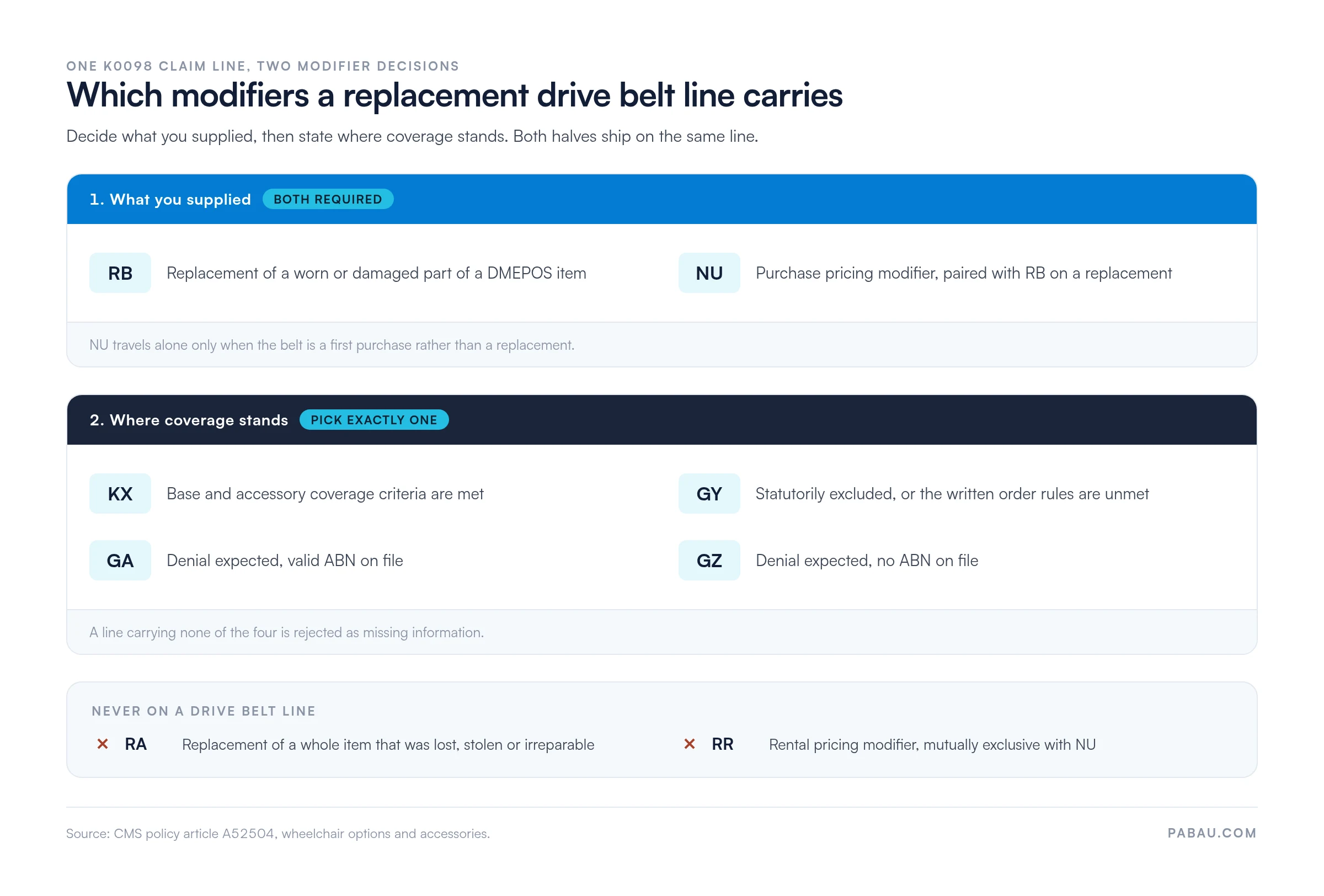
The CMS policy article for wheelchair options and accessories, A52504, carries the definition of RB. It covers an option or accessory supplied as a replacement for the same part, worn or damaged.
That is exactly what a replacement drive belt is. The same article adds that RB travels with the NU pricing modifier and the appropriate informational modifiers.
One of GA, GY, GZ or KX is mandatory on every K0098 line. A52504 states that lines billed without one of the four are rejected as missing information. They are mutually exclusive alternatives, so exactly one goes on the line.
RA and RR are the two modifiers most often appended to K0098 in error. Neither one fits a drive belt replacement.
Accuracy here does more than protect one payment. Incorrect modifier use can raise a fraud flag during CMS post-payment review. Check the current policy articles for Jurisdiction C (CGS) or Jurisdiction D (Noridian) before you submit.
Cross-reference the patient’s wheelchair record before you bill. Confirm the original power wheelchair was covered under Medicare Part B. Check that the drive belt model or serial number matches the approved equipment. A mismatch between the replacement part and the covered base is a common audit trigger.
K0098 is paid from the DMEPOS fee schedule that CMS updates each January, and the allowed amount shifts with the payment locality.
Inside a Competitive Bidding Area (CBA) the winning bid rate replaces it again. Prior-year figures are no help, so look the rate up fresh.
One trap catches new billers here. The CMS Physician Fee Schedule lookup tool excludes DME codes, so it returns nothing for K0098. Pull the current allowed amount from the CMS DMEPOS fee schedule files instead, or from your DME MAC’s fee schedule lookup at Noridian or CGS.
Watch the remittance advice Medicare returns on these claims, because it is the fastest read on whether payment is landing at the right rate.
When an ERA shows a reduced amount, check the adjustment reason code. It usually points to a locality difference or a Competitive Bidding rate.
A single repair visit often touches more than one code, and each discrete part gets billed on its own. The neighbours below come up most often on power wheelchair claims.
The AAPC Codify HCPCS lookup is worth a check when you need the full descriptor for one of them.
When several parts are replaced on one date of service, each code takes its own line on the CMS-1500 and its own modifiers. Bundling two components under a single K0098 line is a common error, and it usually ends in a rejection.
Repair labor is billed separately from the part, in 15-minute units under K0739, and only on beneficiary-owned equipment.
K0098 claims fail for predictable reasons, and the denial codes that come back name most of them. These seven cause the bulk of the rework.
Run this over the claim before it leaves the billing system. It takes under a minute per line.
A medical claims management system that validates required fields and keeps the order on the patient record catches most of these before submission. The rest come down to habit: same checks, same order, every claim.
Audit your K0098 claims monthly against the ERA data and track the reason codes. Three come up most often on power wheelchair part denials. CO-4 flags an incorrect modifier and CO-50 a service not deemed medically necessary. CO-97 means the payment is already included in another service. Fixing the root cause cuts the denial rate inside one billing cycle.
Most K0098 denials are documentation and modifier problems, and both get settled before the claim leaves the building.
Suppliers working from spreadsheets keep the practitioner order in one place and the modifier decision in another. When an audit letter arrives months later, someone has to rebuild the file by hand.
Practice management software like Pabau holds that record in one patient file instead. Digital forms capture the practitioner’s order and the necessity notes at the point of care.
Every entry is timestamped and attributed to the person who wrote it, so the audit trail already exists when a DME MAC asks for it.
Pabau’s claims management then pre-fills the CMS-1500 from that record and checks the required fields are complete before submission.
On the US pipeline it also runs real-time eligibility checks, posts ERA remittances, and tracks claim status. You still pick the modifiers yourself. You stop losing claims to a blank field or a missing order.

Pabau pre-fills the CMS-1500 from the patient record, validates the required claim fields, and tracks claim status after submission. Your orders, delivery records and remittance data stay in one place.

K0098 is a small code with a narrow job, and the difficulty never sits in the code itself. It sits in the four things around it: a current order, the RB and NU pair, one coverage modifier, and the locality rate. Line those up and the belt gets paid at the first pass.
The suppliers who stop reworking these claims are rarely the ones who memorized the modifier table. They are the ones whose system will not let an incomplete line out the door.
Book a demo to see how Pabau keeps DME orders, delivery records and claim status in one place.

Need a framework for handling claim denials systematically? Denial management in healthcare walks through root-cause analysis and workflow fixes for recurring denial patterns.
Want to read a Medicare remittance properly? Electronic remittance advice explains ERA file formats, adjustment codes, and how to reconcile Medicare payments.
Looking for the wider Medicare billing picture? Medicare billing covers enrollment, claim submission and the rules that apply across Part B services.
Want a broader compliance reference? Medical billing compliance requirements covers documentation standards, payer audits, and supplier obligations across DME and other claim types.
Only when a valid ABN was signed before the belt was supplied, and the line carries GA. Without an ABN the line takes GZ, and the denial leaves the supplier liable rather than the beneficiary. The ABN has to name the item and the reason you expect a denial. One signed after delivery does not count.
Medicare sets no fixed interval for a drive belt. Each replacement stands on its own record of wear or failure, so the service note and the order date carry the claim. Repeat claims inside a short window do attract review. Log what failed, and when, every time.
Medicare does not pay for a part the manufacturer or supplier already has to replace free of charge. Check the warranty term before the belt ships. Where it still applies, the repair goes ahead without a K0098 line, and the file should record why nothing was billed.
No. The descriptor names a power wheelchair, so a belt on a power-operated vehicle does not belong on a K0098 line. Scooters sit in the K0800 to K0812 range, and their parts follow that equipment’s own coverage rules. Confirm which base the patient owns before you code the repair.