

HCPCS code E0198: Water pressure pad billing guide
HCPCS code E0198 is a water pad for a standard mattress HCPCS code E0198 is the ...

Last Updated: Oct 13, 2026
K0739 is the HCPCS Level II code for repair or nonroutine service for durable medical equipment other than oxygen equipment requiring the skill of a technician, labor component, per 15 minutes.
Let Pabau's smart automation suggest the right codes, reduce claim denials, and keep your practice compliant—effortlessly.
Automate repetitive tasks and focus on what matters most—your patients.
Reduce coding errors and ensure compliance with the latest regulations.
Clean claims, fewer denials, and faster reimbursements.
Powerful insights and reporting to help your practice thrive.
HIPAA compliant SOC 2 certified GDPR-compliant Trusted by 4,000+ clinics worldwide

HCPCS Code K0739 covers skilled technician labor for repairing non-oxygen durable medical equipment, billed in 15-minute increments.
Only nonroutine repairs that require a technician’s skill qualify, so routine maintenance and oxygen equipment repairs use other codes.
There is no national base rate for K0739. Medicare prices the code per DME MAC jurisdiction, and CGS publishes $20.11 per unit for Jurisdiction C in 2026.
A signed repair order must be on file before claim submission, and its absence is the leading cause of K0739 denials.
Practice management software like Pabau tracks billing units, stores repair documentation, and flags incomplete K0739 claims before submission.
HCPCS Code K0739 is a Level II HCPCS code maintained by the Centers for Medicare and Medicaid Services (CMS). CMS publishes one long description for the code. It reads, “Repair or nonroutine service for durable medical equipment other than oxygen equipment requiring the skill of a technician, labor component, per 15 minutes.”
Three elements define whether a service qualifies. First, the equipment being repaired must be durable medical equipment other than oxygen equipment. Second, the repair must be nonroutine and require the skill of a qualified technician. Third, only the labor component is captured by this code, so replacement parts are billed separately under the applicable HCPCS supply codes.
Medicare pays HCPCS Code K0739 by the unit, and one unit is 15 minutes of skilled technician labor. There is no single national base rate for this code that contractors then adjust. CMS prices K0739 directly at the DME MAC jurisdiction level. Its own fee schedule documentation flags repair labor codes as exempt from the national ceilings and floors that cap most DMEPOS amounts. The rate that governs your claim is the one your own contractor publishes.
Each jurisdiction updates its own published labor rate once a year. The prior year’s amount is raised by the CPI-U percentage increase, which CMS set at 2.7 percent for CY2026 in MLN Matters MM14326. That calculation involves no national figure and no geographic adjustment factor. So the amount allowed differs between jurisdictions, and a rate you looked up last year is already out of date.
Two contractors administer DMEPOS claims across the four jurisdictions. Jurisdictions B and C go to CGS Administrators, and Jurisdictions A and D go to Noridian Healthcare Solutions. Each contractor publishes its own labor fee schedule carrying the current K0739 rate. For 2026, CGS lists $20.11 per unit for Jurisdiction C, applied uniformly across every state in it. Treat that as a worked example, not a figure to bill on elsewhere. The CMS DMEPOS fee schedule files list the state-level amounts for every K-code, K0739 included.
Medicare covers K0739 only when seven conditions are met, and a claim that fails any one of them gets denied on review. The rules come from the Medicare Benefit Policy Manual, Chapter 15. Section 110.2 of that chapter governs repair, maintenance, and replacement of covered DME.
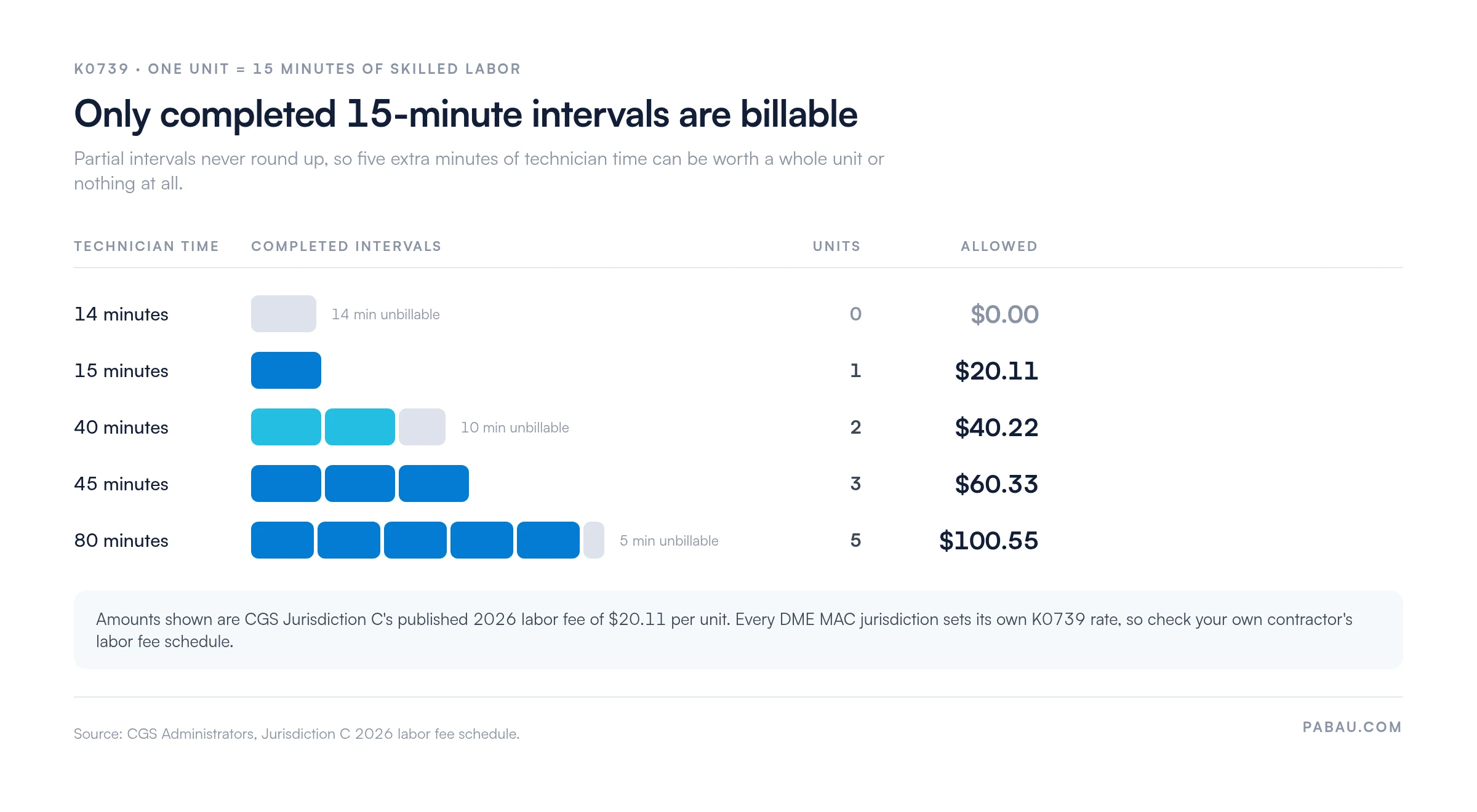
Accurate billing starts with counting units correctly. One unit equals 15 minutes of skilled technician labor, and you round down to the nearest completed interval. A 40-minute repair is 2 units, not 3. Partial intervals never round up, which is why two repairs that feel the same length can pay different amounts. Consistent clean claim submission for K0739 rests on that unit discipline.
Modifiers add claim context and are required in several billing scenarios. The modifiers below are the ones commonly cited on K0739 claims. Confirm current requirements against your MAC’s LCD before use, because modifier rules change with policy updates.
Place modifiers in the correct CMS-1500 field, which is Box 24D. Do not append contradictory modifiers to a single claim line. When a modifier’s applicability is unclear, contact your MAC rather than risk a denial.
That box has room for four modifiers, so a K0739 line needing five or more has to carry modifier 99. The modifier table for HCPCS code K0105 puts the remaining modifiers in the remarks or description field.
Documentation failures drive most K0739 denials. Both Noridian and CGS Medicare require a repair order on file before the claim is submitted. Treat the list below as a pre-claim checkpoint, run before the technician’s work is billed.
Run a documentation checklist before you submit any K0739 claim. Confirm the repair order, the technician credentials, the specific malfunction description, the medical necessity evidence, and the labor time in 15-minute increments. Claims that clear this checklist are denied far less often.
Whether a K0739 repair needs prior authorization depends on the equipment type, the repair cost, and the applicable MAC’s local coverage determination. High-value repairs are the ones that trigger it, particularly on complex power wheelchairs and other expensive DMEPOS items.
Some MACs also want prior approval once cumulative repair costs approach the equipment’s purchase price. CMS updates this policy periodically, so check the current CMS and MAC rules for your equipment category before starting a costly repair.
Four variables decide whether a K0739 claim is paid. They are the unit count, the modifier, the equipment’s eligibility, and the completeness of the documentation. Every denial pattern in the table below traces back to one of them.
Grouping your own K0739 rejections against the standard medical billing denial codes shows which pattern costs your practice the most. Tracking denial reasons by code gives billing staff a prioritized correction list.
Review K0739 denial patterns quarterly using your remittance data. Group denials by reason code and sort by frequency. The most common reason code points to the single process change that will lift your K0739 approval rate the most.
Selecting the right HCPCS code matters because payers apply automated edits that flag mismatched equipment categories. The table below shows how K0739 relates to the other DME codes suppliers meet most often. Getting the category right is what keeps a repair claim out of the adjustment queue.
Repair or modification of a patient’s own augmentative communication device bills under V5336, so check which code your payer expects before billing labor here.
When replacement parts are needed alongside the labor captured by K0739, bill the appropriate supply HCPCS code on a separate claim line. Match each part to its own supply code by description rather than folding it into the labor units.
On a patient-owned UV phototherapy unit, the replacement lamp bills under A4633 while only the technician’s time bills under K0739.
Billing K0739 across many repairs, technicians, and patients is an operational problem before it is a coding one. Paper repair orders live in one folder, technician time lives on a separate sheet, and the claim gets assembled from whatever the biller can find. That is the sequence a MAC audit picks apart.
Practice management software like Pabau keeps those records together. Its claims management software holds the repair order, the logged technician time, and the claim line on the same patient record. The documentation therefore exists before the claim goes out.
The payoff is that the time log and the repair order travel with the claim. A MAC audit then finds the record where it expects to. No one has to reassemble the paperwork from a folder months later.

Pabau’s claims management software helps DME suppliers attach repair orders, track billing units, and submit accurate HCPCS claims. Fewer claims come back denied, so reimbursement lands sooner.

K0739 pays reliably when the paperwork exists before the claim does. A signed repair order, a logged labor time, and a specific malfunction description are what turn a repair into a payable unit.
The trade-off worth remembering is that the unit rule always runs against you. Round down, bill the completed intervals, and accept the loss on the partial one. A supplier who rounds up gains one extra unit on a claim and loses the audit.
Pabau connects repair documentation to HCPCS claim lines, tracks 15-minute labor units, and flags an incomplete record before it reaches a payer. Book a demo to see how that shortens the path from a technician’s time log to a paid K0739 claim.

Need to understand clean claim requirements? Clean claim submission guidelines explains the documentation and field-level requirements that decide whether a HCPCS claim reaches adjudication.
Want to reduce revenue lost to denials? Denial management in healthcare walks through a systematic approach to tracking, appealing, and preventing claim denials across code types.
Looking for billing compliance guidance? Medical billing compliance covers the documentation standards, audit risk areas, and payer policy requirements that apply to HCPCS billing programs.
HCPCS Code K0739 covers the skilled technician labor of repairing non-oxygen durable medical equipment, billed per 15 minutes of work. It also covers nonroutine service on that equipment. The code captures labor only, so replacement parts require separate HCPCS supply codes on additional claim lines.
K0739 is billed per 15-minute unit of skilled technician labor, and each completed 15-minute interval equals one unit. A 40-minute repair is billed as 2 units. Round down to the nearest completed interval, and document start and end times to support the unit count.
There is no single national amount. Medicare prices K0739 per DME MAC jurisdiction, and each contractor publishes its own labor fee schedule. CGS lists $20.11 per unit for Jurisdiction C in 2026, where one unit is 15 minutes of skilled technician labor. Jurisdictions set the figure by raising the prior year’s rate by the CPI-U increase, so check what your own contractor publishes.
Six items are required. You need a signed repair order created before work begins, a specific description of the malfunction, and evidence of technician qualifications. You also need a time log supporting the units billed and proof the beneficiary still requires the equipment. Missing any of these commonly triggers a denial.
Modifiers vary by MAC and by billing scenario. The KX modifier may be required by some MACs to indicate that coverage criteria have been met. Verify modifier requirements against your MAC’s current local coverage determination before appending any modifier, because requirements change with annual policy updates.
No. K0739 explicitly excludes oxygen equipment, and the official code description specifies “other than oxygen equipment.” Repairs to oxygen concentrators, portable oxygen systems, or liquid oxygen equipment require separate HCPCS codes. Billing K0739 for oxygen equipment will be denied by automated payer edits.
Prior authorization may be required for high-cost repairs, particularly on complex power wheelchairs and other expensive DMEPOS items. Requirements vary by equipment type, repair cost, and MAC jurisdiction. Verify them with your MAC before starting a costly repair, because CMS updates DMEPOS prior authorization policy periodically.
Medicare distinguishes repair from replacement on cost and clinical judgment. When cumulative repair costs approach or exceed the purchase price of the equipment, Medicare may require replacement instead of continued repair reimbursement. The treating practitioner’s documentation and MAC-specific LCD thresholds decide which pathway applies.



