CCSD code H4430: Examination of rectum under anaesthetic
CCSD code H4430 pays for the examination alone CCSD code H4430 is the UK private...

Last Updated: Oct 20, 2026
K0069 is the HCPCS Level II code for rear wheel assembly, complete, with solid tire, spokes or molded, replacement only, each.
Two words in that descriptor do the heavy lifting. The word solid separates K0069 from K0070, and replacement only separates it from a wheel that ships with a new chair. Get either one wrong and the line denies, which puts the claim back in your rework queue.
Let Pabau's smart automation suggest the right codes, reduce claim denials, and keep your practice compliant—effortlessly.
Automate repetitive tasks and focus on what matters most—your patients.
Reduce coding errors and ensure compliance with the latest regulations.
Clean claims, fewer denials, and faster reimbursements.
Powerful insights and reporting to help your practice thrive.
HIPAA compliant SOC 2 certified GDPR-compliant Trusted by 4,000+ clinics worldwide

HCPCS code K0069 is the Level II code for a rear wheel assembly, complete, with solid tire, spokes or molded, replacement only, each.
Medicare pays K0069 from the DMEPOS fee schedule, and competitive bidding rates sit below standard rates, so check the current figure first.
Coverage runs through LCD L33792, Wheelchair Options/Accessories, which wants a written order dated on or before delivery plus a covered diagnosis code.
Every K0069 line needs a transaction modifier, and two wheels bill as two lines of one unit, never one line of two.
The written order, the eligibility response and the signed delivery receipt all need to sit where an auditor can find them in one search.
K0069 pays for a single rear wheel assembly on a manual wheelchair, supplied as a replacement. The tire is solid, and the wheel runs on spokes or a molded rim.
CMS keeps the code in the HCPCS Level II K-series, the group reserved for durable medical equipment with no permanent Level I CPT classification.
The solid tire is the first thing to check. K0069 applies only to non-pneumatic rear wheels, so an air-filled rear wheel bills under K0070 instead.
Billing K0069 for a pneumatic assembly is the most common error on this code family. It fails on the descriptor, not on medical necessity.
Replacement only is the second thing to check. The code does not cover a wheel supplied as part of a new wheelchair, which is exactly what replacement only rules out.
It covers the wheel you swap in later, once the original is worn, damaged, or no longer suits the patient.
K-series codes get reviewed each year, so check that the code is still active before a large batch goes out. The CMS HCPCS Level II code set is the reference for that.
Product-level questions go somewhere else. The Pricing, Data Analysis and Coding contractor, known as PDAC, decides which code a specific product maps to. Its verdict beats the manufacturer’s marketing sheet every time.
Medicare pays K0069 from the DMEPOS fee schedule, and the claim runs through one of the four DME Medicare Administrative Contractors.
Your allowable depends on where the beneficiary lives. An address inside a competitive bidding area draws the bidding rate, which sits below the standard fee schedule amount for the same code.
Then comes the split. Medicare pays 80% of the allowable once the beneficiary has met the Part B deductible. The other 20% is coinsurance, and a supplemental Medigap plan often picks it up.
Bill the full allowable either way, because trimming your charge to the expected payment only lowers what you collect.
CMS republishes the DMEPOS fee schedule every January 1, so a figure you saved last year is already stale. Pull the current amount before a batch goes out, and pull it for the beneficiary’s state rather than your own.
Medicare covers K0069 only when the file already shows medical necessity, established before the wheel goes out the door.
That documentation lives in your records rather than on the claim, and the DME MAC asks for it later. Thin files are what turn a paid claim into a recoupment demand two years on.
So the order of operations matters. Establish necessity, get the order signed, verify eligibility, deliver, then bill. Any other sequence leaves a hole that an auditor will eventually find.
Local Coverage Determination L33792, Wheelchair Options/Accessories, is the policy that governs K0069. Its companion policy article, A52504, carries the coding and documentation detail.
Between them, they set the bar you have to clear:
Check that L33792 is still the active version for your jurisdiction before you rely on it. Policies get revised and replaced, and the Medicare Coverage Database holds the current text for each DME MAC region.
Run eligibility on the delivery date as well, not only at order date. A beneficiary can move into a Medicare Advantage plan between those two dates, and that changes where the claim has to go.
Save the eligibility response itself, not a note saying you checked. Store a screenshot or the 271 response, dated the same day as delivery. An auditor only wants to know whether Part B was active when the wheel changed hands.
A K0069 line with no modifier rejects before anyone reads the clinical file. The modifier tells the DME MAC what kind of transaction this is. A new purchase, a used purchase, a rental and a replacement each take a different one.
Here is how that plays out on a pair of wheels. A beneficiary wears through both rear wheels on a chair they own, and you supply two new solid-tire assemblies. That bills as two lines of K0069, one unit each, with the same modifier on both lines.
What it does not bill as is one line with a quantity of two. Most DME MACs return quantity-billed accessory lines unprocessed. Rules for rental versus purchase do shift between jurisdictions, so read your own contractor’s guidance before you lock a billing template.
The AAPC HCPCS code lookup is a quick second reference for K-series modifier context.
The diagnosis on a K0069 claim has to do real work. It has to appear on the covered list in LCD L33792, and it has to match what the clinical notes say. A clinically sensible code that is missing from the list still denies.
The codes below turn up most often on manual wheelchair accessory claims. Treat them as a starting point rather than a covered list, because the DME MACs revise the policy periodically.
Our ICD-10-CM code library is the quickest way to read a full descriptor before it goes on the claim.
The policy is the authority here, not this table. Read the active version of L33792 before each batch, and keep the note that supports the diagnosis in the same file as the written order.
A clean K0069 claim follows the same seven steps every time, and each one produces a document you may be asked for later. Work them in order.
Run this list over the claim before it leaves the queue. It costs a minute and it saves a 30-day denial cycle.
Most K0069 denials come from the same short list. Good denial management practice flags these patterns inside the billing queue, before the claim ever reaches a payer.
Track your K0069 denials by reason code for one quarter. If the same code keeps coming back, the fix is usually one step in the intake process rather than a billing rule. You will find it faster than any appeal.
K0069 sits in a small family of codes for wheelchair wheels, tires and casters, and picking the neighbor by mistake is easy.
Only two questions separate them. Is the part a complete assembly or a single component, and which tire is fitted to it.
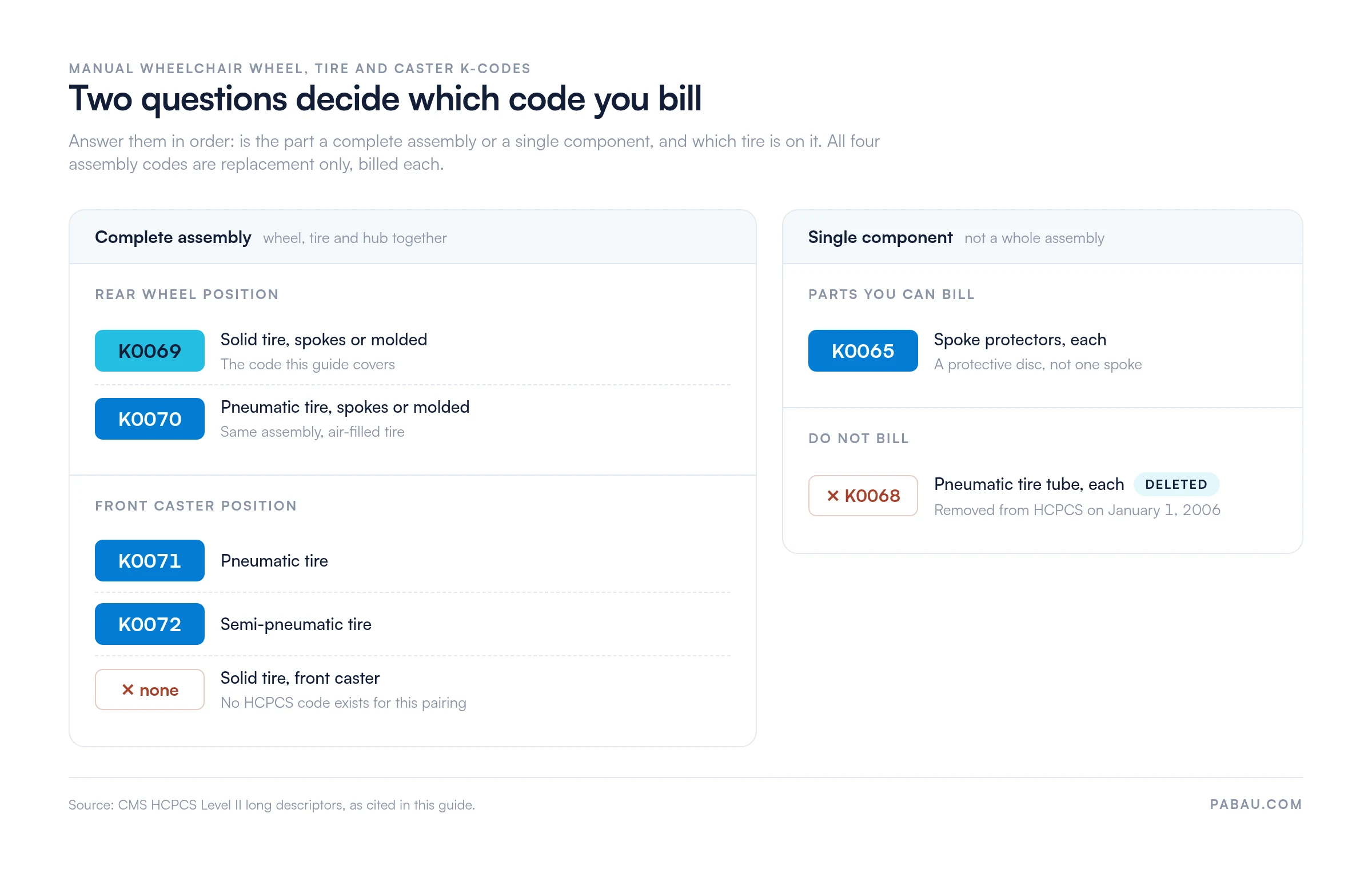
K0069 against K0070 is where most selection errors happen. Both describe a complete rear wheel assembly with the same spokes-or-molded build, so the tire is the only thing separating them.
Pull the manufacturer’s specification sheet and read it before you code, because a product name rarely settles the question.
A K0069 claim is only as strong as the file behind it. In most practices, that file is spread across four places:
Practice management software like Pabau pulls those pieces onto the patient record instead. The order and the delivery receipt attach as documents. The clinical note that supports the diagnosis sits next to them.
The claim itself goes out electronically through the clearinghouse connection for your region, and Pabau’s medical claims management tracks its status from there.
No software should choose your modifier for you, and Pabau does not try to. What it keeps together is the order, the note, the receipt and the claim status. A documentation request that lands 18 months later then takes one search instead of an afternoon.

Pabau stores the written order, the clinical note and the delivery receipt against the patient, then submits and tracks the claim electronically. Your billing team can answer a documentation request without opening a second system.

K0069 is not a difficult code. It is a precise one, and precision is where the denials come from. Read the descriptor, match the tire, append the modifier, and date the order before delivery. Do those four things and the line usually pays on the first pass.
The part worth remembering is that none of those checks are clinical. A wheelchair wheel a patient genuinely needs still gets denied over a stale fee schedule or an order signed a day late. That is a process problem, which means it is fixable inside your own workflow.
Pabau’s claims management keeps the order, the note, the receipt and the claim status together. The answer to a documentation request is then already on the patient record. Book a demo to see how that would fit the way your billing team already works.

Seeing the same denial reason twice? Denial management in healthcare sets out how to group denials by cause and build an appeals process around them.
Want the whole billing cycle in order? What is medical billing walks the cycle from patient intake through to posted payment.
Chasing first-pass payment rates? What makes a clean claim lists the fields payers reject on most often, and how to catch them earlier.
New to billing Medicare directly? Medicare billing covers enrollment, the claim forms, and the rules that catch new suppliers out.
Comparing tools for a billing team? Best medical billing software in the US reviews the platforms suppliers use to manage claims and remittance.
Issue an Advance Beneficiary Notice, form CMS-R-131, whenever you expect Medicare to deny the wheel as not medically necessary. The beneficiary signs it before delivery, and you append modifier GA to the claim line. Without a signed ABN on file, you cannot bill the beneficiary for the denied amount.
Medicare gives you one calendar year from the date of service. Miss that window and the claim is denied as untimely, with no appeal on the deadline itself. Delivery paperwork that sits unscanned for months is the usual reason a supplier runs out of time.
Jurisdiction follows the beneficiary’s permanent address. Noridian Healthcare Solutions handles Jurisdictions A and D. Jurisdictions B and C go to CGS Administrators. A supplier serving several states files with both, so check the address on every claim.
No, not while the warranty is in force. Medicare does not pay for a replacement the manufacturer’s warranty already covers, so the supplier arranges it at no charge. Record the warranty end date when you supply the chair, so the question is settled before you code the claim.