CCSD code H4430: Examination of rectum under anaesthetic
CCSD code H4430 pays for the examination alone CCSD code H4430 is the UK private...

Last Updated: Oct 20, 2026
K0037 is the HCPCS Level II code for high mount flip-up footrest, each.
The paperwork rules have moved too. CMS retired the Certificate of Medical Necessity in 2023, and the standard written order replaced the detailed written order in 2020. Plenty of K0037 guidance still describes the old forms.
Let Pabau's smart automation suggest the right codes, reduce claim denials, and keep your practice compliant—effortlessly.
Automate repetitive tasks and focus on what matters most—your patients.
Reduce coding errors and ensure compliance with the latest regulations.
Clean claims, fewer denials, and faster reimbursements.
Powerful insights and reporting to help your practice thrive.
HIPAA compliant SOC 2 certified GDPR-compliant Trusted by 4,000+ clinics worldwide

HCPCS code K0037 covers one high mount flip-up footrest, billed each, as a wheelchair accessory under Medicare Part B.
Coverage sits under LCD L33792, and the wheelchair base has to be a covered item before the footrest can be billed.
CMS retired the Certificate of Medical Necessity in 2023, so a standard written order now carries the practitioner’s instruction.
The KX modifier confirms the coverage criteria are documented, and two footrests bill on two lines with one unit each.
K0195 covers elevating leg rests for a capped rental base, sold as a pair, so it never substitutes for K0037.
HCPCS code K0037 describes a high mount flip-up footrest, each. It is a HCPCS Level II code, so the Centers for Medicare and Medicaid Services maintains it rather than the American Medical Association. The code is active and valid for 2026.
The billing unit is each, so one unit covers one footrest. Two footrests can go on a single line with two units, or on two lines carrying the RT and LT modifiers. The modifier section below explains when each option applies.
The K-series sits within HCPCS Level II and covers durable medical equipment items not classified elsewhere in the code set.
A high mount flip-up footrest attaches to the wheelchair frame at a raised mounting point instead of the standard lower position. It pivots upward so the patient can transfer sideways without the footrest in the way.
A fixed footrest or an elevating leg rest each carry a different code.
Medicare Part B covers K0037 as a wheelchair accessory when the patient’s wheelchair base is itself covered under the durable medical equipment benefit.
Coverage decisions sit with the DME MAC for the supplier’s jurisdiction, which means Noridian Healthcare Solutions or CGS Administrators. The governing Local Coverage Determination is LCD L33792, Wheelchair Options/Accessories.
Verifying the patient’s Medicare enrollment comes first, before any K0037 claim is built.
A K0037 claim has to satisfy every condition below. The DME MAC checks them during pre-payment or post-payment review, and missing one of them is enough to deny the line.
Coverage does not carry over from the wheelchair base to every accessory hung off it. Each accessory code, K0037 included, needs its own documented medical necessity. A covered power wheelchair does not, on its own, justify the K-series accessories attached to it.
Documentation for K0037 follows the DMEPOS written order framework, and the supplier owns it. The practitioner generates most of the paperwork, but the supplier’s file is what gets audited.
Shipping equipment before a valid written order arrives is non-compliant, whether or not the claim eventually pays.
Two rule changes matter here. CMS discontinued the Certificate of Medical Necessity and the DME Information Form for dates of service on or after January 1, 2023.
Before that, the standard written order replaced the detailed written order on January 1, 2020. A file built to the retired templates will not answer what a DME MAC asks for today.
Required documentation for K0037 now looks like this. Each item stays in the supplier’s file for audit purposes, typically for at least seven years.
An internal superbill capturing the HCPCS code, diagnosis codes and service details helps your own team. A DME MAC’s Additional Development Request, though, asks for the five items above.
Flag K0037 claims for a documentation review before submission, not after denial. Build a short pre-submission check into your billing workflow. It confirms that the standard written order is signed and dated, the proof of delivery is filed, and the product matches the descriptor. Catching a missing document at submission costs minutes. Finding it after a denial costs days and puts timely filing at risk.
Enrolled DMEPOS suppliers bill K0037 on a CMS-1500 form or its electronic equivalent, the 837P. The claim goes to the DME MAC for the state where the beneficiary lives, not the state where the supplier sits. From there it follows a predictable path.
The fields below are the ones that decide whether the line clears those front-end edits.
Wheelchair accessory claims carry two separate families of modifiers, and confusing them produces the same denial as a wrong code. The first family tells the DME MAC where the claim stands against the coverage criteria.
The ladder below runs through that family in the order the policy applies it.
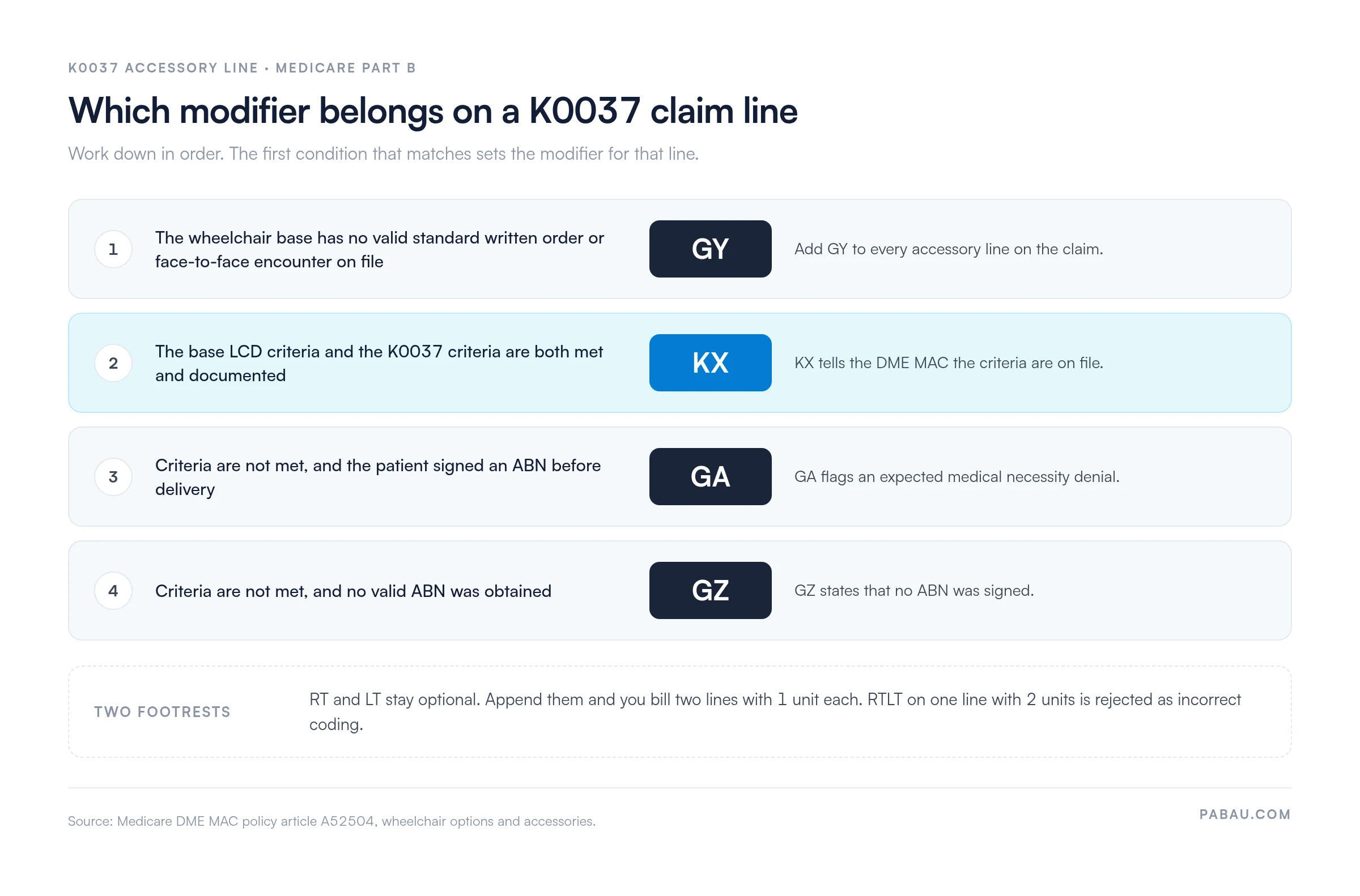
KX is the one you will reach for most. It belongs on the accessory line only when the coverage criteria in the base LCD and the criteria for K0037 are both met and documented. Appending KX without that file behind it is a compliance problem rather than a shortcut.
RT and LT sit in the second family, and they stay optional on wheelchair accessories. Append them for two footrests and you bill two separate lines with one unit each. Putting RTLT on a single line with two units is rejected as incorrect coding.
Medicare payment for K0037 comes from the DMEPOS fee schedule, which varies by locality and updates every January. CMS publishes the file on its DMEPOS fee schedule page, and your DME MAC posts locality-specific amounts as well.
This reference does not print a dollar figure. A point-in-time rate goes stale the moment the schedule updates, and a stale rate is worse than none at all. Look K0037 up in the current file for your locality instead.
Medicare pays 80% of the allowed amount once the Part B deductible is met. The patient or a secondary payer covers the remaining 20%. Confirm secondary coordination before you bill, so that balance does not sit unassigned for months.
K0037 sits in a group of K-series wheelchair accessory codes with similar names and different products behind them. Picking the wrong one from this group is a common source of denials.
The table maps the neighboring codes and the distinction that decides each.
These two get confused more than any other pair in the group. The products do different clinical jobs and bill on different units, so a substitution shows up under audit.
K0037 attaches at a raised mounting point and flips up, so the patient can transfer sideways without the footrest blocking the path. It is billed each. The clinical rationale is transfer access and positioning at the higher mount height.
K0195 extends the lower leg toward horizontal, usually to manage lower-extremity edema, post-surgical positioning, or a knee that will not flex. It is billed as a pair, and it applies to a capped rental base. Where the patient owns the chair, the elevating leg rest is coded E0990 instead, per leg rest.
A patient who needs both gets separate, individually documented orders for each code. Supplying an elevating leg rest does not satisfy an order written for a flip-up footrest.
K0037 denials repeat in a small number of shapes. Naming them makes each one checkable before submission rather than after.
Sorting your K0037 denials by reason code shows which of these is costing money. The reference on common denial codes explains what a DME MAC’s remittance advice is telling you. From there, each denial maps back to a specific step in the workflow.
Audit your K0037 denials monthly, sorted by reason code. CO-4 means the procedure code is inconsistent with the modifier used, or that a required modifier is missing, which points at your modifier logic. CO-50 means the payer does not consider the item medically necessary, which points at the clinical record. CO-16 means information is missing or incomplete, which points at the pre-submission check. Each reason code names a different fix.
Two verifications catch most of what goes wrong, and both happen before the claim is built. Confirm the wheelchair base has an active coverage determination on file. Then confirm the product you supplied is the one K0037 describes.
For that second check, the PDAC contractor’s product classification database is the authority on which specific products map to which HCPCS code.
The CGS Medicare coding verification resource explains how to request a verification when a product is not listed. Assigning a code from a manufacturer’s marketing description is where descriptor mismatches begin.
Run this list before the claim leaves your system:
One more habit is worth building in. The CMS HCPCS overview lists annual additions, deletions and descriptor changes each cycle. A quick look every January confirms K0037 still reads the way your billing system stores it.
Most of the work above lives in two places, the clinical record and the claim form. Re-keying between them is where transcription errors enter. Practice management software like Pabau holds both in one system. The codes attached to a service land on the charge line without a second pass.
Pabau’s streamlined claims management builds the claim from the record itself. ICD-10 and HCPCS lookup libraries sit behind a search icon, so a coder can confirm a descriptor without leaving the claim.
Required fields are validated before the send button unlocks, which catches missing-information rejections early. In the US, claims route through Claim.MD, with real-time eligibility checks, claim status tracking and ERA remittance posting.
That keeps eligibility, submission and remittance on one screen, rather than spread across a clearinghouse portal, a spreadsheet and the patient record. For a billing team working a long list of accessory codes, the saving is mostly in the checking.
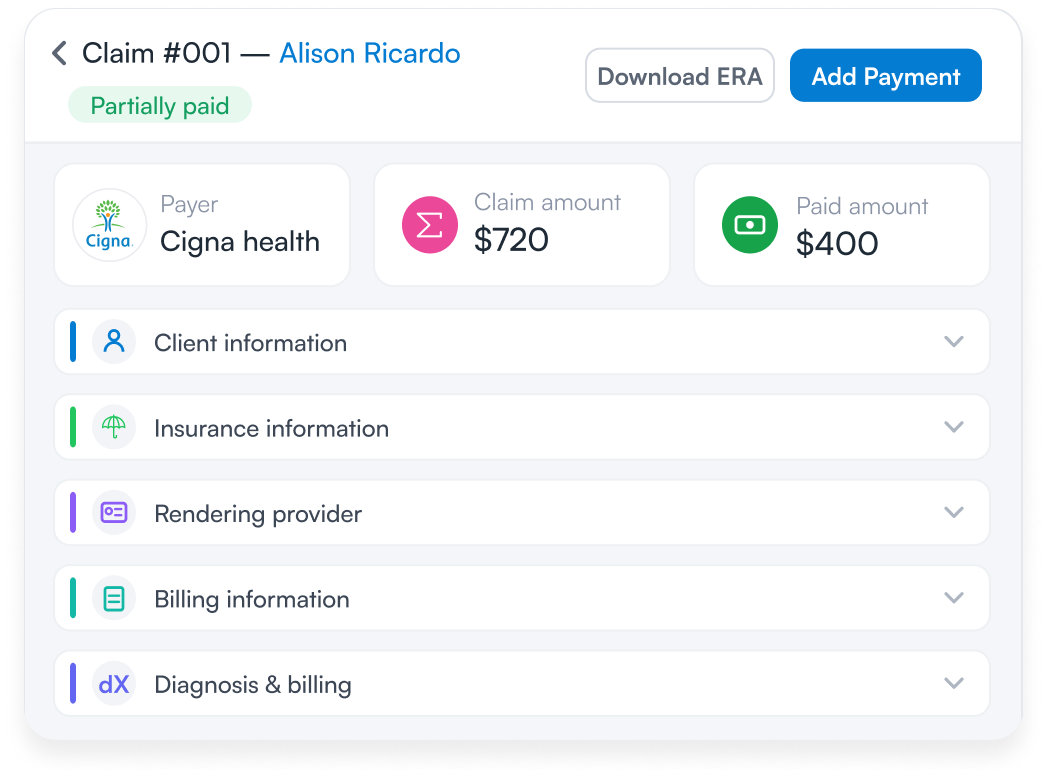

Pabau builds the claim from the patient record and validates the required fields before it can be sent. In the US, Claim.MD handles eligibility checks, claim status and ERA posting.

K0037 is a short line on a claim with a long chain behind it. Get the code right and you have done the easy part. The wheelchair base still has to be covered, the order still has to predate delivery, and the product still has to match the descriptor.
Two points are worth carrying away. The CMN and the DWO are gone, so a file built to those templates will not answer an Additional Development Request. And the coverage modifier makes a claim of its own. KX asserts that documentation exists, so it belongs only on a line where it does.
Holding that standard across a whole book of accessory claims is a workflow problem more than a coding one. Book a demo to see how Pabau keeps the claim, the record and the remittance in one place.

Want the full claims lifecycle in one place? What is medical billing walks through every step from patient intake to payment posting.
Need to read the reason codes on your remittance? Common denial codes in medical billing decodes the CO and PR codes DMEPOS suppliers see most.
Wondering what makes a claim pay first time? What is a clean claim sets out the fields and checks that keep a submission out of the rejection queue.
Tightening the revenue cycle around DME claims? Revenue cycle management for healthcare covers the run from eligibility checks to remittance reconciliation.
Worried about how an audit would go? Medical billing compliance explains the records a payer expects to find and how long to keep them.
Yes. The first level is a redetermination, filed with the DME MAC within 120 days of the date on the remittance advice. Timely filing denials are the exception, since no clinical argument changes the filing date.
It varies by state. Many state Medicaid programs recognize K0037 but set their own fee limit, quantity limits and prior authorization rules. Check the state’s DME fee schedule and its wheelchair accessory policy before supplying the item.
Most do, because HCPCS Level II is the standard code set for supplies across payers. Coverage criteria, prior authorization and documentation rules still differ from Medicare, so check the plan’s own DME policy rather than applying the LCD.
The supplier. The treating practitioner writes the order and the clinical notes. The supplier’s file, though, is what the DME MAC audits and what an overpayment demand targets.
No. A footrest is the assembly supporting the foot and lower leg, while a footplate is the platform it ends in. K0042 covers a standard size footplate as a replacement part only, so it never substitutes for K0037.