

CCSD code G5100: Bypass of duodenum billing guide
CCSD code G5100 bills a bypass that leaves the duodenum in place CCSD code G5100...

Last Updated: Oct 16, 2026
K0195 is the HCPCS Level II code for elevating leg rests, pair (for use with capped rental wheelchair base).
It is a Level II code in the durable medical equipment (DME) range, and it is never payable on its own. A capped rental wheelchair base code has to appear on the same claim.
Two details decide most K0195 denials. The chair has to be a rental, and the claim has to show a pair. Supply one rest, or fit the rests to a purchased chair, and E0990 is the correct code.
Let Pabau's smart automation suggest the right codes, reduce claim denials, and keep your practice compliant—effortlessly.
Automate repetitive tasks and focus on what matters most—your patients.
Reduce coding errors and ensure compliance with the latest regulations.
Clean claims, fewer denials, and faster reimbursements.
Powerful insights and reporting to help your practice thrive.
HIPAA compliant SOC 2 certified GDPR-compliant Trusted by 4,000+ clinics worldwide

HCPCS Code K0195 covers elevating leg rests supplied as a pair for a capped rental wheelchair base.
K0195 is never payable alone. A capped rental wheelchair base code must appear on the same claim.
Use E0990 instead when the chair is purchased, or when only one leg rest is supplied.
Bill the pair as a single unit of service, with the RR modifier plus KH, KI or KJ.
Rates vary by MAC locality, so check the current CMS DMEPOS fee schedule before you submit.
HCPCS Code K0195 describes elevating leg rests, pair (for use with capped rental wheelchair base). It is a Level II code maintained by the Centers for Medicare and Medicaid Services (CMS). The HCPCS Level II coding system covers durable medical equipment, prosthetics, orthotics, and supplies (DMEPOS) that CPT does not classify.
The K-code range covers manual wheelchair bases, power wheelchairs, and wheelchair accessories. K0195 belongs to the accessory group. Elevating leg rests raise the lower legs to relieve dependent edema, post-surgical swelling, or venous insufficiency in patients who cannot use standard swing-away rests.
Medicare reimbursement for K0195 comes from the annual CMS DMEPOS fee schedule. Rates vary by Medicare Administrative Contractor (MAC) locality, so a supplier in California may be allowed a different amount than one in Texas. Check current figures in the CMS DMEPOS fee schedule files rather than a third-party listing.
The table below sets out how K0195 payment is determined rather than a single national figure. Confirm the allowable for your locality against the current CMS files before you submit.
The allowed amount on a K0195 claim is the lesser of your submitted charge and the fee schedule rate. Medicare pays 80% of that allowable. The beneficiary or a secondary payer covers the remaining 20% coinsurance.
Medicare Part B covers K0195 when the medical necessity criteria are met. Local Coverage Determinations (LCDs) issued by each MAC govern the detail. The core requirement is structural. K0195 must be billed with a capped rental wheelchair base, and never as a standalone item.
Beyond the companion code, MACs expect the following criteria to be met before K0195 is billed. Check them before the equipment leaves your warehouse, not after the denial arrives.
Thin documentation is the second most common cause of a K0195 denial, after the missing companion code. Every claim needs a complete package on file before it goes out.
Keep the companion base code and the K0195 line together in your claim records. An auditor reconstructing billing intent looks for that pairing first.
Document the clinical reason the elevating rests are needed, not just the diagnosis. ‘Bilateral lower extremity edema secondary to chronic venous insufficiency, limiting standard leg rest use’ is far stronger than ‘edema, elevating leg rests needed.’ That specificity is what lowers your audit risk on K0195 claims.
The diagnosis code on a K0195 claim has to support the need for elevating leg rests. Each MAC’s LCD lists the codes it covers. The table below shows commonly accepted ICD-10-CM codes, but verify against the LCD that applies to you.
Use the most specific code the record supports. Avoid defaulting to R60.9 when a documented diagnosis is more precise. MACs read poor specificity as thin medical necessity documentation and deny on that basis.
A visit to adjust or replace an existing device is coded differently from the original supply. The diagnosis list for HCPCS code C1750 reserves Z49.01 and Z49.02 for catheter fitting and adjustment encounters, not initial placement.
A consistent workflow keeps K0195 claims clean and shortens the wait for payment. Each step below is a point where suppliers commonly slip.
K0195 denials follow a short list of patterns, and catching them costs far less than appealing. A DME appeal typically adds 30 to 60 days to the payment timeline.
K0195 sits among the K-codes and E-codes covering wheelchair bases and their accessories. The standard wheelchair base, K0001, is the companion code most often paired with it.
Knowing which codes pair with K0195, and which only look similar, keeps suppliers clear of unbundling edits. The AAPC HCPCS code lookup is useful for cross-referencing during claim preparation.
The choice between K0195 and E0990 is where billers most often slip. K0195 covers a pair of elevating leg rests on a capped rental wheelchair base, billed as one unit of service.
E0990 covers a single elevating leg rest assembly, billed each, and it is the code for a purchased chair. Supply two rests with a purchased chair and you bill E0990 twice, not K0195 once. The chart below reduces the whole choice to rental status and the number of rests supplied.
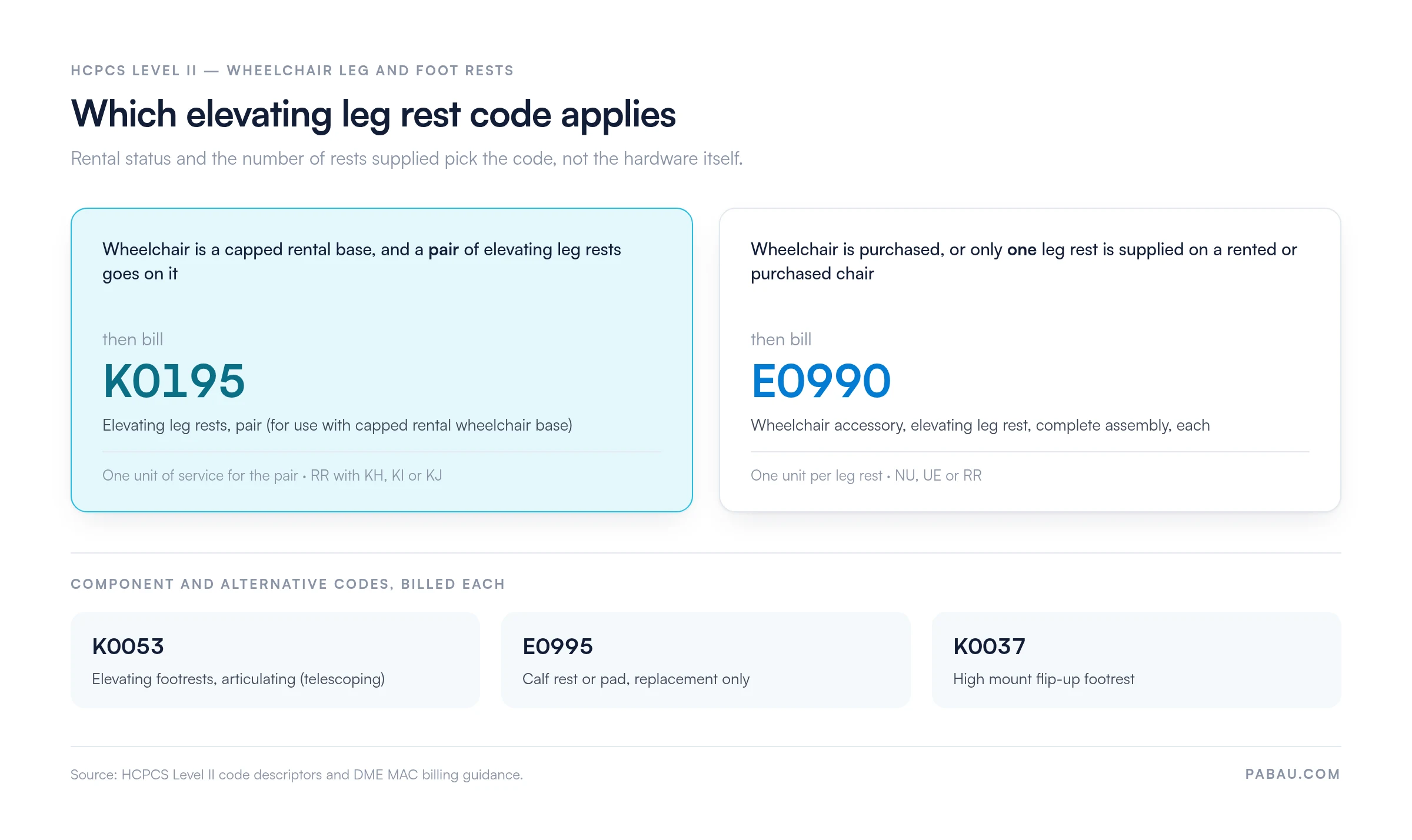
Run a pre-submission check on every K0195 claim. Confirm the companion base code is on the claim, and that the ICD-10 code sits on your MAC’s covered list. Then check that the written order date is on or before the delivery date. Those three checks clear most K0195 denial reasons before the claim leaves your system.
DME suppliers and multi-specialty practices often run two systems. Clinical documentation lives in one, billing in another, and staff cross-check by hand that the companion code made it onto the claim. That manual step is where a missing K0195 base code slips through.
Practice management software like Pabau keeps both sides in one record. Pabau’s claims management software tracks the codes a claim needs, attaches the supporting documentation, and flags a line that is missing its companion code. So your team catches the K0195 pairing before the claim goes out, rather than after the remittance comes back.
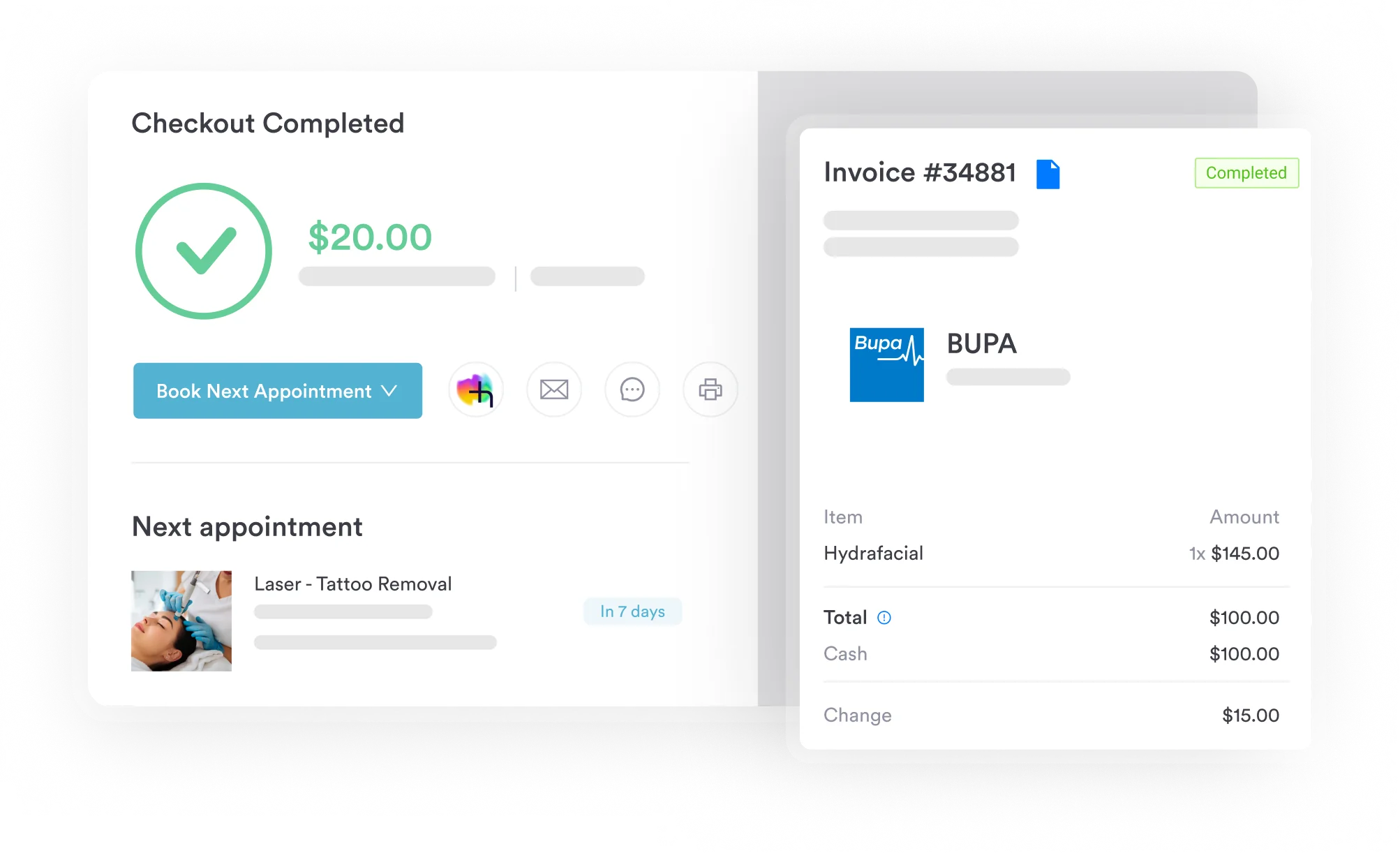

Pabau’s claims management software tracks HCPCS code requirements, attaches documentation to each claim, and flags a missing companion code before you submit.

K0195 is a simple code with one rule that decides most of its claims. It has to travel with a capped rental wheelchair base code, and it only covers a pair. Get the pairing and the unit count right, and the rest is ordinary DME documentation.
The trade-off worth remembering is that a K0195 denial is cheap to prevent and slow to fix. Two minutes checking the base code beats waiting out an appeal.
Book a demo to see how Pabau keeps HCPCS companion codes and documentation on the same claim, so fewer DME claims come back denied.

Need a primer on DME claim submission rules? Understanding medical billing workflows covers how DMEPOS claims fit into the broader Medicare revenue cycle.
Struggling with claim denials on HCPCS codes? Denial management in healthcare walks through the appeal process and prevention strategies for common DMEPOS denial reasons.
Want to understand remittance advice on DME claims? Electronic remittance advice explained covers how to read ERA files and reconcile K-code payments from Medicare.
HCPCS Code K0195 describes elevating leg rests, supplied as a pair, for use with a capped rental wheelchair base. It is a Level II code in the durable medical equipment category, billed by enrolled DMEPOS suppliers under Medicare Part B.
No. K0195 must always be billed with a capped rental wheelchair base code on the same claim. A standalone K0195 line is the leading cause of denial for this code, because the descriptor ties the item to a rental base.
Rates for K0195 vary by MAC locality and change with the CMS DMEPOS fee schedule. Allowables are lower in competitive bidding areas, where contracted suppliers bill their bid rates. Verify the current figure in the CMS DMEPOS fee schedule files before you submit.
K0195 covers a pair of elevating leg rests on a capped rental wheelchair base, billed as one unit of service. E0990 covers a single elevating leg rest assembly, billed each. Use E0990 for a purchased chair, or whenever only one leg rest is supplied.
One. K0195 describes the pair, so the correct number of services is one, not two. Append the RR rental modifier along with KH, KI or KJ for the rental month being billed.
The ICD-10 code must support the need for elevating leg rests. That usually means lower extremity edema, venous insufficiency, or a mobility impairment requiring a wheelchair. Common choices are I87.2, R60.0 and G82.20. Verify them against the LCD your MAC applies to K0195.
Yes. Medicare Part B covers K0195 as a DMEPOS benefit when the medical necessity criteria are met. The item must come from an enrolled DMEPOS supplier. The patient owes 20% coinsurance after the Part B deductible, unless a secondary payer picks it up.
In a competitive bidding area, only suppliers contracted under the program may bill Medicare for K0195. A non-contracted supplier gets no reimbursement for an item provided there, however strong the medical necessity documentation is.



