CCSD code H4430: Examination of rectum under anaesthetic
CCSD code H4430 pays for the examination alone CCSD code H4430 is the UK private...

Last Updated: Oct 20, 2026
J7686 is the HCPCS Level II code for treprostinil, inhalation solution, fda-approved final product, non-compounded, administered through dme, unit dose form, 1.74 mg.
HCPCS code J7686 bills treprostinil, inhalation solution, FDA-approved final product, non-compounded, administered through DME, unit dose form, 1.74 mg. Treprostinil is a prostacyclin analogue approved for pulmonary arterial hypertension (PAH). Every clause of that descriptor narrows what the code covers, from the manufacturing route to the size of one billing unit.
The HCPCS Level II J-code system is maintained by the Centers for Medicare and Medicaid Services. It assigns J-codes to drugs that cannot be self-administered, and that are typically given in clinical settings or through durable medical equipment.
The unit dose form and the 1.74 mg strength are built into the code itself. One billing unit equals one 1.74 mg vial. If a patient receives two vials in a single dosing session, you bill two units, not one. The claim reports the number of vials, not the total milligrams delivered.
Let Pabau's smart automation suggest the right codes, reduce claim denials, and keep your practice compliant—effortlessly.
Automate repetitive tasks and focus on what matters most—your patients.
Reduce coding errors and ensure compliance with the latest regulations.
Clean claims, fewer denials, and faster reimbursements.
Powerful insights and reporting to help your practice thrive.
HIPAA compliant SOC 2 certified GDPR-compliant Trusted by 4,000+ clinics worldwide

HCPCS code J7686 describes treprostinil inhalation solution: FDA-approved, non-compounded, administered through DME, unit dose form, 1.74 mg per billing unit.
J7686 is covered under Medicare Part B as a DME-administered drug. One billing unit equals one 1.74 mg unit dose vial dispensed to the patient.
Billing J7686 for compounded treprostinil is an audit trigger. The code is exclusively for the FDA-approved, non-compounded final product, so a compounded formulation needs a different code.
Practice management software like Pabau ties HCPCS code documentation to the clinical record, supporting the trail CMS requires for J7686 claims.
Treprostinil is a prostacyclin analogue used to treat pulmonary arterial hypertension (PAH), classified under WHO Group 1. It reduces pulmonary vascular resistance by dilating the pulmonary and systemic arterial vascular beds and inhibiting platelet aggregation. The inhaled route delivers the drug directly to the pulmonary vasculature via a breath-actuated ultrasonic nebulizer provided as durable medical equipment.
Tyvaso is the brand name for the FDA-approved inhaled treprostinil solution that corresponds to HCPCS code J7686. Tyvaso DPI (dry powder inhaler) may use a separate code. Always confirm the specific formulation dispensed before assigning J7686.
The non-compounded requirement exists because compounded prostacyclin preparations are held to different purity standards. They are not interchangeable with the FDA-approved product for billing purposes. Payers flag a compounded formulation billed under J7686 at the claim level.
J7686 is covered under Medicare Part B as a drug administered through durable medical equipment. CMS Nebulizer Policy Article A52466 governs coverage for nebulizer drugs, treprostinil among them.
The DME Medicare Administrative Contractor (DME MAC) processes these claims, not the Part A or standard Part B carrier. Practices billing J7686 submit through the DMERC channel rather than the physician fee schedule pathway.
Coverage rests on three conditions, and all three have to hold on the same claim.
Medicaid and commercial payer criteria differ from Medicare. Do not apply Medicare rules universally without checking each plan’s own policy. Prior authorization requirements vary by payer and plan year, so confirm eligibility and authorization status before dispensing.
Every J7686 claim needs a supporting ICD-10 diagnosis code that establishes pulmonary arterial hypertension as the medical indication. The primary supporting codes come from the I27 category. Verify the covered diagnosis list against the current Local Coverage Determination (LCD) for your DME MAC jurisdiction. Covered codes may be updated annually.
The diagnosis code must appear on the claim and be supported by clinical documentation in the patient record. A physician order naming the condition, plus clinical notes establishing the PAH diagnosis, is what an auditor asks for. Full descriptors for each of these entries sit in the ICD-10-CM code library.
J7686 is priced under the Medicare DMEPOS fee schedule, not the physician fee schedule. Reimbursement is typically based on average sales price (ASP) methodology or contractor-priced rates, depending on the payer and the pricing mechanism CMS assigns. Rates change annually and may vary by region and DME MAC jurisdiction.
Do not carry a dollar figure into a claim or a patient quote without checking its year and source. Verify the current allowable amount through the CMS fee schedule search tool or your DME MAC’s published rate tables.
Billing above the allowable creates a compliance risk. Billing below it costs revenue. A rate check before submission avoids both.
Verify the J7686 reimbursement rate quarterly, not just at the start of the plan year. CMS mid-year ASP updates can adjust the allowable amount between January and July. Flag the update schedule in your billing calendar so no claims slip through at a stale rate.
CMS Nebulizer Policy Article A52466 defines the documentation CMS requires to support medical necessity for J7686 claims. Incomplete records are the leading cause of J7686 denials at audit. Build the checklist below into your pre-billing workflow rather than your post-denial response.
Practices that capture physician orders, diagnosis codes, and dispensing details in one workflow answer DME MAC audit requests faster. The alternative is reassembling six separate records months after the claim paid.
J7686 claims follow the DME billing pathway. Denials in this category usually trace to unit-count errors, a missing diagnosis pairing, or a descriptor mismatch. Walk through these steps in sequence before submitting.
Running J7686 through audit-ready claims management cuts the manual touchpoints where these errors start. A clean claim submission for J7686 needs all six elements above verified before transmission.
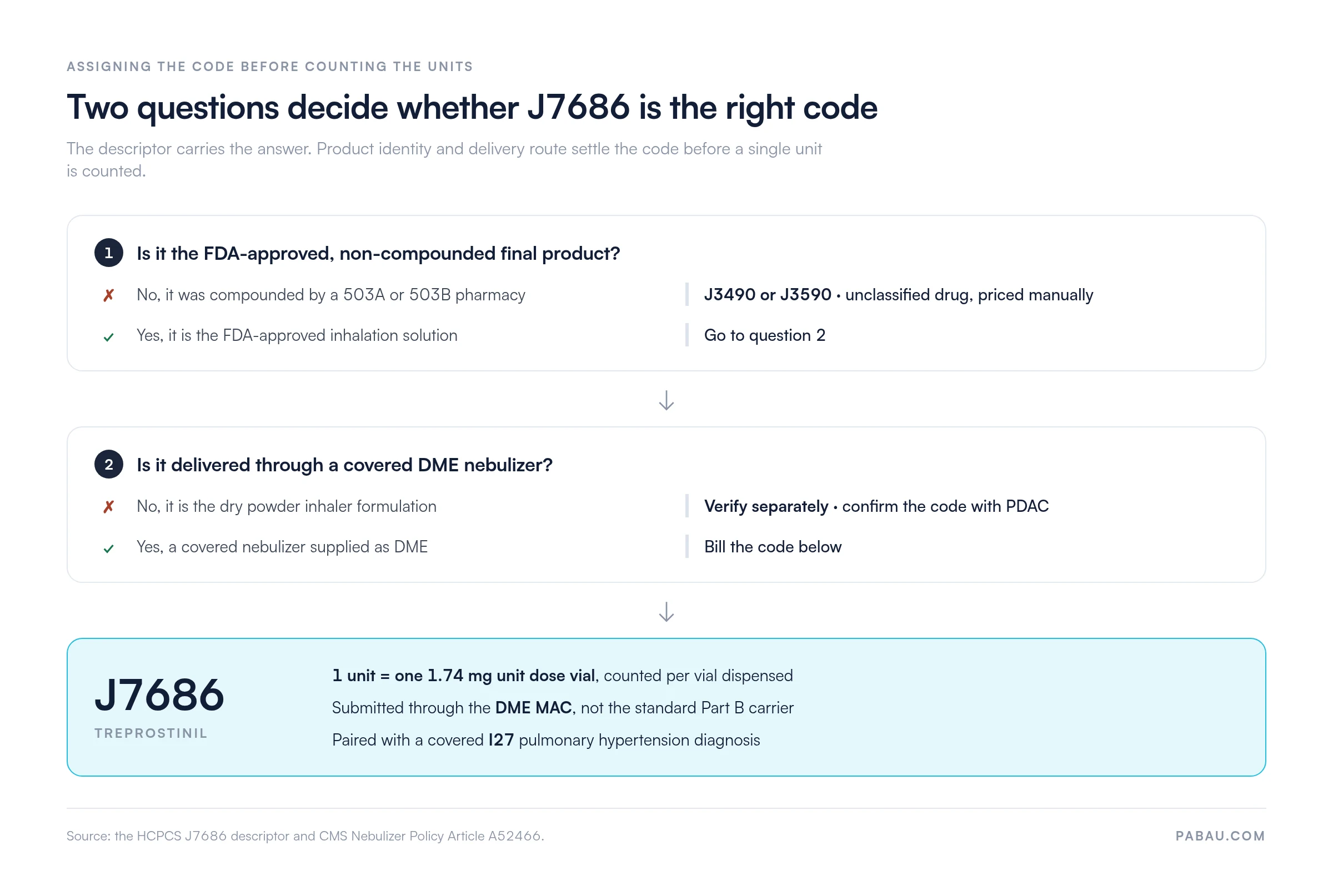
The most consequential compliance risk on J7686 claims is coding a compounded treprostinil preparation under this code. J7686 is explicitly restricted to the FDA-approved, non-compounded final product. Compounded treprostinil, prepared by a 503A or 503B pharmacy, does not meet this descriptor. Using J7686 for a compounded formulation misrepresents the product billed to the payer.
Compounded treprostinil is typically billed under a not-otherwise-classified HCPCS code such as J3490 or J3590, depending on payer guidance. Verify the correct code for compounded prostacyclins with your DME MAC and payer contracts. Catching a misassignment here is what keeps it from becoming a recoupment demand later.
The J76xx code range covers inhalation solutions administered via DME nebulizers. When reviewing a J7686 claim, billers sometimes encounter adjacent codes for other inhalation drugs. The table below lists codes commonly seen alongside J7686 in PAH and respiratory billing contexts. Verify each code’s full descriptor against the AAPC HCPCS code database before assigning.
Not every code in that range uses the nebulizer route. J7665 covers mannitol given through a dry powder inhaler, and one unit is one 5 mg capsule administered rather than a vial.
Reading the remittance advice on every J76xx claim surfaces payer-specific adjudication patterns and denial reasons. Without it, each explanation of benefits has to be reviewed by hand.
Run a quarterly report on all J76xx claims submitted and paid. Compare units billed to dispensing records. Discrepancies between dispensed quantity and billed units are the single most common J7686 audit finding and are entirely preventable with a routine reconciliation step.
In most practices the pieces of a J7686 claim sit in different places. The physician order is in the chart, the dispensing record is with the supplier, and the unit count is typed into the claim by hand. When a DME MAC audit letter arrives months later, someone rebuilds that chain from three systems.
Practice management software like Pabau keeps them on one client record. The physician order, the I27 diagnosis code, the vials dispensed, and the invoice line all attach to the same patient file. Custom medical forms hold the fields A52466 asks for, so the note is complete before anyone builds the claim.
The payoff shows up twice. Unit counts are read off the dispensing record instead of retyped, and an audit response becomes a lookup rather than a reconstruction.

Pabau keeps physician orders, diagnosis codes, and dispensing records on the same client file as the invoice. See how practices cut DME billing errors and shorten audit responses.

Every constraint on J7686 is settled before the claim is built. Confirm the product identity, count the vials, and route the claim to the DME MAC with a covered I27 diagnosis. Do that and there is little left for an auditor to find.
Treating J7686 as a post-denial problem is the expensive path. A quarterly reconciliation of vials dispensed against units billed catches the same errors an auditor would. You can still correct those without a recoupment letter.
Pabau keeps the physician order, the diagnosis, and the dispensing record attached to the invoice they support. Book a demo to see what specialty drug billing looks like when the documentation is already in place.

Need the pre-submission checklist for a J-code claim? Clean claim submission covers the checks that stop the most common rejections.
Want the paperwork side of a drug claim in one document? Superbill explains which orders, codes, and charges belong on it.
Chasing prior authorization before you dispense? Insurance eligibility verification shows what to confirm with the plan first.
Looking for a structured way to work J7686 denials? Denial management in healthcare sets out the review process for drug and DME rejections.
Reading remittance files for early warning signs? Electronic remittance advice explains how to spot recurring denial patterns in an ERA.
HCPCS code J7686 bills treprostinil inhalation solution, FDA-approved and non-compounded, administered through durable medical equipment. The unit dose form holds 1.74 mg, which is one billing unit. It is the standard code for Tyvaso and equivalent FDA-approved inhaled treprostinil used in pulmonary arterial hypertension.
One billing unit equals one 1.74 mg unit dose vial of treprostinil inhalation solution. If a patient receives two vials in a dispensing period, bill two units of J7686. Billing one unit for multiple vials or vice versa is a common audit finding for DME drug claims.
Yes, J7686 is covered under Medicare Part B as a drug administered through DME. Claims are processed by the DME Medicare Administrative Contractor (DME MAC), not the standard Part B carrier. Medical necessity rests on a covered ICD-10 diagnosis code, and the product must be the FDA-approved, non-compounded form.
Four codes carry most J7686 claims. They are I27.0 for primary pulmonary hypertension, I27.20 for pulmonary hypertension unspecified, I27.21 for secondary pulmonary arterial hypertension, and I27.29 for other secondary pulmonary hypertension. Verify the covered list against your DME MAC’s current Local Coverage Determination before billing.
J7686 applies only to the FDA-approved, non-compounded treprostinil product (Tyvaso). Compounded treprostinil from a 503A or 503B pharmacy does not qualify. It is typically billed under a not-otherwise-classified code such as J3490 or J3590. Using J7686 for a compounded formulation misrepresents the product billed to Medicare.
Prior authorization requirements for J7686 vary by payer, plan type, and plan year. Medicare does not universally require prior authorization for J7686, but individual Medicare Advantage plans may. Verify the requirement with the plan before dispensing, and keep any authorization number in the patient record.