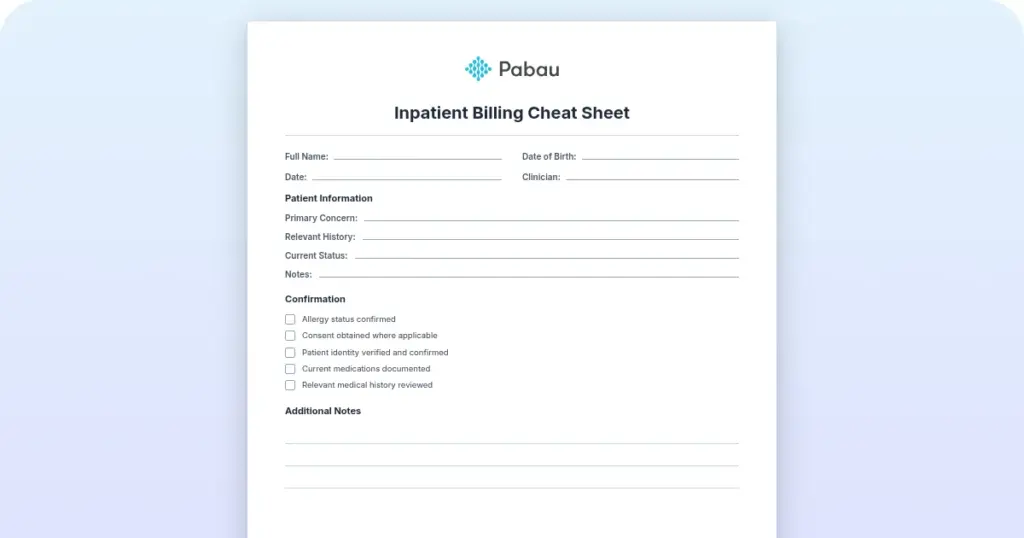
Inpatient billing cheat sheet
An inpatient billing cheat sheet is a quick reference for the codes and claim ru...

Last Updated: Oct 19, 2026
J7627 is the HCPCS Level II code for budesonide, inhalation solution, compounded product, administered through dme, unit dose form, up to 0.5 mg.
CMS gives HCPCS code J7627 one precise meaning: Budesonide, inhalation solution, compounded product, administered through DME, unit dose form, up to 0.5 mg. Every word in that descriptor carries billing weight. "Compounded product" is the phrase that decides payment. "Unit dose form, up to 0.5 mg" defines the unit of service. "Administered through DME" places the drug under the durable medical equipment benefit in CMS's Healthcare Common Procedure Coding System (HCPCS Level II).
One fact governs every J7627 claim: Medicare will not pay it. All four DME MACs deny compounded inhalation solutions as not reasonable and necessary. That leaves the code two realistic uses. It can settle patient liability, or produce a formal denial for a secondary payer. When the FDA-approved product suits the patient, J7626 is the code that gets paid.
J7627 sits in the J-code range (J0000-J9999), which covers drugs administered by routes other than oral. Within that range, J76xx codes specifically address inhalation solutions dispensed through nebulizer equipment. Payer edits are built around that grouping, so a J76xx line is screened against nebulizer drug policy rather than general drug rules.
Let Pabau's smart automation suggest the right codes, reduce claim denials, and keep your practice compliant—effortlessly.
Automate repetitive tasks and focus on what matters most—your patients.
Reduce coding errors and ensure compliance with the latest regulations.
Clean claims, fewer denials, and faster reimbursements.
Powerful insights and reporting to help your practice thrive.
HIPAA compliant SOC 2 certified GDPR-compliant Trusted by 4,000+ clinics worldwide

HCPCS code J7627 describes budesonide inhalation solution, compounded product, administered through DME, in unit dose form up to 0.5 mg.
Medicare does not pay J7627. All four DME MACs deny compounded inhalation solutions as not reasonable and necessary, nationwide.
No documentation makes the code payable. Bill J7626, the non-compounded FDA-approved equivalent, whenever it is clinically appropriate.
J7627 still has a legitimate use with a GA or GZ modifier, which settles beneficiary liability or produces a formal denial for a secondary payer.
Pabau’s claims management software flags modifier and units-of-service errors before nebulizer drug claims are submitted, reducing avoidable denials.
Budesonide is an inhaled corticosteroid used to reduce airway inflammation in patients with chronic obstructive pulmonary disease (COPD) and asthma. When a patient cannot use a metered-dose inhaler effectively, a prescriber may order budesonide as a nebulizer solution. What the pharmacy then dispenses sets the HCPCS code path. An FDA-approved unit dose product such as Pulmicort Respules bills as J7626. A pharmacy-compounded solution bills as J7627. Only the first of those two paths leads to payment.
The compounding distinction decides whether Medicare pays anything at all. Compounded budesonide can be prepared at a range of concentrations, commonly 0.25 mg/2 mL, 0.5 mg/2 mL, or 1 mg/2 mL. That flexibility lets prescribers tailor dosing when a standard formulation does not fit the patient. Medicare treats every one of those preparations as not reasonable and necessary, whatever the concentration.
The compounding pharmacy’s regulatory status under FDA rules (Section 503A or 503B) still matters for licensing, product quality, and liability. It will not change the coverage outcome, but verifying compliance before dispensing remains good practice.
This is the most common coding error on budesonide nebulizer claims. The two codes look almost identical on a claim form, and only one of them pays.
The practical rule is to confirm with the dispensing pharmacy which product was supplied before selecting the code. Submitting J7626 for a compounded product misrepresents the drug and invites a post-payment recovery demand. Submitting J7627 when an FDA-approved vial was dispensed throws away a payable claim. Neither error is recoverable once the remittance arrives.
J7627 belongs to a family of four budesonide HCPCS codes. Two variables separate them: FDA-approved versus compounded, and unit dose versus concentrated form. Those two variables decide payment on every budesonide nebulizer line, as the grid below sets out.
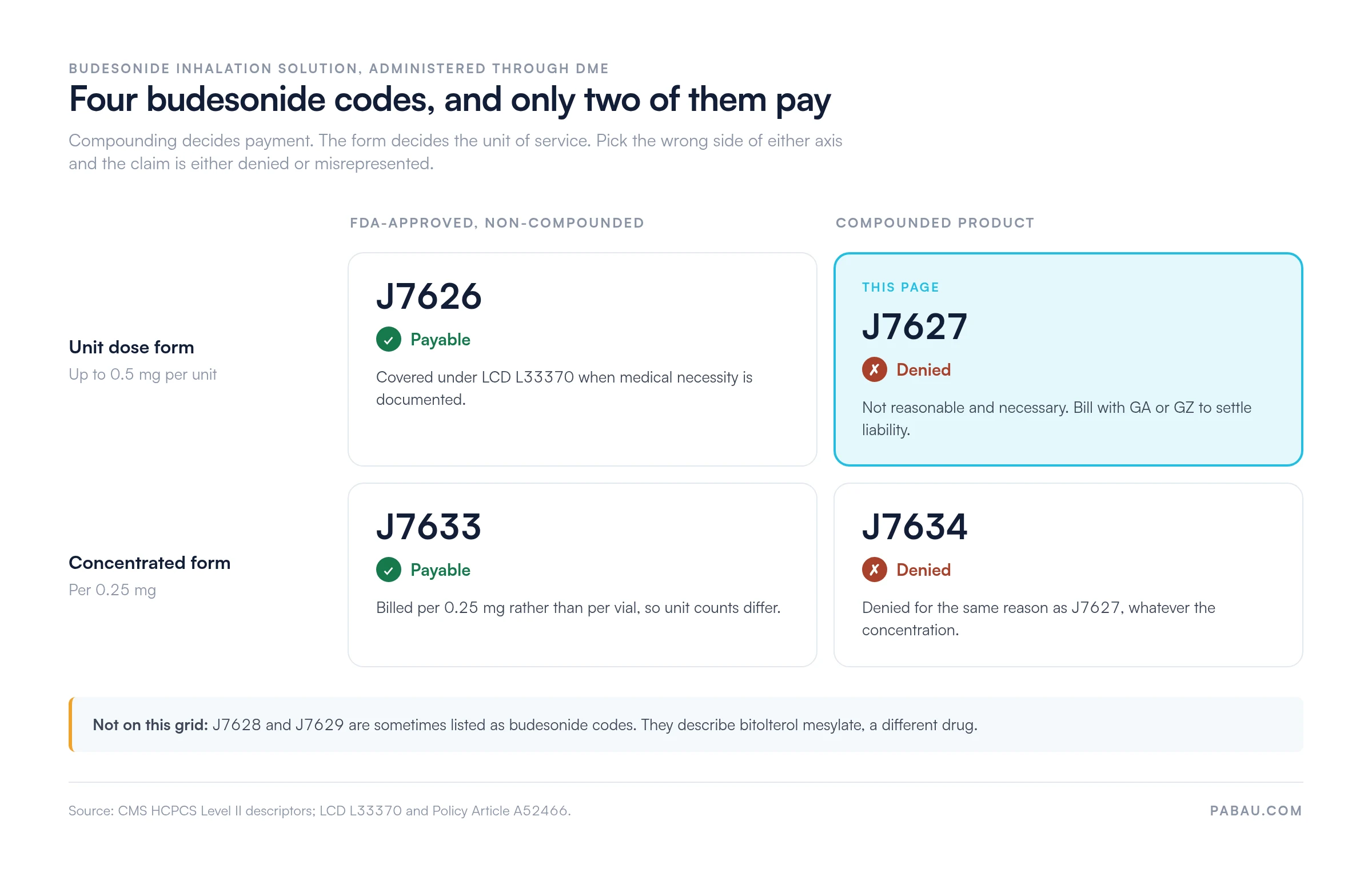
J7633 and J7634 apply to concentrated formulations billed per 0.25 mg rather than per unit dose. The compounded-versus-approved split runs the same way in both pairs, so J7633 is payable and J7634 is denied alongside J7627. Confirm current status against the CMS HCPCS annual file before billing any of them, as code status can change between fiscal years.
One crosswalk error worth naming: J7628 and J7629 are sometimes listed as budesonide codes. They describe bitolterol mesylate, a different drug entirely, and they have no place on a budesonide claim.
Not every nearby J-code describes a nebulized solution. Mannitol under J7665 is an inhalation powder given through an inhaler, and one unit is a 5 mg capsule.
Medicare does not cover HCPCS code J7627. The DME MACs deny compounded inhalation solutions as not reasonable and necessary, and J7627 sits on that denial list. So does compounded flunisolide, billed as HCPCS code J7641. The rule comes from LCD L33370 (Nebulizers) and its companion Policy Article A52466.
This is nationwide policy rather than a jurisdictional quirk. Noridian (JA and JD) and CGS (JB and JC) issue the LCD and the policy article in identical form, so switching MACs changes nothing. CMS repeats the position outside the coverage database. Its Medicare Learning Network compliance page on nebulizers and related drugs carries the same denial list, J7627 included.
No amount of documentation changes that outcome. A52466 places the non-compounded J7626 among the codes that can support medical necessity. J7627 appears in no covered group at all. It is listed instead under the ICD-10 codes that do not support medical necessity, with every ICD-10 code marked as non-supporting. Staying compliant on this code means telling the patient about the cost before dispensing, not assembling a stronger file.
What that means at the claim level:
Those liability uses settle who owes the money. A J7627 line can be worth submitting to establish that, or to satisfy a secondary payer’s paperwork. It will not be paid as a Medicare benefit under any circumstances the current policy describes.
No ICD-10 code establishes medical necessity for J7627. Policy Article A52466 marks all ICD-10 codes as non-supporting for the compounded inhalation solutions, so the diagnosis on the claim cannot rescue the line.
The codes below matter for J7626, the covered non-compounded equivalent. They are the ones to get right when the order moves to the FDA-approved product. Verify the current accepted diagnosis list against your MAC’s LCD, as covered codes are subject to periodic revision.
Use the most specific code the record supports. Submitting J44.9 when J44.1 is documented is an under-coding risk. Coding an exacerbation without supporting documentation creates audit exposure in the other direction. Always match the diagnosis code to what appears in the physician’s order and the beneficiary’s medical record.
J7627 is billed per unit dose form, with each unit covering up to 0.5 mg. One claim line equals one unit dose dispensed. Three vials across a 30-day supply means three units of service. The same unit rule governs J7626, which is the line that pays, so accurate counts matter most on the FDA-approved product.
Over-reporting units is a common audit trigger, and under-reporting leaves revenue on the table. Count the vials named on the pharmacy invoice rather than the days in the supply period.
The unit definition in a descriptor decides the arithmetic. HCPCS code J3265 bills one unit per 10 mg administered, and drug discarded from the single-dose vial goes on a second line with modifier JW.
Key billing rules to follow:
Check the pharmacy invoice before you pick the code, not after the claim goes out. It should show the vial count, the concentration per vial, and whether the product was compounded or FDA-approved. That one line on the invoice decides between a payable J7626 claim and a J7627 line that will deny.
Modifiers on a J7627 line do a different job than on a covered code. They cannot make the claim payable. What they do is record who is responsible for the cost once Medicare denies it. Getting that wrong leaves the practice holding a charge it could have billed to the patient. Always verify modifier requirements with your MAC before submitting, as requirements can differ by jurisdiction. A missing or wrong modifier comes back as one of the standard denial codes in billing.
On a J7627 line, GA is the modifier to get right. It tells the MAC that the beneficiary signed an Advance Beneficiary Notice and agreed to pay for the compounded product. GZ signals that you expect the denial but have no notice on file, which means the charge stays with the practice. KO still describes the unit dose formulation on a single-drug line.
If the prescriber combined budesonide with another nebulized drug in one unit dose, use KP on the first drug and KQ on the subsequent drug. Never apply RR or NU to the drug line itself. Those modifiers belong on the nebulizer equipment line, which is a separately covered DME item billed under E0570.
There is no Medicare payment to plan for on J7627. The line denies before an allowable is applied. Reimbursement modeling for compounded budesonide should treat the patient or a secondary payer as the payment source. Any figure you quote a patient should come from the pharmacy’s charge, supported by a signed ABN.
For the codes that do pay, rates come from the DMEPOS fee schedule, which CMS updates annually. Rates change each fiscal year and vary by jurisdiction. A dollar figure published here would be stale before this page is next reviewed. Reading the remittance advice after submission confirms the allowable your MAC applied to J7626.
Two reimbursement facts billers should know:
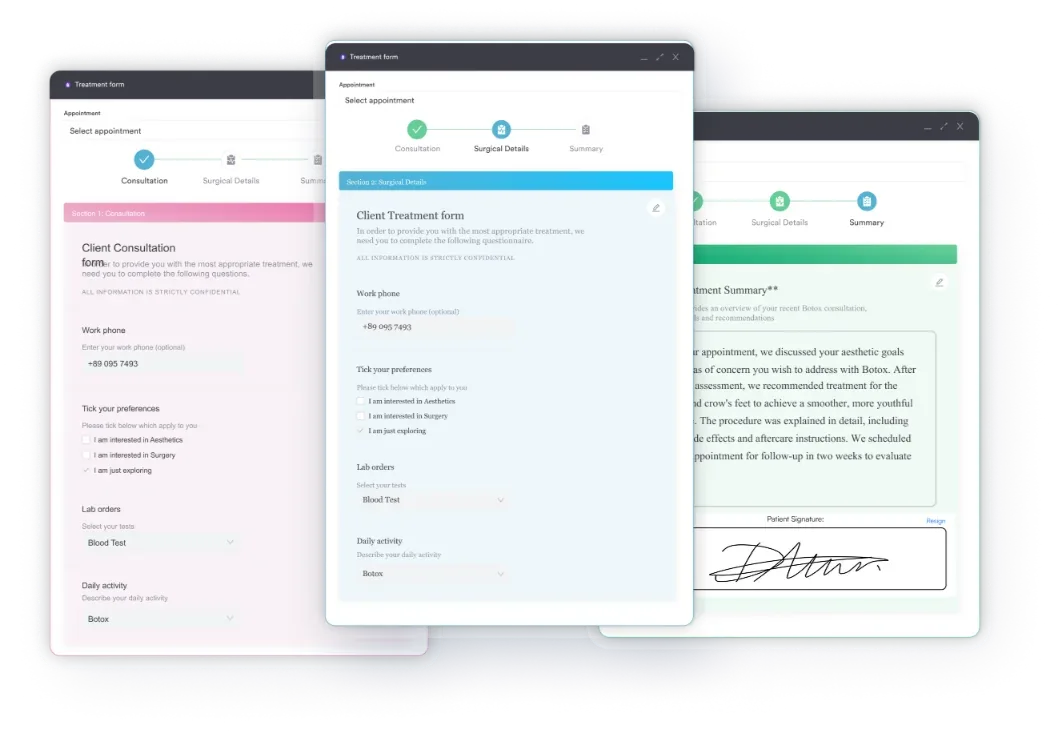
Documentation on a J7627 order serves a different purpose than on a covered code. It will not win coverage, because policy has already ruled the drug out. What it protects is the practice’s ability to collect from the patient and to answer an audit request cleanly. Building that checklist into order intake, rather than scrambling at audit time, is the operational fix. A standard intake form keeps it consistent across every compounded order.
What to keep on file for a compounded budesonide order:
Thorough documentation reduces audit exposure. Keep supporting records for the standard Medicare retention period, typically seven years. Make them retrievable on short notice if a MAC audit request arrives. On this code, the work is routing orders to J7626 rather than appealing a settled decision.
Put the J7627 checkpoint in order intake, not in denial follow-up. When a compounded budesonide order arrives, the first question is whether J7626 will do the job. If it will not, the ABN gets signed before anything is dispensed. Practices that leave that conversation until the denial lands usually end up writing the charge off.
Budesonide nebulizer claims involve more moving parts than a standard office visit. Unit dose counts, modifier selection, ICD-10 pairing, ABN status, compounding pharmacy records, and DME equipment lines often sit across separate systems. When a team reconciles those by hand, errors compound.
Practice management software like Pabau, with integrated claims management software, flags modifier mismatches and units-of-service discrepancies before the claim leaves the office.
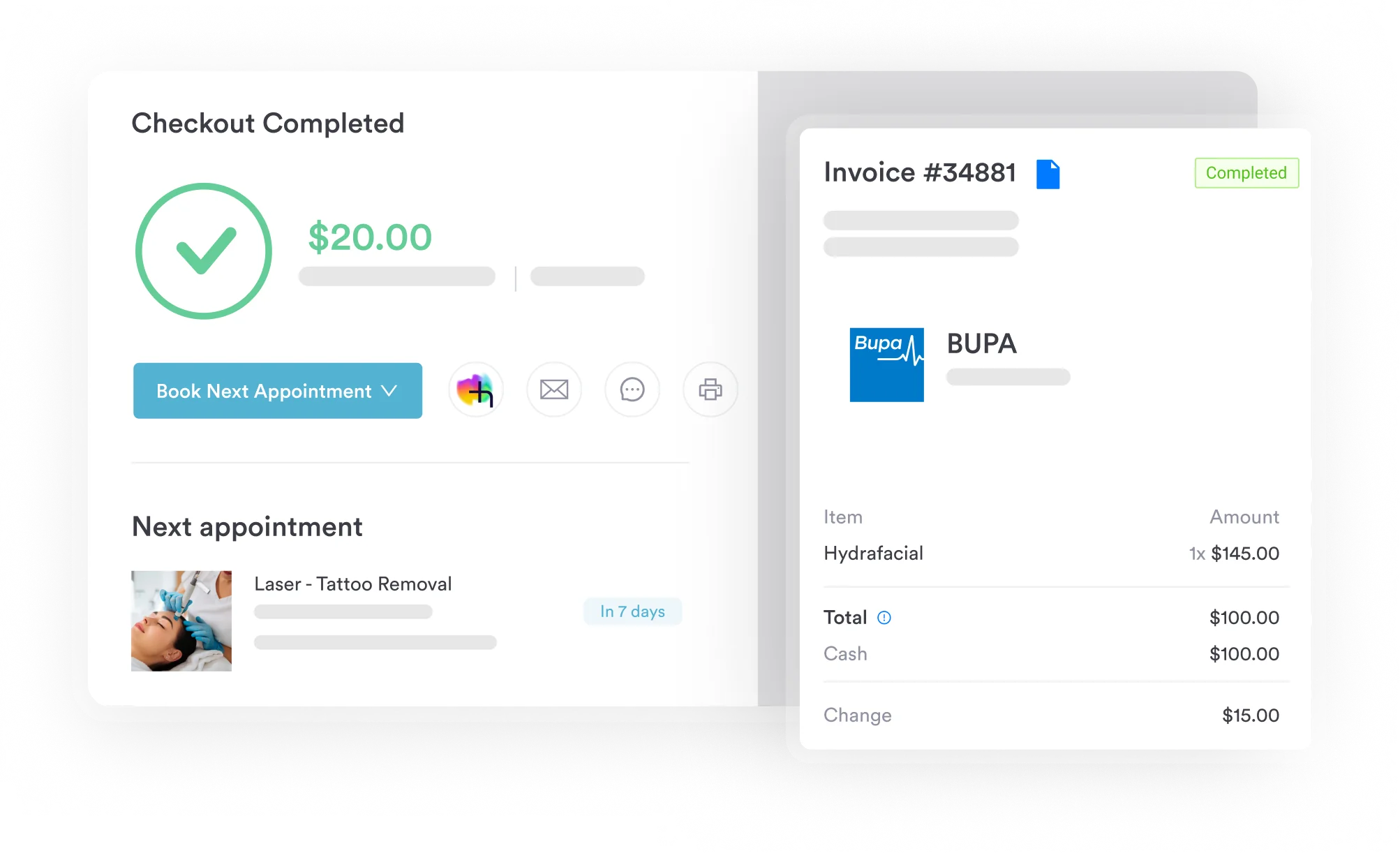
Pabau’s billing workflow tools let practice teams validate claims against code rules at the point of entry, rather than weeks later when a denial returns. For respiratory practices billing nebulizer drugs regularly, cross-referencing dispensed vial counts against submitted units before submission removes a lot of rework.
Structured digital intake forms capture the compounding pharmacy details and the signed ABN at the order stage. The documentation burden then becomes a workflow instead of a scramble. In a DME-heavy practice, that check runs on every nebulizer drug line before it is submitted.

Pabau’s claims management tools flag modifier mismatches and units-of-service errors before submission. Your team spends less time on rework and more on patient care.

HCPCS code J7627 is narrow in scope, and the most useful fact about it is that Medicare will not pay it. Compounded inhalation solutions are denied nationwide as not reasonable and necessary under LCD L33370 and Policy Article A52466. No documentation packet turns a J7627 line into revenue. The code still earns its place in liability and secondary-payer paperwork, and that work runs on a signed ABN plus the right modifier.
The billing decision happens well before the claim goes out. Confirm with the pharmacy which product is being dispensed. Move the order to J7626 whenever the FDA-approved vial fits the prescription. Reserve J7627 for cases where the patient has accepted the cost in writing.
Practices billing nebulizer drugs regularly benefit most from building these checks into the workflow before submission. Pabau supports pre-submission validation, so teams catch coding errors at the source. To see how it fits a respiratory or DME billing workflow, book a demo.

Need to understand the broader billing compliance framework? Medical billing compliance covers the key regulatory requirements every billing team should have documented before an audit.
Struggling with claim denials on complex HCPCS codes? Denial management in healthcare walks through systematic approaches to reducing and resolving denials before they affect cash flow.
Want a cleaner revenue cycle across your billing operation? Revenue cycle management explains how each stage from patient intake to payment posting connects, and where most practices leak revenue.
HCPCS code J7627 is the billing code for budesonide, inhalation solution, compounded product, administered through DME, unit dose form, up to 0.5 mg. It describes pharmacy-compounded budesonide dispensed for inhalation through a durable medical equipment nebulizer. Medicare denies the code as not reasonable and necessary, so the payable equivalent is J7626, the non-compounded FDA-approved version of the same drug.
No. Medicare denies J7627 as not reasonable and necessary, and that decision is nationwide. LCD L33370 and Policy Article A52466 are issued in identical form by all four DME MACs. Both list compounded inhalation solutions among the codes that will be denied. No amount of documentation makes the code payable. Bill J7626 when the FDA-approved product is clinically appropriate, or submit J7627 with a GA or GZ modifier to settle beneficiary liability.
J7626 covers non-compounded FDA-approved budesonide unit dose vials, such as Pulmicort Respules. J7627 covers pharmacy-compounded budesonide inhalation solutions. The distinction decides payment rather than paperwork. J7626 is covered when medical necessity is documented, while J7627 is denied nationwide under LCD L33370 and Policy Article A52466. Confirm with the dispensing pharmacy which product type was supplied before selecting the code.
An appeal built on medical necessity will not succeed. The denial follows a nationwide coverage policy rather than a case-by-case judgment about the patient, so there is no clinical argument that reverses it. Appeals are worth filing only where the line denied for a different reason, such as a clerical error in the code or the units. The productive route is switching the order to J7626 where clinically possible, and holding a signed ABN where it is not.
No ICD-10 code supports medical necessity for J7627. Policy Article A52466 marks all ICD-10 codes as non-supporting for compounded inhalation solutions. The COPD codes (J44.0, J44.1, J44.9) and asthma codes (J45.20, J45.30, J45.40, J45.50, J45.901) apply to J7626, the covered non-compounded equivalent. Verify the accepted diagnosis list against your MAC’s current LCD, as covered codes can change between fiscal years.
GA and GZ are the modifiers that matter, because they record liability on a code Medicare will deny. Append GA when the beneficiary signed an Advance Beneficiary Notice and accepted the cost. Append GZ when no notice was signed, which means the denial cannot be billed to the patient. KO still describes a single-drug unit dose line. Use KP and KQ when budesonide is combined with another nebulized drug in one unit dose. RR and NU stay on the nebulizer equipment line.
The priority document is a signed Advance Beneficiary Notice, issued before dispensing. It should name the drug, the expected denial, and the estimated cost to the patient. Also keep the physician order specifying the compounded product, its concentration, dosage and frequency. Hold the compounding pharmacy’s licensing and preparation records, plus a signed proof of delivery. Keep the remittance advice too, if a secondary payer needs proof of the denial. The nebulizer’s own DME coverage documentation continues to apply separately. Retain records for the standard Medicare retention period, typically seven years.
Four budesonide codes sit together. J7626 and J7627 cover the unit dose form up to 0.5 mg, non-compounded and compounded respectively. J7633 and J7634 cover the concentrated form per 0.25 mg, again non-compounded and compounded. The two compounded codes, J7627 and J7634, are denied. J7628 and J7629 are sometimes mistaken for budesonide codes, but they describe bitolterol mesylate.