CCSD code S5524: Billing guide for UK private practice
CCSD code S5524: Official descriptor and procedure overview CCSD code S5524 is a...

Last Updated: Nov 20, 2026
J7518 is the HCPCS Level II code for mycophenolic acid, oral, 180 mg. It covers Myfortic and generic delayed-release tablets, at one billing unit per 180 mg.
Medicare pays for it under the Part B immunosuppressive drug benefit, after a Medicare-covered organ transplant. Pharmacies bill the DME MAC with a transplant diagnosis such as Z94.0.
Let Pabau's smart automation suggest the right codes, reduce claim denials, and keep your practice compliant—effortlessly.
Automate repetitive tasks and focus on what matters most—your patients.
Reduce coding errors and ensure compliance with the latest regulations.
Clean claims, fewer denials, and faster reimbursements.
Powerful insights and reporting to help your practice thrive.
HIPAA compliant SOC 2 certified GDPR-compliant Trusted by 4,000+ clinics worldwide

HCPCS code J7518 is mycophenolic acid, oral, 180 mg, covering Myfortic and generic delayed-release tablets.
One unit equals 180 mg, so a 180 mg tablet bills as 1 unit and a 360 mg tablet as 2 units.
Medicare Part B pays for J7518 only after a Medicare-covered organ transplant, through the DME MAC.
A transplant diagnosis such as Z94.0 or a T86.1- kidney transplant code supports medical necessity.
The Medicare payment limit is $0.257 per unit from October 1 to December 31, 2026.
J7518 was not touched by the October 2026 mycophenolate changes, but J7517 and J7519 were deleted.
HCPCS code J7518 is the Level II code for mycophenolic acid, oral, 180 mg. The CMS Medicare Part B payment limit file lists it with a 180 mg billing unit. Medicare pays for it under the immunosuppressive drug benefit, after a Medicare-covered organ transplant.
The drug is sold as Myfortic, by Novartis, and as generic mycophenolic acid delayed-release tablets. Both strengths, 180 mg and 360 mg, bill under the same code.
Mycophenolic acid is an antimetabolite immunosuppressant. It blocks the purine synthesis that T and B lymphocytes rely on, which dampens the immune response that drives organ rejection.
The Myfortic prescribing information on DailyMed approves it for prophylaxis of organ rejection after a kidney transplant. It is given with cyclosporine and corticosteroids. The usual adult dose is 720 mg twice a day.
Myfortic is an enteric-coated, delayed-release tablet, and patients swallow it whole. It is not interchangeable milligram for milligram with mycophenolate mofetil, the drug in CellCept. That difference is why the two drugs never share a HCPCS code.
Medicare Part B covers J7518 under the immunosuppressive drug benefit. The DME MAC policy article Immunosuppressive Drugs (A52474) sets the criteria, and a claim has to meet all of them.
Kidney recipients whose Medicare is based on end-stage renal disease alone lose it 36 months after a successful transplant. Since January 1, 2023, they can enroll in the Part B immunosuppressive drug benefit (Part B-ID). It covers these drugs only, with the Part B deductible and 20% coinsurance.
Part D steps in when Part B does not apply. A patient whose transplant Medicare did not cover usually fills mycophenolic acid through a Part D plan. The same goes for off-label use outside transplant care.
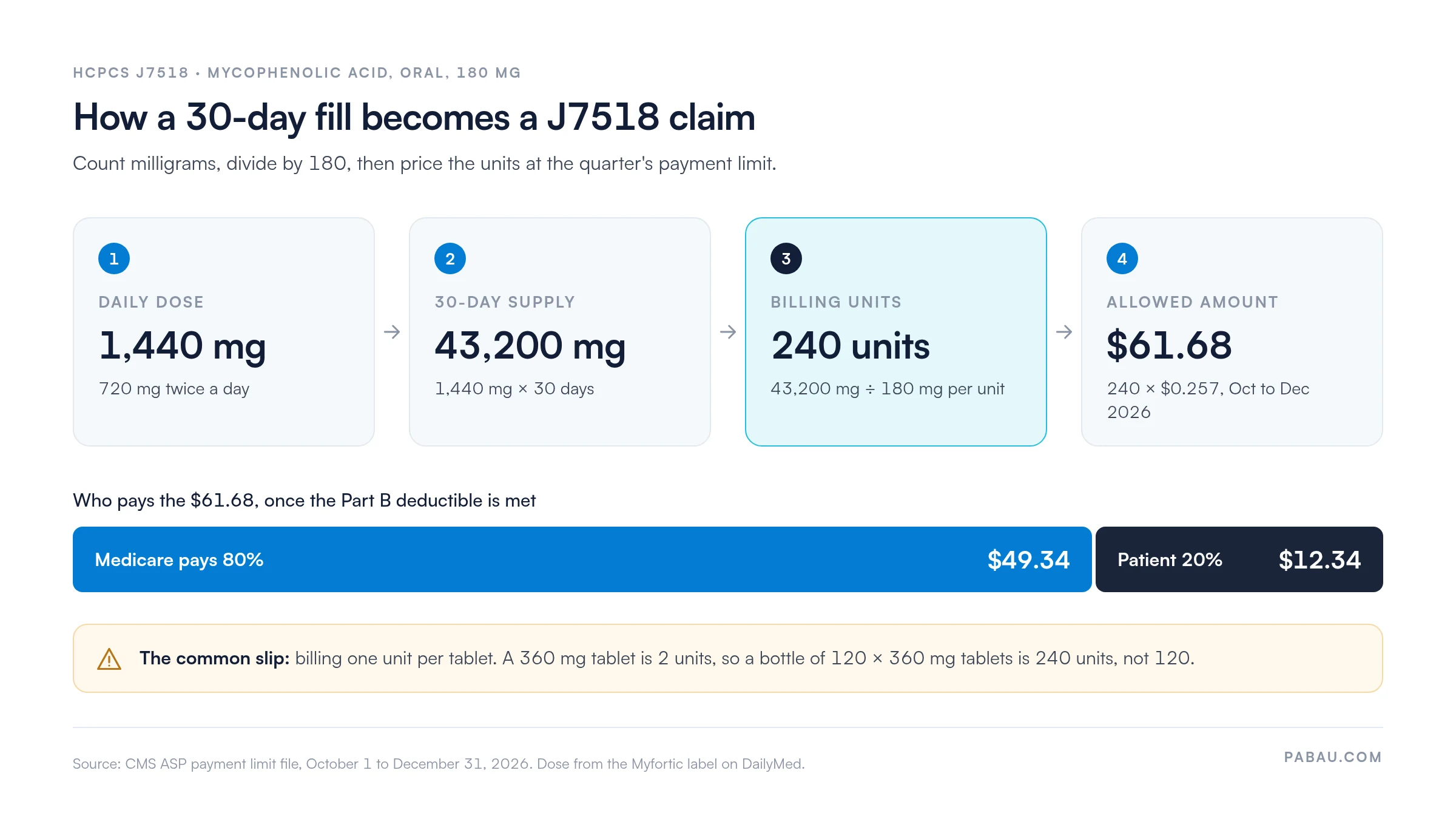
Divide the total milligrams dispensed by 180. Mycophenolic acid tablets only come in 180 mg and 360 mg strengths, so the result is always a whole number.
Count milligrams, not tablets. A pharmacy that bills one unit per tablet underbills every 360 mg tablet by half.
Medicare pays J7518 from the Average Sales Price methodology, at the limit in the quarterly CMS ASP pricing files. The physician fee schedule does not price it, so skip that lookup.
Take a 30-day supply at 720 mg twice daily, or 240 units. At the October 2026 limit, the allowed amount is 240 × $0.257, or $61.68. Medicare pays 80%, $49.34, once the Part B deductible is met, and the patient owes $12.34.
The limit moves every quarter. Check the file for the quarter the date of service falls in before you quote a patient a figure.
A transplant diagnosis carries medical necessity. Policy article A52474 lists the Z94 transplant status codes, the T86 transplant complication codes, and Z48.2- aftercare codes. These are the pairings that come up most with mycophenolic acid.
Listing a code does not guarantee payment on its own. The record still needs the transplant date, the transplant type, and the prescriber’s order. For a rejection episode, T86.11 is the code to pair with the claim, and the notes should show how the rejection was diagnosed.
The October 2026 ASP NDC-HCPCS crosswalk, published with the CMS ASP pricing files, maps Myfortic and the generics to J7518. A few of the listed products are below.
Report the NDC in the 11-digit 5-4-2 format with the N4 qualifier when the payer asks for it. Medicaid and commercial plans usually do, so confirm the rule with each one.
Pharmacies billing the DME MAC add a modifier that says whether the coverage criteria are met. They also bill a supply fee on the same claim as the drug.
Record the transplant date in the patient record before the first fill. KX depends on it, and a missing date turns a clean claim into a GY denial.
Mycophenolic acid and mycophenolate mofetil are different drugs with different codes. The October 2026 HCPCS update made this harder, because it deleted two mofetil codes, J7517 and J7519. Check the CMS HCPCS quarterly update before you reuse an old claim template.
Myfortic always bills as J7518. CellCept and generic mycophenolate mofetil bill as J7524 from October 1, 2026, at 5 mg per unit. The unit sizes alone make a swapped code obvious in a pre-bill review. Cyclosporine is a different drug again, billed as J7515 in 25 mg units.
Most J7518 denials trace back to a handful of avoidable mistakes. Our denial code reference explains the reason codes that come back.
When a claim does deny, denial management starts with the remittance code. Fix the line it names and resubmit, rather than appealing a coding error.
A J7518 claim leans on details that sit in different places: the transplant date, the prescription, and the diagnosis. When they live in separate systems, someone retypes them, and that is where KX and unit errors start.
Pabau, a practice management platform with built-in billing tools, keeps them on one patient record. Its claims management software submits the claim you build from that record and tracks what comes back.
Your team can see the transplant date, the prescription, and the claim status without switching screens. That makes it easier to catch a missing date before the claim goes out.

Pabau holds the transplant date, the prescription history, and the claim status on one patient record. Your billing team builds each J7518 claim from data already there.

J7518 is mycophenolic acid, and only mycophenolic acid. Once the drug is right, the claim turns on two facts: units in 180 mg steps, and a Medicare-covered transplant on file.
The October 2026 update moved the mofetil codes, not this one. Use it as the moment to clean out old templates, and the J7518 claims that follow will go out clean the first time.
Book a demo to see how Pabau keeps transplant drug claims tied to the patient record.

Billing another oral immunosuppressant? HCPCS code J7520 walks through oral sirolimus under the same Part B benefit.
Need a broader HCPCS reference? What is medical billing explains how J-code drug claims fit into the broader revenue cycle.
Struggling with claim denials across your practice? Denial management in healthcare covers the full appeal workflow from CARC code to corrected claim.
Want a clean claim checklist for drug billing? What is a clean claim outlines every field a payer checks before accepting a drug claim for processing.
HCPCS code J7518 represents mycophenolic acid, oral, 180 mg. It covers Myfortic and generic mycophenolic acid delayed-release tablets. The drug prevents organ rejection after a kidney transplant.
One unit of J7518 equals 180 mg. A 180 mg tablet bills as 1 unit and a 360 mg tablet as 2 units. A 30-day supply at 720 mg twice daily is 240 units.
Yes, after a Medicare-covered organ transplant. The patient needs Part A at the time of the transplant and Part B when the drug is dispensed. The pharmacy bills the DME MAC under policy article A52474.
The Part B payment limit is $0.257 per 180 mg unit from October 1 to December 31, 2026. It was $0.325 from July 1 to September 30, 2026. Medicare pays 80% after the deductible.
Transplant codes support it. Z94.0 covers kidney transplant status, and T86.1- codes cover kidney transplant complications such as rejection. Z48.22 covers aftercare following a kidney transplant.
No. Myfortic is mycophenolic acid and always bills as J7518. J7517 and J7519 were mycophenolate mofetil codes, and both were deleted for dates of service from October 1, 2026.