

ICD-10 Code S42.444P: Medial epicondyle fracture, right humerus
ICD-10 Code S42.444P: full descriptor and code validity ICD-10 Code S42.444P car...

Last Updated: Oct 13, 2026
Billable Code Specific Code
T86.11 is the billable ICD-10-CM code for kidney transplant rejection. It applies whenever the treating physician documents that the recipient's immune system is attacking the transplanted kidney, across all three rejection subtypes.
The code sits in the T86.1x subcategory alongside kidney transplant failure (T86.12) and kidney transplant infection (T86.13). Assignment turns on the physician's own wording. Without a documented rejection statement, the unspecified T86.10 applies instead.
Let Pabau's smart automation suggest the right codes, reduce claim denials, and keep your practice compliant—effortlessly.
Automate repetitive tasks and focus on what matters most—your patients.
Reduce coding errors and ensure compliance with the latest regulations.
Clean claims, fewer denials, and faster reimbursements.
Powerful insights and reporting to help your practice thrive.
HIPAA compliant SOC 2 certified GDPR-compliant Trusted by 4,000+ clinics worldwide

ICD-10 code T86.11 is a billable, specific ICD-10-CM code for kidney transplant rejection, valid for FY2026 claims from October 1, 2025.
Rejection (T86.11) and failure (T86.12) are distinct events, and only the physician’s documented wording decides which code applies.
Assign both T86.11 and the appropriate N18.x CKD code when chronic kidney disease coexists with rejection, per ICD-10-CM Official Guidelines.
Pabau’s claims management software supports accurate ICD-10 code submission and integrates with Claim.MD for real-time eligibility and electronic claims processing.
ICD-10 code T86.11 is the billable ICD-10-CM diagnosis code for kidney transplant rejection. It is classified under Chapter 19, which covers injury, poisoning and certain other consequences of external causes. Within that chapter it sits in the T86 block, covering complications of transplanted organs and tissue.
The code is fully specific, so it carries the level of detail payers expect on a submitted claim. No additional character extensions are needed.
T86.11 is appropriate when the treating physician has documented kidney transplant rejection as the active diagnosis. That physician is usually a transplant nephrologist or a transplant surgeon.
The code itself does not separate acute rejection from chronic rejection. That distinction lives in the physician’s note and supports the specificity of the record, though both forms map to T86.11. Verify billable status and effective dates against the CDC/NCHS ICD-10-CM web tool each fiscal year, since annual updates occasionally revise code validity.
The T86.1x family covers all kidney transplant complications and is where most coding errors originate. Choosing the right code requires the physician to explicitly state the type of complication in the record.
T86.10 is a fallback code. It signals that the coder could not find a specific complication type in the documentation. Payers flag unspecified codes for additional review, and some Medicare Administrative Contractors apply scrutiny to transplant-related claims coded at T86.10. When the physician’s note or discharge summary says “rejection,” T86.11 is always the more accurate and defensible assignment.
Never assign T86.10 without first querying the physician when the record hints at a specific complication type. Biopsy results, calcineurin inhibitor trough levels, and creatinine trends are all signals that the physician can clarify what happened.
Rejection and failure are distinct clinical events, and the coder cannot make that determination independently. Rejection is an immunologic process in which the recipient’s immune system mounts a response against the allograft.
Failure, coded as T86.12, refers to graft dysfunction that ends in loss of function. It can follow rejection, or arise through separate mechanisms such as chronic injury, drug toxicity, or recurrent disease.
A patient whose creatinine is rising may be experiencing rejection, failure, or both. Only the physician’s documented assessment distinguishes them for coding purposes. If the record uses both terms, query for clarification rather than assigning both codes without guidance. The chart below traces each documented finding to the code it supports.
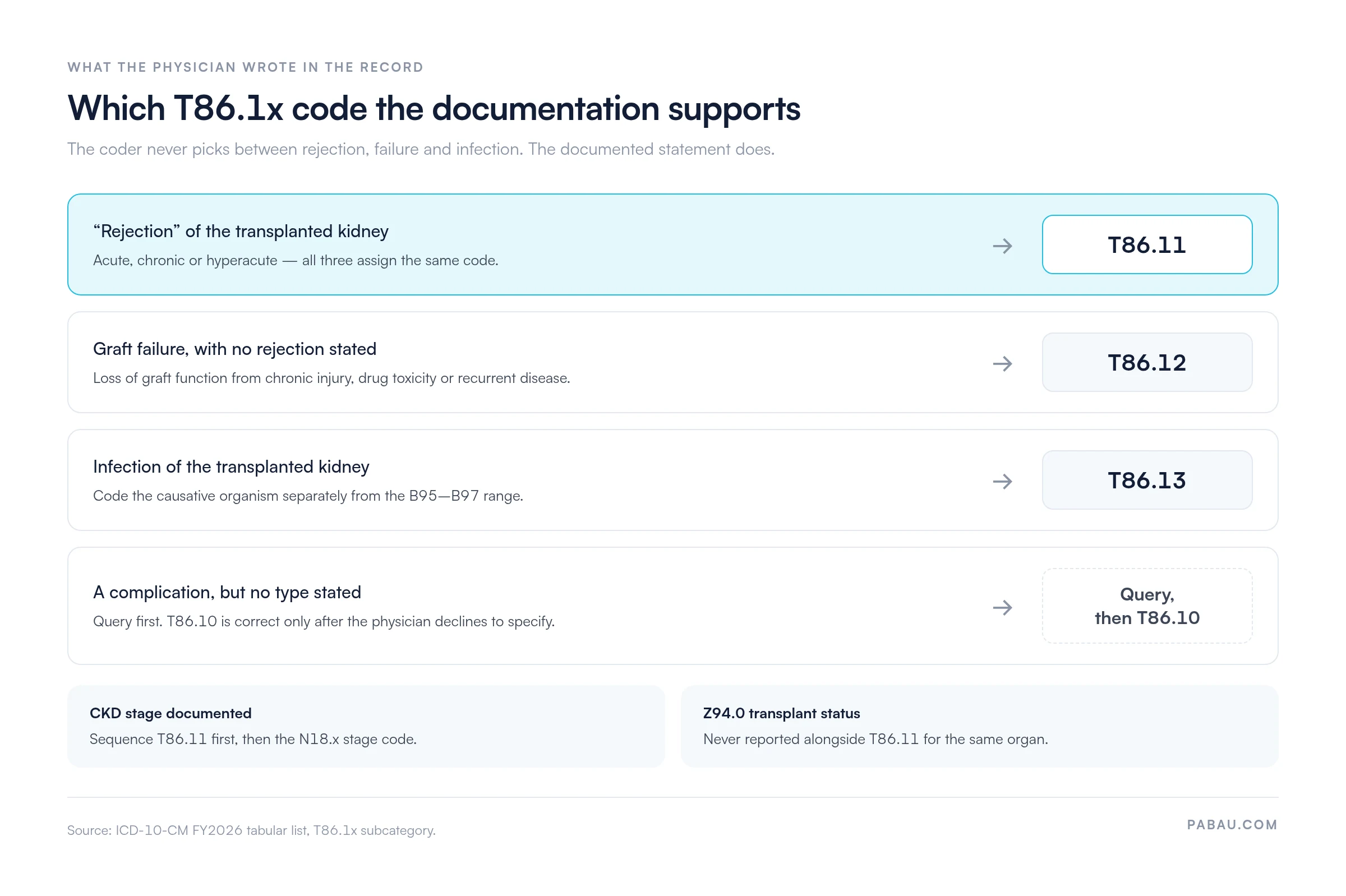
Kidney transplant rejection is the immunologically driven process by which the recipient’s immune system recognizes the donor kidney as foreign and attacks it. Clinicians recognize three subtypes:
All three subtypes map to T86.11 in the current code year, so the subtype shapes the treatment plan rather than the code selection.
According to the CMS ICD-10-CM coding guidance, T86.11 is classified as a complication of care. It is assigned when a causal relationship exists between the transplant procedure and the rejection episode. The code applies however long ago the transplant took place, provided the physician has documented the rejection diagnosis.
T86.11 requires explicit physician documentation of kidney transplant rejection. Coders cannot infer rejection from laboratory values or imaging alone. The physician must connect those findings to a rejection diagnosis in a signed, dated entry in the medical record.
The following elements, when present in the record, support the assignment of T86.11 and strengthen the documentation against audit queries:
When none of these elements appear with an explicit rejection statement, query the physician before assigning T86.11. The AAPC ICD-10-CM code reference is a useful cross-check while that query is open. Track unresolved queries through your clinical documentation improvement (CDI) process, so that coding is not held up.
Z94.0 (kidney transplant status) and T86.11 serve different purposes and should not be confused. Z94.0 is a status code recording that a patient has a functioning transplanted kidney with no current complication. T86.11 is the active-complication code used when rejection is occurring.
When rejection is the reason for the encounter, T86.11 is assigned as the principal or primary diagnosis. Z94.0 is not reported alongside it, because the transplanted organ is no longer functioning without complication.
Use the insurance eligibility verification step of your revenue cycle to confirm the patient’s transplant status before the encounter. Payers sometimes require prior-authorization documentation that references the complication code rather than the transplant status code.
The ICD-10-CM Official Guidelines permit assigning both T86.11 and an N18.x (CKD) code when a transplant recipient has documented chronic kidney disease alongside active rejection. A transplant recipient can carry CKD as a condition separate from the rejection episode, and the guidelines allow both to sit on the same claim.
Procedure codes billed with the rejection diagnosis carry their own documentation requirements. Dialysis initiation and renal biopsy are the common examples, and those requirements must be met too. Keep a query log for CKD staging, so that repeat queries across your CDI team stay consistent and defensible on audit.
Track physician query response rates for T86.11 encounters in your CDI dashboard. Transplant cases with unresolved queries usually default to T86.10. That loses the specificity supporting case complexity and reimbursement. A 30-day query resolution target reduces unspecified code assignment across the T86.1x family.
Transplant complication coding is an audit-sensitive area. These are the most frequently cited errors by CDI teams and coders working with the T86.1x family:
Catching these errors before submission costs far less than appealing them afterwards. Reading the payer denial codes your transplant claims come back with tells you which documentation weakness the payer is reacting to. Pair that reading with a CDI query workflow and a clearinghouse that holds T86-family claims for a second look before they reach the payer.

Coders reviewing records from transplant nephrology will meet several terms that all map to ICD-10 code T86.11. Recognizing these synonyms keeps the right code in play even when the physician uses non-standard phrasing. According to the AAPC ICD-10-CM code reference, recognized synonyms include:
Any of these documented by the physician in a progress note, discharge summary, or consult letter supports the assignment of T86.11. Coders can also cross-check an unfamiliar phrase against the FY2026 ICD-10-CM alphabetical index. That confirms the phrase points to T86.11 rather than to a neighboring T86.1x code.
Documentation retention and query management standards for transplant complication coding sit outside the code itself. Work from your payer-specific coverage determinations and the ICD-10-CM Official Guidelines for Coding and Reporting.
Build a transplant-specific synonym library for your CDI team. Include the T86.11 synonyms alongside their T86.12 and T86.13 counterparts. Reviewers can then flag the right code family while abstracting transplant notes. Update the library with each FY code release.
Coding kidney transplant rejection correctly depends on a CDI reviewer finding the physician’s rejection statement before the claim goes out. Today that statement often sits in a discharge summary or consult note, which billing staff have to track down separately from the encounter record.
Practice management software like Pabau keeps the physician’s documentation, the CDI query, and the claim in the same patient record. A coder assigning T86.11 can see the rejection statement, biopsy findings, and immunosuppression changes without switching systems.
That record feeds Pabau’s claims software for practices, which carries the ICD-10 code onto the claim without rekeying. It integrates with Claim.MD, which submits electronic claims to more than 4,000 US payers and runs real-time eligibility checks before the visit.
The result is fewer claims that default to the unspecified T86.10 for lack of a documented answer, and less rework chasing denials after the fact.

Pabau’s claims management software integrates with Claim.MD to submit clean ICD-10-coded claims, verify eligibility in real time, and track denials before they become write-offs.

Kidney transplant rejection coding turns on one sentence in the chart. Without a documented rejection statement the claim falls back to the unspecified T86.10, which weakens the case complexity and invites payer review. The distinction between rejection, failure, and infection sits in the physician’s assessment, so coders query rather than infer.
Build the query step into the workflow before the claim goes out, and T86.11 stops being a coin toss against T86.10. Book a demo to see how Pabau keeps CDI queries, documentation, and transplant claims in one patient record.

Need a framework for managing claim denials on transplant codes? Denial management in healthcare covers how to build a systematic denial prevention and appeals workflow.
Want to understand clearinghouse claim validation? What makes a clean claim outlines the elements payers check before processing an ICD-10-coded submission.
Looking for guidance on ICD-10-coded billing submissions? How superbills support ICD-10 coding explains how to structure claim documentation for transplant and other complex diagnoses.
ICD-10 code T86.11 is the billable ICD-10-CM diagnosis code for kidney transplant rejection. It is used whenever a physician has documented that a transplant recipient’s immune system is rejecting the donated kidney. It applies across acute, chronic, and hyperacute rejection. The code is valid for claims with service dates on or after October 1, 2025, under the FY2026 edition.
Yes, T86.11 is a billable and specific ICD-10-CM code, confirmed by both the CDC/NCHS official tabular list and the AAPC code reference. It requires no additional character extension and can be submitted on claims for dates of service from October 1, 2025 onward.
T86.11 is kidney transplant rejection, an immunologic attack on the allograft. T86.12 is kidney transplant failure, meaning loss of graft function. Rejection and failure are distinct clinical events, and only the treating physician determines which applies. The coder relies on explicit physician documentation rather than interpreting lab values independently.
No. Z94.0 (kidney transplant status) indicates a functioning transplanted kidney with no current complication. T86.11 indicates an active complication. When rejection is documented and coded as T86.11, Z94.0 is not assigned for the same organ in the same encounter. The complication code takes precedence over the status code.
The physician must state kidney transplant rejection explicitly in the medical record, in a progress note, discharge summary, or consult letter. Supporting evidence such as biopsy findings, rising creatinine, or augmented immunosuppression strengthens the documentation. None of it substitutes for the physician’s rejection statement. Query the physician if rejection is clinically indicated but not explicitly documented.
The T86.1x family includes T86.10 (kidney transplant complication, unspecified), T86.11 (rejection), T86.12 (failure), T86.13 (infection), and T86.19 (other complication). T86.10 should only be used after querying the physician when no specific complication type can be determined from the documentation.




