

HCPCS code E0198: Water pressure pad billing guide
HCPCS code E0198 is a water pad for a standard mattress HCPCS code E0198 is the ...

Last Updated: Oct 13, 2026
J7502 is the HCPCS Level II code for cyclosporine, oral, 100 mg.
Let Pabau's smart automation suggest the right codes, reduce claim denials, and keep your practice compliant—effortlessly.
Automate repetitive tasks and focus on what matters most—your patients.
Reduce coding errors and ensure compliance with the latest regulations.
Clean claims, fewer denials, and faster reimbursements.
Powerful insights and reporting to help your practice thrive.
HIPAA compliant SOC 2 certified GDPR-compliant Trusted by 4,000+ clinics worldwide

HCPCS Code J7502 describes cyclosporine, oral, 100 mg, a Level II J-code for immunosuppressive drug billing.
Medicare Part B covers J7502 post-transplant, but oral cyclosporine has a specific Part B exception that must be documented correctly.
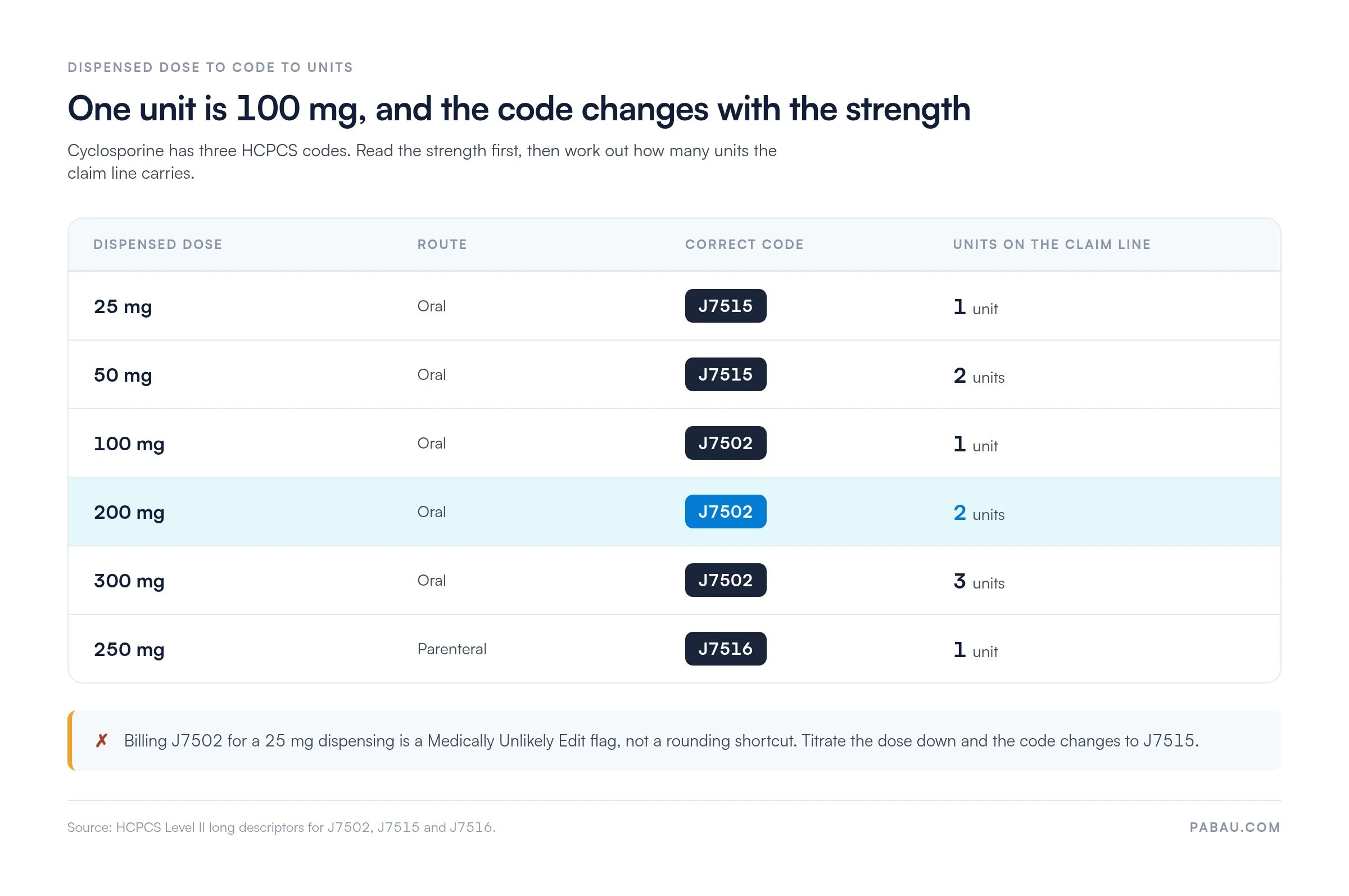
One unit is 100 mg, so a 200 mg dispensing bills two units and a 25 mg dose moves to J7515.
Reimbursement follows ASP methodology and CMS updates it quarterly. Check the current quarter’s file before you quote a dollar figure.
Pabau’s claims management software supports HCPCS drug code workflows, NDC crosswalk lookups, and claim scrubbing to reduce J7502 denials.
HCPCS Code J7502 is maintained by the Centers for Medicare and Medicaid Services (CMS) as part of the HCPCS Level II code set. It reports a single 100 mg oral dose of cyclosporine or cyclosporine modified. The table below captures the core code metadata billing teams need before submitting a claim.
One practical point: HCPCS Level II codes like J7502 are distinct from CPT codes. CMS maintains the J-series for drugs and biologicals billed outside the physician fee schedule.
That makes it the correct code set for immunosuppressive drug claims. Coders can confirm current code status through the AAPC HCPCS lookup before they build the claim line.
Cyclosporine is a calcineurin inhibitor that suppresses T-cell-mediated immune responses. Its primary clinical role is preventing acute rejection following solid organ transplantation. Medical necessity documentation for HCPCS Code J7502 claims must reflect one of these established indications.
Transplant pharmacies supporting prescription management workflows need to distinguish between cyclosporine (non-modified, sold as Sandimmune) and cyclosporine modified (Neoral, Gengraf).
The two formulations have different bioavailability profiles and are not bioequivalent, but both map to HCPCS Code J7502 for billing purposes. The distinction matters clinically and for NDC crosswalk accuracy, not for the J-code itself.
Document the specific transplant organ, transplant date, and current immunosuppressive regimen in every claim supporting J7502. Medicare Administrative Contractors (MACs) frequently request this detail during audits, and missing it is a leading cause of post-payment recoupment.
Oral drugs usually fall under Medicare Part D rather than Part B coverage. Cyclosporine post-transplant is one of a narrow set of exceptions carved out under the Part B immunosuppressive drug benefit. Confirming insurance eligibility verification before dispensing is the fastest way to avoid a coverage dispute between Part B and Part D.
The Part B exception applies when the patient received a Medicare-covered organ transplant and the drug is used for immunosuppressive therapy. CMS authority for this benefit sits in the Medicare Benefit Policy Manual, Chapter 15.
Check the relevant National Coverage Determination before you bill. Then check whether your MAC has issued a Local Coverage Determination that narrows or expands coverage for a specific indication.
Important caveat: Medicare coverage criteria change periodically. Always verify current NCD and MAC LCD status before billing. The table above reflects the general framework as of publication. Dollar thresholds, formulary position, and prior-authorization rules are set at the MAC level.
Medicare reimburses J7502 under the Average Sales Price (ASP) methodology. CMS calculates ASP from manufacturer-reported sales data and publishes updated payment limits quarterly, typically effective January, April, July, and October.
Billing staff should pull the current quarter’s ASP pricing file from CMS rather than relying on a prior period’s rates.
The standard payment formula for Part B drugs is ASP plus 6%, and the 2% sequestration reduction comes off the effective payment. No geographic or shortage-area bonus applies to the drug payment itself. The Health Professional Shortage Area bonus covers physician professional services, not Part B drugs.
Verify current rates directly in the CMS Physician Fee Schedule lookup. A billing cycle spent chasing an outdated figure usually costs more in staff time than the quarterly rate check itself.
Under the buy-and-bill model, the provider purchases cyclosporine, dispenses it to the patient, and then submits the claim for reimbursement. Submitting a clean claim the first time is the fastest way to shorten the reimbursement cycle.
The steps below reflect the standard buy-and-bill workflow for immunosuppressive drug billing under Medicare Part B rules. MAC-specific variations apply, so confirm current guidance from your MAC before submitting.
Critical compliance note: CMS generally classifies self-administered drugs as Part D, and oral cyclosporine is self-administered at home under most treatment protocols. The post-transplant immunosuppressive drug benefit is a specific Part B carve-out. Billing J7502 under Part B for a non-exempt indication is improper billing.
Consult CMS Pub. 100-02, Chapter 15 for the authoritative framework. Also review your obligations under HIPAA-compliant documentation standards when you retain acquisition and dispensing records.
Every J7502 claim to Medicare needs a National Drug Code (NDC) in the right format. That means an 11-digit NDC with qualifier N4, in Box 24D on the CMS-1500 or the equivalent 837P loop.
CMS publishes a quarterly NDC-to-HCPCS crosswalk file that maps product-level NDCs to the matching J-code. Checking it before submission catches the product mismatches that trigger automatic denials.
The primary branded and generic products that map to J7502 are listed below. NDC numbers change when manufacturers update lot configurations or discontinue products. Treat this table as a reference framework and confirm against the current CMS crosswalk file.
When billing units, each J7502 unit equals 100 mg. A patient dispensed 200 mg on a given date receives two units of J7502 on that claim line. The NDC reported should match the specific product dispensed rather than a generic placeholder.
Incomplete documentation is the most common reason J7502 claims face post-payment audit recoupment. Proper medical billing fundamentals require that every claim be supported by a contemporaneous clinical record. The checklist below reflects the documentation standard most MACs apply to J7502 claims.
Four codes account for most J7502 rejections, and each one names a different failure. Working from the denial code rather than the dollar amount is what makes an appeal land.
Transplant programs typically bill multiple immunosuppressive agents for the same patient. Knowing the related codes in the J7500 series prevents unbundling errors and helps billing teams build correct multi-drug claim lines.
J7515 is the code to use when a patient’s dose has been titrated down to 25 mg. Never bill J7502 for a 25 mg dispensing, even when cyclosporine modified is the same product.
Billing the wrong unit size is a Medically Unlikely Edit flag and a common audit trigger. The mapping below shows how a dispensed dose becomes a code and a unit count.
Practices running transplant programs, and the primary care practices that maintain those patients long term, juggle a rotating roster of J-codes. Manual NDC entry and quarterly rate refreshes are the two steps where billing errors concentrate.
Practice management software like Pabau closes both steps. Pabau’s claims management software automates the NDC-to-J-code crosswalk lookup, flags mismatched unit counts, and scrubs each claim before it reaches the payer. So CO-16 and CO-4 errors surface at submission rather than six weeks later on a remittance.
Electronic claims leave Pabau through its Claim.MD integration, so the 837P and the returning ERA land in the same patient record. Built-in drug code management holds HCPCS Level II claim lines alongside procedure codes, so a transplant patient’s multi-code claim gets built in one place.
Pabau also fits the wider medical billing software stack, with denial tracking and payment posting in the same dashboard. That keeps the J7502 revenue cycle visible to the billing team without a second login.
Run a quarterly audit of all J7502 claims against the current CMS ASP file. Claims billed at the prior quarter’s rate that came in underpaid can often be corrected with a timely filing adjustment request. Most MACs accept corrected claims within 12 months of the original date of service.

Pabau’s claims management tools help transplant and specialty practices submit accurate J-code claims, track NDC crosswalks, and reduce cyclosporine billing denials before they happen.

A J7502 claim is decided before it is submitted. The formulation you documented, the NDC you entered, and the unit count you calculated either agree with the dispensing record or they do not.
So the habit worth building is quarterly rather than per-claim. Pull the current ASP file before you quote a figure, and read the denial code before you appeal.
The trade-off is that the buy-and-bill model puts the acquisition cost and the reimbursement risk on your practice. Software that catches the unit count and the NDC at submission is what keeps that risk small. Book a demo to see how Pabau handles J-code billing for a specialty practice.

Billing another Part B drug under buy-and-bill? J1556 covers the immune globulin equivalent, including unit math and NDC reporting.
Need the same breakdown for an injectable J-code? J0132 sets out the descriptor, coverage rules, and documentation a payer expects.
Want eligibility checks done before the patient arrives? Patient onboarding software shows how intake, consent, and insurance capture fit into one workflow.
HCPCS Code J7502 is used to bill cyclosporine, oral, 100 mg. It is an immunosuppressive drug prescribed to prevent organ rejection after kidney, liver, and heart transplants. J7502 is a HCPCS Level II J-code maintained by CMS for reporting provider-dispensed immunosuppressive agents under Medicare Part B and commercial payer plans.
J7502 is billed under Medicare Part B using the buy-and-bill model. The provider acquires the drug, dispenses it, and submits the claim with the correct NDC, unit count, and supporting diagnosis codes. The NDC is 11 digits with an N4 qualifier, and one unit covers each 100 mg dispensed. Part B covers cyclosporine for post-transplant immunosuppressive therapy under a specific oral drug exception. Other indications may route to Part D instead.
Medicare reimburses J7502 at the Average Sales Price (ASP) plus 6%, updated quarterly by CMS. A specific dollar figure cannot be cited here because ASP-based rates change every quarter. Verify the current payment limit in the CMS quarterly ASP drug pricing file or through the CMS Physician Fee Schedule lookup tool before billing.
Two units. One unit of J7502 equals 100 mg, so a 200 mg dispensing bills two units on the same claim line. A 25 mg dose belongs to J7515 instead, and billing J7502 for it triggers a Medically Unlikely Edit.
Cyclosporine (non-modified, brand name Sandimmune) and cyclosporine modified (Neoral, Gengraf) are not bioequivalent, but both map to HCPCS Code J7502 for billing purposes. The billing code is identical. The distinction matters for NDC reporting, because the NDC on the claim has to name the exact product dispensed. Never enter a generic placeholder NDC when a specific brand or generic formulation left the shelf.
Coverage for non-transplant indications is significantly more restricted. Medicare Part B typically covers cyclosporine only under the post-transplant immunosuppressive drug exception. For rheumatoid arthritis and psoriasis, Part D is often the primary payer. Check your MAC’s Local Coverage Determination for specific guidance, and issue an Advance Beneficiary Notice if Part B coverage is uncertain before dispensing.
Under the buy-and-bill model, the provider purchases cyclosporine directly, dispenses it to the patient, and then bills J7502 to the payer. Reimbursement follows ASP methodology, and the provider carries both the acquisition cost and the reimbursement risk. Billing compliance requires retaining purchase invoices and dispensing records, as MACs frequently request these during post-payment audits of J-code claims.
Medicare requires an 11-digit NDC in the format XXXXX-XXXX-XX, reported with qualifier N4 in Box 24D of the CMS-1500. The 837P electronic claim carries it in the equivalent loop. The NDC must match the specific product dispensed. Check the mapping against the CMS quarterly NDC crosswalk file before submission, because NDC numbers change when manufacturers update lot configurations or packaging.



