

HCPCS Code E0272: Foam rubber mattress billing guide
HCPCS Code E0272: official descriptor and code overview HCPCS Code E0272 is the ...

Last Updated: Nov 6, 2026
J7682 is the HCPCS Level II code for tobramycin, inhalation solution, FDA-approved final product, non-compounded, unit dose form, administered through DME, per 300 milligrams.
It covers TOBI, Bethkis and generic tobramycin nebulizer solution, an inhaled antibiotic used mainly in cystic fibrosis with Pseudomonas aeruginosa. One unit equals one 300 mg ampule. DME suppliers bill it under Medicare Part B, and LCD L33370 covers it for cystic fibrosis or bronchiectasis.
Let Pabau's smart automation suggest the right codes, reduce claim denials, and keep your practice compliant—effortlessly.
Automate repetitive tasks and focus on what matters most—your patients.
Reduce coding errors and ensure compliance with the latest regulations.
Clean claims, fewer denials, and faster reimbursements.
Powerful insights and reporting to help your practice thrive.
HIPAA compliant SOC 2 certified GDPR-compliant Trusted by 4,000+ clinics worldwide

HCPCS code J7682 bills FDA-approved, non-compounded tobramycin inhalation solution in unit dose form, given through a DME nebulizer.
One unit equals 300 mg, so each TOBI, Bethkis or generic ampule is one unit, and a 56-ampule box is 56 units.
Medicare covers J7682 for cystic fibrosis or bronchiectasis under LCD L33370, with the six diagnosis codes in Policy Article A52466 Group 10.
A J7682 line carries KO, plus KX when the LCD criteria are met, and JZ when no drug is discarded.
Compounded tobramycin goes to J7685, which Medicare denies, and TOBI Podhaler capsules never go on a J7682 line.
HCPCS code J7682 covers tobramycin inhalation solution that is an FDA-approved final product, non-compounded, in unit dose form and administered through DME. It bills per 300 milligrams. The descriptor comes from the CMS HCPCS quarterly file.
Tobramycin is an inhaled aminoglycoside antibiotic. Patients with cystic fibrosis use it to suppress Pseudomonas aeruginosa in the airways, and some patients with bronchiectasis use it too. A DME supplier dispenses the ampules and bills Medicare Part B under the nebulizer benefit.
J7682 is a tobramycin code and has no link to tiotropium. Tiotropium (Spiriva) has no nebulizer-solution HCPCS code in the CMS file. It is sold as handheld inhalers, which fall outside the DME nebulizer benefit.
If the order is for a nebulized long-acting antimuscarinic, the code with its own entry is J7677, revefenacin, billed per microgram. LCD L33370 covers revefenacin for obstructive pulmonary disease, not for cystic fibrosis.
Like the rest of the HCPCS Level II code set, the J76xx codes split each drug by product type and dose form. For tobramycin, the choice comes down to the product the pharmacy dispensed. The table lists the codes a J7682 biller is most likely to meet.
Patients with cystic fibrosis often use tobramycin, dornase alfa and hypertonic saline in the same month. Each drug gets its own line, its own code and its own units, so the saline goes on a separate J7131 line. Never fold them into one J7682 line.
Six ICD-10-CM codes support J7682, listed in Group 10 of Policy Article A52466. They cover cystic fibrosis with lung involvement, bronchiectasis and tuberculosis of lung.
Only E84.0 appears from the cystic fibrosis category. A claim coded to another E84 code, such as E84.9, falls outside Group 10. The policy article also warns that a listed code does not guarantee coverage by itself.
Bill one unit for every 300 mg dispensed. Every product on the CMS crosswalk is a 300 mg ampule, so units equal ampules. The fill volume does not change the count: Bethkis and some generics come in 4 mL, while TOBI comes in 5 mL.
The labeled regimen is one 300 mg ampule twice a day for 28 days, then 28 days off. One treatment cycle is therefore 56 units. That matches the 56-ampule box, which the CMS crosswalk lists at 56 billable units.
Never bill J7682 per milligram. A 300 mg ampule entered as 300 units overstates the claim 300 times. Divide the milligrams dispensed by 300, and check the result against the ampule count on the delivery record.
A covered J7682 line carries KO, KX and JZ. Policy Article A52466 sets each one, and a line missing a required modifier is rejected or denied before anyone reviews the records.
LCD L33370 treats tobramycin as reasonable and necessary for a beneficiary with cystic fibrosis or bronchiectasis. Coverage also depends on the equipment and on who bills the claim.
A beneficiary whose tobramycin does not meet the Part B criteria may have coverage under a Part D plan instead. Check that route before you issue an ABN.
Medicare’s payment limit for J7682 is $11.404 per 300 mg unit for October 1 to December 31, 2026. The beneficiary owes 20% coinsurance. The figure comes from the CMS ASP pricing files, which update every quarter.
At that rate, a 56-unit treatment cycle has a Medicare allowable of about $638.62 before coinsurance. CMS notes that a code’s presence in the payment file says nothing about coverage. The DME MAC still applies the LCD.
Medicare Advantage, Medicaid and commercial plans set their own rates. Check each contract rather than reusing the Medicare figure.
Original Medicare does not require prior authorization for J7682. The LCD criteria and the KX attestation do that work instead. Medicare Advantage, Medicaid and commercial plans often require prior authorization for inhaled tobramycin.
As an example, Pennsylvania Health and Wellness clinical policy PA.CP.PHAR.211 asks for this evidence before it approves TOBI, Bethkis or Kitabis Pak:
That policy approves the first request for 6 months. Renewals run 12 months and need evidence that the patient is responding, such as stable lung function or fewer hospital stays. Criteria differ by plan, so pull the payer’s own policy before you dispense.
A DME MAC reviewer checks the same file for every J7682 claim. Keep each item below before the first delivery, and keep it current for each refill.
The 28-days-off weeks matter for refills. A refill shipped during an off-cycle, without a fresh affirmative response, looks like supply the patient did not need.
J7682 is limited to FDA-approved tobramycin nebulizer solution. These products and situations need a different code or end in a denial:
The diagram below sorts each tobramycin product a supplier is likely to meet by the code it takes.
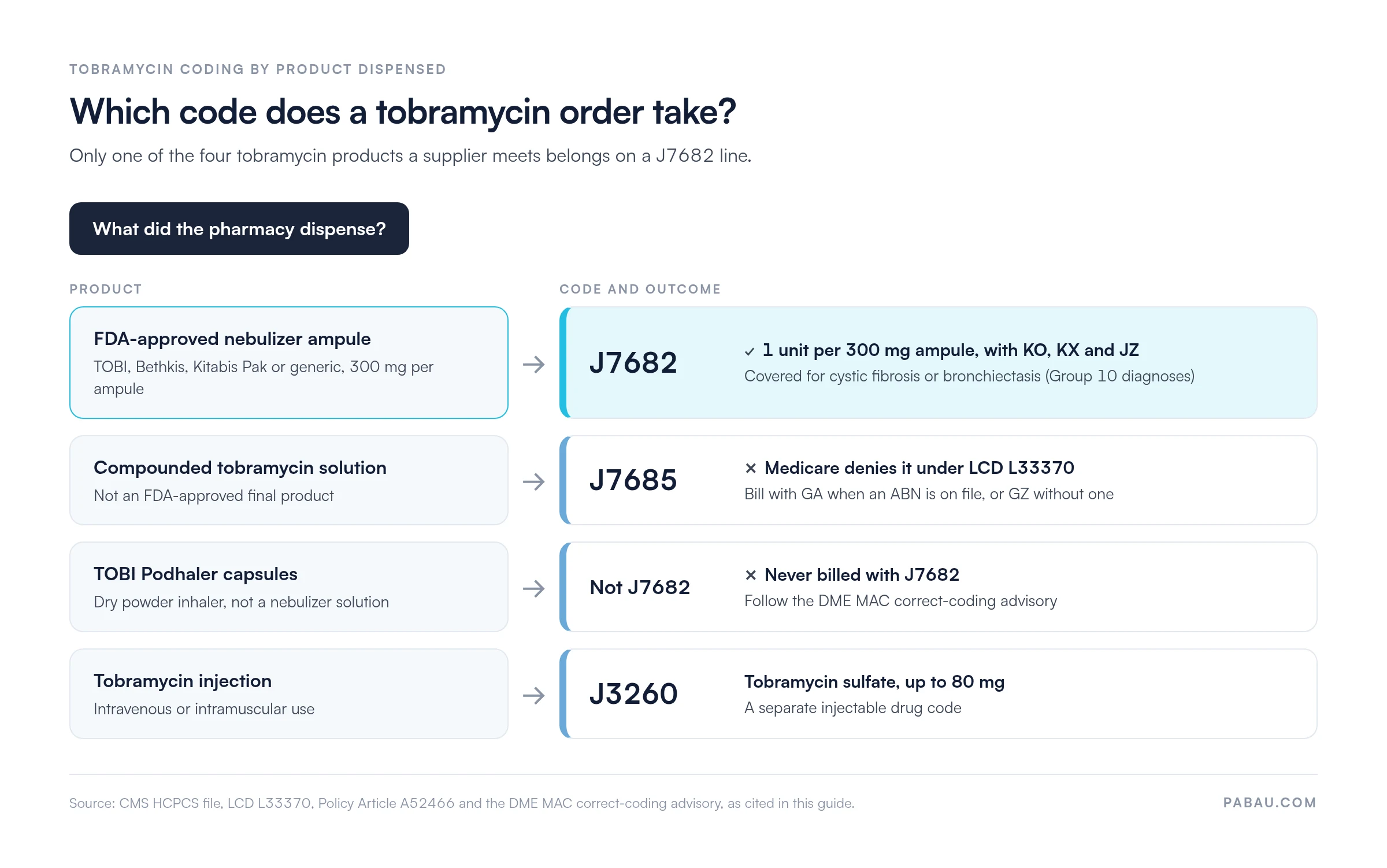
Most J7682 rework traces back to units, modifiers or the dispensed product. The fixes below follow the wording of LCD L33370 and Policy Article A52466. Strong denial management workflows then catch any that slip through.
A clean claim for J7682 carries the code, units of ampules, KO, KX and JZ, a Group 10 diagnosis and the dispensing fee code.
Errors on J7682 start when the order, the delivery record and the claim sit in different places. The biller then counts units from memory and picks modifiers without seeing the file.
Pabau, the practice management and billing platform we build, keeps the order, signed forms and the claim on the same patient record. The biller can see the product, the ampule count and the ABN before coding the line.
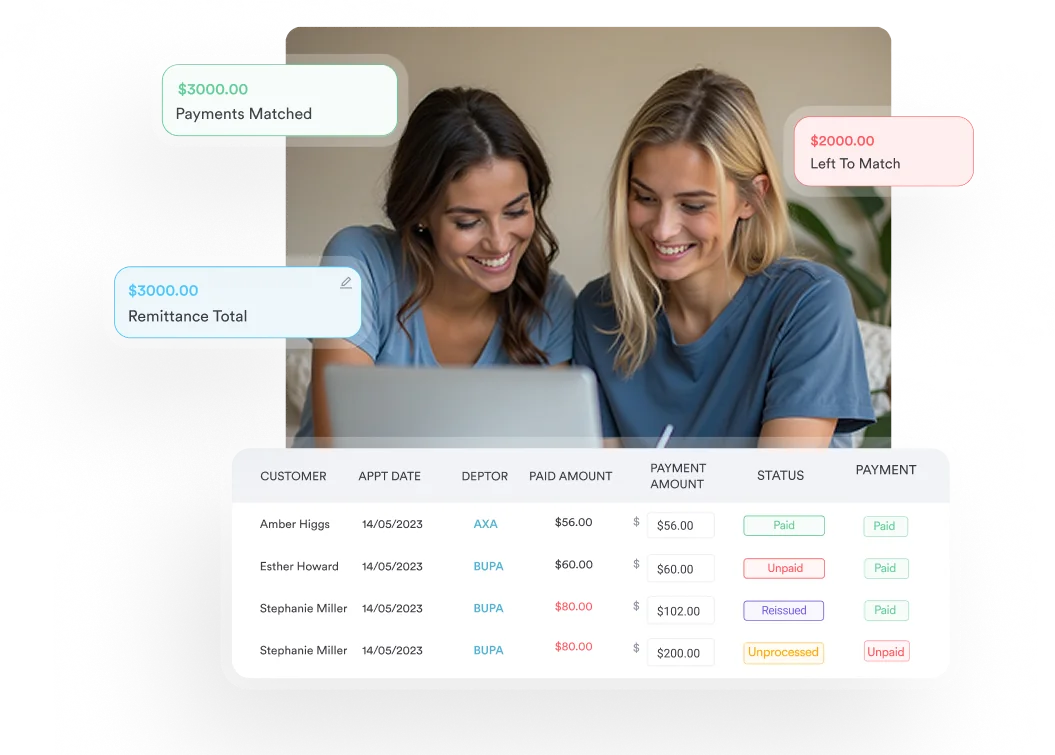
Claims management in Pabau prepares and tracks each claim from that record. When a remittance comes back, the denial reason sits next to the documents that answer it.

Pabau keeps the order, the ABN and the claim on one patient record. Your billing team can check units and modifiers before a J7682 claim goes out.

J7682 rewards a supplier who checks three facts before delivery. Those facts are the product, the diagnosis and the unit count. Confirm the ampules are FDA-approved tobramycin, not a compounded batch or Podhaler capsules.
Match the diagnosis to Group 10, and bill one unit per ampule. With KO, KX and JZ on the line, the claim passes the modifier edits in Policy Article A52466.
The cost of skipping those checks lands every 56 days, when the next cycle ships. Book a demo to see how Pabau keeps orders, ABNs and nebulizer drug claims in one place.

Need to understand how claims move through the clearinghouse? Medical claims clearinghouse guide covers how electronic claims are routed, validated, and returned to billers.
Dealing with repeated remittance denials? Denial codes in medical billing decodes the most common CARC and RARC codes appearing on DME and drug claims.
Want to understand the electronic remittance process? Electronic remittance advice explained walks through how ERAs map to claim lines and how to reconcile 835 transactions.
HCPCS code J7682 covers tobramycin inhalation solution, FDA-approved, non-compounded, in unit dose form, given through a DME nebulizer. It bills per 300 mg. TOBI, Bethkis, Kitabis Pak and generic tobramycin inhalation solution all map to it.
One TOBI ampule is one unit, because the ampule holds 300 mg and the code bills per 300 mg. A 28-day cycle at two ampules a day is 56 units.
No. J7682 is tobramycin. Tiotropium has no nebulizer-solution HCPCS code, and Spiriva inhalers fall outside the DME nebulizer benefit. The nebulized long-acting antimuscarinic with a code is revefenacin, J7677.
Medicare accepts the six Group 10 codes in Policy Article A52466: A15.0, E84.0, J47.0, J47.1, J47.9 and Q33.4. These cover cystic fibrosis with pulmonary manifestations, bronchiectasis and tuberculosis of lung.
J7682 is FDA-approved, non-compounded tobramycin, and J7685 is compounded tobramycin. Both bill per 300 mg. Medicare covers J7682 for cystic fibrosis or bronchiectasis and denies J7685 as not reasonable and necessary.
A covered J7682 line carries KO for a single-drug unit dose, KX when the LCD criteria are met, and JZ when no drug is discarded. Use GA with an ABN or GZ without one when criteria are not met. Never use KP or KQ.
No. TOBI Podhaler is a dry powder inhaler, not a nebulizer solution. The DME MAC correct-coding advisory says its tobramycin capsules must not be billed with J7682.




