CCSD code H4430: Examination of rectum under anaesthetic
CCSD code H4430 pays for the examination alone CCSD code H4430 is the UK private...

Last Updated: Oct 20, 2026
J3101 is the HCPCS Level II code for injection, tenecteplase, 1 mg.
HCPCS code J3101 bills injection, tenecteplase, 1 mg, so one unit equals one milligram administered. The code now covers two FDA-approved indications: acute ischemic stroke and acute STEMI. That matters more than it sounds, because the stroke dose is half the STEMI dose at every weight tier.
Below are both dose tables, the ICD-10 codes that carry medical necessity, the NDC and wastage rules, and the checks worth running before you submit.
Let Pabau's smart automation suggest the right codes, reduce claim denials, and keep your practice compliant—effortlessly.
Automate repetitive tasks and focus on what matters most—your patients.
Reduce coding errors and ensure compliance with the latest regulations.
Clean claims, fewer denials, and faster reimbursements.
Powerful insights and reporting to help your practice thrive.
HIPAA compliant SOC 2 certified GDPR-compliant Trusted by 4,000+ clinics worldwide

HCPCS code J3101 describes injection, tenecteplase (TNKase), 1 mg. It is billed per milligram under Medicare Part B for both of the drug’s FDA-approved indications.
TNKase carries two labeled indications. The FDA approved acute ischemic stroke on March 3, 2025, alongside the existing acute STEMI indication. Neither use is off-label.
The stroke dose is half the STEMI dose at every weight tier. Stroke runs 15 mg to 25 mg, so 15 to 25 units. STEMI runs 30 mg to 50 mg, so 30 to 50 units.
Medicare reimburses J3101 at ASP+6% in hospital outpatient and physician office settings. Rates update quarterly, so verify the current rate in the CMS ASP drug pricing file before billing.
Practice management software like Pabau pairs ICD-10 and HCPCS code lookup libraries with required-field checks, then submits the finished claim electronically. Fewer J3101 lines leave the practice incomplete.
J3101 is a Level II HCPCS drug code maintained by the Centers for Medicare and Medicaid Services (CMS). Its official descriptor is Injection, tenecteplase, 1 mg.
The code sits in the J-code range, which covers drugs given by routes other than oral, so injection, infusion, or inhalation in an outpatient setting.
Tenecteplase carries two labeled indications, and neither is off-label use. The FDA approved acute ischemic stroke (AIS) in adults on March 3, 2025.
The existing indication, reducing the risk of death from acute ST elevation myocardial infarction (STEMI), still stands. Tenecteplase itself is a tissue plasminogen activator (tPA), engineered for single-bolus intravenous delivery.
That second approval doubled the number of dose tables a coder works from. The stroke dose tops out at 25 mg. The STEMI dose tops out at 50 mg. One code bills both.
Alteplase needs a prolonged infusion. Tenecteplase does not, and its weight-based single-dose protocol is what makes it practical where infusion logistics are a barrier.
The dose is therefore fixed at the moment of injection, and it varies only by patient weight and indication.
One practical consequence: because the drug goes in during a stroke or cardiac event, the paperwork gets written under pressure. Confirm the administered dose from the medication administration record (MAR) or the procedural note, never from the ordered dose.
One billing unit of J3101 equals 1 mg of tenecteplase administered. The drug is dosed by patient body weight, and the weight tiers are identical for both indications. Only the dose inside each tier changes, and the stroke dose is exactly half the STEMI dose.
So the same 75 kg patient generates 20 units on a stroke claim and 40 units on a STEMI claim. The chart below sets both tables side by side, which is the fastest way to see how far apart the two unit counts sit.
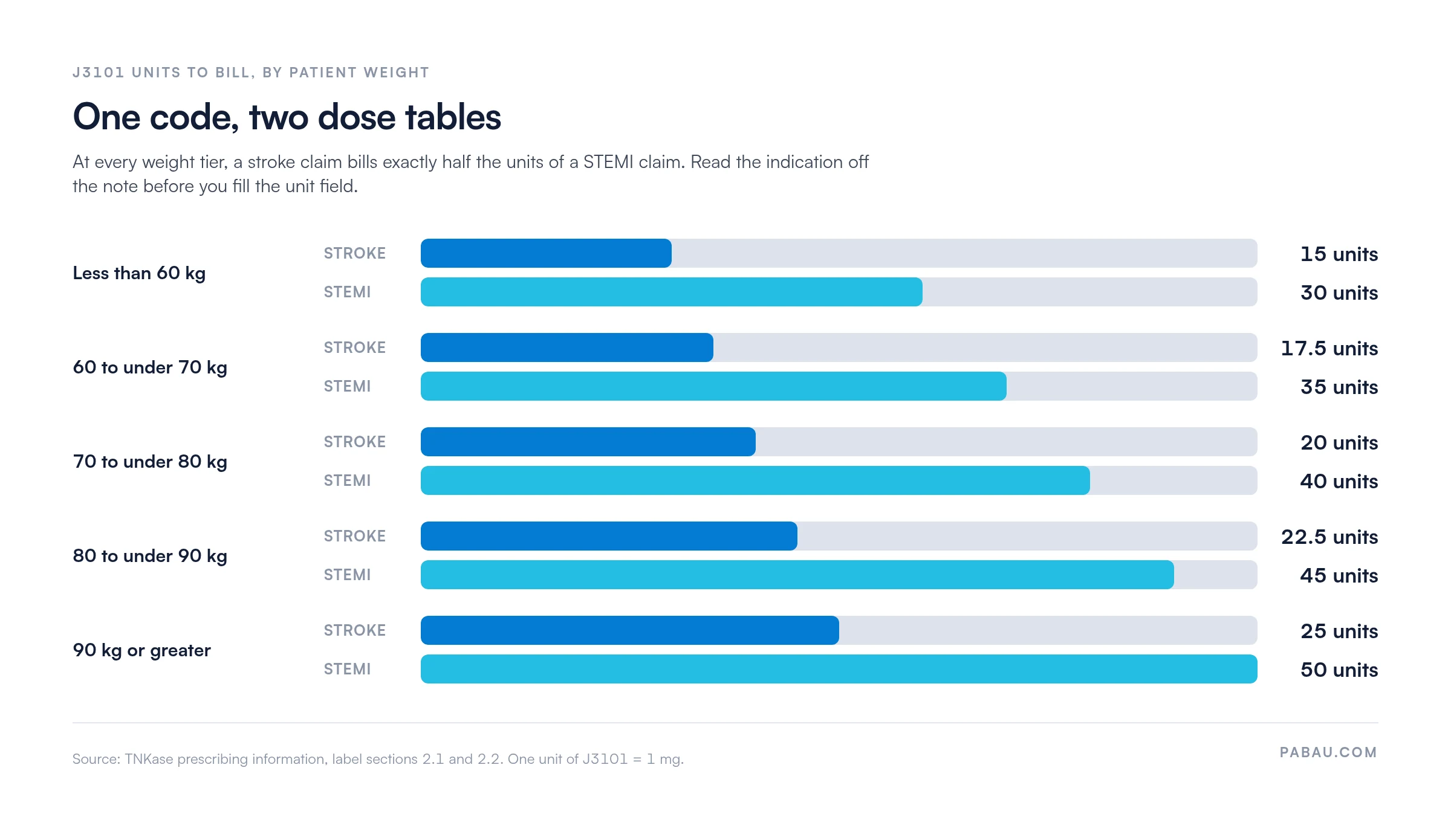
For acute ischemic stroke, TNKase goes in as a single intravenous bolus over 5 seconds. Treatment starts as soon as possible and within 3 hours of symptom onset. The maximum recommended dose is 25 mg, which is 25 units of J3101.
Fractional units: two stroke tiers land on half-milligram doses, 17.5 mg and 22.5 mg. Some payer systems accept a decimal quantity on the drug line, and others require whole units. Confirm the convention with the payer or MAC before submitting 17.5 or 22.5 units, and never round the documented dose itself.
For acute STEMI, the bolus also goes in over 5 seconds, as soon as possible after symptom onset. The maximum recommended dose is 50 mg, so no STEMI claim should exceed 50 units.
Common billing error: billing the ordered dose rather than the administered dose. If a 90 kg patient receives 50 mg but the order lists a provisional 45 mg, bill the 50 mg. The claim follows the medication administration record, not the order.
Build the indication into your J3101 charge capture rule, not just the weight. On a claim carrying an I63.x stroke diagnosis, any unit count above 25 exceeds the labeled maximum. A count of 30 or more usually means someone read the STEMI table by mistake. Catch it before the claim goes out, because a thrombolytic overpayment is the kind of finding that pulls the whole drug line into an audit.
Medicare Part B reimburses J3101 under the Average Sales Price plus 6% (ASP+6%) methodology used for provider-administered drugs.
The rate applies in both hospital outpatient department (HOPD) and physician office settings. CMS recalculates ASP quarterly, so the dollar figure per unit changes every January, April, July, and October.
To find the current rate, use the CMS Physician Fee Schedule lookup tool or the quarterly ASP drug pricing file on cms.gov. Pull the new file on the first working day of each quarter. Update charge capture from it, rather than waiting for a payment variance to surface the change.
Reading the remittance advice after adjudication is the fastest way to catch a stale rate on J3101. A payment that does not match the current quarter usually points to a claim lag or a payer contract override.
Medicare covers tenecteplase under Part B when a covered outpatient setting administers it and the record supports medical necessity.
Coverage follows the FDA-approved indications, and there are now two. A stroke claim and a STEMI claim are both coverable when the diagnosis code and the clinical record line up.
Claims submitted without a supporting I63.x or I21.x code are routinely denied.
Local Coverage Determinations (LCDs) from the relevant Medicare Administrative Contractor (MAC), such as Noridian, CGS, or Palmetto, may add documentation requirements. Check the applicable MAC’s site for current LCD guidance on J3101.
Watch one lag effect. Because the stroke indication is recent, some payer edit tables still key J3101 to cardiac diagnoses alone. If a stroke claim denies for a diagnosis mismatch, appeal with the current prescribing information attached.
Tenecteplase is billed under the buy-and-bill model. The provider buys the drug from a wholesaler or specialty pharmacy, administers it, then bills the payer for both the drug and the administration service.
That order matters for cash flow. Acquisition cost is paid upfront, and reimbursement arrives 30 to 45 days later.
Every J3101 claim needs a supporting ICD-10-CM diagnosis code that establishes medical necessity. Which series you draw from depends on the indication.
Stroke claims use the I63 cerebral infarction series, and STEMI claims use the I21 series. Both sit in the wider ICD-10-CM code library if you need to check a neighboring subcategory.
The I63 series carries medical necessity for a stroke bolus. Code to the documented mechanism, the documented vessel, and the side of the body.
The table below lists the subcodes that appear most often on thrombolytic claims.
Two traps in the I63 series. I63.8 became a non-billable parent code on October 1, 2019, split into I63.81 and I63.89, so a claim carrying I63.8 rejects as an invalid code. Laterality is also required on most subcategories, and an unspecified-side code invites a medical necessity review on a drug this expensive.
One more distinction is worth building into the workflow. A receiving facility does not bill J3101 for a dose given somewhere else. It reports Z92.82 instead, which flags tPA administered at another facility within the previous 24 hours.
The I21 series covers the cardiac indication. Use the code that names the infarct site, because the unspecified option draws documentation requests.
Use the most specific ICD-10-CM code the documentation supports. Payers apply medical necessity edits when the submitted diagnosis does not align with an indication the applicable LCD supports. Confirm coverage linkage with your MAC before billing an NSTEMI diagnosis with J3101.
Most Medicaid programs and many Medicare Advantage plans require the 11-digit National Drug Code (NDC) on drug claim lines. For tenecteplase billed as J3101, the NDC must match the package administered. TNKase ships in two vial strengths, and each carries its own NDC.
NDC numbers change when Genentech / Roche revises packaging, so confirm current values through the NLM HCPCS API or a current NDC file. Hardcoded values in the practice management system go stale.
The 25 mg vial exists to serve the stroke indication, since a stroke dose of 15 mg to 25 mg is drawn from it. A STEMI dose of 30 mg to 50 mg needs the 50 mg vial. So the NDC on a stroke claim is usually not the NDC on a STEMI claim.
How to report the NDC on a claim: Enter the 11-digit NDC in the shaded area of Box 24. On the 837P electronic transaction, use the NDC qualifier field instead. Include the qualifier “N4”, the 11-digit code, the unit of measure qualifier “UN”, and the quantity administered.
Both TNKase vials are single-dose containers, so Medicare’s discarded-drug policy applies to J3101. A 15 mg stroke dose drawn from the 25 mg vial leaves 10 mg behind. Part B pays for that remainder when the claim reports it properly.
CMS has required one of the two modifiers on single-dose-vial drug claims since July 1, 2023. Claims carrying neither have been returned as unprocessable since October 1, 2023. Payment for waste is capped at the amount printed on the vial label, so the two lines together should never exceed 25 or 50 units.
Record the discarded amount in the patient’s chart as well as on the claim. That note is what supports the JW line if the drug charge is ever reviewed.
J3101 rarely appears alone. The table below shows the codes most often billed alongside it, plus the adjacent codes coders check while working tenecteplase claims.
A drug claim also needs its administration line, and CPT 96374 is the code a single tenecteplase bolus takes. Bill it once per encounter alongside the drug itself.
There is no stroke-specific alternative. The J3101 descriptor, Injection, tenecteplase, 1 mg, is indication-neutral. The same code bills the stroke dose and the STEMI dose, and only the unit count and the diagnosis change.
Before a J3101 claim goes out, the note has to name four things. Those are the indication, the patient weight, the administered dose, and the clinical basis for thrombolysis.
Tenecteplase claims attract scrutiny because of the drug’s unit cost and the specificity thrombolytic therapy needs. So the habits that matter get set at the point of care, well before a claim reaches any scrubber.
Turn that into a short pre-submission pass. Five checks catch most of what comes back on a J3101 line.
Those records are also what make a denial appealable later. Missing clinical evidence is the most common reason appeals fail. Having the note, the weight, and the NDC to hand before the deadline removes that risk.
Traditional Medicare (Parts A and B) does not require prior authorization for J3101 in most settings. Tenecteplase goes in during stroke and cardiac emergencies, where pre-approval is impractical.
Medicare Advantage plans operate differently. Some require prospective authorization for high-cost Part B drugs even in urgent settings, and many carve emergency events out of the standard workflow.
Commercial and Medicaid requirements vary and change regularly. Never assume a payer skips prior authorization based on a previous claim, and check the current policy before administration when the clinical situation permits. The AAPC HCPCS code lookup is a quick way to confirm the code’s current status and any billing notes attached to it.
Manual J3101 billing goes wrong at four points. Those are the indication, the unit count tied to the weight tier, the NDC line, and the diagnosis linkage that triggers coverage.
Those four often live in four places. The MAR sits in the chart, the code sits in a lookup tab, and someone retypes both into the claim.
Practice management software like Pabau closes that distance by building the claim from the record itself. The service attached to the encounter lands on the charge line, and diagnosis slots are seeded from the client’s recorded problem list.
Full ICD-10-CM and HCPCS lookup libraries sit behind a search icon and refresh with each official release.
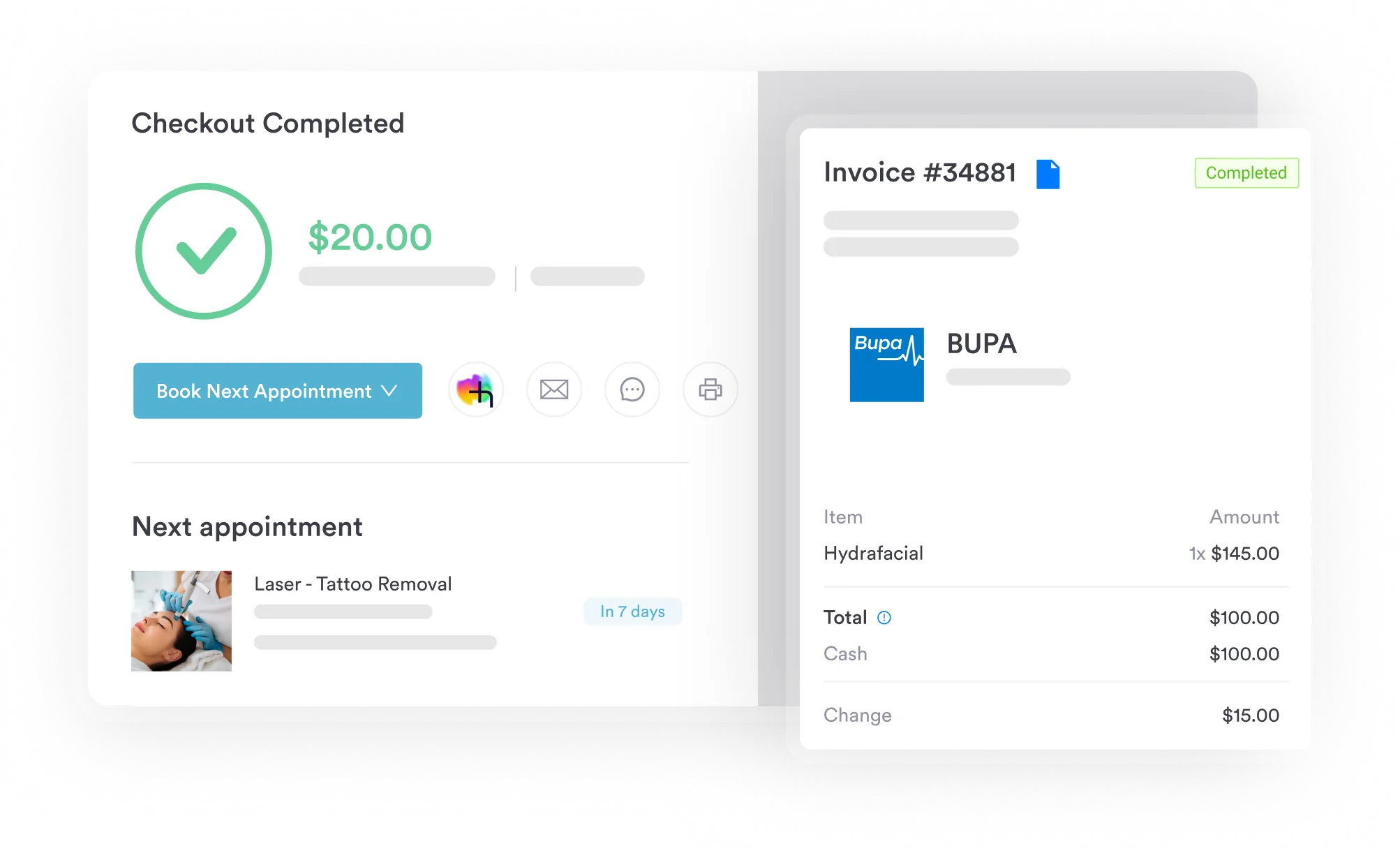
Before the send button unlocks, the system checks that the fields a claim cannot go without are filled, such as membership numbers and authorization codes.
The claim then goes out electronically. On US claims, remittance posting and claim-status tracking come back into the same record.
None of that picks the code for you. A coder still reads the indication and counts the milligrams, and no software should be trusted to do either.
What changes is how much of the claim gets retyped, and how many J3101 lines leave the practice missing something the payer needed. That is the job of claims software for practices.

Pabau’s claims management software builds the claim from the encounter record, checks that required fields are complete, and submits it electronically. Fewer J3101 lines come back for something the payer needed.

J3101 asks very little of a coder and punishes small mistakes hard. The unit field holds one number, and that number is wrong the moment someone reads the STEMI table against a stroke chart.
So build the indication into the charge rule, not just the weight. To see how it handles HCPCS drug lines from charge capture through remittance, book a demo.

Need to tell the two thrombolytic J-codes apart? HCPCS code J2997 covers alteplase billing, coverage, and reimbursement, which is the code J3101 is most often confused with.
Tempted to bill an unclassified drug code? HCPCS code J3490 explains when the unclassified code is correct, and why a drug with its own J-code never qualifies.
Billing the administration line as well as the drug? CPT code 96374 covers IV push billing, modifiers, and the documentation a single bolus needs.
Want to reduce rejections before submission? Clean claim submission covers the checklist every billing team should run before transmitting high-cost injectable claims.
Dealing with J3101 denials after adjudication? Denial management workflows outlines how to track, appeal, and prevent recurring denials on drug J-codes.
No. Once the patient is admitted, the drug is paid inside the inpatient MS-DRG under Part A, not as a separate Part B line. Report it in the inpatient charges instead. J3101 is a Part B drug line for hospital outpatient and physician office settings.
Revenue code 0636, pharmacy drugs requiring detailed coding. Hospital outpatient claims pair 0636 with the HCPCS code on the same line, so 0636 never stands alone. Payers that require an NDC expect it on that line too.
Whoever bought the drug bills it. In a hospital outpatient department the facility reports J3101 on its own claim, and the physician bills only the professional service. In a physician office the practice bills both the drug and the administration.
No. The Sterile Water for Injection vial is co-packaged with TNKase, so it has no separate code and no separate claim line. Its cost sits inside the drug’s package price and the ASP that Medicare pays on.