CCSD code H4430: Examination of rectum under anaesthetic
CCSD code H4430 pays for the examination alone CCSD code H4430 is the UK private...

Last Updated: Oct 20, 2026
J2840 is the HCPCS Level II code for injection, sebelipase alfa, 1 mg.
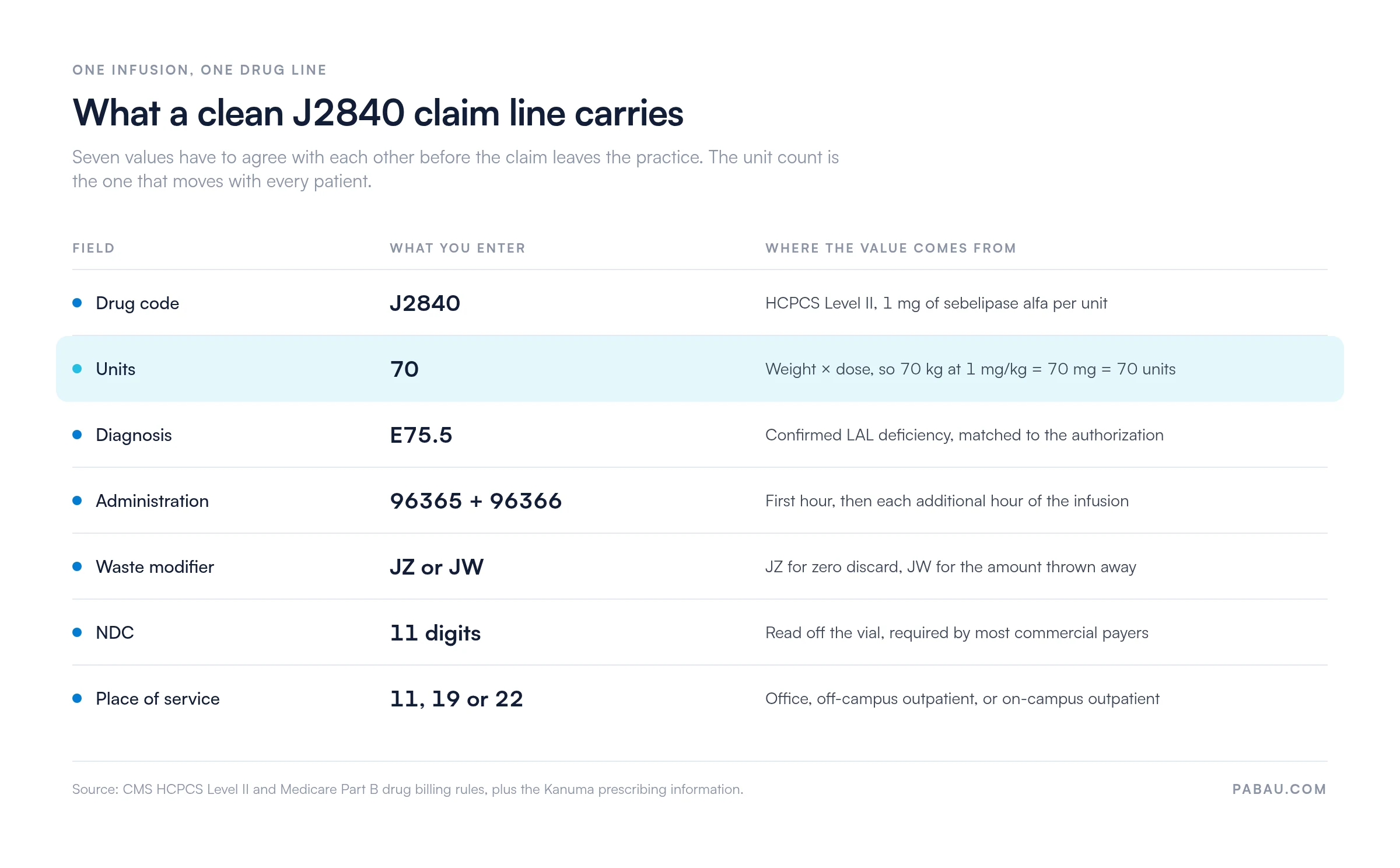
The drug is dosed by body weight, so the unit count changes with every patient. A 70 kg adult on 1 mg/kg needs 70 units on the drug line.
Let Pabau's smart automation suggest the right codes, reduce claim denials, and keep your practice compliant—effortlessly.
Automate repetitive tasks and focus on what matters most—your patients.
Reduce coding errors and ensure compliance with the latest regulations.
Clean claims, fewer denials, and faster reimbursements.
Powerful insights and reporting to help your practice thrive.
HIPAA compliant SOC 2 certified GDPR-compliant Trusted by 4,000+ clinics worldwide

HCPCS code J2840 covers an injection of sebelipase alfa, sold as Kanuma, billed at 1 mg per unit.
Units are weight-based. Multiply the patient’s weight in kg by the dose in mg/kg, then bill one unit per milligram.
Medicare pays J2840 under Part B at ASP plus 6%, and CMS refreshes that rate every quarter.
E75.5 is the diagnosis code that carries the claim, and most commercial payers want prior authorization first.
Practice management software like Pabau pre-fills the claim from the client record and checks required fields before submission.
J2840 is a HCPCS Level II code, and the Centers for Medicare and Medicaid Services (CMS) maintains it.
Sebelipase alfa is an enzyme replacement therapy (ERT) made by Alexion Pharmaceuticals, part of AstraZeneca. The brand name on the vial is Kanuma.
Because Kanuma is infused in a clinical setting rather than dispensed to the patient, J2840 sits in the buy-and-bill model.
The practice buys the drug, administers it, and then bills the payer for both the drug and the administration.
Lysosomal acid lipase deficiency (LAL-D) is a rare inherited disorder. The LAL enzyme does not work properly, so cholesteryl esters and triglycerides build up in the liver, spleen, and blood vessels. Sebelipase alfa replaces the missing enzyme.
The condition shows up in two forms, and they are dosed differently. Wolman disease is the severe infantile presentation. Cholesterol ester storage disease (CESD) is the attenuated form that appears in children and adults.
J2840 is billed per milligram, so the units on the claim equal the total milligrams given at that visit. It is also the value that goes wrong most often on Kanuma claims.
The formula: weight in kg x dose in mg/kg = total mg = units of J2840.
Use the weight taken on the day of the infusion, not the one from the last visit. Auditors compare the units billed against the weight in the note, and a growing child makes that difference obvious.
Round the dose the way the prescriber and the Kanuma prescribing information say to, and never round up to finish a vial.
Under Part B, Medicare pays for J2840 using the Average Sales Price methodology. ASP is the manufacturer’s weighted average price across purchasers. The 6% add-on is meant to cover what it costs the practice to buy and hold the drug.
CMS republishes ASP payment limits every January, April, July, and October. Each quarter’s figure reflects sales data from two quarters earlier.
Sebelipase alfa is a low-volume biologic, so its ASP can move sharply between quarters. Pull the current number from the CMS ASP drug pricing files before you quote a rate.
Setting matters too. Part B covers J2840 in a physician office, an outpatient practice, or an infusion center. Hospital outpatient departments bill under OPPS instead, which can pay a different amount for the same milligram.
Check where the infusion happened before you apply any published figure.
Commercial plans negotiate their own rates. Most still use ASP as the reference point, then apply a contracted multiplier that often lands between ASP plus 10% and ASP plus 25%. A few price off Average Wholesale Price (AWP) instead.
Bookmark the CMS ASP drug pricing file and reopen it every January, April, July, and October. Search the quarter’s file for J2840 and read the payment limit per unit. That figure is what Medicare pays for a single milligram, so multiply it by your unit count before you give a patient an estimate.
Kanuma does not go to the patient through a retail pharmacy. The practice buys it, stores it cold, infuses it, and waits to be paid.
That gap between the purchase order and the remittance is money sitting on your shelf. On a cheap drug the sequence below would barely matter. Here it does.
Most payers require prior authorization before the first Kanuma infusion, then again at intervals for continuing therapy. The exact list varies, so confirm it with the plan.
What follows is the documentation payers commonly ask for on specialty biologics.
Reauthorization turns on evidence of response. Payers usually want to see liver enzymes improving, growth parameters holding up in pediatric patients, or a documented change in symptoms.
Send that evidence with the renewal rather than waiting to be asked for it.
Every J2840 claim has to point at a diagnosis that justifies the drug. LAL deficiency sits in the lipid storage disorder range. A vague or unrelated code is one of the fastest ways to get this claim rejected.
Check the code against the Local or National Coverage Determination that applies to sebelipase alfa. Then confirm it with your Medicare Administrative Contractor (MAC).
Our ICD-10-CM code library carries the full descriptions if you need to compare neighboring codes before you commit.
J2840 never travels alone. Two administration codes sit beside it, and two unclassified codes wait in reserve for the payer that does not recognize J2840 yet.
If you do fall back to J3490 or J3590, attach the drug name, the NDC, the acquisition invoice, and the dosing detail. Unclassified drug lines without that packet get denied as a matter of routine.
The AAPC HCPCS code lookup is a quick way to confirm a neighboring descriptor while you build the claim.
Rare-disease infusion billing leaves little room for a slip. Seven values have to agree with each other on one claim, and the diagram below shows where each of them comes from.
Modifiers tell the payer how the drug reached the patient and what happened to the rest of the vial. Two of them are mandatory on Medicare claims, and the others depend on the policy in front of you.
The same handful of slips shows up again and again, so a fixed check catches most of them. Work down this list before the claim leaves the practice, and keep a copy of it beside the infusion schedule.
When one does come back, work it the same week. High-value drug lines age badly, and the appeal window can close while the claim sits in a queue.
Our guide to managing claim denials covers how to triage a stack of them without losing the timely filing deadline.
A practice running Kanuma has a handful of patients and no margin for a lost claim. In most setups the biller assembles the claim by hand from three places: the infusion note, the authorization letter, and the vial label. Rekeying those values is where the unit count and the diagnosis code drift apart.
Practice management software like Pabau keeps the record and the claim in one system. The claim form pre-fills from the client record, so codes already attached to the service land on the charge line instead of being typed twice. Built-in ICD-10 and HCPCS lookup libraries let staff confirm a descriptor without leaving the claim.
Pabau also checks that the claim’s required fields are complete before it can be sent, and authorization numbers are part of that check.
Our claims management software then submits through a clearinghouse connection that returns eligibility results, claim status, and electronic remittance advice.

Pabau pre-fills the claim from the client record, checks the required fields before submission, and tracks claim status on the way back. Your billers spend less time rebuilding claims by hand.

J2840 is an easy code to describe and a hard one to bill. The descriptor takes a single line. The claim behind it needs a weight from the right day, an authorization that has not lapsed, and a diagnosis code that matches both.
The practices that stop losing money here are the ones that stop treating each infusion as a fresh puzzle. Fix the sequence once, write it down, and run the same check every time. The arithmetic never changes. Only the patient does.
Want to see the claim and the clinical record stay in step without a second data entry? Book a demo and we’ll walk through how Pabau handles a specialty drug claim end to end.

Want fewer claims coming back in the first place? What makes a claim clean sets out the fields payers check before they adjudicate.
Not sure how your claim actually reaches the payer? Medical claims clearinghouse guide explains the routing between practice, clearinghouse, and plan.
Need to check that a drug line paid correctly? Electronic remittance advice explained shows how to read an ERA and spot an underpayment.
Working a stack of denials this week? Denial management in healthcare covers how to triage, appeal, and stop the same denial repeating.
Billing the saline that runs with the infusion? HCPCS code J7030 covers normal saline infusion and how it is reported.
Enter the 11-digit NDC from the vial in the shaded portion of the service line, with the N4 qualifier in front of it. Follow it with the unit of measure and the quantity administered. Most commercial payers reject the drug line without it.
Kanuma comes in single-dose vials, so any remainder is discarded. Bill the administered amount on one line, then the discarded amount on a second line with modifier JW. When nothing is thrown away, append JZ to the drug line instead.
Some commercial plans require white bagging, where a specialty pharmacy ships the drug to the practice. The pharmacy bills the plan for the drug, so you bill only the administration codes. Confirm the plan’s supply channel before you order.
CMS publishes medically unlikely edits (MUEs) that cap the units payable per patient per day. Check the current practitioner services MUE table for J2840 before you submit a high unit count for a heavier patient.
Read the remark code first. Then rebuild the packet: the enzyme or genetic test result, the specialist letter, the dosing plan, and the weight on file. File inside the payer’s appeal window, which commonly runs 60 to 180 days.