CCSD code H4430: Examination of rectum under anaesthetic
CCSD code H4430 pays for the examination alone CCSD code H4430 is the UK private...

Last Updated: Oct 20, 2026
J2820 is the HCPCS Level II code for injection, sargramostim (gm-csf), 50 mcg.
Let Pabau's smart automation suggest the right codes, reduce claim denials, and keep your practice compliant—effortlessly.
Automate repetitive tasks and focus on what matters most—your patients.
Reduce coding errors and ensure compliance with the latest regulations.
Clean claims, fewer denials, and faster reimbursements.
Powerful insights and reporting to help your practice thrive.
HIPAA compliant SOC 2 certified GDPR-compliant Trusted by 4,000+ clinics worldwide

HCPCS Code J2820 describes injection of sargramostim (GM-CSF), brand name Leukine, billed per 50 mcg administered.
Medicare reimburses J2820 at ASP + 6% under Part B. Rates update quarterly, so verify each one against the current CMS ASP file.
Covered indications include post-autologous and allogeneic bone marrow transplant, AML myeloid reconstitution, and delayed neutrophil recovery under LCD L37176.
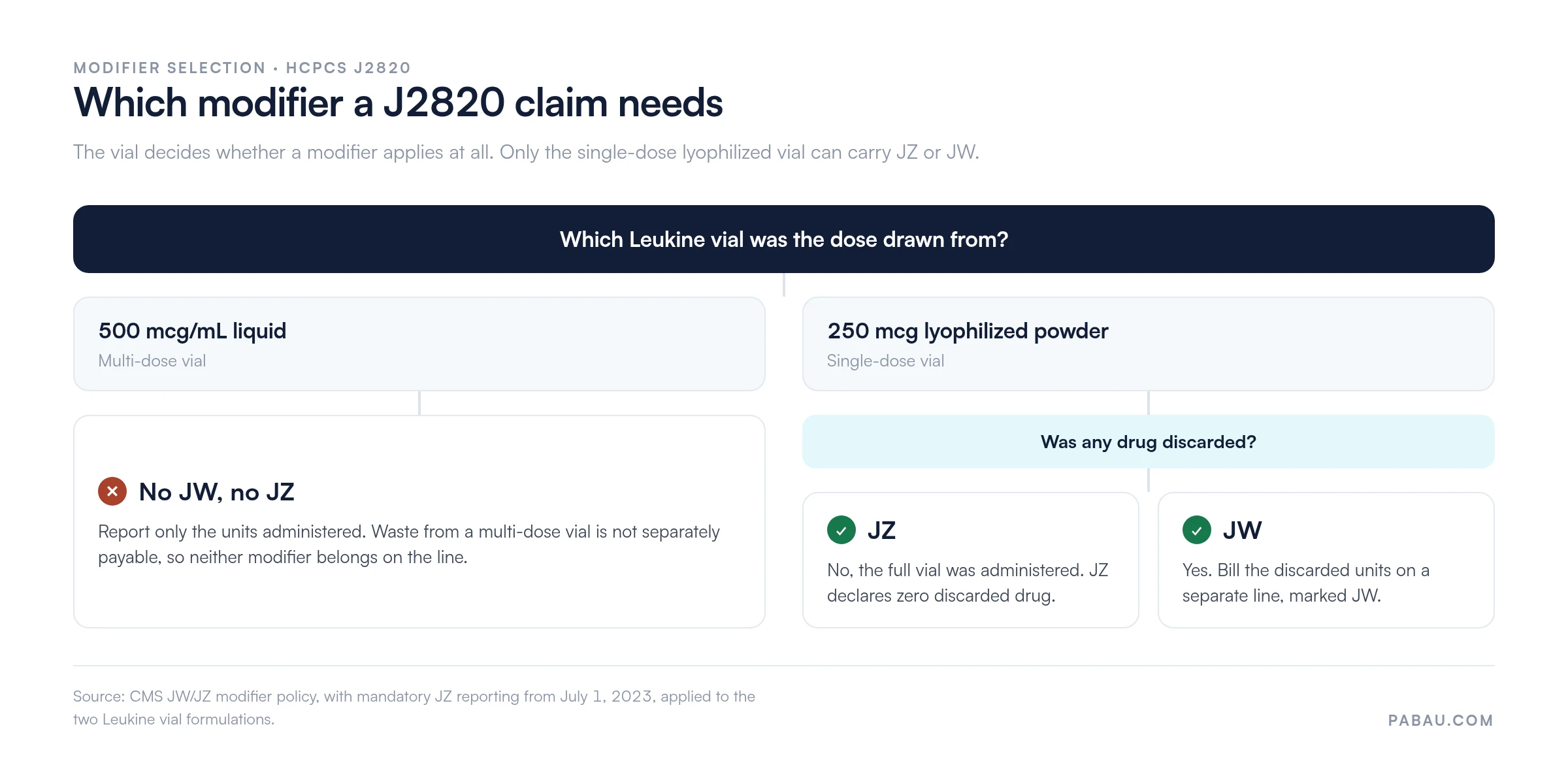
Mandatory JZ reporting began July 1, 2023, and it applies only to the single-dose lyophilized vial of Leukine.
Practice management software like Pabau tracks J-code documentation, records the units administered, and submits claims electronically.
HCPCS Code J2820 is a Level II HCPCS code describing Injection, sargramostim (GM-CSF), 50 mcg. One unit equals 50 mcg administered, so the unit count on the claim follows directly from the documented dose.
Sargramostim is a recombinant human granulocyte-macrophage colony-stimulating factor, marketed as Leukine by Partner Therapeutics. It promotes the growth and differentiation of myeloid progenitor cells. As a result, that makes it central to bone marrow transplant recovery and neutropenia management.
This guide covers the billing units, the covered indications, and Medicare reimbursement. It also covers the ICD-10 crosswalk, prior authorization, and the documentation standards a J2820 claim has to meet.
The billing unit for J2820 is 50 mcg. Every 50 mcg of sargramostim administered equals one reportable unit. As a result, submitting the wrong unit count is the single most common denial trigger for this code.
Per the FDA label, the standard dose is 250 mcg/m² per day across indications. The 500 mcg/m² dose is not an interchangeable alternative. Instead, it applies only as an escalated third course, after two 250 mcg/m² courses have failed to produce neutrophil recovery.
For a patient with a body surface area of about 1.8 m², a 250 mcg/m² dose yields 450 mcg. Next, divide by 50 mcg per unit and report 9 units of J2820. Round down to the nearest whole unit unless payer policy explicitly permits rounding up.
Document the exact dose in the patient’s chart and on the administration record before submitting. NDC reporting is also required on Medicare claims for J-code drugs, which the crosswalk section below covers.
Software that captures the administered dose at the point of care can populate the billing unit field for you. As a result, that removes the manual transcription step where most unit errors start.
Medicare coverage for HCPCS Code J2820 runs through Local Coverage Determination L37176, White Cell Colony Stimulating Factors. Coverage is narrow. As a result, administering sargramostim outside a covered indication, or without adequate documentation, invites a denial or a recoupment audit.
The following clinical scenarios are covered under CMS LCD guidance. Confirm the applicable LCD is current for your MAC jurisdiction before submitting, as coverage criteria can be revised.
Off-label uses of sargramostim fall outside LCD L37176 and should not be reported with J2820 on Medicare claims without payer-specific verification.
L37176 governs the whole white cell colony stimulating factor family, not sargramostim alone. Similarly, the same coverage criteria apply when you bill J1442 for filgrastim.
Check the current revision of LCD L37176 each January, when CMS releases updated coding guidance. Coverage criteria for white cell colony stimulating factors have been revised several times. Billing against a superseded revision is a common audit trigger.
Every J2820 claim must be supported by an ICD-10-CM diagnosis code that establishes medical necessity. The diagnosis code must match the documented covered indication. Otherwise, using an ICD-10 code that does not align with the LCD-covered indication will trigger an automatic denial.
Verify ICD-10-CM codes against the current year’s official tables from the CDC/NCHS ICD-10-CM web tool. Codes effective in one fiscal year may be revised or retired in the next. Build that check into the pre-submission workflow, so a retired code never reaches a payer.
Medicare Part B reimburses J2820 using the Average Sales Price (ASP) methodology. In the physician office setting, reimbursement equals ASP + 6% of the drug’s ASP. In contrast, in the hospital outpatient department, the drug is typically bundled into the Ambulatory Payment Classification (APC) rate rather than paid separately at ASP + 6%.
ASP rates are updated quarterly by CMS. The amount effective in one quarter may differ from the prior quarter. Therefore, pull the current figure from the CMS ASP pricing files for your billing period.
The physician fee schedule lookup tool is the wrong source for this code. It prices services rather than Part B drugs, so a J-code rate taken from it will not match what the MAC pays.
The superbill generated after each sargramostim administration should capture the billed units, the NDC, the lot number, and the date of service. In turn, those fields feed the claim and build the medical necessity record at the same time.
CMS requires NDC (National Drug Code) reporting on Medicare Part B drug claims alongside the HCPCS code. The NDC identifies the specific Leukine product by labeler, formulation, and package size. Therefore, it must accompany J2820 on the claim form.
Leukine (sargramostim) is available in two formulations. One is a 500 mcg/mL liquid in a multi-dose vial. The other is a 250 mcg lyophilized powder in a single-dose vial, reconstituted before use.
Each formulation and package size carries a distinct NDC. The NDC reported must match the vial used, not a generic placeholder. As a result, payers audit NDC-to-HCPCS consistency, and a mismatch triggers an automatic claim edit.
Verify the NDC at the point of drug administration rather than at the billing stage. As a result, that prevents the retrospective corrections that delay payment by a full adjudication cycle.
Medicare does not require prior authorization for J2820 in most settings, but most commercial payers do. PA requirements vary by plan and can change annually – confirming requirements with each payer before administering the drug is the only reliable safeguard.
Eligibility verification should include a specific check for specialty drug authorization, not just general benefit eligibility. In other words, a pre-appointment check that captures drug-specific requirements prevents costly post-service denials. Key items payers typically require for PA approval:
For denied PA requests, most commercial payers permit peer-to-peer review. Then, request the appeal within the payer’s stated timeframe, typically 30 to 60 days from the denial date.
Given the per-unit cost of sargramostim, specialty drug PA denials deserve their own queue rather than the general denial backlog. In short, one unbilled 450 mcg dose is a material write-off.
LCD L37176 sets the documentation standards a J2820 claim has to meet to survive audit. Specifically, the record must support both the covered indication and the specific dose administered.
Missing or inadequate documentation is the second most common reason J2820 claims are denied or recouped after audit.
Retention rules come from both Medicare and state law, and the longer window governs. As a result, many oncology practices standardize on seven years for specialty drug records, holding the administration log and the NDC alongside the claim.
The CMS HCPCS program guidelines provide the authoritative framework for J-code documentation standards.
Coding accurately for HCPCS Code J2820 requires more than knowing the unit size. The following guidelines reflect CMS LCD coding rules and common payer editing patterns.
Which modifier applies depends on the vial the dose came from, and on whether any drug was left in it.
Reviewing denial codes systematically shows which J2820 edits keep recurring. In turn, the pattern tells you whether the cause is missing documentation, a coding workflow problem, or a payer policy change.
The NLM HCPCS Level II API is a useful programmatic resource for teams building claim validation checks into their billing software.
Audit J2820 claims quarterly for modifier JZ compliance. JZ reporting became mandatory on July 1, 2023, with claim edits following that October. Practices that never updated their billing templates keep accumulating avoidable edits. One template audit and a staff refresh clears the category.
Sargramostim can be acquired and administered under two models. The buy-and-bill model applies in physician office and outpatient settings: the practice purchases the drug directly, administers it, and bills J2820 to the payer. In contrast, the specialty pharmacy model routes the drug through a pharmacy to the patient or infusion center, typically shifting billing responsibility away from the practice.
Commercial payer policies may mandate specialty pharmacy dispensing for sargramostim regardless of the practice’s preference. Therefore, confirm the acquisition model during PA verification.
Buy-and-bill practices carry the drug cost until the payer pays. As a result, that makes it worth tracking acquisition cost against reimbursement per claim, and flagging any line where the spread turns negative.
Oncology and transplant billing teams face a compounding documentation problem. The clinical record, the administration log, the NDC, the ICD-10 crosswalk, and the authorization all have to agree at the moment of submission. As a result, when one layer is missing or mismatched, the claim fails.
Practice management software like Pabau closes that loop. Specifically, Pabau’s claims management software holds the administered dose, the units, the NDC, and the authorization record against the same encounter.
The difference for a J-code-heavy practice is where the administered-dose data lives. It has to sit at the clinical record level, then reach the billing team without re-entry. That is where unit errors on J2820 begin.

Pabau’s claims management software helps oncology and transplant practices track HCPCS J-code documentation, manage prior authorization records, and submit clean claims electronically. See how it works for your billing team.

J2820 rewards precision more than most J-codes. Sargramostim is expensive, LCD L37176 names a short list of covered indications, and the unit count is plain arithmetic on the documented dose.
Four habits remove most of the denial categories in the table above. Capture the dose at the point of care, and check the diagnosis against the current LCD revision. Then report the NDC that matches the vial, and pick JZ or JW from the vial rather than from habit.
Pabau tracks those four across every J2820 claim, without manual cross-checks between disconnected systems. Book a demo to see how specialty drug billing runs in one place.

Need a complete framework for submitting clean claims? Building a clean claim process covers the documentation and submission standards that reduce first-pass denials.
Billing the other white cell growth factor? HCPCS Code J1442 covers filgrastim units, coverage, and reimbursement under the same LCD.
Managing denial patterns across your billing team? Denial management in healthcare explains how to categorize, track, and resolve recurring claim denials.
Want the fields a drug administration record should carry? What a superbill includes walks through each line and why payers ask for it.
Looking for a broader guide to billing fundamentals? What is revenue cycle management outlines how billing, collections, and documentation connect.
HCPCS Code J2820 is used to bill for injections of sargramostim (GM-CSF), brand name Leukine, at a rate of one unit per 50 mcg administered. Specifically, it is used primarily in oncology and transplant settings for myeloid reconstitution following bone marrow transplant and for neutropenia management in AML and chemotherapy patients.
The billing unit is 50 mcg. For every 50 mcg of sargramostim administered, one unit of J2820 is reported. For example, a 500 mcg dose equals 10 units, and a 250 mcg dose equals 5 units.
In the physician office setting, Medicare reimburses J2820 under Part B at ASP + 6%. Rates update quarterly, so verify the current amount in the CMS ASP pricing files for your billing period. In contrast, hospital outpatient settings typically receive an APC bundled rate rather than a separate ASP-based payment.
Medicare generally does not require prior authorization for J2820, but most commercial payers do. Requirements vary by payer and change annually. Therefore, confirm authorization requirements before administering sargramostim to avoid post-service denials.
The HCPCS code for granulocyte-macrophage colony-stimulating factor (GM-CSF) is J2820. Sargramostim is the only recombinant GM-CSF currently FDA-approved for clinical use in the United States, marketed under the brand name Leukine.