CCSD code H4430: Examination of rectum under anaesthetic
CCSD code H4430 pays for the examination alone CCSD code H4430 is the UK private...

Last Updated: Oct 20, 2026
J2778 is the HCPCS Level II code for injection, ranibizumab, 0.1 mg.
That conversion is where most J2778 denials and underpayments start. A biller who treats the code as a flat-line charge submits one unit for a 0.5 mg dose worth five. The underpayment then repeats on every injection cycle.
Let Pabau's smart automation suggest the right codes, reduce claim denials, and keep your practice compliant—effortlessly.
Automate repetitive tasks and focus on what matters most—your patients.
Reduce coding errors and ensure compliance with the latest regulations.
Clean claims, fewer denials, and faster reimbursements.
Powerful insights and reporting to help your practice thrive.
HIPAA compliant SOC 2 certified GDPR-compliant Trusted by 4,000+ clinics worldwide

HCPCS Code J2778 describes Injection, ranibizumab, 0.1 mg, the billing unit for Lucentis, an anti-VEGF drug used in ophthalmology.
Each billed unit equals 0.1 mg. A 0.5 mg dose for wet AMD is 5 units, and a 0.3 mg dose is 3 units.
Every claim must pair J2778 with a supported ICD-10-CM diagnosis carrying the correct laterality character.
Medicare Part B reimburses J2778 at ASP plus 6% under the buy-and-bill model. Prior authorization requirements vary by payer.
Practice management software like Pabau pre-fills claim data and runs validation checks before submission, so incomplete J2778 claims are caught in-house.
HCPCS Code J2778 is the Healthcare Common Procedure Coding System Level II code for Injection, ranibizumab, 0.1 mg. Ranibizumab is marketed under the brand name Lucentis (Genentech/Roche) and belongs to the anti-VEGF (vascular endothelial growth factor) class of ophthalmic drugs. J-codes classify physician-administered drugs in outpatient settings; J2778 sits within the ophthalmology drug subset alongside codes for aflibercept and other retinal agents.
According to CMS Local Coverage Article 52451, Medicare covers ranibizumab for four primary indications. Each claim must pair J2778 with a supported ICD-10-CM diagnosis code. Submitting the code with an unsupported diagnosis is the fastest path to a medical-necessity denial. Several of the retinal codes below have non-billable parent entries, so the claim needs the full-length code rather than the category.
Always code to the highest level of specificity the category offers, including laterality where it exists. Omitting the laterality character is a common cause of rejections on retinal codes. Where laterality is not available, as with E11.311, the shorter code is the complete one.
One unit of HCPCS Code J2778 equals 0.1 mg of ranibizumab administered. The prescribing physician documents the dose in milligrams; the biller converts that figure to units by multiplying by 10. This conversion is where unit errors are most common.
Note: dose recommendations may vary based on individual patient protocols and updated FDA prescribing information. Always confirm the administered dose from the physician’s clinical note before calculating units. Billing a dose that does not match the documented amount is an audit risk under Medicare’s medical record reconciliation rules.
Medicare Part B reimburses HCPCS Code J2778 at the average sales price (ASP) plus 6%. CMS updates ASP pricing quarterly, so the exact reimbursement rate changes four times per year. Current rates come from the quarterly ASP pricing files CMS publishes for Part B drugs, not from the physician fee schedule.
The ASP+6% formula covers the drug acquisition cost plus a dispensing margin. Because ranibizumab is a high-cost ophthalmic injectable, the reimbursement per injection episode can be substantial. Practices that track the quarterly ASP updates and adjust their expected payment avoid being surprised by a mid-year rate change. Checking the remittance after each payment cycle confirms Medicare applied the current ASP rate.
Under the buy-and-bill model, the ophthalmology practice purchases ranibizumab directly, administers it in-office, and then bills Medicare. This is the standard pathway for J2778 reimbursement. The alternative, specialty pharmacy dispensing, applies when the drug is dispensed to the patient rather than administered by the practice.
Choosing the pathway is a purchasing decision that sits with the practice. What claims management software does is pre-fill the claim from stored record data and run validation checks before submission. A claim missing its authorization number is held back rather than sent.
Modifiers tell Medicare how and where the drug was administered. Omitting a required modifier, or applying the wrong one, delays or denies payment. The table below covers the modifiers most commonly used with J2778.
Modifier requirements vary by Medicare Administrative Contractor (MAC). Check current bulletins from your MAC, such as Palmetto GBA or National Government Services, before applying laterality modifiers. Not every MAC wants RT or LT on a drug code. Capture the modifier at the point of care rather than reconstructing it after the fact.
Flag your J2778 claims for a modifier audit at least quarterly. Pull a sample of 20 claims and cross-check the modifier applied against the MAC’s current billing guidelines. Even a single incorrect modifier, applied consistently across hundreds of injection claims, can produce a material refund obligation on audit.
Medicare does not universally require prior authorization for J2778, but many commercial payers and Medicare Advantage plans do. Requirements vary by payer, plan year, and the indication being treated. Check the patient’s benefits before the appointment, so you know whether an authorization is needed and what the payer wants with it.
A typical prior authorization documentation package for ranibizumab includes the following:
Step therapy requirements are the most common commercial payer barrier. Some plans require documented failure of bevacizumab (Avastin, billed off-label for ophthalmic use) before approving ranibizumab. This requirement does not apply to Medicare Part B, but it is common among Medicare Advantage plans. Always confirm with the payer before administering the drug.
Payers can also require the sequence in reverse. For diabetic macular edema, some want anti-VEGF therapy documented before they approve focal laser photocoagulation, billed as 67210.
A clean claim for an ophthalmic injectable depends on what is in the chart before the claim goes out. Every element below has to be documented.
Medicare’s medical record reconciliation process cross-checks the billed dose against the administration record. A discrepancy between the documented dose and the billed units is a high-priority audit trigger. Build a reconciliation step into the workflow that compares the clinical note, the drug log, and the claim before transmission.
Ranibizumab is one of several anti-VEGF agents that Medicare Part B covers. Knowing the related codes prevents billing the wrong drug and keeps formulary discussions with payers straight. The AAPC HCPCS code lookup is a quick way to confirm a descriptor before you commit it to a claim.
Important: J0180 is agalsidase beta, an unrelated drug, so it is a frequent mis-pick next to J0179. Verify every descriptor against the CMS quarterly HCPCS update before billing, since biosimilar codes and interchangeability status change with each release.
Photodynamic therapy for choroidal neovascularization uses a different retina drug, verteporfin (Visudyne). Its old code, HCPCS code J3395, was deleted on January 1, 2005, so bill J3396 instead.
Two FDA-approved ranibizumab biosimilars carry their own HCPCS codes. Byooviz (ranibizumab-nuna) bills under Q5124, and Cimerli (ranibizumab-eqrn) bills under Q5128. Q2049 is not one of them, despite appearing in some reference lists. That code is imported liposomal doxorubicin.
Before billing a biosimilar, confirm the code for the product actually administered against the current CMS quarterly release. Interchangeability status affects substitution at the pharmacy, but the claim still needs the code for the product in the vial.
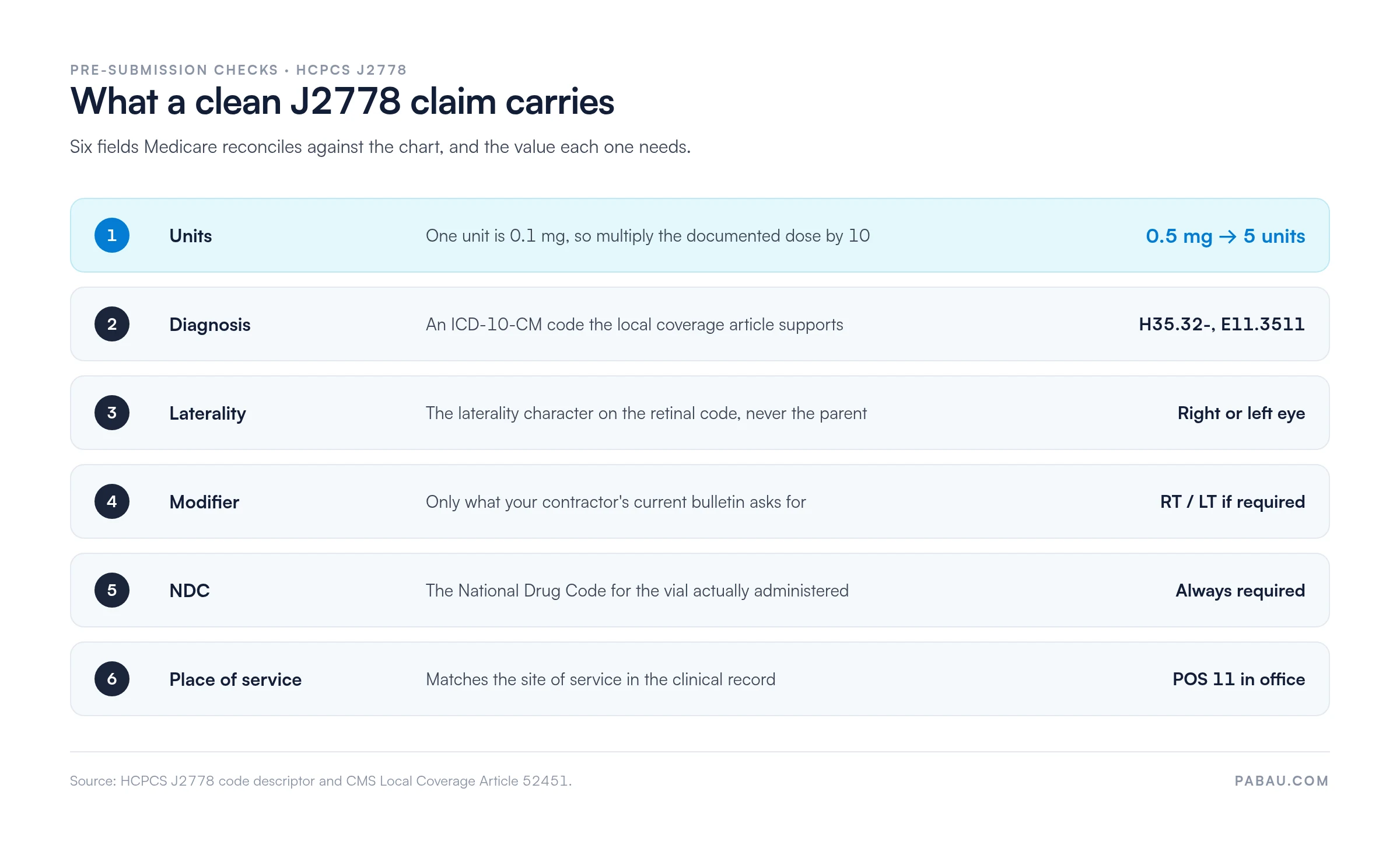
These are the errors ophthalmology billing teams hit most often, and each one is caught by a check that runs before submission. The six fields below are the ones Medicare reconciles against the chart. Understanding denial codes in medical billing helps you find the root cause when a J2778 claim comes back rejected.
An ophthalmology practice billing J2778 by hand retypes the dose, the diagnosis, and the NDC from the chart into the claim. Each retype is a chance for the units to drift away from the documented dose.
Pabau pre-fills the claim from the treatment record where the injection was documented, so the units follow the dose. Validation checks then run before submission and flag a claim whose authorization or membership number is missing.
The coder still chooses the modifier and the diagnosis, because those are clinical judgments. What the software removes is the transcription work and the incomplete submissions that follow it.

Pabau pre-fills each J2778 claim from the treatment record and runs validation checks before submission, so incomplete claims never reach the clearinghouse.

J2778 denials are systematic rather than random. Wrong unit counts, parent diagnosis codes, and skipped modifiers turn up on the same claims at practice after practice. A pre-submission checklist and a current covered-diagnosis list resolve most of them before they reach the payer.
Software will not choose the modifier for you, but it can stop a claim missing its units, its NDC, or its authorization number. Book a demo to see how Pabau validates injectable claims before they leave your practice.

Need help understanding claim rejections? Denial management in healthcare walks through the most common denial categories and how to build a recovery workflow.
Want to reduce errors before claims go out? Medical billing compliance covers the documentation standards that support defensible claims.
Submitting claims electronically? 837 file submission explains how electronic claim files work and what a clean submission looks like.
HCPCS Code J2778 is the billing code for Injection, ranibizumab, 0.1 mg. It is a HCPCS Level II J-code for in-office administration of ranibizumab, sold as Lucentis. Payers use it for retinal conditions including wet AMD and diabetic macular edema.
One unit equals 0.1 mg. A 0.3 mg dose requires 3 units; a 0.5 mg dose requires 5 units. Always confirm the administered dose from the clinical note before calculating units. The wrong unit count is the most common J2778 claim error.
Yes. Medicare Part B covers ranibizumab (J2778) for neovascular (wet) age-related macular degeneration as a covered indication under the applicable Local Coverage Determination. The claim must include a supported ICD-10-CM diagnosis code with the correct laterality character for the treated eye.
Traditional Medicare does not universally require prior authorization for J2778, but Medicare Advantage plans and most commercial payers do. Requirements vary by payer and plan year. Verifying coverage before administering the drug prevents situations where the claim is denied for lack of authorization after the drug has already been used.
Yes. Byooviz bills under Q5124 and Cimerli bills under Q5128. Q2049 is not a ranibizumab biosimilar, despite appearing in some code references, because it is imported liposomal doxorubicin. Confirm the code for the product administered against the current CMS HCPCS release before billing.