CPT Code 62284: Injection procedure for myelography
CPT Code 62284: official descriptor and procedure overview The American Medical ...

Last Updated: Oct 19, 2026
J2430 is the HCPCS Level II code for injection, pamidronate disodium, per 30 mg.
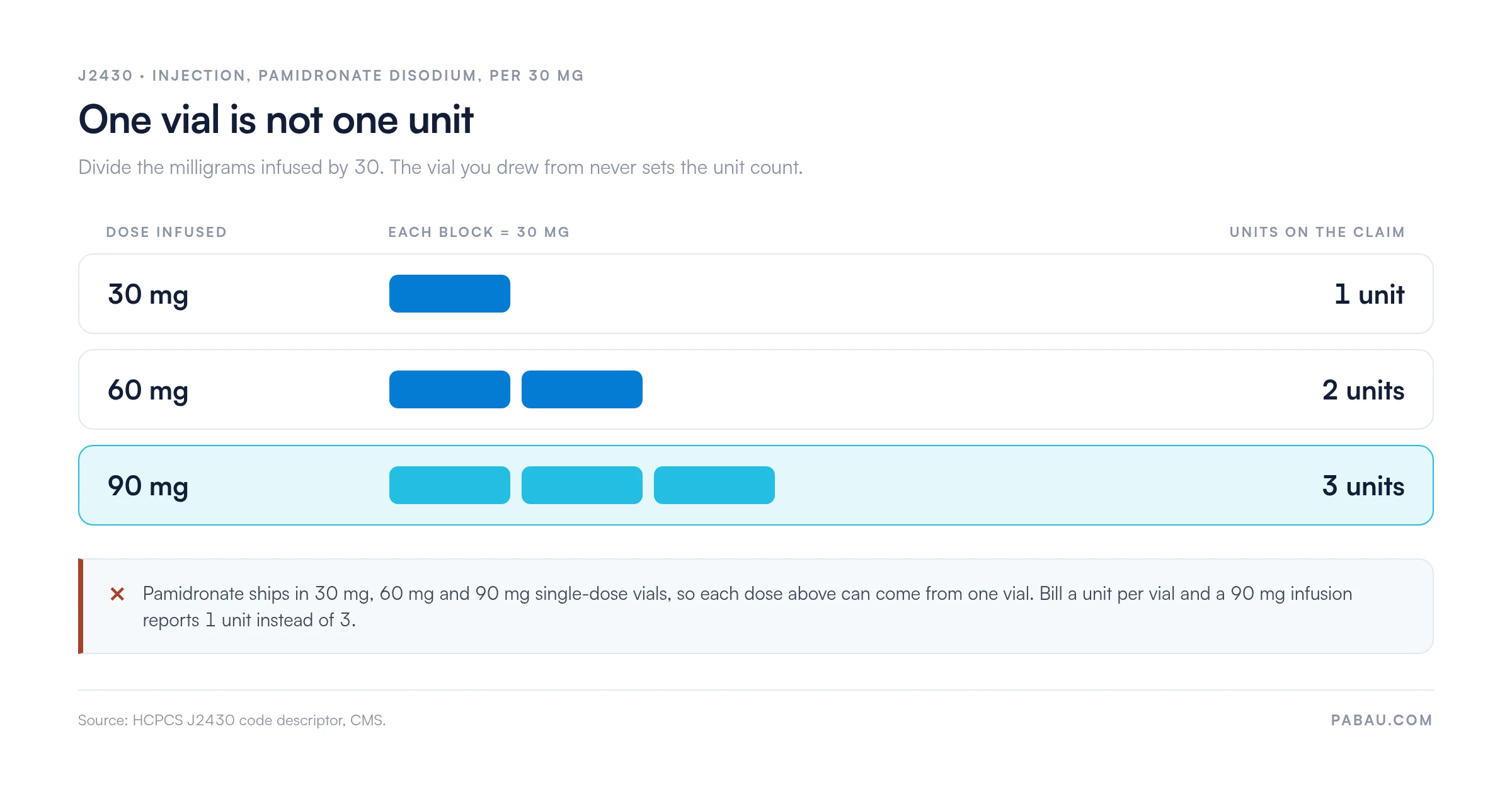
That one distinction decides most J2430 claims. A 90 mg dose is 3 units, even though it arrives in a single 90 mg vial. Report it as 1 unit and the claim still pays, just at a third of what it should. No rejection comes back, so the shortfall surfaces months later.
The rest is detail worth checking before you file. Start with what the code covers.
Let Pabau's smart automation suggest the right codes, reduce claim denials, and keep your practice compliant—effortlessly.
Automate repetitive tasks and focus on what matters most—your patients.
Reduce coding errors and ensure compliance with the latest regulations.
Clean claims, fewer denials, and faster reimbursements.
Powerful insights and reporting to help your practice thrive.
HIPAA compliant SOC 2 certified GDPR-compliant Trusted by 4,000+ clinics worldwide

HCPCS code J2430 bills the injection of pamidronate disodium, per 30 mg, given as an IV infusion.
Units follow the dose, not the vial, so a 90 mg infusion bills as 3 units of J2430.
A covered ICD-10 diagnosis has to sit on the claim, or Medicare denies the drug as not medically necessary.
Pamidronate comes in single-dose vials, so every Medicare claim carries either the JW or the JZ modifier.
Medicare Part B pays J2430 at ASP plus 6%, and CMS republishes that rate every quarter.
J2430 is an active HCPCS Level II code for the injection of pamidronate disodium, per 30 mg. It sits in the J series, which covers drugs given by injection or infusion that patients do not administer themselves.
CMS maintains the code through the HCPCS National Panel. Descriptors and code status get reviewed each year, so confirm the code was active on the date of service you are billing.
Divide the dose in milligrams by 30, then put the answer in the units field. A 60 mg infusion is 2 units. A 90 mg infusion is 3.
The trap is the packaging. Pamidronate is sold in 30 mg, 60 mg, and 90 mg single-dose vials, so one vial often holds the whole dose. That makes the vial count and the unit count look interchangeable. They are not.
Work it through on one claim line. A patient with hypercalcemia of malignancy receives 90 mg over two hours in the office. The claim carries J2430 with 3 units, an administration code for the infusion time, and E83.52 as the diagnosis.
Two figures have to agree before that claim goes out: the milligrams in the administration record and the units in the claim field. Where they disagree, the administration record wins and the claim gets corrected.
Pamidronate has four FDA-approved indications that Medicare and most commercial payers recognize.
Each one needs its own ICD-10-CM code on the claim to establish medical necessity. A claim without a covered diagnosis is the leading medical-necessity denial for this drug.
Two rows catch people out. C90.01 says the myeloma is in remission, which rarely supports an infusion for active osteolytic disease.
The M85 group is the other one, because those codes describe bone density and structure disorders rather than metastasis. Our ICD-10 reference for coders carries the full descriptor for each of these.
Off-label use: some physicians infuse pamidronate for osteoporosis or other bone conditions outside that list. Coverage varies by payer and by local coverage determination (LCD). Check your MAC’s LCD before you administer the drug for a diagnosis that is not on it.
Medicare Part B pays J2430 under the Average Sales Price (ASP) method. The payment is the drug’s ASP plus 6%, recalculated each quarter from manufacturer-reported sales data. So the rate for J2430 changes four times a year.
That has a practical consequence for anyone quoting a figure. A rate you confirmed in Q1 will not match what the same claim pays in Q3. Pull the current quarter’s ASP file before you promise a patient or an administrator a number.
Use the CMS Physician Fee Schedule lookup tool to get the current payment for your locality and place of service. Never quote a dollar figure without naming the quarter it came from.
The site of care sets both the claim form and the payment rate. J2430 is billed from three settings, and each has its own place of service (POS) code.
A wrong POS code is one of the surest ways to trigger a payment discrepancy. If the infusion happened in a hospital-based center but the claim says POS 11, expect a corrected claim request or an overpayment demand on audit.
Audit your J2430 claims quarterly by POS code. Run a report of every J2430 claim filed in the past 90 days. Then cross-reference each POS code against the location of service in your scheduling system. Mismatched POS codes tend to go unnoticed until a payer audit surfaces them.
JA and JZ carry the routine traffic. JA tells the payer the drug went in intravenously, and JZ confirms that none of the vial was discarded. The rest of the list below applies only in specific situations.
GY and GZ get mixed up constantly. GY says Medicare never covers the item at all. GZ says Medicare does cover it, but this particular claim will fail medical necessity. Pamidronate is a covered benefit, so an off-label infusion calls for GA or GZ instead.
JW and JZ are not optional either. Medicare requires one of them on every separately payable drug in a single-dose container. You cannot use both for the same drug on the same date. Confirm the JA and KX rules in your own jurisdiction’s LCD.
Medicaid programs, and some commercial plans, require the National Drug Code (NDC) alongside the HCPCS code. The NDC names the exact product, package size, and manufacturer. J2430 is the code the claim pays on.
On a CMS-1500 the NDC goes in the shaded area of box 24. On an electronic claim it travels in the drug identification segment of the 837 file. Pamidronate NDCs differ by manufacturer and vial size, and they change whenever packaging changes.
Verify the pairing against the CMS NDC-HCPCS crosswalk file, which CMS republishes with the quarterly ASP pricing files.
An oncology infusion claim carries the drug code and an administration code, and sometimes a second bone-modifying agent. Knowing the neighboring codes prevents unbundling errors and keeps the line items in the right order.
Watch the administration code. When pamidronate goes in alongside chemotherapy, decide whether the infusion counts as chemotherapy administration (96413) or a therapeutic infusion (96365). The clinical context and your MAC’s policy settle it, and the two families pay differently.
Most of the work happens before the drug is infused. Practices that treat billing as a post-visit task see more denials than practices that build the checks into the order itself.
Medicare Part B generally does not require prior authorization for J2430 on a covered oncology indication. MAC-specific LCDs can still ask for supporting labs, such as a serum calcium result for hypercalcemia of malignancy.
Medicaid runs the other way. Several state programs do require prior authorization, and the criteria differ from one state to the next. Commercial requirements vary just as much, so confirm with each payer before the appointment is booked.
Pamidronate claims fail in patterns. Work through the table below and you will catch most of them before submission, rather than three weeks later in an appeal.
Start every denial with the remittance, not the claim. The CARC and RARC codes on the ERA name the reason.
From there you know whether the fix is a corrected claim, an appeal with records, or a billing template change. A structured denial management process also shows you which of these eight keeps recurring.
Run a J2430 pre-submission check on every claim. Units equal milligrams divided by 30. A covered ICD-10 diagnosis sits on the line. JZ or JW is present, plus JA if your MAC asks for it. The POS code matches where the patient sat. Medicaid claims carry the NDC, and any required prior authorization is on file. That check takes a minute. Working the denial takes far longer.
Payers expect the medical record to support every J2430 claim, and bisphosphonate infusions draw documentation audits in oncology settings. Here is what belongs in the chart before billing:
Missing any one of these turns a paid claim into a post-payment demand. Practices that infuse pamidronate regularly should audit a sample of charts each quarter, rather than wait for a payer to do it for them.
In most infusion practices, the same facts get entered twice. A nurse records 90 mg in the administration note, then a biller retypes the drug, the units, and the diagnosis into the claim form. Every re-entry is another chance for the unit math to slip.
Practice management software like Pabau removes that second entry. The service already sits on the client record, so the charge line and the supporting diagnosis carry straight through to the claim form. Built-in ICD-10-CM and HCPCS lookup libraries let a biller confirm a descriptor without leaving the claim.
It also refuses to send an incomplete claim. Required fields, such as authorization numbers and membership details, have to be filled before the send button unlocks.
In the US, claims go out through Claim.MD, which brings eligibility checks, claim status tracking, and remittance posting into the same screen.
For an infusion team, that means fewer rejections to rework and a shorter wait between the appointment and the payment. Pabau’s claims software for practices comes with every subscription, so there is no separate billing tier to buy.

Pabau pre-fills the claim from the client record and gives billers built-in ICD-10 and HCPCS lookup libraries. It also holds a claim back until every required field is complete. Your team spends less time reworking infusion claims that came back.

Get the unit math right and J2430 stops behaving like a problem code. Divide the milligrams by 30, put a covered diagnosis on the line, and add JZ or JW because the vial is single-dose.
The rest is timing. A check that costs a minute before the infusion saves hours of appeal work later. An appeal never gets back the months the money sat unpaid either.
Want to see those checks running inside the patient record? Book a demo and we will walk one J2430 claim from the infusion note through to the remittance.

Working through a stack of rejected claims? Denial management in healthcare sets out how to track, appeal, and prevent rejections across payer types.
Not sure what a payer checks first? Clean claim requirements lists the data elements a claim needs to clear the initial payer edits.
Struggling to read a remittance? Electronic remittance advice explains the adjustment codes that tell you why a drug line paid short.
Filing claims electronically? The 837 claim file walks through the segments that carry your codes, units, and NDC data.
Part B. Pamidronate is infused in the office by clinical staff, so it is not a self-administered drug. That puts it inside Part B’s drug benefit, billed as J2430 plus an administration code. Part D covers drugs a patient takes at home.
No. J2430 pays for the pamidronate only. Diluent, tubing, and routine supplies are packaged into the payment for the administration code, so you cannot bill them separately. Bill the infusion time with 96413 or 96365 instead.
Whoever bought the drug. Under buy and bill, the practice purchases the vial, infuses it, and reports the units on J2430. If a specialty pharmacy ships the drug to you instead, the pharmacy bills for it and you bill only the administration code.
Medicare allows one calendar year from the date of service to file or refile. Send a corrected claim rather than an appeal when the original paid on the wrong unit count. Commercial deadlines are shorter, often 90 to 180 days.