CCSD code H4430: Examination of rectum under anaesthetic
CCSD code H4430 pays for the examination alone CCSD code H4430 is the UK private...

Last Updated: Oct 20, 2026
J2170 is the HCPCS Level II code for injection, mecasermin, 1 mg.
Eton Pharmaceuticals is the current FDA labeler for Increlex. Eton acquired the product from Ipsen in a deal that closed in December 2024, so older payer policies may still name Ipsen as the manufacturer.
Let Pabau's smart automation suggest the right codes, reduce claim denials, and keep your practice compliant—effortlessly.
Automate repetitive tasks and focus on what matters most—your patients.
Reduce coding errors and ensure compliance with the latest regulations.
Clean claims, fewer denials, and faster reimbursements.
Powerful insights and reporting to help your practice thrive.
HIPAA compliant SOC 2 certified GDPR-compliant Trusted by 4,000+ clinics worldwide

HCPCS code J2170 describes injection, mecasermin, 1 mg, and you bill one unit for each milligram given.
Medicare Part B pays J2170 at average sales price plus 6%, and that rate changes every calendar quarter.
Missing prior authorization is the leading cause of J2170 denials, so secure it before the first dose.
Increlex ships in a multi-dose vial, so the JW and JZ wastage modifiers never apply to J2170.
Practice management software like Pabau tracks J2170 units, prior authorization status, and NDC rules in one place.
Mecasermin is a recombinant human IGF-1 produced by DNA technology. The FDA approved Increlex for two indications, both involving children who cannot produce adequate IGF-1. Those indications govern medical necessity documentation and the ICD-10 codes that pair with J2170.
Those thresholds are stricter than the growth percentiles many payer policies quote, so check the current Increlex label when you assemble the clinical evidence. Mecasermin is given by subcutaneous injection, usually twice daily. It is not approved for short stature from other causes, and off-label use will not meet payer medical necessity criteria for J2170.
Each unit of J2170 equals 1 mg of mecasermin. Bill one unit for every milligram administered, so a 4 mg dose is 4 units. Under-reporting and over-reporting both create compliance exposure. Map the dose to units at the time of service, not at the end of the month.
Wastage modifiers do not belong on J2170: Increlex ships only as a 40 mg/4 mL multi-dose vial. CMS excludes multi-dose vials from its discarded-drug policy, so modifiers JW and JZ have no place on a J2170 line. Bill the milligrams the patient actually received.
Do not carry that rule across to single-dose drugs. HCPCS code J2185 covers meropenem in 500 mg and 1 g single-dose vials, so the wastage modifiers apply there. JW has been required since January 1, 2017, and JZ since July 1, 2023.
Medicare reimburses J2170 under the Part B drug benefit using average sales price (ASP) plus 6%. This applies when mecasermin is given in a physician office or outpatient setting. ASP-based rates change each calendar quarter, so verify the current payment limit in the CMS Physician Fee Schedule lookup tool before you submit.
Mecasermin is a high-cost specialty biologic, and Medicaid rates for it vary widely by state. Never quote a dollar figure to a family without first checking the current quarterly ASP file and your contracted rate.
Most commercial payers and many Medicare Advantage plans require prior authorization for J2170, given what a course of Increlex costs. Traditional Medicare Part B generally does not, though Medicare Administrative Contractors (MACs) may publish Local Coverage Determinations (LCDs) with their own criteria. Running insurance eligibility verification before the first dose prevents the most common J2170 denials.
Build the authorization workflow before the drug is ordered rather than after. A typical request includes:
Requirements differ by payer and by plan year. Read the payer’s specialty drug policy before you submit the authorization request.
Thin documentation is a top denial driver for J2170. Mecasermin is indicated for two narrow clinical scenarios, so the record has to establish one of them plainly. That work happens in the clinical chart, not on the claim form.
If a MAC has issued an LCD for mecasermin in your jurisdiction, the documentation must satisfy those criteria as well. Check your MAC website for current LCDs affecting J2170 coverage.
Review the applicable Medicare Administrative Contractor LCD for mecasermin before billing J2170. MAC jurisdictions differ in their coverage criteria. Submitting without meeting the LCD requirements is the fastest route to a denial that documentation alone cannot fix.
The diagnosis codes on a J2170 claim have to support the FDA-approved indications for mecasermin. A growth-related code that does not match the clinical documentation creates medical necessity exposure. The codes below are the ones most often paired with J2170.
The diagnosis has to reflect the FDA-approved indication. Do not reach for a generic short stature code such as R62.52 without documented endocrine disease, because it will not satisfy medical necessity for J2170. Endocrine and metabolic diagnoses sit in Chapter 4 of the code set. Our ICD-10-CM code index covers the families you will use alongside this drug.
Many payers, including most state Medicaid programs, require the National Drug Code (NDC) on J2170 claim lines. Report it in the 11-digit format, using 5-4-2 segmentation, matched to the vial presentation dispensed. Increlex is supplied as a 40 mg/4 mL (10 mg/mL) multi-dose vial for subcutaneous injection.
NDC reporting requirements vary between payers. Medicare Part B traditionally does not ask for the NDC on the claim form, while many commercial payers and Medicaid programs do. Where it is required, report it in loop 2410 of the 837P transaction with the qualifier “N4”, plus the quantity and the unit of measure.
Knowing when J2170 is the correct code, and when a neighboring code is, prevents misrouted claims. The AAPC HCPCS code lookup is a quick way to confirm current descriptors and crosswalks before you commit a claim line.
J2170 claims fail more often than standard office visit codes, because a specialty drug carries more conditions on the line. The five checks below run in the order the work happens, from the authorization request through to the modifier field.
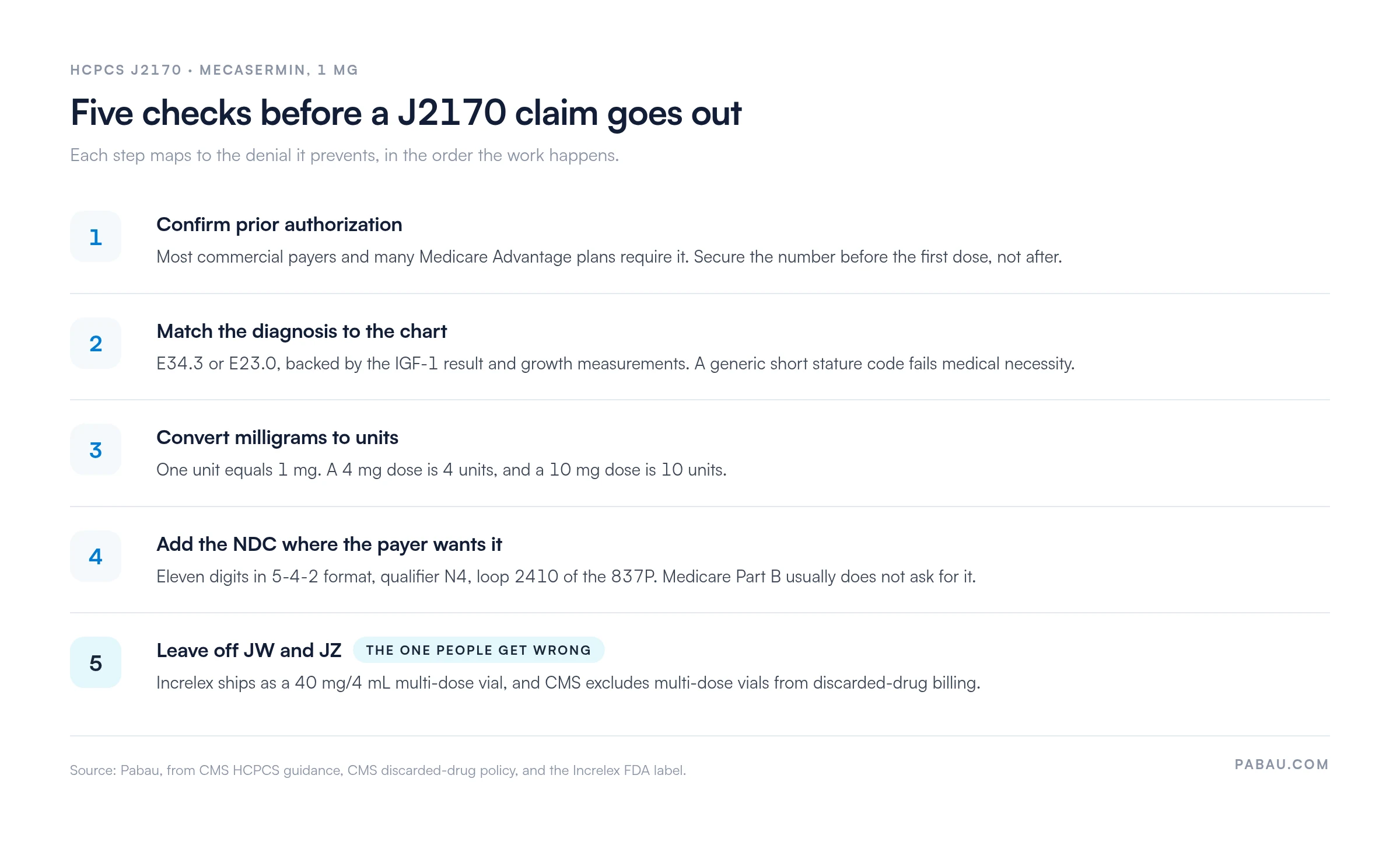
Each of these is cheaper to catch at the point of service than after a denial. Authorization tracking and an NDC reference inside the billing workflow remove most of the manual checking that produces them.
Most practices track specialty drug billing across a spreadsheet, a payer portal, and the clinical chart. The authorization number lives in one place, the NDC in another, and the administered dose in a third. Reconciling the three by hand before each claim is where J2170 units and modifiers go wrong.
Pabau is practice management software that holds the appointment, the clinical note, and the claim in a single patient record. Its medical claims management tools track HCPCS units, authorization status, and payer-specific NDC rules against the encounter that generated them. Billing staff work from one screen instead of three.
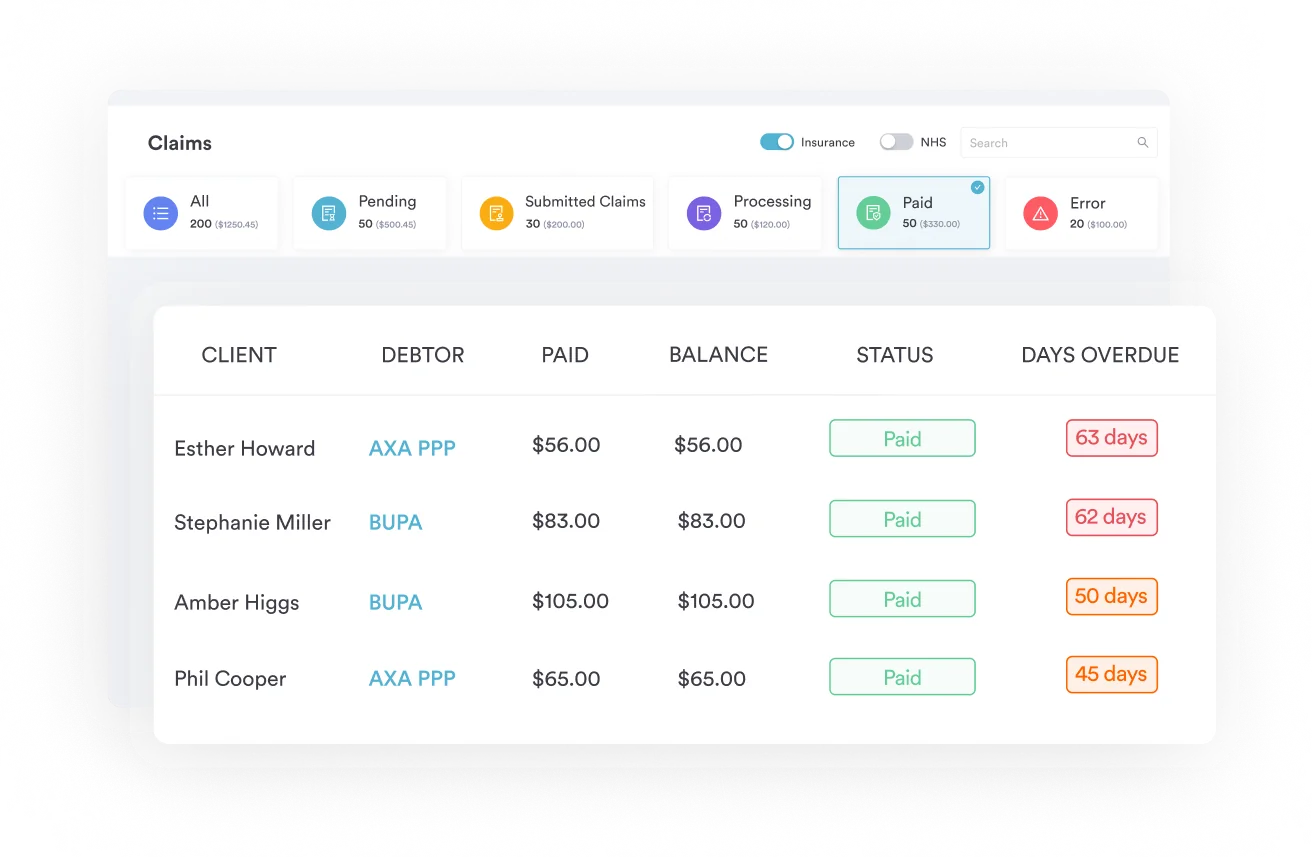
Fewer claims come back for a missing number, and your team spends less time rebuilding a line item weeks after the injection. For a drug this expensive, one prevented denial pays for a lot of admin time.

Pabau tracks HCPCS billing units, prior authorization status, and NDC requirements for specialty injectables in one place. See how it works for your practice.

A J2170 claim is won or lost before the injection. Three things carry most of them through on the first pass. You need the authorization in hand, a diagnosis the chart genuinely supports, and one unit billed per milligram.
The J2170 detail worth remembering is the vial. Increlex is a multi-dose presentation, so a JW or JZ modifier that reads as diligence on other J-codes becomes an error here. Book a demo to see how Pabau tracks authorizations, units, and NDCs for every specialty injectable your practice bills.

Need to understand how medical billing processes connect to HCPCS claims? Revenue cycle management explained covers how each billing touchpoint flows from coding through reimbursement.
Want to build better specialty drug denial workflows? Denial management in healthcare outlines the root causes of specialty drug denials and how to address them systematically.
Looking for a structured approach to superbill accuracy? How to create accurate superbills walks through the documentation fields that prevent rejections on specialty injectable claims.
Checking coverage before a high-cost injection? Insurance eligibility verification sets out what to confirm with the payer before the first dose is drawn up.
Want fewer rejections across every claim you send? What makes a clean claim explains the fields payers check first and how to get them right at the point of service.
HCPCS code J2170 is a Level II injectable drug code that describes injection, mecasermin, 1 mg. Mecasermin is a recombinant human insulin-like growth factor-1, sold as Increlex. It treats growth failure in children with severe primary IGF-1 deficiency, or with growth hormone gene deletion and neutralizing antibodies to GH. The code is billed per 1 mg administered.
Bill one unit of J2170 per 1 mg of mecasermin administered. A 4 mg dose is 4 units, and a 10 mg dose is 10 units. Increlex is supplied in a multi-dose vial, so the JW and JZ wastage modifiers do not apply to J2170. Bill only the milligrams the patient received.
J2170 is covered under Medicare Part B when mecasermin is administered by a provider in a physician office or outpatient setting. Part D covers self-administered drugs. Mecasermin is a subcutaneous injection usually given under clinical supervision, which makes Part B the applicable benefit for most J2170 claims.
Most commercial payers and many Medicare Advantage plans require prior authorization for J2170, given the cost of the drug. Traditional Medicare Part B generally does not, though a MAC-issued LCD may impose coverage criteria. Verify the requirement with each payer before mecasermin is administered.
Medicare reimburses J2170 at average sales price (ASP) plus 6% under the Part B drug benefit. ASP-based rates update each calendar quarter, so no fixed dollar figure stays reliable for long. Verify the current payment limit in the CMS ASP drug pricing file before each billing cycle.
The codes most often paired with J2170 are E34.3, short stature due to endocrine disorder, and E23.0, hypopituitarism. The diagnosis has to reflect a documented FDA-approved indication for mecasermin. Generic short stature codes without supporting endocrine documentation will not satisfy medical necessity for J2170.
Eton Pharmaceuticals is the current FDA labeler for Increlex. Eton acquired the product from Ipsen in a transaction that closed in December 2024. Payer policies and coding references written before that date may still list Ipsen as the manufacturer.