CCSD code H4430: Examination of rectum under anaesthetic
CCSD code H4430 pays for the examination alone CCSD code H4430 is the UK private...

Last Updated: Oct 20, 2026
J1990 is the HCPCS Level II code for injection, chlordiazepoxide hcl, up to 100 mg.
The code itself is the easy part. Five other fields decide whether the line pays, starting with the National Drug Code. Get one of them wrong and the claim bounces, usually with a reason code that never names the field. For a practice giving these injections weekly, that adds up to hours of rework a month.
Let Pabau's smart automation suggest the right codes, reduce claim denials, and keep your practice compliant—effortlessly.
Automate repetitive tasks and focus on what matters most—your patients.
Reduce coding errors and ensure compliance with the latest regulations.
Clean claims, fewer denials, and faster reimbursements.
Powerful insights and reporting to help your practice thrive.
HIPAA compliant SOC 2 certified GDPR-compliant Trusted by 4,000+ clinics worldwide

HCPCS code J1990 covers an injection of chlordiazepoxide HCl, up to 100 mg per billed unit
Medicare Part B pays J1990 on the average sales price, and CMS updates that file every quarter
A missing or malformed National Drug Code is the fastest way to get a J1990 line rejected
Modifier JA reports an intravenous dose and JB reports a subcutaneous one, so neither fits an intramuscular injection
Most J1990 denials trace back to four fields: the NDC, the unit count, the place of service, and the diagnosis
The Centers for Medicare and Medicaid Services (CMS) publishes J1990 in HCPCS Level II. That code set covers drugs a patient cannot reasonably take on their own. Those drugs get their own claim line, separate from the visit.
The descriptor reads: injection, chlordiazepoxide HCl, up to 100 mg. Those last four words carry the unit rule, so read them as part of the code rather than a footnote.
One point to flag before you bill: chlordiazepoxide is a Schedule IV controlled substance under the Drug Enforcement Administration. Administering it brings record-keeping duties that ordinary drug billing does not. A valid prescription and a documented reason for the injection need to sit in the chart before the claim goes out.
Medicare Part B covers J1990 when a clinician gives the drug in a covered outpatient setting and documents why.
Coverage is not automatic, though. Medicare Administrative Contractors (MACs) publish Local Coverage Determinations (LCDs) naming which conditions qualify, so check your regional MAC’s policy first.
Payment follows the average sales price, or ASP. CMS publishes ASP drug pricing files quarterly, and Part B pays ASP plus a percentage add-on. Look up the current add-on rate in the applicable CMS file, because it moves.
Medicaid coverage varies by state, so one state’s rule tells you little about the next. Commercial plans pay from their own fee schedule or formulary.
For the current payment amount, use the CMS Physician Fee Schedule lookup tool. Rates move with each quarterly ASP release. A dollar figure typed into an internal billing sheet goes stale within months, so point staff at the lookup instead.
A clean J1990 claim needs more than the code. Each data element below has an automated edit waiting behind it, so work through the sequence before you submit.
Put together, those steps produce one claim line carrying six fields. Here is what each field has to hold.
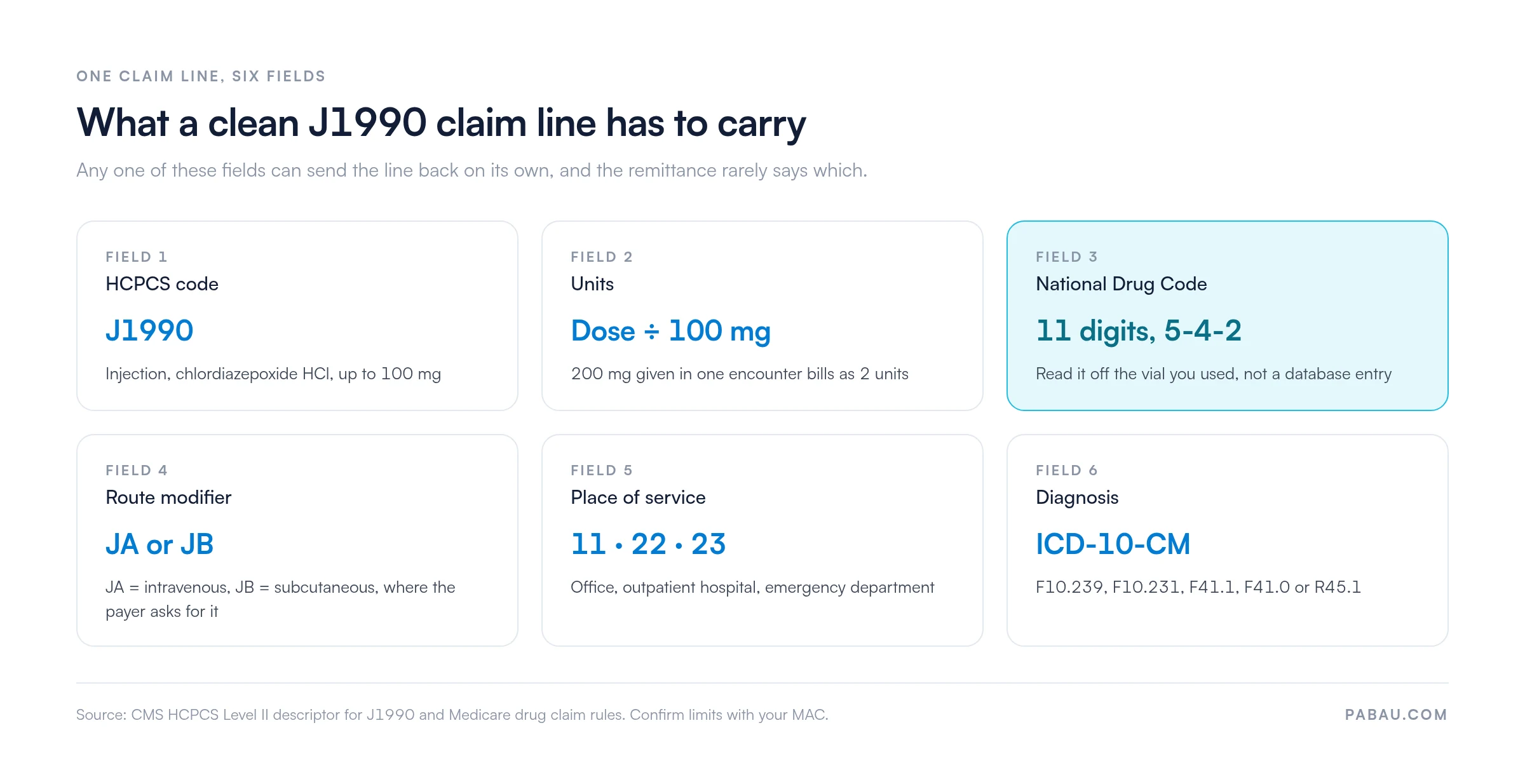
JA and JB report how the drug reached the patient, and they split intravenous from subcutaneous. That is the whole distinction. An intramuscular dose falls outside both, so neither modifier belongs on that line.
Applicability is payer-specific, so confirm with your MAC or commercial plan before appending either one routinely. Adding a modifier a payer never asked for rarely causes a denial. Leaving out one it requires usually does.
Keep a short payer sheet listing which MACs and commercial plans want JA or JB on J-code lines. When a J1990 claim denies for the first time with a payer, read that remittance closely. The reason code usually tells you whether a modifier was expected but absent.
Chlordiazepoxide injection shows up mostly in alcohol withdrawal, acute anxiety, and agitation. The codes below are the pairings you will meet most often.
Coverage still varies by MAC, and an LCD can narrow or widen the list, so verify before you lean on one.
Treat that table as a starting point, not a covered list. The AAPC HCPCS code lookup helps you confirm a pairing, and our ICD-10-CM code reference goes deeper on the diagnosis side.
Place of service does two jobs on a J1990 claim. It tells the payer where care happened, and it selects the payment rate.
Physician offices and hospital outpatient departments account for most of these injections, with emergency departments close behind on withdrawal cases.
Medicare pays more in non-facility settings because the practice carries overhead a hospital would otherwise absorb. So POS 11 on a service delivered in an outpatient department is not a rounding error. It reads as an overpayment, and it is a familiar audit trigger.
Note the site of care while the encounter is in front of you.
Sometimes a payer will not recognize J1990 for a particular scenario, and the question of a fallback code comes up. J3490, unclassified drugs, is what coders usually reach for.
Be careful here. CMS guidance does not confirm a crosswalk between J1990 and J3490. Swapping in J3490 rests on three conditions. You need an explicit payer instruction, a copy of the drug invoice, and a note explaining why J1990 would not work. Without all three, keep billing J1990.
The same rule reaches other J-codes. HCPCS code J2550 covers injectable promethazine HCl, and J3490 fits there only when a compounded or proprietary concentration falls outside its descriptor.
J1990 denials repeat themselves. Seven patterns cover the bulk of them, and each one is catchable before the claim leaves the building.
Denial patterns surface faster when you track reason codes at the line level instead of the claim level.
Read the remittance for the Claim Adjustment Reason Codes sitting against J1990. Better still, spend 30 seconds on the line before it goes anywhere.
Practices that run this pass every time send a clean claim far more often. Reworking a denied J1990 line usually costs more than the line pays.
Most J1990 errors are data-entry errors made under time pressure. The NDC sits on a vial in one room, and the dose sits in a clinical note. Meanwhile the claim gets built somewhere else again. When those three live apart, the mismatch surfaces on the remittance instead of before submission.
Practice management software like Pabau closes that distance by building the claim from the record itself. The service already carries its HCPCS code, so the charge line fills in from what the clinician recorded.
Recorded diagnoses seed the ICD-10 slots, and search libraries of more than 20,000 ICD-10-CM and CPT/HCPCS codes sit behind each field.
Claims software for practices then checks that every required field is complete before the Send button unlocks. From there the claim goes out through the US clearinghouse connection, Claim.MD. Eligibility checks, remittance posting, and claim-status tracking run in the same place, so a denied J1990 line shows up without a separate portal login.
What software will not do is choose your modifier. JA versus JB stays a coding decision, and it belongs to a person who has read the chart.

Pabau’s claims management tools build the claim straight from the client record. Drug and code details stay in one place, and every required field gets checked before submission.

J1990 is an easy code to pick and a fussy one to get paid. The descriptor stays silent on the NDC field, the unit math, and the modifier question. Those three are what the payer checks.
So the useful work happens upstream of the claim. Build the checks into how the injection gets recorded, and the billing side stops guessing at submission time. Practices that do this watch the same J-code go out clean week after week. Rework time then goes to the claims that need it.
If drug claims are a regular part of your week, it is worth seeing how the record and the claim can share one source. Book a demo to walk through a J-code claim in Pabau, from the injection note to submission.

Want the wider picture behind the J-code? What is medical billing walks through how codes, diagnosis pairing, and submission connect across the revenue cycle.
Seeing J1990 denials you cannot explain from the code alone? Denial management in healthcare covers how to read a denial and build a prevention workflow around it.
Need a reference for the reason codes on your remittance? Medical billing denial codes explains what each adjustment reason code asks you to fix before resubmission.
Tracing a drug charge back to where it started? What is a superbill shows how the source document feeds the codes and charges that land on a claim.
Yes. J1990 covers the drug, and a separate CPT code covers the work of giving it. Use 96372 for an intramuscular or subcutaneous injection, or 96374 for an intravenous push. Check NCCI edits before billing both on the same encounter.
No. Drugs given to an admitted patient fall under the Part A payment for that stay, so the hospital does not bill the J-code separately. J1990 belongs on outpatient claims, which covers the physician office, the hospital outpatient department, and the emergency department.
It can. CMS asks for JW on the amount discarded from a single-dose container, and JZ when none was discarded. Whether the rule reaches your J1990 line depends on the container you use, so confirm the requirement with your MAC.
Start with the reason code on the remittance, not the resubmission. The Claim Adjustment Reason Code tells you whether the problem was the NDC, the units, the diagnosis, or a missing modifier. Fix that one field and send it back as a corrected claim.