CCSD code H4430: Examination of rectum under anaesthetic
CCSD code H4430 pays for the examination alone CCSD code H4430 is the UK private...

Last Updated: Oct 20, 2026
J1955 is the HCPCS Level II code for injection, levocarnitine, per 1 gm.
Medicare wants whole units rounded up, so a 1.5 gram dose bills as 2 units, not 1.5.Coverage is narrow as well, and national coverage determination 230.19 names the exact patients who qualify.
Let Pabau's smart automation suggest the right codes, reduce claim denials, and keep your practice compliant—effortlessly.
Automate repetitive tasks and focus on what matters most—your patients.
Reduce coding errors and ensure compliance with the latest regulations.
Clean claims, fewer denials, and faster reimbursements.
Powerful insights and reporting to help your practice thrive.
HIPAA compliant SOC 2 certified GDPR-compliant Trusted by 4,000+ clinics worldwide

HCPCS code J1955 bills an intravenous injection of levocarnitine at one gram per unit, covering Carnitor and its generics.
Units are whole numbers rounded up, so a 1.5 gram dose bills as 2 units, not 1.5.
Medicare covers J1955 under NCD 230.19 only for ESRD patients on dialysis at least three months, with plasma free carnitine below 40 micromol/L.
Those patients also need erythropoietin-resistant anemia or intradialytic hypotension, and coverage stops without documented improvement within 6 months.
Pair a carnitine deficiency code with N18.6, then add JW for discarded vial contents or JZ when nothing is wasted.
HCPCS code J1955 is the Level II billing code for an injection of levocarnitine, per 1 gram. Levocarnitine is the active form of carnitine, an amino acid derivative that carries long-chain fatty acids into mitochondria for energy.
When the kidneys fail, dialysis strips carnitine out of the bloodstream faster than the body replaces it. That shortfall is what puts dialysis patients at risk of deficiency.
The brand name is Carnitor, and several generic formulations are on the market. J1955 applies to the brand and to every generic equivalent, as long as the drug goes in intravenously. Oral levocarnitine never bills under this code.
According to the Centers for Medicare and Medicaid Services (CMS), HCPCS Level II J-codes cover injectable drugs that a physician or supplier administers.
The setting is a physician office or an outpatient department. Each J-code carries a defined billing unit, and for J1955 that unit is one gram of levocarnitine.
CMS wants whole units on the claim, rounded up to the next unit. A 1.5 gram dose therefore bills as 2 units, and a 2.5 gram dose bills as 3.
Record the exact dose administered in the clinical note even though the claim line carries the rounded figure.
Hemodialysis removes carnitine at every session, because the molecule is small enough to cross the membrane. Plasma free carnitine falls over time, and the result is iatrogenic carnitine deficiency.
Patients report muscle weakness and fatigue, and the record may also show cardiac dysfunction or impaired fat metabolism.
Levocarnitine replaces what dialysis takes out. It goes in intravenously at the end of a session, because oral absorption is unreliable in this group. That route is the reason a J-code exists here rather than a self-administered drug code.
National coverage determination 230.19 decides when Medicare Part B pays for J1955, and the test is strict. Bill outside its criteria and the claim comes back denied.
Covered indication: NCD 230.19 covers intravenous levocarnitine for ESRD patients who have been on dialysis for at least three months. Those patients need a documented carnitine deficiency, meaning a plasma free carnitine level below 40 micromol/L. Deficiency on its own is not enough. The record also has to show signs and symptoms of one of two conditions.
The criteria stack, and each one is a separate place a claim can fail.
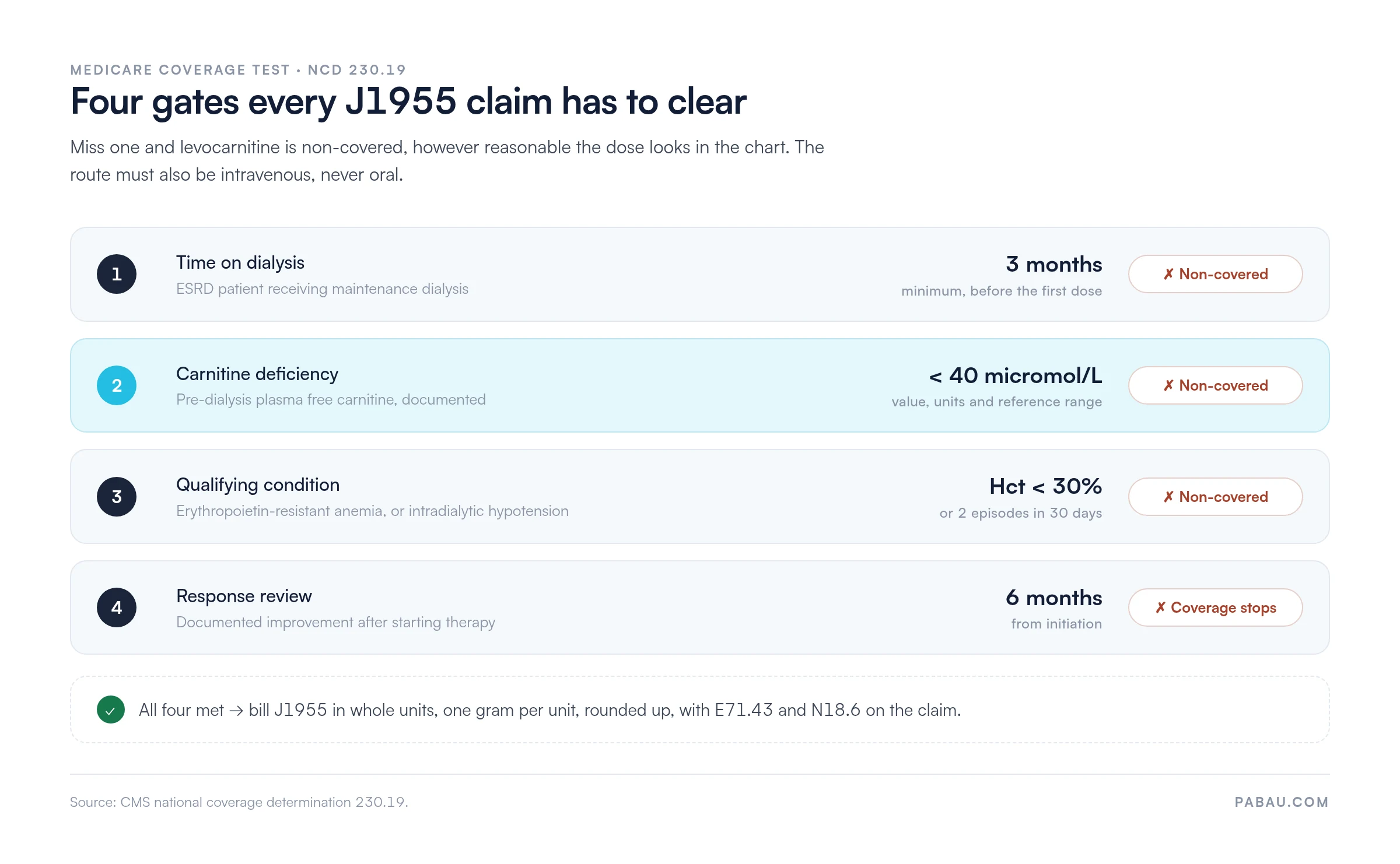
Continued therapy carries its own test. Medicare covers ongoing treatment where the record documents a pre-dialysis plasma free carnitine level below 40 micromol/L before the first dose.
The treating physician can instead certify that stopping the drug would push the level below 40 micromol/L and bring the problem back. The problem in question is the erythropoietin-resistant anemia or the intradialytic hypotension.
Cite NCD 230.19 in the documentation behind a J1955 claim, and name the criteria the patient meets. Extrapolating coverage to off-label uses is a compliance risk, even where it looks clinically reasonable.
Read the current determination text in the CMS Medicare Coverage Database before you finalize a claim.
Every J1955 claim needs at least one covered ICD-10-CM diagnosis code to carry medical necessity. Missing or mismatched diagnosis codes are the top denial trigger on this code.
The table below lists the codes that line up with the NCD 230.19 criteria. Check with your Medicare Administrative Contractor (MAC) for the current covered list, since NCD updates add and remove codes.
Report the most specific carnitine deficiency code the record supports, which for dialysis-related deficiency is E71.43. Pair it with N18.6 so the claim shows the indication and the patient’s ESRD status together.
Our ICD-10-CM code library holds the full descriptors if you need to check a neighboring code. You can also cross-reference the covered list against the current code year using the AAPC HCPCS lookup.
Medicare pays for levocarnitine on the Average Sales Price (ASP) methodology, calculated per gram. CMS updates those rates quarterly and publishes them in the Part B drug pricing files.
The table shows how payment is set in each setting.
Rates for ASP-based drugs move every quarter, so a figure from a prior-year reference may already be stale. Confirm the current amount before you finalize a superbill or a claim batch.
For dialysis facilities, the bundling question comes first. The same ESRD prospective payment system that governs Q4081 also decides whether levocarnitine is separately payable or already inside the bundle.
Check the CMS Part B drug pricing file every quarter at cms.gov. Levocarnitine ASP rates typically update in January, April, July, and October. Billing at an outdated rate creates underpayment risk and can trigger reconciliation requests from your MAC.
Modifiers tell the payer about circumstances that change how a claim adjudicates. Three come up regularly with J1955. Choosing the wrong one, or leaving a required one off, is a common denial and a compliance exposure.
The dates that matter: CMS made JZ available on January 1, 2023, but reporting it was optional at that point. Mandatory reporting of JW or JZ on single-dose vial drug claims began on July 1, 2023. MACs started rejecting claims that carry neither modifier from October 1, 2023.
In practice, report the administered amount on the first line with JZ when nothing was discarded. Where part of the vial is wasted, add a second line item for the discarded portion and append JW to it.
Buy-and-bill submissions for J1955 need an NDC crosswalk. The National Drug Code for the levocarnitine product you purchased has to appear alongside the HCPCS code. Many MACs and commercial payers reject a claim that carries the J-code with no NDC behind it.
The table below shows the shape of the products on the market. NDC availability changes as manufacturers enter and leave.
Verify the NDC against the vial you actually purchased at the time of billing, rather than a static list. The FDA National Drug Code Directory and your wholesaler’s documentation are the two places to confirm it.
Report the NDC in 11-digit format, the 5-4-2 configuration, on the claim line. Then translate the unit of measure from the package label into the billing unit, which is grams for J1955.
Your practice management system should store that conversion against the claim record so an auditor can follow it. Manual NDC entry is slower and produces more errors.
J1955 follows the buy-and-bill model. The practice or dialysis facility buys the drug, administers it, then bills the payer for the drug and its administration. Errors compound here, because one wrong assumption repeats across every claim in the batch.
Place of service changes the payment. A physician office claim (POS 11) pays on the non-facility fee schedule. A hospital outpatient claim (POS 22) pays under OPPS. A dialysis facility may already have the drug inside its bundled ESRD payment.
Hemodialysis usually runs three sessions a week. Submit one claim line per session date of service rather than aggregating the week’s doses. Each administration needs its own date, dose quantity, and note entry. A superbill line for levocarnitine should carry the session date, the dose in grams, and the administering provider.
Traditional Medicare does not require prior authorization for J1955. NCD 230.19 is the coverage authority. A documented ESRD dialysis claim with the right ICD-10 codes should process under Part B without a separate authorization step.
Commercial payers are another matter. Many managed care and Medicare Advantage plans do require prior authorization for levocarnitine. Administer the drug first and the financial liability lands on the practice. The work starts before the dose, not after a denial reaches your worklist.
A request to a commercial or Medicare Advantage plan should carry four things. Include the confirmed ESRD diagnosis and the current dialysis schedule, showing at least three months of treatment.
Add the pre-dialysis plasma free carnitine result, with the value and the reference range. Attach the notes documenting erythropoietin-resistant anemia or intradialytic hypotension. Finish with the planned dose in grams and the expected frequency.
Thin documentation sits behind most post-payment audit recoveries on levocarnitine claims. The record has to support every element of NCD 230.19 on its own. Payment survives a contractor review only when the note does that work.
Capture the dialysis start date, the diagnosis confirmation, and the carnitine lab values at the point of care. Reconstructing those details from memory months later is where records fall apart. HIPAA and False Claims Act obligations then govern how the file is stored and protected.
Keep supporting documentation for at least 7 years from the date of service on Medicare claims.
Build a J1955 documentation checklist into the intake workflow for every dialysis session where levocarnitine is ordered. Flag a missing lab value or NDC record before the claim leaves. Catching it pre-claim costs minutes, and catching it post-audit costs thousands.
Three errors account for most of the J1955 denials that come back to a dialysis program. None of them are clinical.
1. Billing fractional units. A 1.5 gram dose entered as 1.5 units will reject at the front end or underpay. Round up, bill 2 units, and keep the 1.5 gram figure in the clinical note.
2. Leading with N18.6 alone. ESRD establishes dialysis eligibility, not medical necessity for levocarnitine. Without a carnitine deficiency code such as E71.43 on the claim, the payer sees no indication for the drug.
3. Sending the line with no waste modifier. A single-dose vial line carrying neither JW nor JZ reads as an incomplete claim, and MACs have rejected those since October 2023.
Here is how one clean session looks. The patient gets 1 gram of levocarnitine at the end of a Tuesday dialysis session, from a 1 gram single-dose vial with nothing left over. The claim line carries J1955, one unit, modifier JZ, the product NDC, and E71.43 with N18.6. The note records the dose, the route, the vial, and the administering provider.
Practices billing J1955 across a dialysis population carry a compounding documentation load. Every session needs its own note, dose record, NDC entry, and modifier decision. Manual re-keying introduces an error at each of those steps.
Practice management software like Pabau closes part of that distance. Its claims management software pre-fills the claim form from the record. The dose and diagnosis code your team already captured land on the charge line, instead of being typed a second time. The JW or JZ call stays with your coder, since only the person at the chairside knows what was left in the vial.
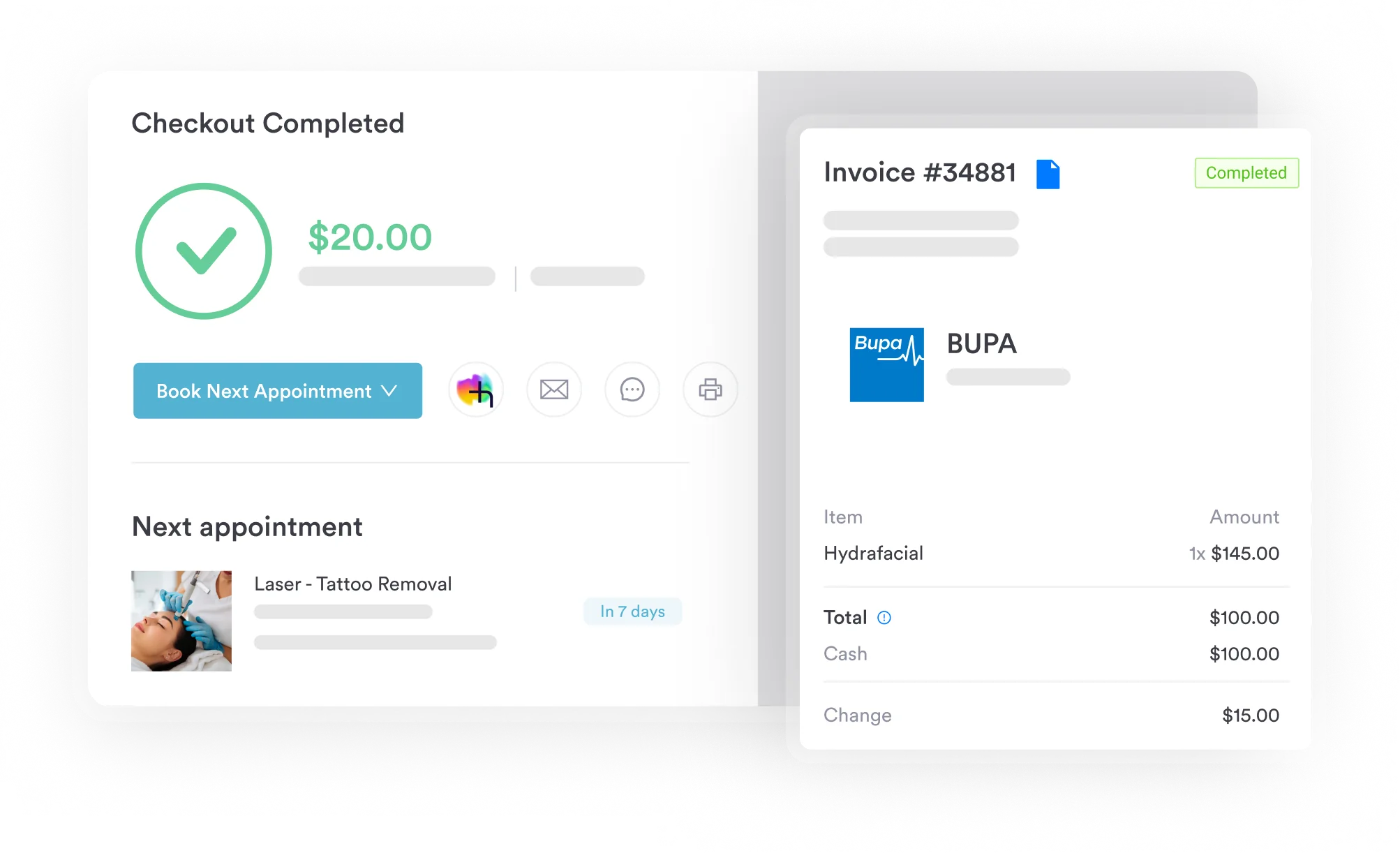
Pabau also holds the audit trail that buy-and-bill demands. Each administration is logged with a timestamp, the administering provider, the product NDC, and the dose quantity.
When a post-payment audit arrives, the claim record and the clinical record already agree. Submission then runs through clearinghouse partners, which transmit the 837P once the required claim fields are complete.
For a dialysis program, the payoff is fewer trips back to the chart. Coders work from a record that already carries the dose, the lab value, and the vial detail. The claim goes out complete the first time.

Pabau pre-fills each claim from the treatment record, so the dose and diagnosis code captured at the chairside carry through to submission. Your coders keep the modifier call and spend less time re-typing data that already exists.

J1955 is a narrow code with a high claim count, which is an awkward combination. The rules rarely change, but they apply to every session line, three times a week, for every patient on therapy. Fix the unit convention and the diagnosis pairing once and most of the exposure goes with them.
The part worth remembering is that coverage lives in the record, not on the claim. NCD 230.19 asks for a lab value, a dialysis history, and a qualifying condition. An auditor will look for all three long after the payment cleared.
If your team re-keys dose and diagnosis data into a claim after every dialysis session, that is where the errors start. Book a demo to see how Pabau carries J-code data from the treatment note through to the claim.

Wondering how a clearinghouse handles a J-code claim? Medical claims clearinghouse guide explains how claims are validated, reformatted, and transmitted to payers.
Need the rules on retention and audit response? Medical billing compliance overview covers documentation retention, HIPAA safeguards, and Medicare audit protocols.
Want to decode the remittance advice on a rejected line? Denial codes in medical billing breaks down the most common denial codes and how to respond to each.
Billing other drugs for the same dialysis population? Q5105 covers epoetin alfa-epbx billing for ESRD patients, including how the ESRD bundle affects payment.
Chasing a higher first-pass acceptance rate? What makes a clean claim sets out the fields payers check before a claim is accepted for adjudication.
It depends on who administers the drug. A physician office bills the professional claim on a CMS-1500, transmitted as an 837P. A dialysis facility or hospital outpatient department bills institutionally on a UB-04, transmitted as an 837I. The NDC is required either way.
CO-50 is the common one, meaning the payer did not consider the service medically necessary. That usually points at a missing carnitine deficiency diagnosis, or a patient who fails an NCD 230.19 criterion. CO-16 is the next most frequent, flagging missing information such as the NDC or the waste modifier.
Yes. Issue an Advance Beneficiary Notice of Noncoverage (Form CMS-R-131) before the dose whenever you expect Medicare to deny it. Without a signed ABN on file, you cannot bill the patient for a service denied as not reasonable and necessary. Append modifier GA to the claim line once it is signed.
That follows the dose and the dialysis schedule rather than a fixed frequency limit. A patient on three sessions a week receiving 1 gram each time produces three separate claim lines of one unit. Bill by date of service and never roll a week of doses into a single line.