CPT Code 62284: Injection procedure for myelography
CPT Code 62284: official descriptor and procedure overview The American Medical ...

Last Updated: Oct 19, 2026
J1572 is the HCPCS Level II code for injection, immune globulin, (flebogamma/flebogamma dif), intravenous, non-lyophilized (e.g., liquid), 500 mg.
Let Pabau's smart automation suggest the right codes, reduce claim denials, and keep your practice compliant—effortlessly.
Automate repetitive tasks and focus on what matters most—your patients.
Reduce coding errors and ensure compliance with the latest regulations.
Clean claims, fewer denials, and faster reimbursements.
Powerful insights and reporting to help your practice thrive.
HIPAA compliant SOC 2 certified GDPR-compliant Trusted by 4,000+ clinics worldwide

HCPCS Code J1572 covers injection of immune globulin (Flebogamma or Flebogamma DIF), intravenous, non-lyophilized, billed per 500 mg.
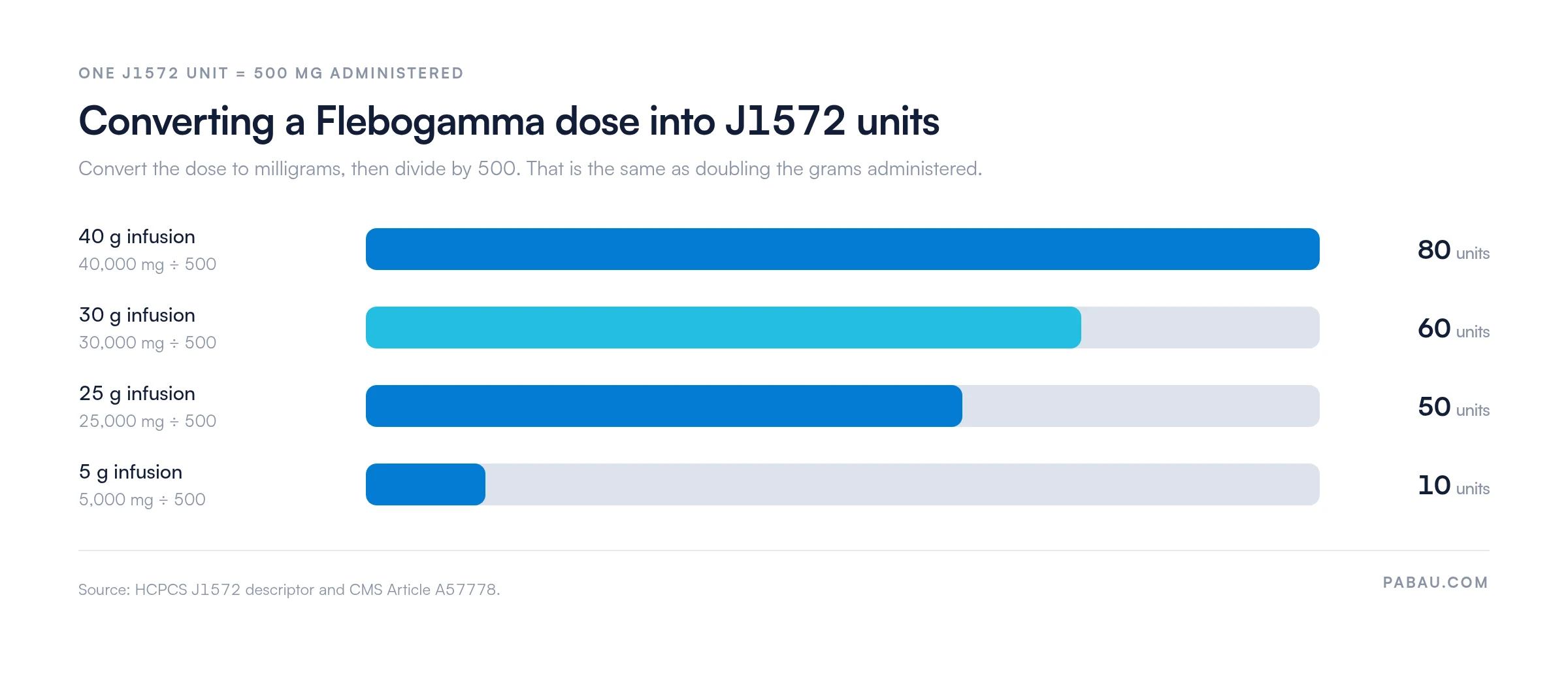
One billing unit equals 500 mg administered. A 5 g dose is 10 units, and a 30 g dose is 60 units.
Medicare Part B covers J1572 for the medically necessary indications listed in CMS Article A57778, and the NDC is required on every claim.
Flebogamma ships in single-dose vials, so each claim carries modifier JW for discarded units or JZ when nothing is discarded.
Practice management software like Pabau keeps the order, diagnosis, and infusion record on one patient file, so J1572 claims are easier to support.
HCPCS Code J1572 covers injection of immune globulin (Flebogamma or Flebogamma DIF), intravenous, non-lyophilized, in 500 mg increments. In fact, infusion teams use it to bill the drug itself whenever a Grifols IVIG product is given on an outpatient basis. In short, this guide covers the descriptor, the unit math, Medicare coverage rules, the supporting ICD-10-CM diagnosis codes, and how the payment rate is set.
HCPCS Code J1572 is a Level II J-code kept by the Centers for Medicare and Medicaid Services (CMS) under the Healthcare Common Procedure Coding System. In general, J-codes cover drugs and biologicals given by injection. So they are required on outpatient Medicare claims when the drug cost is billed apart from the professional or facility fee.
Flebogamma and Flebogamma DIF are intravenous immune globulin (IVIG) products made by Grifols. Also, both contain purified human immunoglobulin G (IgG) antibodies pooled from thousands of plasma donors, and both come as a liquid, ready-to-infuse solution. As a result, they differ from lyophilized (powder-form) IVIG products, which must be mixed before use and carry different HCPCS codes.
The “DIF” suffix in Flebogamma DIF means an extra depth-filtration purification step. In turn, this step lowers the risk of pathogen transmission without changing the IgG content or how the drug works. For billing purposes, both formulations fall under HCPCS Code J1572 and are coded the same way. So practices that stock only one formulation do not need a separate code. Indeed, the descriptor clearly covers both.
In practice, Flebogamma treats primary immunodeficiency diseases and the autoimmune or inflammatory conditions where extra IgG is medically necessary. Overall, the practices billing J1572 most often are IV therapy practices and infusion centers giving IVIG on an outpatient basis. In the end, the treating physician’s documented diagnosis decides whether the claim passes Medicare coverage review.
The trickiest part of J1572 billing is unit calculation. In short, every 500 mg given equals one billable unit. So billing teams must convert the ordered gram dose to milligrams, then divide by 500 to get units. Also, rounding rules do not apply here. Instead, bill only for the amount given and documented in the infusion record.
Worked example: A patient receives a 30 g IVIG infusion of Flebogamma. Converting: 30 g x 1,000 = 30,000 mg. Dividing: 30,000 / 500 = 60 units. The claim line reads: J1572 x 60.
Applied to the doses an infusion practice sees most often, the same math gives the unit counts below.
First, bill type and revenue codes decide whether the claim reaches the right payment system at all. So the table below lists the standard values for outpatient infusion settings per CMS Article A57778.
The drug and its administration are separate claim lines. So report the infusion time with an administration code, starting at CPT 96365 for the first hour, then an add-on code for each extra hour.
Flebogamma comes in single-dose vials, so the discarded-drug modifiers come into play. Then, report JW on a separate line with the units discarded, or JZ on the J1572 line to confirm that nothing was thrown away.
Getting the line right on first submission matters more for IVIG than for almost any other outpatient drug. This matters because practices that run claims software for infusion billing submit from the record that already holds the order and the infusion note. So the biller is not matching two systems by hand.
Track the lot number and NDC from every Flebogamma vial at the time of infusion. Documenting it in the infusion record at the point of care removes one of the most common denial triggers before the claim is even submitted.
Medicare Part B covers J1572 when the service is medically necessary and backed by the right ICD-10-CM diagnosis code. Specifically, coverage is set by CMS Local Coverage Article A57778. This article lists the covered HCPCS codes, supported diagnosis codes, bill type codes, and documentation rules.
In other words, coverage turns on the documented diagnosis rather than on the drug. The benefit check before each infusion appointment therefore has to confirm the indication as well as active eligibility.
One denied IVIG claim can mean thousands of dollars of drug the practice has already bought and infused. Therefore, J1572 needs a standing appeal process rather than an ad hoc one.
Every J1572 claim requires at least one supporting ICD-10-CM diagnosis code. Specifically, per CMS Article A57778, the following categories show common covered indications. Even so, practices should get the current, full list directly from A57778, since CMS updates covered diagnosis codes often. Indeed, using a diagnosis code not listed in A57778 without extra documentation may lead to an automatic denial.
Verify the full list of supported diagnosis codes in the current version of CMS Article A57778. Codes outside that list may still be submitted with supporting documentation, but automatic denials are more likely. Even so, document the clinical reasoning whenever the diagnosis sits at the edge of the covered indications. Then confirm the descriptor against the ICD-10-CM code library before the claim goes out.
Medicare pays J1572 under the Part B drug payment method, which uses Average Sales Price (ASP) plus 6% (ASP+6%). Notably, CMS updates ASP-based rates every quarter. So the rate published in one quarter reflects drug sales data from two quarters prior, and the payment amount changes four times a year.
Because IVIG unit costs are high, a small per-unit difference adds up quickly across a patient panel. So, set a calendar reminder to cross-check the billing system’s drug fee schedule against the CMS ASP drug pricing files at the start of each quarter.
The Physician Fee Schedule lookup tool does not price J1572. Part B drugs are priced from the quarterly ASP file instead. A rate pulled from the fee schedule search will not match what the MAC pays.
Exact dollar amounts for J1572 are not published here because ASP-based rates change every quarter and vary by MAC area. So always check the current rate directly from CMS ASP pricing files before you submit high-value IVIG claims.
Missing documentation is the second most common reason for J1572 claim denials, after unit calculation errors. Namely, CMS and commercial payers expect a set of records to back up each IVIG infusion claim. So building a documentation checklist into the infusion workflow before the patient leaves the chair works better than rebuilding records after a denial.
Consistent documentation reduces audit exposure and shortens the appeal when a payer requests records. Overall, the requirements below reflect standard CMS guidance for Part B drug claims under A57778.
Apply the same documentation standard to every IVIG infusion, not only the high-dose ones. Otherwise, uneven records create the pattern that draws MAC attention during post-payment review.
J1572 sits among several product-specific immune globulin codes, and none of them can replace another. Also, the J157x range is not reserved for immune globulin, so a neighboring number is no guide to what a code covers. The AAPC HCPCS code reference carries the full descriptor for every code below.
J1575 is the code to keep furthest from J1572. It covers Hyqvia, given under the skin with hyaluronidase, and it bills per 100 mg rather than per 500 mg. So mixing up the two codes gets the units wrong by a factor of five, in whichever direction the error runs. Instead, match the code to the product name on the purchase invoice and the administration record every time.
J1572 claims attract payer scrutiny because IVIG therapy is high-cost and high-volume. Notably, most practices that get J1572 denials see the same handful of errors again and again. So fixing them at the workflow level, rather than the appeal level, costs far less.
In turn, building denial prevention around these patterns cuts write-offs and shortens the revenue cycle for IVIG infusions. Usually, the root cause sits upstream of the claim, in intake or in the infusion record.
Indeed, each of these costs far less to catch at the chair than in the appeals queue. In fact, a pre-submission check against the infusion record clears most of them in under a minute.
Run a monthly report of all J1572 claims denied in the previous 30 days and sort them by denial reason. When more than 10% of denials share one root cause, the workflow is at fault, not a single biller. So fix the intake or documentation step instead of appealing claim by claim.
Most infusion practices build a J1572 claim from three places. Specifically, the order sits in the chart, and the amount given sits in the infusion record. Meanwhile, the NDC sits on the vial label or in a pharmacy log. So the biller matches them up afterward.
Overall, Pabau, practice management software for infusion and IV therapy practices, holds those pieces on one patient file. The order, the covered diagnosis, and the infusion note with its lot and NDC are all recorded at the chair. The claim is then raised from that same record.
When a MAC asks for records on a J1572 line months later, answering is a lookup rather than a rebuild. Submitted claims and their status stay attached to the patient, so nobody hunts through a separate billing system to find out what happened.

Pabau gives infusion and IV therapy practices one patient file for the physician order, the infusion record, and the claim. Billers work from the documentation instead of chasing it across systems.

The unit count is where J1572 claims are won or lost. The rest of the line, from the NDC to the diagnosis pointer, can be verified at the chair while the patient is still in it.
So put the check where the information is created rather than where the claim is built. A biller rebuilding a 30 g infusion from a note three days later is only guessing. After all, no pricing file records what went into the patient.
Pabau keeps that record in one place for infusion and IV therapy practices. Book a demo to see how it supports J1572 documentation from the physician order through to the submitted claim.

Working out which immune globulin code applies? HCPCS code J1575 covers Hyqvia at 100 mg per unit, the code most often confused with J1572.
Chasing the reason behind a rejected IVIG line? Common denial codes in medical billing maps the frequent CARCs to their root causes and appeal routes.
Want fewer J1572 lines coming back at all? What is a clean claim sets out the fields a payer checks before it accepts a claim.
Checking benefits ahead of a high-cost infusion? Insurance eligibility verification covers the checks that catch a coverage problem before the drug is drawn.
Rebuilding the process after a run of denials? Denial management in healthcare explains how to categorize denials and fix the upstream cause.
HCPCS Code J1572 bills the injection of immune globulin (Flebogamma or Flebogamma DIF), given intravenously in a non-lyophilized liquid formulation. One unit is 500 mg administered. Specifically, it is the correct code when a Grifols IVIG product is given in an outpatient, office, or infusion center setting. The drug is then billed separately to Medicare Part B or a commercial payer.
J1572 represents Flebogamma and Flebogamma DIF, two intravenous immune globulin products manufactured by Grifols. Also, both are liquid-form IgG preparations. The DIF variant uses an additional depth-filtration purification step but is billed identically under the same J1572 code.
Bill one unit of J1572 for every 500 mg administered. Then, convert the dose to milligrams and divide by 500. A 25 g infusion equals 50 units; a 40 g infusion equals 80 units. The units billed must exactly match the quantity documented in the infusion administration record.
Required documentation includes a signed physician order and clinical records establishing the covered ICD-10-CM diagnosis. You also need an infusion administration record with the drug name, lot number, NDC, total dose, and start and stop times. Also, add any payer-required prior authorization. The NDC must appear on the claim form (CMS-1500 box 24 or the 837P 2410 loop).