

CCSD code G5100: Bypass of duodenum billing guide
CCSD code G5100 bills a bypass that leaves the duodenum in place CCSD code G5100...

Last Updated: Oct 16, 2026
J1575 is the HCPCS Level II code for injection, immune globulin/hyaluronidase, (hyqvia), 100 mg immuneglobulin.
HyQvia is not an intravenous product, and the IV immune globulin codes do not describe it. Get either detail wrong and the claim comes back denied, or it gets recouped months later in a post-payment review.
Let Pabau's smart automation suggest the right codes, reduce claim denials, and keep your practice compliant—effortlessly.
Automate repetitive tasks and focus on what matters most—your patients.
Reduce coding errors and ensure compliance with the latest regulations.
Clean claims, fewer denials, and faster reimbursements.
Powerful insights and reporting to help your practice thrive.
HIPAA compliant SOC 2 certified GDPR-compliant Trusted by 4,000+ clinics worldwide

HCPCS code J1575 reports HyQvia, and one unit equals 100 mg of the immune globulin component.
A 10 g infusion bills as 100 units, so the unit math is the first thing to check on the claim.
HyQvia is infused subcutaneously, so the intravenous immune globulin J-codes never apply to it.
Medicare pays J1575 under the ASP plus 6% method, and that rate changes every quarter.
Coverage follows the diagnosis, so check the ICD-10 code against your MAC’s current LCD before you submit.
J1575 is a Level II HCPCS code maintained by the Centers for Medicare and Medicaid Services (CMS). Its official long descriptor reads: Injection, immune globulin (HyQvia), 100 mg immuneglobulin.
The short descriptor in most payer systems reads: Inj immune globulin hyqvia 100 mg. Both point to the same product and the same billing unit, so neither wording changes what you put on the claim line.
HyQvia is a combination product from Takeda Pharmaceuticals. It carries immune globulin 10% and recombinant human hyaluronidase (rHuPH20), given together in one session.
The hyaluronidase briefly increases the permeability of subcutaneous tissue. That lets a larger volume of immune globulin go in under the skin than a standard subcutaneous infusion allows.
The route is what drives the coding. An IV immune globulin code such as J1566 or J1568 does not describe a HyQvia infusion. J1575 exists to capture the hyaluronidase-facilitated subcutaneous route on its own.
That distinction has to survive the trip from treatment note to claim line. Record the product name, not just the drug class.
Medicare reimburses J1575 under the Part B drug methodology of average sales price (ASP) plus 6%, the standard framework for physician-administered drugs.
ASP values move every quarter, so no fixed dollar figure stays current for long. Check the active rate in the CMS Physician Fee Schedule lookup tool or the current ASP Drug Pricing File before you submit.
Facility and non-facility rates can differ depending on where the infusion happens. The remittance advice returned after adjudication shows the rate the payer applied.
Reconcile that figure against the ASP file for the same quarter, and you will spot a systematic underpayment while it is still appealable.
One J1575 unit is 100 mg of the immune globulin component, so the arithmetic is a single division. Take the total dose in milligrams and divide by 100. A patient who receives 10 g in one session generates 100 units on the claim. The chart below runs that conversion across a range of doses.
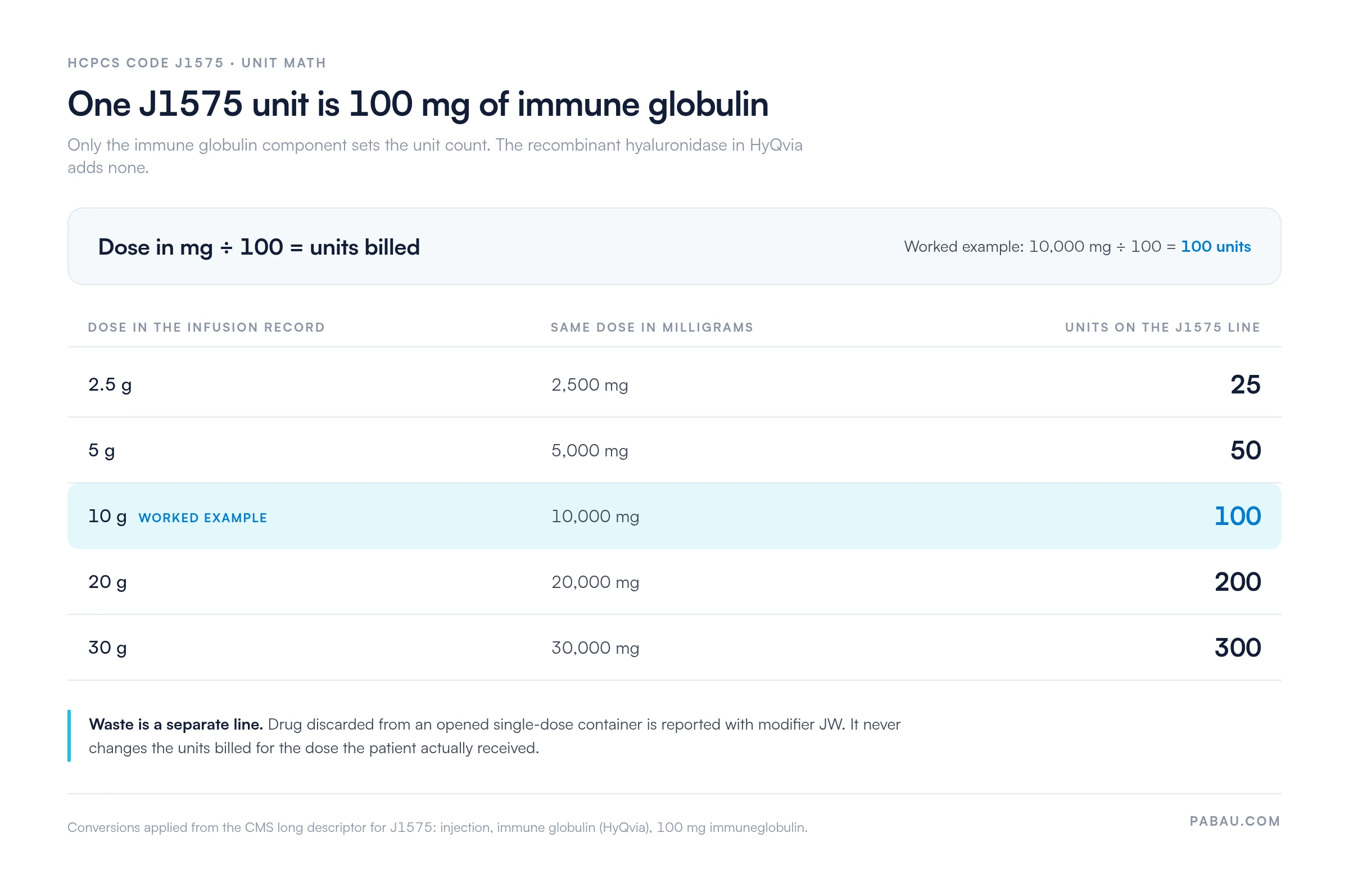
Miscounted units are one of the most common compliance problems on specialty biologics. A single transposed digit changes the claim total by an order of magnitude. A repeated error starts to look like a pattern to an auditor. Check the administered dose against the infusion record before anyone types a unit count.
Ask your infusion nurses to record the dose in milligrams alongside grams. Most unit errors on J1575 start life as a gram figure that someone converts twice, or forgets to convert at all. When the record already carries the milligram total, the billing team has nothing left to calculate.
Modifier use on J1575 follows standard Part B drug rules, and the waste modifiers are the ones that decide whether a claim processes at all.
Check current CMS guidance and your payer’s policy before you apply any of them, because an incorrect modifier invites a denial or a compliance review.
Place of service codes commonly used with J1575 include POS 11 for the physician office and POS 22 for hospital outpatient.
Infusion suites report the POS that matches how the site is licensed and enrolled. Some payers restrict J1575 to specific settings, so read the policy before billing an outpatient or home infusion.
POS 22 places the infusion in a hospital outpatient department, where the facility files its own UB-04 for the device costs it incurs. Codes billed that way, such as HCPCS code C1732, never cross onto the CMS-1500.
Medicare covers immune globulin products, J1575 included, for a defined set of diagnoses. Those diagnoses are listed in CMS Article A57778 on billing and coding for immune globulin.
The diagnosis has to be supported by clinical documentation that shows medical necessity. Off-label use falls outside Medicare coverage.
Treat that table as a starting point rather than a covered list. The diagnoses payable with J1575 are governed by the Local Coverage Determination (LCD) your MAC has issued, and those lists get revised.
Cross-check the diagnosis against the current ICD-10-CM codes and against your own jurisdiction’s LCD before you submit anything outside primary immunodeficiency.
J1575 is one of several J-codes for immune globulin, and picking the wrong one is a reliable denial trigger. Payers separate the codes by route and by product, not by drug class.
Use the crosswalk below to confirm the code against the product that was administered.
Two things follow from that table. The first is that unit size varies across the family. A dose worth 100 units under J1575 bills as 20 units under a 500 mg code. The second is that a product switch mid-therapy changes the code, the units, and often the authorization behind them.
Prior authorization (PA) requirements for J1575 vary by payer and by plan year. Medicare Fee-for-Service does not universally require PA, while Medicare Advantage plans and commercial payers frequently do.
Run the benefit check at scheduling rather than at the point of service, so a PA requirement surfaces before the first dose is drawn up.
Where PA applies, payers typically want a covered diagnosis, documented clinical necessity, and sometimes evidence that other immune globulin formulations were tried or considered. Several also ask for the prescribing physician’s specialty and the setting where the infusion will happen.
Authorizations also expire. Track the expiration date against the patient’s infusion cycle. Renew it before the next appointment, rather than learning about it from a denial.
Thin documentation is the leading cause of J1575 audits and post-payment recovery demands. The record has to support the diagnosis and the clinical decision to use HyQvia specifically.
A chart note that reads like a billing checklist rarely survives a reviewer, because it never explains why this product suited this patient.
Keep a HyQvia-specific infusion log that captures the dose, lot number, and administration time in one place. When that log feeds the billing record directly, unit errors and missing documentation surface before the claim goes out rather than after the remittance arrives.
CMS guidance on immune globulin coverage sits in Article A57778 and in the Local Coverage Determinations each MAC issues.
Together they set out which diagnoses qualify, what documentation has to accompany a claim, and which HCPCS codes fall inside the coverage scope. Reading them before you build the billing workflow beats reacting to denials afterward.
Four coverage principles shape every J1575 claim under Part B:
Home infusion adds one more question. Coverage can run through Medicare Part B or Part D, depending on the setting and the benefit category.
Confirm which applies before a patient starts infusing at home. The active LCD for your jurisdiction is searchable in the Medicare Coverage Database.
Six things have to line up on a clean J1575 claim. They are the code, the units, a covered diagnosis, the POS, the modifiers, and a current authorization.
Here is the path each claim takes, and where the money tends to leak out of it.
Steps one and seven are where practices lose money on J1575. A missed authorization does not announce itself until step six, by which point the drug is already in the patient. An unreconciled remittance is quieter still, because a systematic underpayment simply never gets challenged.
Filing a clean claim the first time depends on all seven steps behaving as one workflow rather than seven separate desks.
In most infusion practices this chain runs on retyping. A nurse writes the dose on the infusion record. A biller then reads it back, converts grams to milligrams, and divides by 100. The result gets keyed into a separate billing system. The diagnosis gets looked up somewhere else again, and the PA number lives in an email thread.
Practice management software like Pabau closes that loop by keeping the record and the claim in one system. Pabau’s claims management software pre-fills the claim form straight from the patient record.
It carries ICD-10 and HCPCS lookup libraries, and it checks that required claim fields are complete before submission. In the US it submits electronically through Claim.MD, our clearinghouse partner, which reaches thousands of payers. That pipeline also handles 837P claims, real-time eligibility checks, and ERA remittance processing.
The result for a J1575 claim is fewer hand-offs between the infusion chair and the payer. The dose your nurse recorded is the dose your biller sees.
Eligibility gets checked before the appointment rather than after the denial. Remittances post against the claim they belong to.

Pabau’s claims management software pre-fills claims from the patient record and offers ICD-10 and HCPCS lookup. Required fields get checked before submission, so J1575 claims leave your practice complete.

J1575 rewards precision in three places: the route, the unit math, and the diagnosis. Get those right and the claim is unremarkable. Miss one and you are facing a denial on a drug the practice has already bought and infused.
The practical move is to push the checks upstream. Verify the benefit and the authorization at scheduling, record the dose in milligrams at the chair, and reconcile every remittance against the quarter’s ASP rate. Practices that do this treat immune globulin as a predictable line of business rather than a recurring appeals project.
If the checks currently live in three systems and someone’s inbox, that is the part worth fixing first. Book a demo to see how Pabau keeps the infusion record, the authorization, and the claim in one place.

Want to see how a clearinghouse handles your claims? Medical claims clearinghouse overview explains how electronic claims travel from practice to payer, and where errors get caught on the way.
Dealing with repeated J1575 denials? Denial codes in medical billing breaks down the CARC and RARC codes so you can action the right fix for each denial type.
Need to verify coverage before every infusion? How Claim.MD clearinghouse works covers real-time eligibility checks, ERA processing, and the payer enrollment that prevents pre-service surprises.
Yes. J1575 covers the drug only, so the administration is reported on its own line. Subcutaneous infusion administration is reported with the 96369 family of CPT codes, subject to payer policy. Check whether your payer bundles administration into a home infusion per diem before you bill both.
Often, yes. Many payers, and most state Medicaid programs, require the 11-digit NDC plus the NDC quantity and unit of measure on the drug line. That figure describes the package administered, so it does not replace the HCPCS unit count. Send both, and keep them consistent with the infusion record.
POS 12 identifies the patient’s home. Confirm the benefit category before you use it, because home infusion of immune globulin can be paid differently from an infusion given in your office. Some plans route the drug through a specialty pharmacy, which leaves the practice billing only the services it provided.
It depends on who supplies the drug. When the practice buys the product and infuses it, J1575 goes to the medical benefit as a Part B drug. When a specialty pharmacy supplies it, the pharmacy bills the drug and your practice bills the administration alone. Verify this during the benefit check.



