CCSD code H4430: Examination of rectum under anaesthetic
CCSD code H4430 pays for the examination alone CCSD code H4430 is the UK private...

Last Updated: Oct 20, 2026
J0881 is the HCPCS Level II code for injection, darbepoetin alfa, 1 microgram (non-esrd use).
Darbepoetin alfa is marketed as Aranesp by Amgen and belongs to the erythropoiesis stimulating agents (ESA) drug class.
The non-ESRD qualifier in the descriptor is the part that decides the code. Darbepoetin alfa given to a dialysis patient bills under J0882 instead. Submit J0881 for that patient and the claim will be denied.
Let Pabau's smart automation suggest the right codes, reduce claim denials, and keep your practice compliant—effortlessly.
Automate repetitive tasks and focus on what matters most—your patients.
Reduce coding errors and ensure compliance with the latest regulations.
Clean claims, fewer denials, and faster reimbursements.
Powerful insights and reporting to help your practice thrive.
HIPAA compliant SOC 2 certified GDPR-compliant Trusted by 4,000+ clinics worldwide

HCPCS code J0881 covers injection of darbepoetin alfa (Aranesp), 1 microgram, for non-ESRD use only.
J0881 is billed per microgram administered. Modifier JA for intravenous or JB for subcutaneous is required on every claim.
Darbepoetin alfa given to a dialysis patient bills under J0882, not J0881.
Medicare pays J0881 at ASP plus 6% under Part B drug pricing, and CMS updates that limit quarterly.
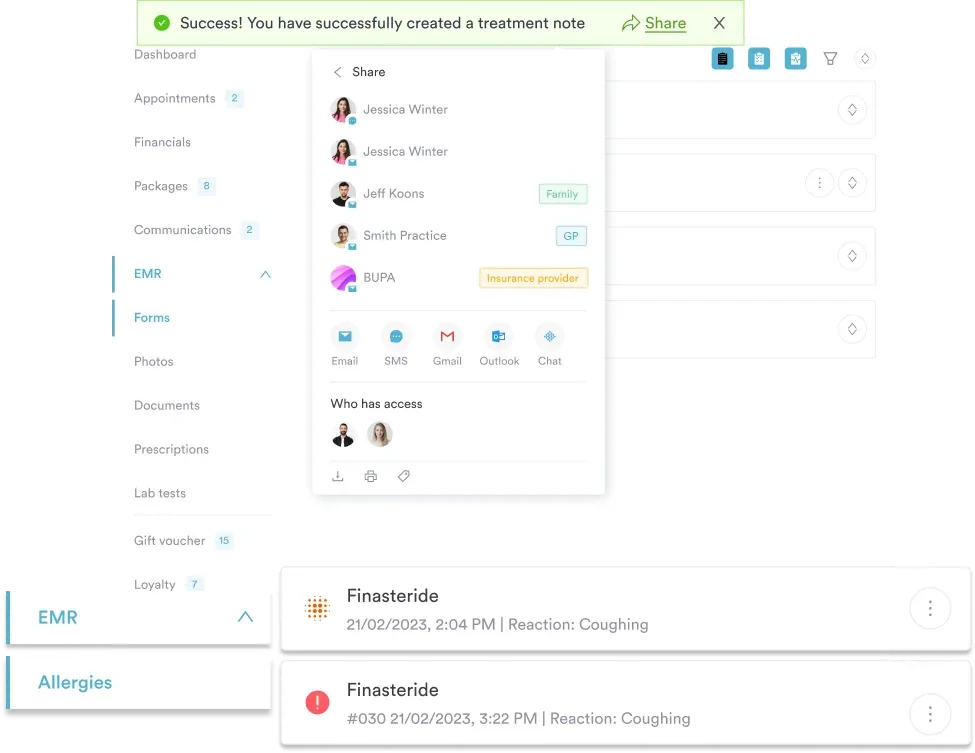
Practice management software like Pabau ties the infusion record to the claim, so units and modifiers match the chart.
The table below summarizes the key attributes of HCPCS code J0881 for quick reference.
J0881 billing units are calculated on a per-microgram basis. Each unit billed equals 1 mcg of darbepoetin alfa actually administered. If a patient receives 100 mcg, the claim reflects 100 units of J0881.
For chemotherapy-induced anemia, the approved starting dose is 2.25 mcg/kg weekly or a fixed 500 mcg every three weeks. The table below converts those regimens into units for a 70 kg patient. Billing teams can use it when auditing practice management documentation.
Round fractional micrograms up to the nearest whole unit. Billing fewer units than administered leaves revenue on the table. Billing more is an overpayment and a compliance risk.
The physician order and the infusion record both have to show the weight-based dose and the volume actually given. That is what lets an auditor verify the unit count on the claim.
Track the darbepoetin alfa dose and the actual administration volume in the clinical note at the time of service. Reconstruct billing from the nursing infusion record rather than from the order. Dose adjustments happen at the chair, and the order may not reflect the final amount given.
Every J0881 claim requires either modifier JA or modifier JB. Omitting it is one of the most common reasons J0881 claims are denied outright. Nothing can be reconsidered until the modifier is appended and the claim resubmitted. According to AAPC’s HCPCS reference, these route-of-administration modifiers are mandatory for all ESA J-codes.
The modifier has to match the route documented in the clinical record. If the chart says subcutaneous and the claim carries JA, that discrepancy becomes an audit flag. Patient record management that links the clinical note to the claim catches these mismatches before submission.
That matters most in IV therapy practices, where the same drug goes out by both routes on the same day.
Coverage for J0881 is set by your Medicare Administrative Contractor (MAC), not by a single national policy. There is no national LCD for ESAs. Each MAC publishes its own Local Coverage Determination, so the medical necessity criteria you have to meet depend on your region.
The primary covered indication is anemia due to myelosuppressive chemotherapy in patients with non-myeloid malignancies. Coverage generally applies when hemoglobin sits below 10 g/dL, per CMS guidance. Always check the current LCD, since thresholds change.
Pairing J0881 with an unspecified anemia code when a more specific one is available is a common denial driver. The diagnosis on the claim should reflect the treating oncologist’s documented indication, not a generic placeholder. Verify against your MAC’s policy before submitting.
Medicare pays J0881 under the Part B drug payment methodology, which uses Average Sales Price (ASP) plus 6%. CMS publishes the current limits in its quarterly ASP pricing files. Aranesp is a high-cost biologic, so even small quarterly shifts in ASP move the payment per claim.
Part B drug payment works differently from physician-service payment. CMS publishes one national payment limit per HCPCS code, with no geographic or locality adjustment applied. A practice in rural Montana and one in Manhattan bill J0881 against the same national limit.
What does vary is coverage policy by contractor and the terms of each commercial contract. Quarterly ASP updates are one of several moving parts in Medicare billing, so build the refresh into a standing process rather than a reminder. Pulling rates automatically through EHR billing integration removes the manual step altogether.
Never publish a dollar rate in patient-facing materials or a charge master without checking the current quarter’s ASP file. The figures here describe the methodology, and no fixed amount stays accurate across quarters.
National Drug Code (NDC) reporting is required for Medicaid claims and increasingly requested by commercial payers. The crosswalk maps the Aranesp package dispensed to J0881, so payers can verify the exact drug, concentration, and package size given. Prescription management software stores NDC numbers against drug records to keep that crosswalk consistent. Coverage verification also surfaces the deductible position, which changes what the practice collects at the desk. Coverage verification also surfaces the deductible position, which changes what the practice collects at the desk.

NDC numbers change when Amgen updates packaging or vial configurations. Always pull the current 11-digit NDC from the vial label rather than a stored reference. State Medicaid programs also differ on NDC qualifier codes, using UN for unit, ML for milliliter, or GR for gram.
Confirm the right qualifier in your state Medicaid billing guide before submission. This is not unique to Aranesp. Any injectable billed under a drug J-code, drug J-code, J1800 included included, needs the NDC that matches the vial in hand.
Your MAC’s ESA Local Coverage Determination sets out the clinical documentation that has to sit in the medical record to support J0881. Thin documentation is the second most common denial cause after modifier errors.
Digital intake forms and structured note templates capture the required data at the point of care rather than during a retrospective audit. It is worth reviewing HIPAA-compliant documentation practices at the same time, so records are both complete and properly secured.
ESAs, including Aranesp, carry a black box warning for increased risk of death, myocardial infarction, stroke, deep vein thrombosis, and tumor progression. Those risks are part of why coverage criteria are so tight.
One requirement has gone away. The ESA APPRISE Oncology program was the FDA Risk Evaluation and Mitigation Strategy attached to that warning, and the FDA discontinued it in April 2017. Prescriber enrollment is no longer required, and billing teams no longer need to verify it before releasing a claim.
The warning itself and the hemoglobin monitoring behind it still stand. Structured medical forms management keeps that monitoring evidence attached to the patient record.
Traditional Medicare fee-for-service does not require prior authorization (PA) for J0881. Coverage is decided retrospectively, when the claim is reviewed against the applicable MAC’s ESA Local Coverage Determination. No PA requirement does not mean the claim pays automatically. Approval simply happens at adjudication rather than beforehand.
Medicare Advantage plans and most commercial payers require PA for J0881 before the first administration. Requirements vary widely, so check with each payer’s specialty drug authorization desk before treatment starts. Missing a required PA on a Medicare Advantage plan usually produces a denial that cannot be appealed on clinical grounds.
J0881 and J0885 are both ESA codes, but they describe different drugs with different dosing schedules and unit definitions. Confusing them produces a wrong-drug claim, which is a compliance problem and a reimbursement error at the same time.
The unit definition is the biggest operational hazard. J0881 units are micrograms. J0885 units are thousands of international units. Billing 100 units of one is nothing like billing 100 units of the other, in drug quantity or in payment.
Renal status decides the code, not the drug. Darbepoetin alfa for a dialysis patient bills under J0882, and epoetin alfa for that same patient bills under Q4081. Confirm renal status in the chart before you choose between the four.
J0881 claims fail at a higher rate than many other Part B drug codes. The code combines a mandatory modifier, a weight-based unit calculation, and strict diagnosis requirements. The errors below account for the majority of J0881 denials.
Run a monthly pre-submission audit on all J0881 claims. Filter for claims missing JA or JB, claims paired with D64.9, and claims where the unit count does not match the recorded infusion volume. Catching these before submission is faster than working denials after the fact.
In most infusion practices the claim gets built after the fact. A biller opens the physician order, reads a paper infusion log, converts micrograms to units, and adds the modifier from memory. Every one of those steps is a place for the unit count or the route to drift from the chart.
Practice management software like Pabau keeps all of it in one record. The nursing note, the administered dose, the route, and the diagnosis sit against the same patient file the claim is built from. Pabau’s claims management software reads the unit count from that note, so nobody retypes a number between two systems.
That is the difference between catching a missing JB before submission and working a denial three weeks later. The hemoglobin results and signed orders an auditor asks for are already attached to the visit.
Teams comparing infusion center software should weigh that link between chart and claim heavily. Every Pabau subscription includes the full platform, so none of it sits behind a higher tier.

Pabau helps infusion and oncology teams link clinical documentation to billing workflows, so modifier errors and unit miscalculations are caught before claims go out. See how it works for your practice.

Darbepoetin alfa claims fail for reasons that are almost always preventable. The usual three are a missing modifier, a unit count taken from the order instead of the infusion log, and an unspecified diagnosis code.
Getting J0881 right is a workflow decision more than a coding one. If the infusion record and the claim come from the same file, the modifier and the unit count take care of themselves. If they do not, someone reconstructs the visit from memory two weeks after it happened.
Check renal status first, then the route, then the micrograms that actually went in. Book a demo to see how Pabau links infusion documentation to J-code claims before they go out.

Billing another injectable J-code? J2010 covers the units, modifiers, and coverage rules for lincomycin injections.
Documenting controlled substance injections too? J2175 explains how units and documentation work for meperidine.
Working through an anabolic agent claim? J2320 walks through nandrolone decanoate units and Medicare coverage.
HCPCS code J0881 is the billing code for injection of darbepoetin alfa (Aranesp), 1 microgram per unit, for non-end-stage renal disease use. It is a Level II HCPCS J-code used for Medicare Part B and other payer billing of this erythropoiesis stimulating agent.
Every J0881 claim requires either modifier JA for intravenous administration or JB for subcutaneous administration. The modifier has to match the route documented in the clinical record. Omitting it is the leading cause of J0881 claim denials.
J0881 billing units equal the total micrograms of darbepoetin alfa actually administered, so each microgram is one unit. For a patient receiving 100 mcg, the claim reflects 100 units. Calculate units from the infusion nursing record rather than the original order, so dose adjustments are captured.
Traditional Medicare fee-for-service does not require prior authorization for J0881. Coverage is decided at claims adjudication against the applicable MAC’s ESA Local Coverage Determination. Medicare Advantage plans and most commercial payers do require prior authorization before initiation, so verify with each payer before administering the drug.
The primary covered diagnoses are D63.0 for anemia in neoplastic disease and D64.81 for anemia due to antineoplastic chemotherapy. D64.9 is generally insufficient for coverage when a more specific code applies. Using it when a specific code is documented increases denial risk significantly.
J0881 covers darbepoetin alfa (Aranesp) billed per microgram. J0885 covers epoetin alfa (Procrit or Epogen) billed per 1,000 international units. Both are non-ESRD codes, but the drugs, dosing schedules, and unit definitions differ. Billing the wrong one produces a wrong-drug claim that must be voided and resubmitted.
Medicare pays J0881 at Average Sales Price plus 6% per unit under the Part B drug payment methodology. The limit is national and carries no locality adjustment. CMS updates it quarterly, so check the current ASP pricing file rather than a static number in the charge master.
Darbepoetin alfa given to a patient with end-stage renal disease on dialysis bills under J0882, not J0881. The drug and the 1 microgram unit are identical. Only the patient’s renal status decides which of the two codes belongs on the claim.
No. The FDA discontinued the ESA APPRISE Oncology Risk Evaluation and Mitigation Strategy in April 2017, so prescribers no longer have to enroll. The black box warning on erythropoiesis stimulating agents still applies, and hemoglobin monitoring still belongs in the record.