HCPCS Code A4627: Spacer and valved holding chamber
HCPCS Code A4627: official descriptor and code definition HCPCS Code A4627 is th...

Last Updated: Oct 21, 2026
J0712 is the HCPCS Level II code for injection, ceftaroline fosamil, 10 mg.
HCPCS code J0712 bills injection of ceftaroline fosamil, the antibiotic sold as Teflaro, in 10 mg increments. One unit equals 10 mg, so a standard adult dose of 600 mg bills as 60 units.
That conversion is the most common place a J0712 claim goes wrong, and a missing NDC is the second. Payers reject both before a human reviewer opens the file, so you rebill instead of appealing.
Let Pabau's smart automation suggest the right codes, reduce claim denials, and keep your practice compliant—effortlessly.
Automate repetitive tasks and focus on what matters most—your patients.
Reduce coding errors and ensure compliance with the latest regulations.
Clean claims, fewer denials, and faster reimbursements.
Powerful insights and reporting to help your practice thrive.
HIPAA compliant SOC 2 certified GDPR-compliant Trusted by 4,000+ clinics worldwide

HCPCS code J0712 bills injection of ceftaroline fosamil (Teflaro), and one unit equals 10 mg administered.
The adult dose is 600 mg every 12 hours for both approved indications, which bills 60 units per infusion.
A renal-adjusted dose changes the unit count, so 400 mg bills 40 units and 200 mg bills 20.
Medicaid and many commercial payers reject the whole line when the 11-digit NDC is missing.
Medicare Part B pays J0712 at ASP plus 6%, and CMS refreshes that rate every quarter.
J0712 is the CMS HCPCS Level II code for injection of ceftaroline fosamil, 10 mg. Ceftaroline fosamil is a fifth-generation cephalosporin, marketed as Teflaro by AbbVie. It is one of the few beta-lactam antibiotics active against methicillin-resistant Staphylococcus aureus (MRSA), which is why it turns up in infusion suites at all.
The FDA approved Teflaro for two indications: community-acquired bacterial pneumonia (CABP) and acute bacterial skin and skin structure infections (ABSSSI).
Bill J0712 only when the drug treats one of those. Off-label coverage varies widely by payer, so get it confirmed in writing before the infusion rather than after.
Medicare Part B reimburses J0712 at ASP plus 6% under Section 1847A of the Social Security Act. CMS builds the average sales price (ASP) from manufacturer-reported sales data and republishes it four times a year. Any dollar figure printed in a reference guide is therefore stale within a quarter.
Check the current allowable in the CMS Physician Fee Schedule lookup tool or the quarterly ASP pricing files before you submit. Rates also vary by Medicare Administrative Contractor (MAC) jurisdiction, so use the file that matches yours.
Buy-and-bill is the usual pathway for this drug. The practice buys Teflaro from a wholesaler, administers it, then bills Part B for the drug and the administration separately.
That means the practice carries the acquisition cost until the claim pays. Margin depends entirely on what you negotiated against the published ASP.
Document acquisition costs carefully, and raise anti-kickback questions with compliance counsel early. Practices that manage buy-and-bill as a margin play attract scrutiny they do not need.
When the remittance lands, compare what was paid against the ASP-based allowable you expected. A shortfall usually points at a unit miscalculation or a MAC-specific fee schedule adjustment, and both are worth catching in the same week.
One unit of J0712 is 10 mg of ceftaroline fosamil administered. The adult dose is 600 mg every 12 hours for both approved indications, so one infusion bills 60 units. There is no adult regimen at 600 mg every 8 hours, whatever an older crosswalk may still say.
Bill the dose that went into the patient, not the vial size. Draw a 600 mg vial, infuse 400 mg, and the line reads 40 units. You can document and claim wastage under payer-specific policy, but the billed quantity always has to match the administration record.
Adults with a creatinine clearance (CrCl) at or below 50 mL/min get a reduced dose, and the unit count drops with it. This is the detail that catches billers who key 60 units out of habit. The label sets three reduced regimens, all still given every 12 hours.
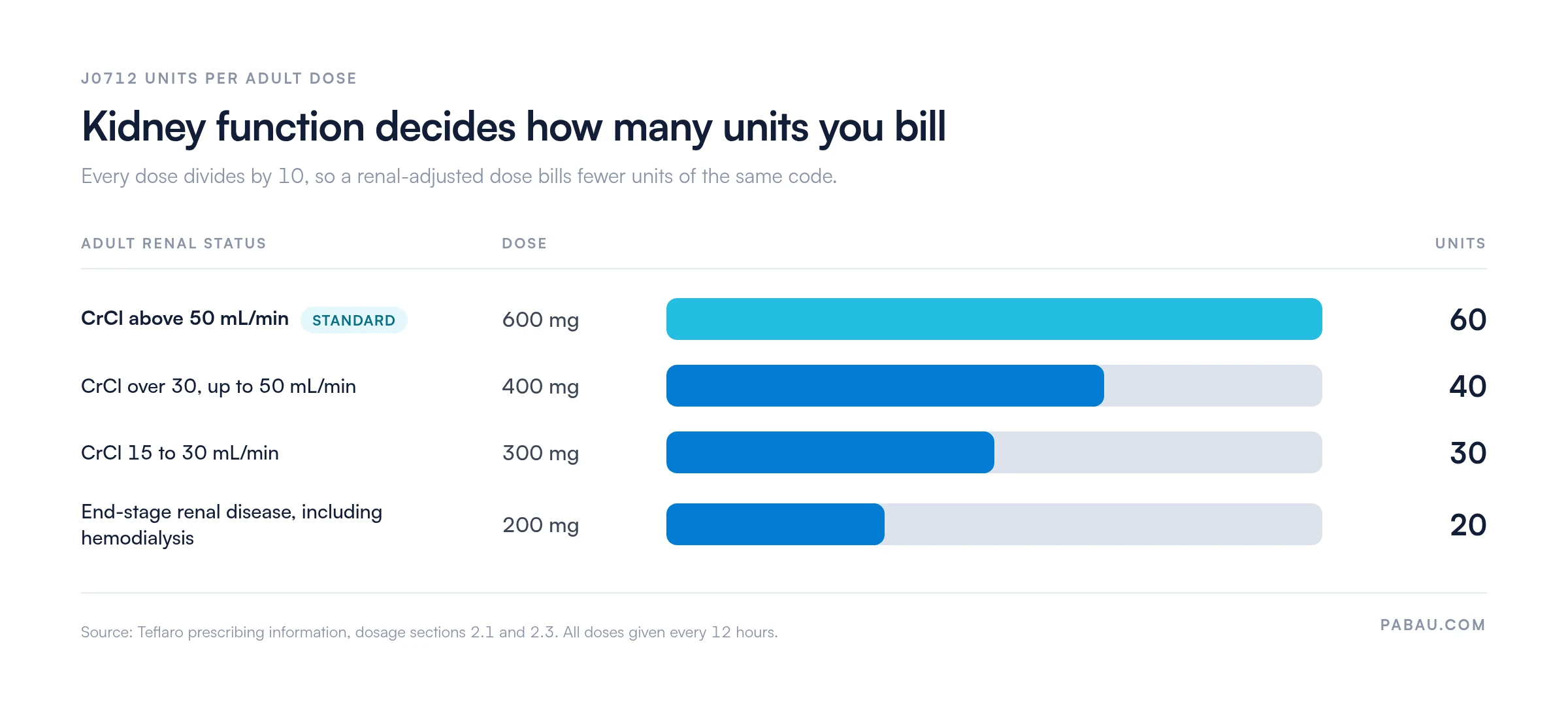
Kidney function can also move mid-course, which moves the unit count with it. Pull the ordered dose from the medication administration record for every date of service rather than assuming the standard 600 mg.
Take a 62-year-old admitted for CABP with a CrCl of 38 mL/min. The order reads 400 mg IV every 12 hours for six days. Each infusion bills J0712 at 40 units, alongside the infusion administration code.
Six days at two infusions a day is 12 administrations and 480 units in total. Those units belong on the dates of service they were given, one line per date. Rolling a whole course onto a single line is a fast way to trigger a medical review.
Put the conversion where the units actually get keyed: J0712 is one unit per 10 mg. Check the ordered dose before you default to 60 units, because a renal-adjusted patient bills 40, 30 or 20. A monthly audit of J0712 unit counts catches habit errors before they turn into an overpayment refund.
Medicaid requires a national drug code (NDC) on every J0712 claim line, and many commercial payers do too. It goes on the drug line in 11-digit format behind the N4 qualifier. The Teflaro 600 mg single-dose vial carries NDC 0456-0600-01, which submits as N4 00456060001.
Teflaro ships as a lyophilized powder in 400 mg and 600 mg single-dose vials, and the two sizes carry different NDCs. Read the number off the carton you opened instead of a saved default. Labelers renumber packages when manufacturing or distribution changes, so check the current Teflaro listing on DailyMed when a carton looks unfamiliar.
Leave the NDC off a payer that wants it and the claim rejects rather than denies. A rejection never enters adjudication, so there is nothing to appeal. You correct the line and resubmit, while the timely-filing clock keeps running.
Two fields decide whether a J0712 line clears adjudication. One is the modifier on the drug line, the other is the diagnosis behind it. Payers edit them separately, so both have to hold up on their own.
Medicare wants one of the two discarded-drug modifiers on every J0712 line drawn from a single-dose vial. Which one you use depends on whether anything was thrown away.
Payers differ on which of these they accept. Confirm against your MAC’s local coverage determination (LCD) and the individual contract before you append one.
Every J0712 line needs at least one ICD-10-CM code that supports an FDA-approved indication and matches the chart. These are the codes that show up most often on Teflaro claims.
The CABP indication on the Teflaro label covers methicillin-susceptible S. aureus isolates, so J15.211 is the specific pneumonia code that fits. A MAC’s LCD can also cover a narrower list than the label allows, and those lists change on an annual cycle.
Check your jurisdiction before you submit, and keep the ICD-10-CM code library open when documentation names an organism the payer wants coded precisely.
Recoupment after payment costs more than a front-end denial, because the money has already been spent. Reviewers ask for the same five things when they pull a Teflaro claim.
For a practice running repeated outpatient ABSSSI courses, a templated infusion note pays for itself quickly. Capture the diagnosis, the ordered dose, the administered dose, and the rationale in the same place every time.
Medicare Part B fee-for-service generally does not require prior authorization for drugs given under buy-and-bill. Medicare Advantage and commercial plans frequently do, and each Advantage plan sets its own formulary. Approval from fee-for-service tells you nothing about the Advantage plan sitting next to it.
Verify eligibility and the plan’s authorization rules before you put the infusion on the schedule. Then confirm that the approved ICD-10 code appears on the authorization, not just the drug name. A clean claim line for J0712 carries the code, the units, the NDC, the administration CPT code, and the authorization number together.
Give J0712 its own pre-submission check. Confirm the HCPCS code, match the units to the dose administered, and put the NDC in N4 format on the drug line. Then check the diagnosis against the LCD-covered list, and add the authorization number where one was required. The check takes under two minutes and heads off the rejection patterns that cost the most rework.
The data elements are the same on a CMS-1500 and a UB-04. What matters is the order you assemble them in, because that is what keeps the dose, the units, and the NDC from drifting apart.
When one does slip through, read the remittance before you resubmit. The denial codes returned on the 835 tell you whether the problem was the unit count, the diagnosis, or the authorization.
Billing teams usually assemble a J0712 line from three places at once. The dose comes from the infusion note, the NDC comes from the carton, and the authorization number comes from the payer portal. Re-keying across three windows is where a 60 quietly becomes a 6.
Practice management software like Pabau keeps those pieces on one record instead. Pabau’s medical claims management pulls the treatment note, the patient’s insurance details, and the coded charge straight into the claim. Code lookup libraries mean the biller selects J0712 from a stored list rather than typing it from memory.
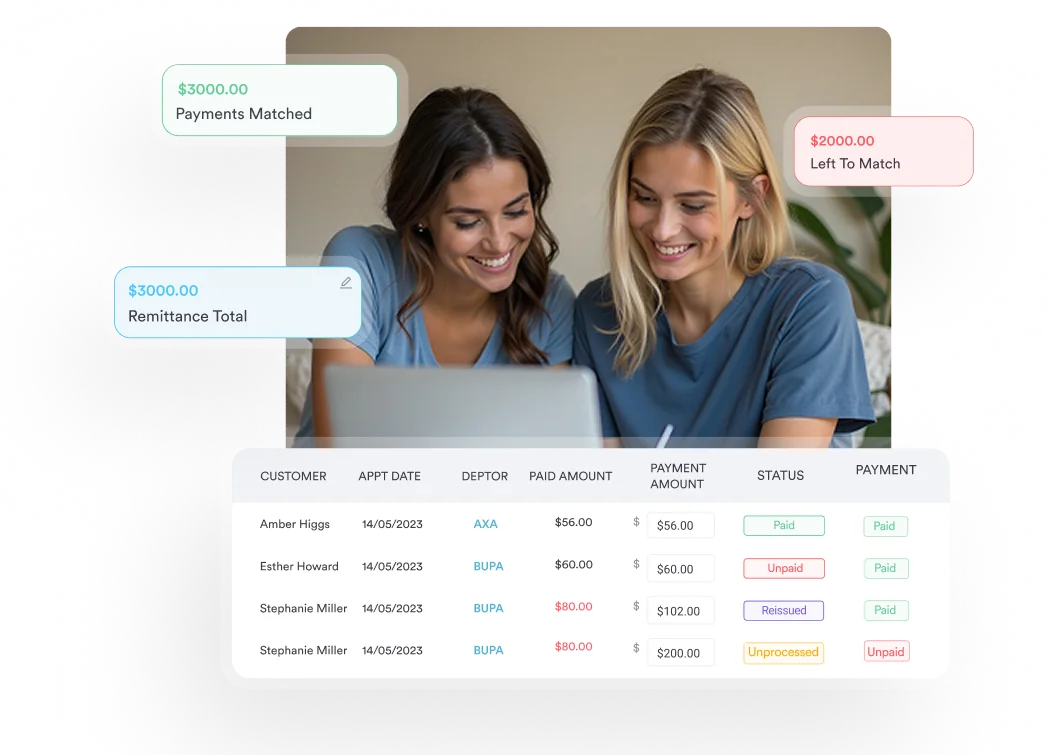
A completeness check then runs before submission and flags any required field left empty, so the line does not leave the practice half-built. Unit counts and modifier choices stay with the biller, where they belong. Pabau’s job is getting a complete claim out the door on the day the infusion happened.

Pabau’s claims management keeps the treatment note, insurance details and coded charge on one record. A completeness check then flags missing required fields before the claim reaches the payer.

J0712 rewards a boring habit. Read the ordered dose off the administration record, divide by 10, and copy the NDC off the carton you opened. Do that on every infusion and unit errors stop appearing on your remittance.
The renal-adjusted doses are the part worth writing down somewhere visible. A patient whose kidney function shifts mid-course shifts the unit count too, and no clearinghouse edit will flag that. It falls to the biller who reads the chart.
Practices that keep the note, the charge, and the insurance details in one system spend less time chasing the pieces of a drug claim. Book a demo and we will walk a J0712 line through Pabau from infusion note to submitted claim.

Need to understand how denials affect your J-code revenue? Denial management in healthcare covers the most common denial patterns and how to build a systematic appeal workflow.
Want a reference for the codes on your remittance? Denial codes in medical billing explains the CARC and RARC codes that come back most often on drug claims.
Not sure what makes a claim pass first time? What is a clean claim sets out the fields payers check before a claim ever reaches adjudication.
Building charge capture for infusion visits? Superbill shows what belongs on the encounter form so the drug and the administration both get billed.
Looking for a primer on how the billing cycle works? Revenue cycle management walks through every stage from charge capture to payment posting.
At 600 mg every 12 hours, an adult bills 120 units a day. The label puts CABP at 5 to 7 days and ABSSSI at 5 to 14 days. That works out to 600 to 840 units for pneumonia, and 600 to 1,680 units for a skin infection. Split them across the dates of service, never onto one line.
The math starts with weight. Children aged 2 to under 18 who weigh 33 kg or less get 12 mg/kg every 8 hours. A 25 kg child receives 300 mg, which bills 30 units per infusion, three times a day. Bill the dose actually given rather than rounding to the nearest vial.
No. J0712 units count 10 mg increments of drug administered. The NDC quantity carries its own unit-of-measure qualifier and reports what came out of the package. The two numbers rarely match, and payers edit them separately, so take each one from its own source.
No. J0712 describes 10 mg of ceftaroline fosamil, so both vial sizes report under it. Only the unit count and the NDC change. A 400 mg vial given in full is 40 units with the 400 mg package NDC. A 600 mg vial is 60 units with its own.