





HCPCS code L2134: Ankle-foot orthosis billing guide
HCPCS code L2134: official descriptor and device specifications The official CMS...

Last Updated: Sep 29, 2026

J0712 is the HCPCS Level II code for injection, ceftaroline fosamil, 10 mg.
Medicare Part B pays the drug under average sales price rules. Every single-dose vial line also carries an NDC and a wastage modifier. Miss one of those and the line denies, after the drug has already gone into the patient.
Let Pabau's smart automation suggest the right codes, reduce claim denials, and keep your practice compliant—effortlessly.
Automate repetitive tasks and focus on what matters most—your patients.
Reduce coding errors and ensure compliance with the latest regulations.
Clean claims, fewer denials, and faster reimbursements.
Powerful insights and reporting to help your practice thrive.
HIPAA compliant SOC 2 certified GDPR-compliant Trusted by 4,000+ clinics worldwide

HCPCS code J0712 covers injection, ceftaroline fosamil (Teflaro), per 10 mg, given intravenously in covered outpatient settings.
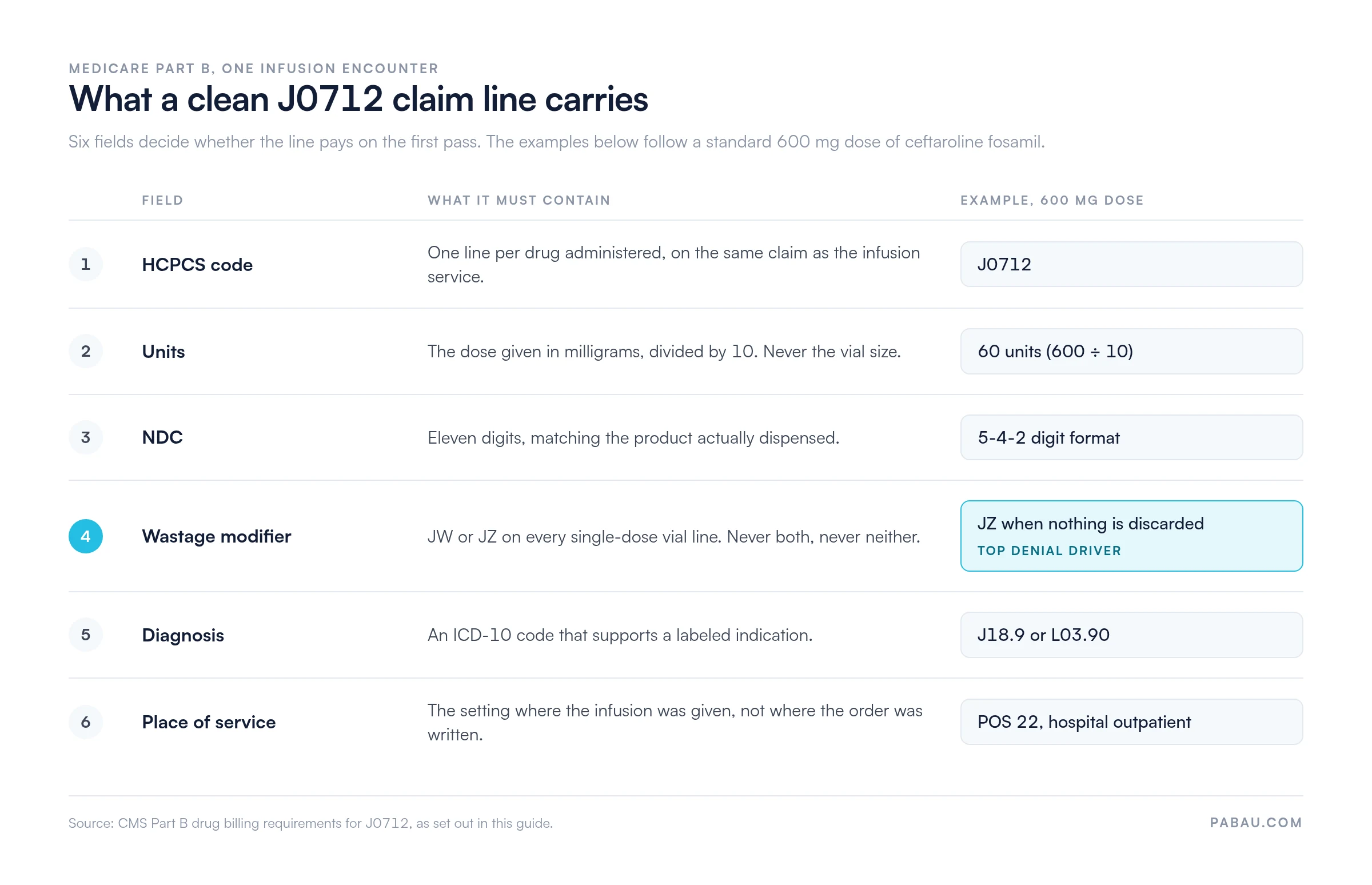
Each billing unit equals 10 mg, so a standard 600 mg dose is reported as 60 units of J0712.
Medicare Part B pays J0712 at ASP plus 6% per unit. Since the CY2023 OPPS final rule, 340B-covered entities are paid at that same rate.
Every single-dose vial line needs JW or JZ, and JZ has been required since July 1, 2023.
Practice management software like Pabau builds the claim from the client record, routes it to the right payer channel, and tracks its status.
HCPCS code J0712 is a Level II drug code for ceftaroline fosamil, billed per 10 mg administered. Ceftaroline fosamil is a fifth-generation cephalosporin sold as Teflaro, whose labeler is Allergan, an AbbVie company.
The Centers for Medicare and Medicaid Services (CMS) keeps it in the J-series, which covers drugs given by injection or infusion.
The code is not new. J0712 has been billable since January 1, 2016, after CMS added it to HCPCS on January 1, 2012.
Medicare Part B covers the drug when a physician administers it incident-to, or when a qualified outpatient facility gives it. Infusion centers and hospital outpatient departments are the usual places it shows up.
Here is the reference data in one place. Scan it as a last check before the claim goes out.
The FDA approved Teflaro for two indications, and coverage follows that label.
Those two are acute bacterial skin and skin structure infections (ABSSSI) and community-acquired bacterial pneumonia (CABP). What makes the drug worth its cost is activity against methicillin-resistant Staphylococcus aureus (MRSA).
Administration is intravenous only, usually as a 60-minute infusion. J0712 therefore never applies to an oral formulation. Nor is it the code for home infusion, which bills under Part D instead. Physician offices with infusion capability round out the settings where the code appears.
Treatment length also differs by indication, per the FDA prescribing information.
Each unit of J0712 is 10 mg of ceftaroline fosamil. To get the unit count, divide the dose administered in milligrams by 10. Bill the dose that went into the patient, not the vial you opened.
The standard adult dose for both indications is 600 mg every 12 hours, which comes to 60 units per infusion. Renal impairment lowers the dose, and the unit count falls with it. The table below covers the doses a billing team sees most often.
Wastage note: Teflaro comes in single-dose vials, so leftover drug has to be accounted for. Put the administered units in the units field. Report any discarded drug on its own line with the JW modifier, as covered below.
Medicare Part B pays J0712 at average sales price (ASP) plus 6% per unit. That rate applies whether or not the provider is a 340B-covered entity.
The CY2023 OPPS final rule ended the earlier 340B reduction, after the Supreme Court struck it down. CMS refreshes ASP pricing every quarter, so the dollar figure moves through the year.
Payment is calculated per unit, which means per 10 mg. For a 600 mg dose, multiply the per-unit rate by 60 to get the expected payment for that infusion.
Pull the new CMS ASP pricing file at the start of each quarter rather than carrying last quarter’s number forward.
340B context: covered entities still buy Teflaro at a discounted acquisition cost, and that has not changed. The discount sits on the purchasing side. Since January 1, 2023, Medicare has paid these providers the same ASP plus 6% as everyone else. HRSA still determines 340B eligibility, so keep the status current for purchasing and reporting.
CMS requires an NDC on every Part B claim line for a separately payable drug, and J0712 is one of them. Submit ceftaroline fosamil without one and the line denies.
The NDC goes on the claim in 11-digit format, written as XXXXX-XXXX-XX. It has to match the product actually dispensed, not the product bought for stock.
Teflaro comes in single-dose vials. Treat the entries below as a starting point, then confirm the current NDC against the FDA NDC database or the CMS ASP file. Packaging changes reassign NDCs more often than most billing teams expect.
Every J0712 claim needs at least one ICD-10 code that supports medical necessity. The two labeled indications drive the common pairings below.
ICD-10 codes change each October, so check the current fiscal year’s files before you bill.
Specificity helps the claim. When cultures confirm Streptococcus pneumoniae, J13 is a stronger pairing than J18.9.
Payers also deny J0712 when the diagnosis sits outside the approved indications. If a clinician treats off-label, document the clinical reasoning and check the commercial payer’s coverage policy first.
Two wastage modifiers govern J0712, and one of them belongs on every line. CMS set the policy in Change Request 13056, issued as Transmittal 12067.
JZ became mandatory on July 1, 2023, after a voluntary period that began January 1, 2023. Contractors started enforcing the claim edits on October 1, 2023.
JW and JZ never appear together on the same drug for the same date of service. Pick JZ when the whole vial goes into the patient. When part of it is thrown away, report the wasted units on a second J0712 line carrying JW. A line with neither modifier is one of the most common Part B drug denials, and the CMS discarded drug policy spells out both cases.
Audit your J0712 claims monthly for missing JW or JZ modifiers. Set up an edit in your billing workflow that flags any J-series single-dose vial line without one of the two modifiers before submission. This single check prevents the most common denial pattern for provider-administered antibiotics.
The paperwork follows the drug in a fixed order. Knowing that order tells you where a claim went wrong when the remittance comes back short.
Medicare Part B does not require prior authorization for J0712 in most outpatient settings. Coverage turns on medical necessity instead.
The drug has to be administered incident-to a physician’s service or in a qualified outpatient facility, and the diagnosis has to match an approved indication.
Commercial payers work differently. Many treat MRSA-active antibiotics as specialty pharmacy drugs, and their rules vary by plan and formulary tier. Expect requests for culture and sensitivity results, evidence that first-line therapy failed, and a prescriber attestation.
Verify with each plan before the infusion is scheduled, because a denial that lands afterwards leaves the practice holding the drug cost.
J0712 bills per 10 mg, while its neighbors bill per 500 mg or per gram. That one difference is why a J0712 line shows 60 units where a cefazolin line shows 2.
Reviewers who compare the two side by side often flag the higher count as an error when it is correct.
Billers who cover several anti-infectives can work through the rest of the J-series in our HCPCS code library. Keeping the unit basis visible at the point of coding is what stops cross-coding errors between similar drugs.
These five patterns account for most J0712 denials. Each one is catchable before submission, which is far cheaper than working the appeal afterwards.
One line, six fields. Read them in this order and most of the denials above never reach the payer.
Four more checks sit outside the claim line itself, in the record behind it:
Build a J0712 claim template in your billing system. Pre-populate the unit formula, require NDC entry before the claim can be saved, and add a prompt that forces a JW or JZ selection. Configuring it takes about 15 minutes and closes the gap the audits keep finding.
Most infusion practices assemble a J0712 line by hand. Someone reads the dose from the chart, does the division, copies the NDC off the vial, and picks a modifier from memory. Every hop between systems is another chance to mistype a figure.
Practice management software like Pabau builds the claim from the client record instead. Codes attached to the service land on the charge line, and diagnosis slots are seeded from the recorded problem list.
Built-in ICD-10 and CPT or HCPCS lookup libraries sit behind a search icon, so a coder can confirm J0712 without leaving the claim.
Pabau then checks that the claim’s required fields are complete before the send button unlocks. From there it routes the claim to the right regional channel and tracks its status.
In the US that includes eligibility checks and electronic remittance posting, so a short-paid J0712 line surfaces while there is still time to appeal. Day to day, that is what faster claims management looks like.
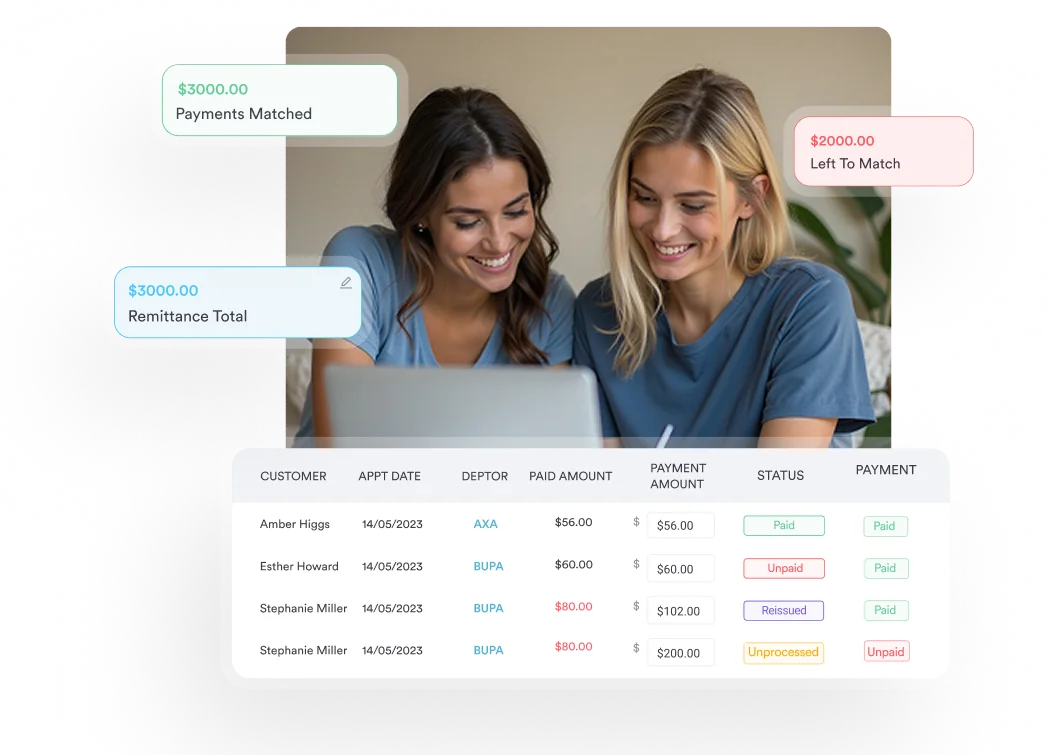

Pabau builds each claim from the client record and checks the required fields are complete. It then routes the claim to the right payer channel and tracks its status until payment posts.

J0712 is an easy code to describe and an easy one to get wrong. The unit count, the NDC, and the wastage modifier decide almost every outcome on the line. Fix those three at the point of coding and the denial queue thins out on its own.
So build the check into the system rather than into somebody’s habit. A workflow that refuses to save an incomplete J0712 line will beat a checklist taped to a monitor, every time. Book a demo to see how Pabau keeps drug claims complete before they reach the payer.

Want to reduce claim denials across all your drug codes? Denial management in healthcare covers the most common denial patterns and how to resolve them efficiently.
Need to see how the NDC and units reach the payer? The 837 claim file breaks down the electronic format that carries every J0712 line item.
Not sure how to read what came back from the payer? Electronic remittance advice explains how to action your ERA payments for J-code encounters.
Looking to tighten up your billing documentation standards? Superbill documentation walks through what must appear on a compliant superbill for outpatient infusion services.
Yes. The drug and its administration are billed as separate lines. Report J0712 for the ceftaroline fosamil, then report the infusion itself with the appropriate administration CPT code. Payers expect both, since neither line pays for the other’s work.
No. Drugs given to an admitted inpatient fall under Part A and are bundled into the facility payment. J0712 is a Part B code for outpatient and physician-office administration.
Report the total units administered for that date of service, which is 120 units for two 600 mg doses. Some payers want each infusion on its own line, distinguished with modifier 59. Check the payer’s edit policy before you split the lines.
CMS publishes a Medically Unlikely Edit value for J0712 in its quarterly edit tables. Any line above that value needs documentation of the dose given. Pull the current table before billing an unusually high unit count.
Not always. Medicare Advantage plans run their own utilization management, and many require prior authorization for MRSA-active antibiotics. Confirm the plan’s policy before the infusion, because Part B’s no-authorization position does not bind them.