CCSD code H4430: Examination of rectum under anaesthetic
CCSD code H4430 pays for the examination alone CCSD code H4430 is the UK private...

Last Updated: Oct 20, 2026
J0456 is the HCPCS Level II code for injection, azithromycin, 500 mg.
Let Pabau's smart automation suggest the right codes, reduce claim denials, and keep your practice compliant—effortlessly.
Automate repetitive tasks and focus on what matters most—your patients.
Reduce coding errors and ensure compliance with the latest regulations.
Clean claims, fewer denials, and faster reimbursements.
Powerful insights and reporting to help your practice thrive.
HIPAA compliant SOC 2 certified GDPR-compliant Trusted by 4,000+ clinics worldwide

HCPCS code J0456 covers the injection of azithromycin, 500 mg, given by intravenous infusion in outpatient and physician office settings
Medicare Part B reimburses J0456 at ASP+6% for non-340B claims, and the dollar rate changes quarterly with the CMS ASP pricing file
Every J0456 line needs modifier JA for the intravenous route, plus JZ when nothing was discarded or JW when part of the vial was
Pabau’s claims management software submits, tracks and reconciles insurance claims, and it validates the fields a payer requires before submission
HCPCS code J0456 describes the injection of azithromycin, 500 mg, per the verbatim official descriptor in the CMS HCPCS Level II code set. It is a supply code for the drug itself, billed alongside the administration code for the infusion.
J0456 belongs to the J-code series, the HCPCS Level II category reserved for drugs administered by injection. Azithromycin (brand name Zithromax) is a macrolide antibiotic supplied as a 500 mg lyophilized powder vial. It is reconstituted and then diluted before administration.
The product is labeled for intravenous infusion only, over 60 minutes or longer. There is no FDA-approved subcutaneous, intramuscular or inhaled route, so every J0456 line describes an IV administration. The code is reportable to Medicare, Medicaid, and most commercial payers when the drug is physician-administered in an eligible setting.
The table below consolidates the core administrative data billers need before submitting a J0456 claim.
Azithromycin injection is FDA-approved for two primary indications: community-acquired pneumonia (CAP) requiring initial IV therapy and pelvic inflammatory disease (PID). Both indications are confirmed in the FDA prescribing information for IV azithromycin. Payers require a supporting ICD-10 diagnosis code that reflects the documented clinical condition before they will adjudicate a J0456 claim.
The table below lists the ICD-10-CM codes most commonly billed with J0456, along with their clinical descriptions. Document the specific diagnosis in the medical record before selecting the code.
Never select an ICD-10 code based on the drug being administered. The diagnosis must be independently documented in the clinical record and confirmed by the ordering clinician. Payers may conduct post-payment audits comparing the diagnosis billed against clinical notes.
When the documented condition sits outside the six codes above, our ICD-10-CM code library holds a reference page for each individual diagnosis code. Check the payer’s covered-diagnosis list for J0456 as well, because a valid code is not automatically a payable one.
Medicare Part B covers physician-administered injectable drugs when medically necessary. J0456 reimbursement follows the Average Sales Price plus 6% (ASP+6%) methodology for non-340B claims submitted by physicians, non-physician practitioners, and hospital outpatient departments. The exact dollar amount changes quarterly as CMS updates the ASP drug pricing file.
Verify the current rate in the quarterly CMS ASP pricing files before estimating patient cost-sharing. The Physician Fee Schedule lookup tool is the wrong place to check J0456, because it does not price separately payable Part B drugs.
Three variables move the amount that actually lands:
The remittance advice returned after adjudication shows the allowed amount alongside any contractual adjustment. Cross-referencing that figure against the current ASP file catches systematic underpayments before they accumulate across a quarter of infusion claims.
Modifier selection on J0456 is not optional, and it involves two separate decisions. CMS requires a route-of-administration modifier on J-code claims where a drug has more than one possible route. It also requires a discard modifier on every drug supplied in a single-dose container, which azithromycin 500 mg is.
The two decisions are independent of each other, and the chart below shows how they resolve for this specific drug.
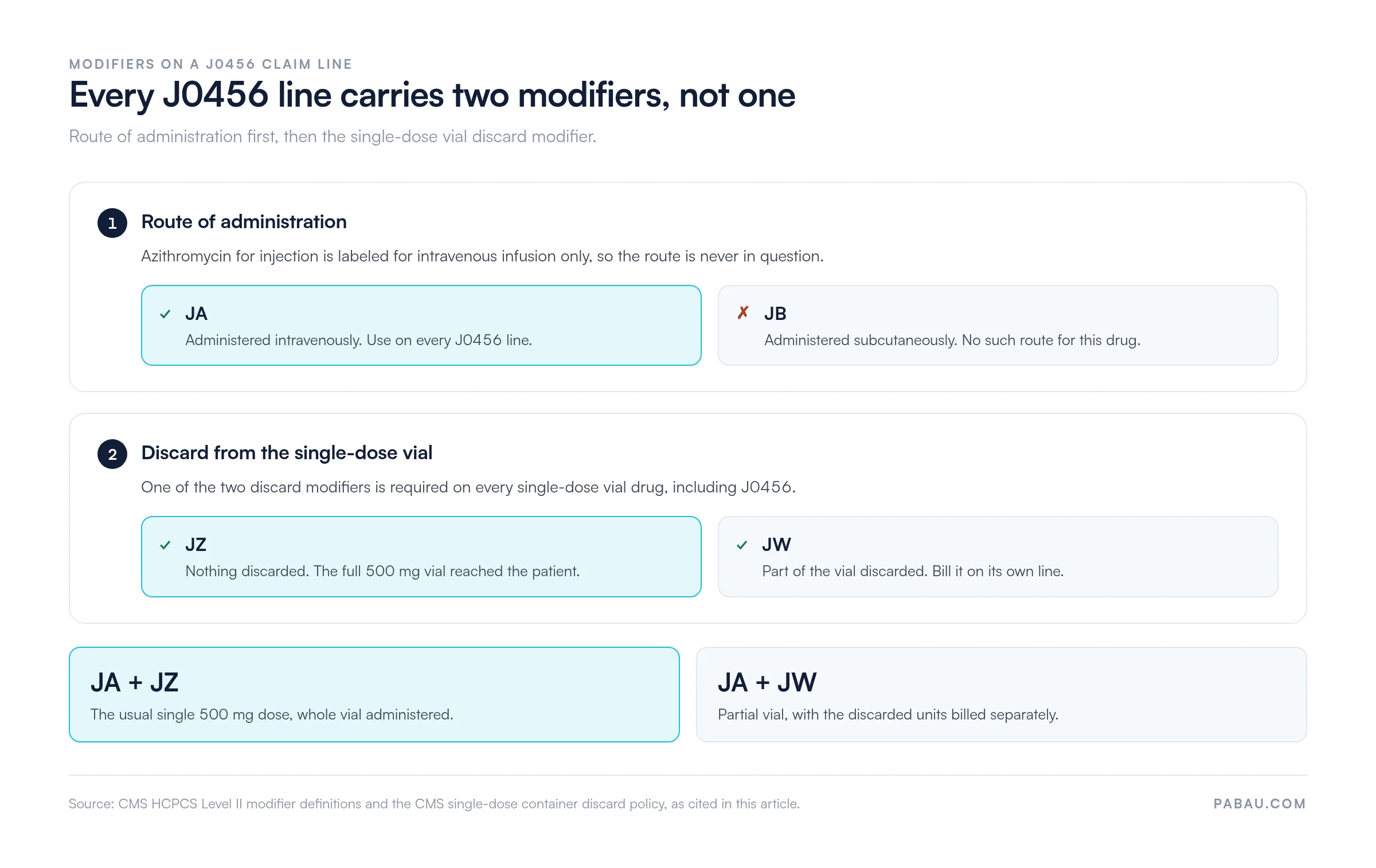
CMS has required JW for discarded amounts from single-dose vials since 2017, and added JZ in 2023 for claims where nothing was discarded. One of the two belongs on every J0456 line. Omitting both is now its own denial trigger, entirely separate from the route modifier.
The route modifier must match the physician order and the nursing administration note. The discard modifier has to match the volume actually drawn from the vial. That means the record states how much was given and how much was wasted. Payer-specific rules also vary, so check the plan’s own modifier policy before a first submission.
Before submitting any J0456 claim, pull the physician order and the nursing administration record side by side. Confirm the route supports JA, then let the recorded volume decide between JZ and JW. A 10-second check here prevents the denial, the appeals letter, and the 30-day resubmission cycle.
The National Drug Code (NDC) identifies the specific drug product, manufacturer, and package configuration dispensed. CMS requires NDC submission on Medicaid professional claims for covered outpatient drugs. Many commercial payers have adopted the same requirement.
Submitting J0456 without the NDC on a Medicaid claim typically results in rejection at the clearinghouse level, before the claim even reaches the payer. NDC codes follow an 11-digit format on claims (5-4-2), converted from the manufacturer’s labeling format. Verify the exact NDC against the vial or package insert at the time of dispensing, not after the fact.
Always cross-reference the NDC against the current NLM HCPCS code lookup and the applicable state Medicaid NDC crosswalk file. Manufacturer NDCs update with each production lot, so a code valid last quarter may not clear today’s claim without re-verification.
A clean J0456 claim requires six elements in sequence. Missing any one of them triggers a denial or a payer request for additional documentation. Our guide to clean claim submission covers the accuracy requirements that apply across every claim type.
J3490 is the HCPCS unclassified injection code, used when no specific code exists for the drug being administered. Two scenarios raise J3490 questions for azithromycin. The first is a dosage variant outside the 500 mg standard. The second is a payer edit that rejects J0456 for a given indication. Use J0456 whenever the specific code applies.
J3490 claims require a drug name, dosage, and route in the claim’s narrative field. Medicare and most commercial payers process them manually, which extends adjudication time significantly. Payer preference is always J0456 when the code is valid. The J3490 guidance above reflects billing community practice, so confirm it with the payer’s Local Coverage Determination before using the unclassified code.
Practices billing azithromycin IV run into the same six errors repeatedly. Each one has a fix at the workflow level rather than at the appeal level, which is where the time and money go.
Tracking denial patterns across J-code claims shows which step of the workflow is failing, rather than which claim failed. Use the AAPC HCPCS code lookup to cross-check code validity and related edits before resubmitting a denied claim.
In most outpatient practices the J0456 line is assembled by hand. Someone reads the administration note, picks the modifiers, keys the NDC, and retypes the claim into a payer portal or a separate billing tool. The clinical record and the claim never meet, so a mistake only surfaces when the remittance comes back.
Practice management software like Pabau closes that loop. Pabau’s connected claims management submits insurance claims from the same record that holds the encounter, then tracks and reconciles them through to payment. It validates the fields a payer requires before submission, so an incomplete claim is caught at your desk rather than 30 days later.
Selecting the code and the modifiers stays with your coder, where it belongs. What changes is the distance the information has to travel. Your billers see which J0456 claims are outstanding, which were paid, and which came back, in one list instead of across three payer portals.

Pabau’s claims management software submits insurance claims, tracks them through to payment, and validates the fields payers require before a claim leaves your desk. See how it shortens the loop on drug administration billing.

Most J0456 denials come from four preventable causes: a missing modifier, a late NDC, an unsupported diagnosis code, or the wrong place of service. None of them are clinical errors. They happen when the documentation reaches billing after the claim has already been built.
The practical fix is to settle the modifiers at the point of care rather than at the point of billing. If the nursing note records the route, the volume given, and the volume discarded, the modifier becomes a lookup. JA plus JZ or JW follows from the record instead of a judgment call. That one habit removes the most common J0456 denial before it exists.
Pabau’s claims management software then carries that record through submission, tracking and reconciliation, so no one rekeys it on the way to the payer. Book a demo to see how J-code claims look when the clinical record and the claim live in the same system.

Need a framework for reducing claim denials across all payer types? Denial management in healthcare walks through root-cause analysis and appeal workflow strategies for outpatient billing teams.
Want to understand how the 837 EDI transaction maps to J-code claims? 837 file guide explains the electronic claim format used to submit HCPCS drug codes to Medicare and commercial payers.
Looking for a checklist to prepare your practice for billing audits? Medical billing compliance covers documentation standards, OIG focus areas, and the record-retention rules that apply to injectable drug claims.
HCPCS code J0456 is the Level II drug code for the injection of azithromycin, 500 mg, given by intravenous infusion. It is used to bill Medicare Part B, Medicaid, and commercial payers for physician-administered azithromycin in outpatient and physician office settings.
Medicare reimburses J0456 at ASP+6% for non-340B claims, meaning 106% of the Average Sales Price for azithromycin 500 mg. The exact dollar amount updates quarterly. Verify the current figure in the quarterly CMS ASP pricing files. The Physician Fee Schedule lookup tool does not price separately payable Part B drugs.
Two modifiers are required. Modifier JA reports the intravenous route, which is the only labeled route for azithromycin injection. Modifier JB means administered subcutaneously and never applies to this drug. The line also needs JZ when nothing was discarded, or JW when part of the single-dose vial was wasted.
Multiple manufacturers produce azithromycin 500 mg injection, including Pfizer and Sandoz, each with distinct NDC codes. All valid 500 mg azithromycin injection products map to J0456 per the CMS NDC-to-HCPCS crosswalk. Always verify the specific NDC from the vial dispensed against the current state Medicaid crosswalk file, as NDCs change with each production lot.