CCSD code H4430: Examination of rectum under anaesthetic
CCSD code H4430 pays for the examination alone CCSD code H4430 is the UK private...

Last Updated: Oct 20, 2026
H2029 is the HCPCS Level II code for sexual offender treatment service, per diem.
Let Pabau's smart automation suggest the right codes, reduce claim denials, and keep your practice compliant—effortlessly.
Automate repetitive tasks and focus on what matters most—your patients.
Reduce coding errors and ensure compliance with the latest regulations.
Clean claims, fewer denials, and faster reimbursements.
Powerful insights and reporting to help your practice thrive.
HIPAA compliant SOC 2 certified GDPR-compliant Trusted by 4,000+ clinics worldwide

HCPCS Code H2029 describes sexual offender treatment service, per diem. CMS maintains it as a Level II code for state Medicaid and state agency programs.
H2029 is billed as one per-diem unit for each day of service, never per session and never per 15-minute increment.
H2028 is the per-15-minutes equivalent. Use H2029 only when the payer pays a daily bundled rate instead of time-based units.
H2029 is not a Medicare code, so coverage, rates and prior authorization rules are set state by state.
Practice management software like Pabau helps behavioral health billing teams document treatment days and submit H2029 claims within state Medicaid rules.
HCPCS Code H2029 is a Level II HCPCS code maintained by the Centers for Medicare and Medicaid Services (CMS). State Medicaid programs and other state agency payers use it to pay for a single day of sexual offender treatment delivered under a structured program. The code applies to individuals mandated into treatment through the courts or the correctional system. The payer reimburses each calendar day of participation rather than each session or time increment.
H-series HCPCS codes cover behavioral health, mental health, and substance abuse services that fall outside the standard CPT code set. H2029 sits within this category alongside codes for alcohol and drug treatment, case management, and residential services. It is not a Medicare-covered code. Coverage is determined at the state level, so reimbursement rules, allowed amounts, and eligibility criteria vary by jurisdiction. Verify active coverage with your state Medicaid program before billing.
The table below provides the official code data for H2029 as maintained by CMS. Always verify the current active status via the CMS HCPCS Level II code files before billing for any given fiscal year.
H2029 covers a full day of structured sexual offender treatment delivered within a program authorized by a state agency or Medicaid plan. It is intended for participants who have been legally mandated into treatment, usually by a court order or the criminal justice system. The code captures the daily cost of participation, not the duration or the number of therapeutic contacts within that day.
Services bundled under the per-diem rate typically include group therapy, individual counseling, psychoeducational components, risk assessments, and progress monitoring. What counts as one per-diem unit depends on the state program’s definition and billing manual. Do not unbundle and separately bill session codes for services already captured in the H2029 rate. That is what triggers duplicate claim edits.
Knowing what falls inside and outside the per-diem bundle is what keeps a program clear of overbilling and audit exposure. Review your state Medicaid billing manual or program contract for the definitive list of bundled services before submitting claims. State programs revise those definitions annually, so re-check the manual at least once a year.
The most common coding confusion around HCPCS Code H2029 involves H2028. Both codes describe sexual offender treatment services. The difference is the billing unit: H2029 pays per calendar day, while H2028 pays in 15-minute increments. The chart below shows how the same treatment day converts into a very different unit count under each code.
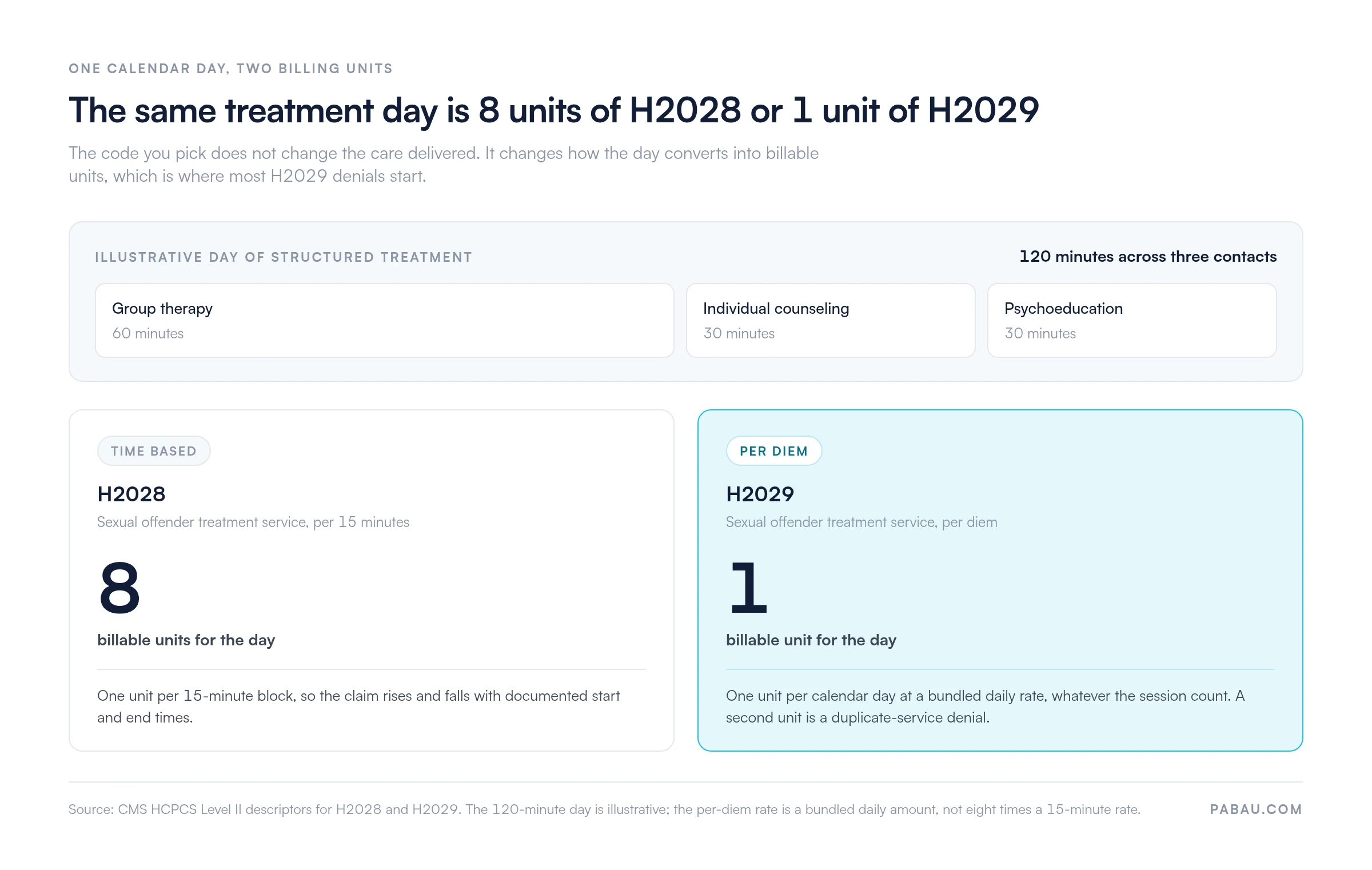
Selecting the wrong code means the claim will not match the payer’s payment methodology, which produces a denial or an underpayment.
The choice between H2028 and H2029 is not a clinical decision. It is a payer and program requirement. Check your state Medicaid fee schedule or program contract to confirm which code and methodology applies. Some states allow both codes depending on the treatment setting, while others mandate one for a specific program type. Settle the unit question before submission, and the rejections that remain tend to map to a handful of common denial codes. Each one points at a different fix.
HCPCS Code H2029 is not a Medicare-covered code. Coverage exists primarily through state Medicaid programs and state agency contracts for behavioral health and corrections-related services. H-series codes are maintained by CMS but implemented at the state level, so coverage, rates, and prior authorization rules differ significantly across states. There is no national fee schedule for H2029, which means each state’s allowed amount has to be tracked on its own.
The table below shows the general framework for how H2029 reimbursement is structured. Actual allowed amounts are state-specific and must be confirmed directly with the payer. Look the figure up in your state Medicaid fee schedule, and confirm it against your program contract before you bill.
Before billing H2029, confirm your state Medicaid program has an active fee schedule entry for this code. H-series codes are not uniformly adopted across all states. Contact your state Medicaid provider relations office or check the published fee schedule PDF directly. Submitting to a state that has not activated H2029 will result in an automatic denial that cannot be appealed on clinical grounds.
Accurate billing starts with the right place-of-service code, correct units, and any required modifiers. H2029’s per-diem structure differs from time-based behavioral health codes, so review each point before submitting.
Submitting a clean claim for H2029 means verifying all six elements above before the claim leaves your system. A missing field, expired authorization, or wrong POS code can trigger a denial that takes weeks to resolve.
H2029 operates inside the Medicaid ecosystem and state agency program structures. It is not a commercial or Medicare code. The program framework around H2029 matters as much as the code itself, because coverage for this service category is discretionary at the state level. Individual state Medicaid agencies make those decisions, not CMS, and they can change with legislative cycles or managed care contract renewals.
Providers billing H2029 typically operate under a state-contracted or certified sexual offender treatment program. Referrals arrive through probation, parole, courts, or corrections agencies rather than standard clinical pathways. That changes the billing work in two ways. Authorization requests often go to the state behavioral health authority instead of a managed care organization. Program eligibility criteria are set by the authorizing agency, not by the clinical provider. Track those authorization sources separately from standard outpatient authorizations to avoid claim routing errors.
Billing H2029 without complete documentation risks a post-payment audit and recoupment. Per-diem codes draw extra scrutiny because the bundled daily rate exceeds session-based codes, so auditors expect evidence of a full day of structured treatment on each billed date.
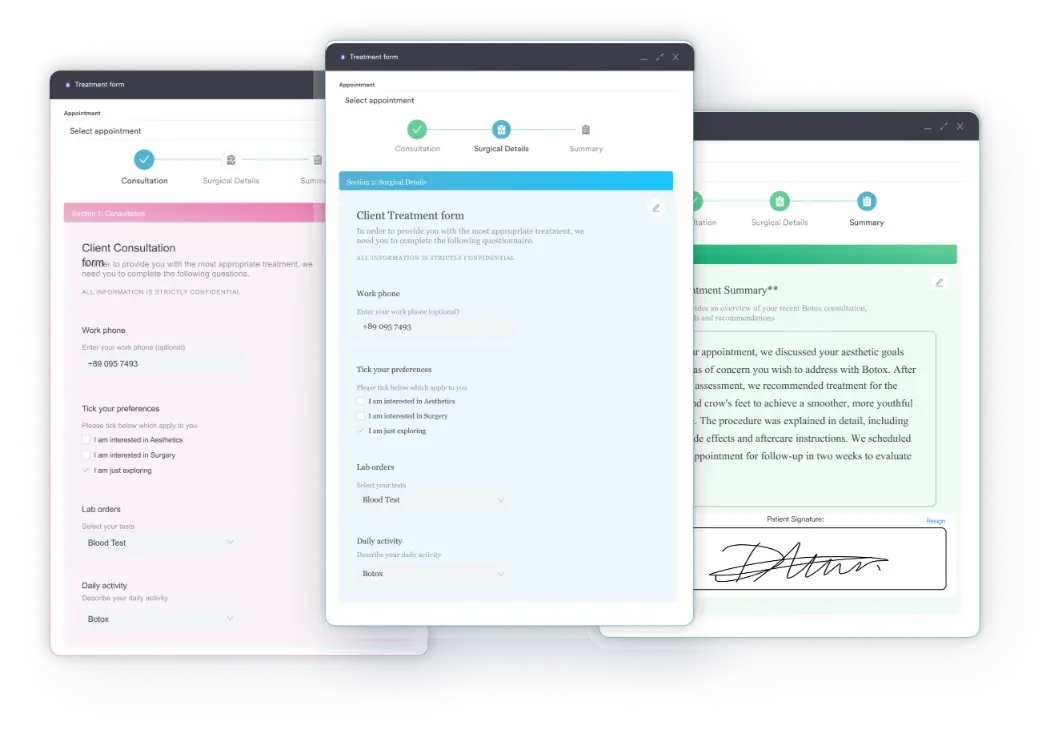
These documentation elements support an H2029 claim; some states require more, so confirm the list in your state Medicaid provider manual.
A complete daily record matters more on a per-diem code, since the claim represents an entire bundled day of services. An undocumented day carries real compliance risk, so build documentation into the workflow at the point of service.
H2029 sits within a cluster of behavioral health H-codes. Billers working with sexual offender treatment programs will meet these related codes. The AAPC HCPCS code lookup gives searchable access to the full H-series for reference. Knowing the adjacent codes prevents miscoding when a participant’s program type or billing methodology changes.
Programs that serve several client populations often carry more than one of these codes at once. When a client moves from one program type to another, confirm the code change with the payer before the next billing cycle. Claims software for billing teams flags the active code assignment per client and alerts staff when an authorization or program type changes.
Run a quarterly audit of every active H2029 authorization against your billing records. For each one, confirm the expiration date and check that the billed units do not exceed the authorized days. Then confirm the daily documentation for those dates is complete and in the record. Catching an expired authorization before a post-payment audit avoids recoupment demands that take months to resolve.
In most sexual offender treatment programs the billing record is assembled after the fact. Attendance sits on a paper sign-in sheet and authorizations live in a spreadsheet. The daily service log gets written up at the end of the month. By then the biller is reconstructing a calendar day nobody recorded properly, and the authorization may already have lapsed.
Practice management software like Pabau moves that work to the day of service. Attendance, consent, treatment notes, and the signed forms all attach to the client record as staff complete them. Authorizations are stored against the client with their expiry date. An expired approval surfaces before the claim is built, not after the denial arrives.
Because the charge is raised from the same record, one treatment day produces one per-diem unit. Billing staff get the documentation that supports it without chasing a clinician for notes. That is the practical difference between a per-diem program that clears its claims and one that spends every quarter answering auditors.

Pabau’s claims management tools help behavioral health teams document treatment days, track prior authorizations, and submit per-diem claims accurately to state Medicaid programs. See how it works in a live demo.

H2029 rewards precision on two questions, and both are answered before a clinician sees a participant. Has your state activated the code, and does the payer pay per diem or per 15 minutes? Settle those with the state Medicaid fee schedule and the program contract, and the coding half of this work stops being a source of denials.
The harder half is the daily record. A per-diem claim asserts that a full day of structured treatment happened, and only same-day documentation can back that up months later. Programs that lose money on H2029 rarely lose it on the code. They lose it on the attendance log nobody completed.
If your program bills across several states, keep one billing profile per state and revisit it each year, because these rules move. Book a demo to see how Pabau keeps treatment days, authorizations, and per-diem claims in one record.

Need a complete framework for behavioral health billing compliance? Medical billing compliance essentials covers the documentation and audit-readiness practices that keep behavioral health claims defensible.
Working through a high volume of behavioral health claim denials? Denial management in healthcare walks through the systematic approach to identifying, appealing, and preventing recurring denials.
Want to understand the full revenue cycle around behavioral health claims? Revenue cycle management explained covers the end-to-end billing process from intake through payment posting.
Want every claim to leave your system right the first time? What is a clean claim sets out the fields and checks that keep a claim from bouncing back.
HCPCS Code H2029 is a Level II HCPCS code that describes sexual offender treatment service, per diem. CMS maintains it, and state Medicaid programs use it to pay for each calendar day of structured treatment. It applies to participants mandated into a program.
Yes, in practice. H2029 is not covered under Medicare and is not a standard commercial insurance code. Coverage is limited to state Medicaid programs, managed Medicaid plans with behavioral health carve-outs, and state agency contracts. Not all states have activated H2029, so verify with your own state before billing.
At minimum: a current individualized treatment plan, a daily service log, and an attendance record confirming participation on the billed date. You also need the prior authorization documentation, the original referral or mandate document, and progress notes for that day. State Medicaid programs may require more, so check your state provider manual.
Modifier requirements for H2029 vary by state Medicaid program. Some states require staff-level modifiers such as HN (bachelor’s degree level) or HO (master’s degree level). Others require program-type modifiers instead. Verify the requirements with your state program before submitting, because a modifier that is correct in one state can cause denials in another.