CCSD code H4430: Examination of rectum under anaesthetic
CCSD code H4430 pays for the examination alone CCSD code H4430 is the UK private...

Last Updated: Oct 20, 2026
H2016 is the HCPCS Level II code for comprehensive community support services, per diem.
It is one of the most widely used behavioral health codes in state Medicaid programs. It also carries a heavier documentation load than most, because every billed day has to stand on its own note.
Let Pabau's smart automation suggest the right codes, reduce claim denials, and keep your practice compliant—effortlessly.
Automate repetitive tasks and focus on what matters most—your patients.
Reduce coding errors and ensure compliance with the latest regulations.
Clean claims, fewer denials, and faster reimbursements.
Powerful insights and reporting to help your practice thrive.
HIPAA compliant SOC 2 certified GDPR-compliant Trusted by 4,000+ clinics worldwide

HCPCS Code H2016 describes comprehensive community support services billed per diem, under the HCPCS Level II H-series for behavioral health and substance use disorder services.
H2016 is a Medicaid billing code and Medicare does not routinely cover it. Rates are set by each state and updated annually, so verify them against your own Medicaid fee schedule.
Missing or expired individualized service plan documentation is the leading denial reason for H2016 claims. Daily progress notes and prior authorization records have to be retained per your state Medicaid program.
Practice management software like Pabau helps behavioral health billing teams document each H2016 day, keep records audit-ready, and submit cleaner claims.
HCPCS Code H2016 covers comprehensive community support services (CCSS) delivered on a per diem basis. It belongs to the HCPCS Level II H-series, maintained by the Centers for Medicare and Medicaid Services (CMS). In turn, that series covers behavioral health and substance use disorder services that fall outside standard CPT coverage.
Per the CMS HCPCS overview, HCPCS Level II codes are maintained nationally and updated annually. Specifically, H2016 sits in the behavioral health group and is used almost exclusively for Medicaid billing.
Comprehensive community support services are structured, community-based interventions for people living with serious mental illness or a substance use disorder. They are aimed at independent living and participation in community life. In practice, they happen where the client lives, works, and socializes, rather than in an office-based therapy session.
The per diem unit follows from that. One unit of H2016 represents one calendar day on which qualifying services were delivered. Notably, no national rule fixes the minimum service hours needed to bill a full day.
Each state’s Medicaid program sets that threshold instead. For example, some require two to four contact hours, while others use a different measure. Either way, verify the per-diem day definition with your own state Medicaid plan before you bill.
Services covered under H2016 typically include:
Crisis prevention sits inside the H2016 per diem. Crisis intervention billed separately in 15-minute units falls under H2011 instead.
The Substance Abuse and Mental Health Services Administration (SAMHSA) sets the evidence-based standards for behavioral health services that states implement through Medicaid. In turn, H2016 services are meant to be intensive, goal-directed, and documented against an individualized service plan.
Provider eligibility for H2016 is set at the state Medicaid level, not federally. In practice, the provider types below are the ones most commonly authorized to bill the code, but your own state program governs the qualification criteria:
Individual practitioners billing independently typically cannot use H2016. For example, that includes licensed clinical social workers, counselors, and psychologists. Instead, the code is built for organizational billing of structured daily programs, not for individual therapy sessions.
Either way, confirm enrollment and credentialing requirements with your state Medicaid agency before you submit claims.
Documentation deficiencies cause the majority of H2016 denials and audit recoupments. The records you keep have to line up with your state Medicaid program’s own H2016 service definition. In turn, that definition is more prescriptive than most CPT documentation rules.
Required documentation for each H2016 claim typically includes:
Records generated in an H2016 program carry the same privacy and security obligations as any other protected health information. In practice, storage, access controls, and retention all sit under the same rules as the rest of the client chart.
Billing H2016 correctly means confirming several prerequisites before the claim goes out, since the per-diem structure adds workflow demands beyond standard CPT billing. Cleaner claims management software catches most of these errors early.
The chart below maps each pre-submission check to the denial it prevents.
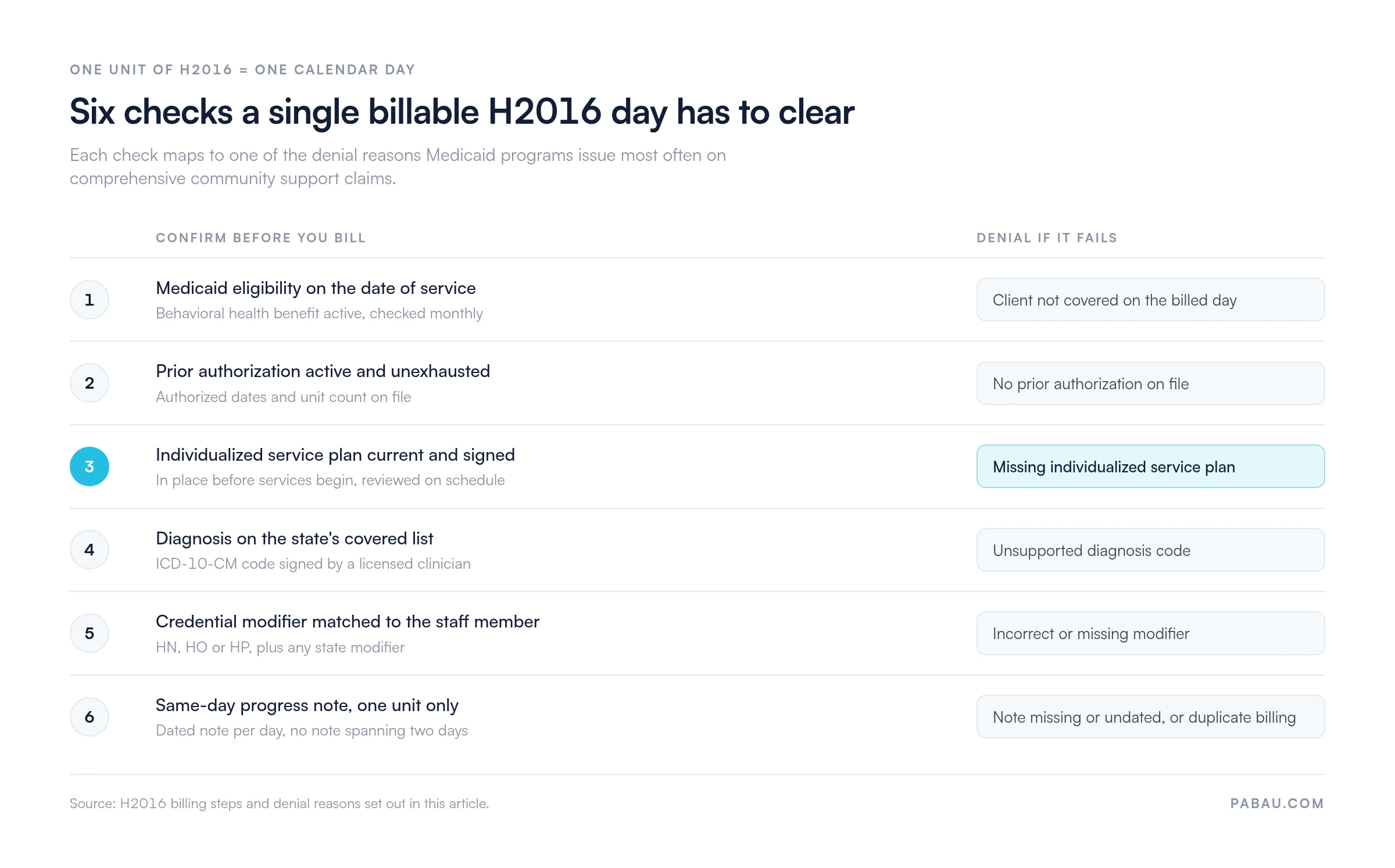
Follow these steps for each H2016 claim:
Tracking claims through to remittance catches denials early, while a corrected claim is still within the filing window.
Audit your H2016 claims quarterly against your state Medicaid fee schedule, since rates update annually and sometimes mid-year. An expired rate is a common revenue leak that claims software will flag automatically.
Modifiers report specific circumstances of the service alongside the base code. Not every state Medicaid program accepts every modifier, so verify acceptability with your payer before you append one. In addition, the table below covers the modifiers most commonly used with H2016 across Medicaid programs.
HB reports the program population, not the service setting. Where a state wants the group setting reported, HQ is the modifier that does it. As a result, mixing the two is a common reason a credential-based rate comes back wrong.
Every H2016 claim needs at least one supporting ICD-10-CM diagnosis code that establishes medical necessity for comprehensive community support services. Accepted codes vary by state Medicaid policy. Instead, treat the table below as a reference for commonly paired codes rather than an approved list.
Many state Medicaid programs restrict H2016 to people who meet the definition of seriously mentally ill (SMI) or carry a co-occurring SUD diagnosis. Anxiety and PTSD codes qualify in some programs and not others. Either way, cross-reference your state’s covered diagnosis list before you bill.
H2016 reimbursement rates are set entirely at the state Medicaid level. No national CMS fee schedule rate exists for this code, in the way one does for Medicare Part B physician services. So the daily rate a CMHC receives in California will differ from what a comparable organization receives in Ohio or Texas.
Several factors drive the variation:
To find your current rate, go to your state Medicaid agency’s fee schedule and look up H2016 for the effective date covering your claim. H2016 is a Medicaid-only code with no Medicare Physician Fee Schedule entry, so the CMS lookup tool returns nothing for it. In addition, where the client sits with a managed care plan, check the MCO’s contracted rate as well.
Prior authorization (PA) requirements for H2016 are payer- and state-specific, with no universal federal rule. In practice, most state Medicaid programs and nearly all Medicaid MCOs require authorization before the first billable day.
Start with insurance eligibility verification, since a client’s Medicaid enrollment can change from one month to the next. Prior authorization then typically involves:
Some states have moved to value-based arrangements that reduce PA requirements for long-term H2016 beneficiaries. Even so, ask your provider relations representative about the current rules for comprehensive community support services in your state.
H2016 denials cluster around a predictable set of errors. Reading the remittance messages against a list of medical billing denial codes helps billing teams name the pattern early. In turn, naming it keeps a repeat error from becoming a systemic recoupment risk. Overall, the table below pairs the top denial reasons with their corrective action.
H2016 sits inside a cluster of H-series codes used for behavioral health and SUD services. Knowing the adjacent codes helps billing staff pick the right one when the service type changes. In addition, you can look up the full H-series range through the AAPC HCPCS code reference. H2016 stays on the active list, but codes do get retired: HCPCS code G0204 was deleted once mammography billing moved to CPT.
The most common coding confusion is between H2016 and H2015. Both describe comprehensive community support services, but H2015 bills in 15-minute increments while H2016 bills as a per-diem unit. In practice, some state Medicaid programs use one, some the other, and some allow either depending on the program structure.
As a result, using the wrong unit type produces a denial that usually needs a full void and resubmit rather than a simple correction.
Flag H2015 vs H2016 as a provider orientation item for new billing staff. Confusing the time-based and per-diem versions of the same service type is one of the most common H-series coding errors. It typically produces a denial that requires a full void and resubmission rather than a simple correction claim.
The documentation load behind H2016 is where the revenue goes. Daily notes, ISP review dates, authorization expiries, credential-based modifiers, and duplicate checks all have to hold on every billed day. Run those in spreadsheets and disconnected systems, and you get the denial patterns in the table above.
Practice management software like Pabau keeps those records in one place. Clinical forms capture the daily note with the staff member’s credential already attached, and authorization dates and unit counts sit on the client record, so billing staff can see what’s authorized before a claim goes out.
Pabau’s claims management software then submits from that same record, keeping documentation audit-ready. When a Medicaid audit arrives, the note, the plan, and the claim trace back to one timestamped source instead of three.
The controls worth building into the daily workflow:
Organizations that run clinical documentation and claims submission from the same record see fewer denials, since the note data and the claim data never have to be re-entered from paper.

Pabau helps community mental health teams document H2016 services accurately, manage prior authorizations, and submit cleaner claims. See how it works for behavioral health organizations.

The per-diem structure is what makes H2016 unforgiving. Consequently, one missing daily note costs one day of revenue, and one expired service plan can invalidate weeks of otherwise clean claims.
So the work that protects H2016 revenue happens before the claim, not after the denial. In practice, build the six checks above into the daily routine, and a clean claim becomes a byproduct of documentation your team was completing anyway.
The trade-off to remember is that state rules move. Each year, re-verify the per-diem day definition, the covered diagnosis list, and the accepted modifier set with your own Medicaid program. To see how Pabau supports behavioral health billing, book a demo.

Need to get prior authorization right before the first billable day? The prior authorization process walks through submission, timeframes, and renewal without a service break.
Want to understand how clearinghouses process behavioral health claims? How a medical claims clearinghouse works explains the submission path from your billing system to Medicaid payer adjudication.
Looking for a clean claim checklist before submission? What makes a clean claim outlines the fields and conditions that prevent Medicaid denials at first pass.
Denials already stacking up on H-series claims? Denial management in healthcare covers the workflow for reworking, appealing, and preventing repeat denials.
HCPCS Code H2016 is a HCPCS Level II billing code for comprehensive community support services (CCSS) billed on a per diem basis. Community mental health centers and behavioral health organizations use it to bill Medicaid. It covers structured, community-based services for people with serious mental illness or a substance use disorder. One unit equals one calendar day of qualifying service delivery.
Bill H2016 with one unit per calendar day of service. Confirm Medicaid eligibility and prior authorization before the service date. Attach the correct credential-based modifier (HN, HO, or HP) and include a qualifying ICD-10-CM diagnosis code. Complete the daily progress note on the date of service. Submit on a CMS-1500 or 837P claim form to your state Medicaid or MCO payer.
Eligible providers are determined by state Medicaid programs. Community mental health centers (CMHCs) and certified community behavioral health clinics (CCBHCs) are commonly authorized. So are licensed behavioral health organizations and, in some states, case management agencies. Individual practitioners billing independently typically cannot use this code. Verify eligibility with your specific state Medicaid agency.
Most state Medicaid programs and Medicaid managed care organizations require prior authorization for H2016 services. PA requirements, authorization period lengths, and renewal processes vary by payer. Services delivered after a PA expiration date are typically denied and non-recoverable. Verify prior authorization requirements directly with your state Medicaid program or MCO before beginning services.