HCPCS code V2599: Other type contact lens billing guide
What is HCPCS code V2599? HCPCS code V2599 is the Level II supply code for a con...

Last Updated: Oct 20, 2026
H1002 is the HCPCS Level II code for prenatal care, at risk enhanced service; care coordination.
HCPCS code H1002 pays for prenatal care coordination, the work of building and managing a care plan for a high-risk pregnancy. State Medicaid programs are its payers, and traditional Medicare is not. The code names a service component rather than a number of visits.
That last detail causes more trouble on this code than any other. Below, we work through the code details, what coordination has to include, and the family H1002 belongs to. We then cover the documentation reviewers ask for and the denial patterns worth fixing first.
Let Pabau's smart automation suggest the right codes, reduce claim denials, and keep your practice compliant—effortlessly.
Automate repetitive tasks and focus on what matters most—your patients.
Reduce coding errors and ensure compliance with the latest regulations.
Clean claims, fewer denials, and faster reimbursements.
Powerful insights and reporting to help your practice thrive.
HIPAA compliant SOC 2 certified GDPR-compliant Trusted by 4,000+ clinics worldwide

HCPCS code H1002 covers prenatal at-risk care coordination, and state Medicaid programs are the payers that recognize it.
The descriptor carries no visit count, so the four-to-six visit rule belonging to CPT 59425 does not apply here.
H1000 through H1005 divide prenatal coordination by service component, not by how many antepartum visits a patient received.
A written, individualized care plan with dated referrals is what turns coordination work into a payable claim.
Practice management software like Pabau keeps the care plan, the referrals, and the claim in one record.
H1002 reimburses care coordination for a pregnant patient already identified as high risk. It is a Level II HCPCS code maintained by CMS, and state Medicaid programs are its primary payers.
The code sits inside the H-series, which CMS reserves for behavioral health, substance use, and Medicaid programs such as prenatal care coordination, known as PNCC.
Coordination is the enhanced service that follows a risk assessment. It does not include the assessment itself, and it does not include the education sessions billed elsewhere in the series.
Care coordination under H1002 is the development, implementation, and ongoing evaluation of a plan of care for a high-risk pregnancy. State program manuals describe it in close to those words.
Minnesota Health Care Programs pays the code and lists the activities it expects a coordinator to carry out:
Notice what is absent from that list. There is no visit threshold, no minimum contact count, and no requirement to see the patient a set number of times.
Requirements differ between states. Read your own Medicaid provider manual before you build billing rules around this list.
A claim repeated across coding blogs holds that H1000 through H1003 split antepartum care into visit tiers. No code in the family works that way.
Those tiers belong to CPT. Code 59425 reports four to six antepartum visits, and 59426 reports seven or more. Postpartum care has its own CPT code in 59430.
Read the H1000 to H1005 descriptors and you will not find a visit count in any of them. Each one names a service component instead, and the visit tiers sit in a separate CPT family.
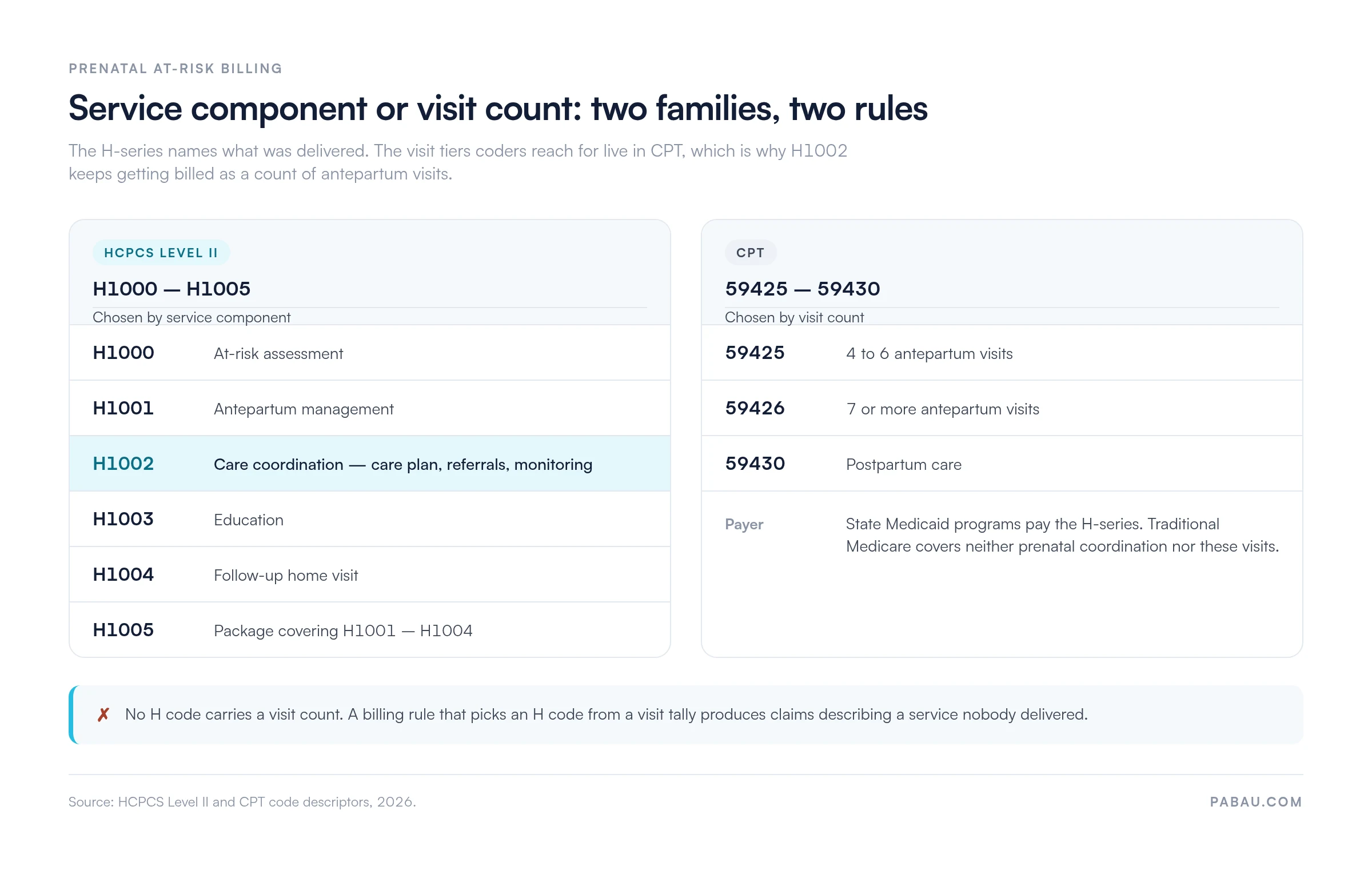
The practical risk here is a chart audit. If your billing policy tells coders to count visits before picking an H code, the resulting claims describe a service nobody delivered.
H1002 belongs to a six-code family that breaks prenatal care coordination into billable parts. Knowing the whole set stops coders from stretching one code over work that belongs to another.
The assessment that comes before coordination has its own guide at H1000.
Read the H1005 descriptor closely, because the package already contains H1001 through H1004. Billing the package and one of its components for the same period is unbundling, and states recoup it.
Rules differ across the rest of the series too. Some states fold H1002 into a single coordination rate, while others pay it as its own line. Check your PNCC manual before adding a second line to a claim.
Provider eligibility comes from each state Medicaid program rather than from CMS centrally. In programs that pay the code, the eligible disciplines usually include:
Enrollment matters as much as discipline. A claim submitted under a provider who is not enrolled in the state program is denied before anyone reads the record.
Track enrollment status per provider rather than per practice, and review it at each revalidation. A lapsed enrollment is easy to miss and stops every claim behind it.
An H1002 claim needs diagnosis codes that show why this pregnancy needs coordination. The exact list is set by your state, so confirm it before you submit. The ranges below appear most often.
One range works against the claim. Z34, supervision of a normal pregnancy, states that the pregnancy is not high risk, which is the opposite of what an enhanced service needs.
Match the secondary codes to the risks named in the care plan. A plan built around housing instability and a claim carrying only a diabetes code will not reconcile in review.
Medicaid reviewers read the coordination record before they read the claim. Before H1002 goes out, the chart should hold:
The weakest point in most H1002 records is the referral loop. A referral mentioned in a phone note but never written into the plan leaves a reviewer with no way to verify it.
Read one recent H1002 chart the way a state reviewer would. Start at the claim, then try to find the care plan, the referrals, and the outcome of each one. Any item you cannot locate in five minutes is what a recoupment letter will be built on.
Modifiers add context to an H1002 line, and most of them describe the program or the delivery method. Your state fee schedule decides which ones apply.
Two corrections are worth writing into your billing rules. HH does not mean home visit, and no modifier reports how many times you saw the patient.
Place of service 12 is what tells a payer the contact happened in the patient’s home. The follow-up home visit itself has its own code in H1004.
There is no national payment amount for H1002. Each state Medicaid program sets its own rate, and a managed care plan may pay a contracted amount instead.
The CMS Physician Fee Schedule lookup will not return a figure for this code. It prices Medicare services, and Medicare does not cover prenatal care coordination. The same lookup does price Medicare-covered screening services such as HCPCS code G0202, which is why it answers for that code and not H1002.
Third-party rate aggregators publish figures scraped from older files. Treat them as a starting point for a question, never as the number you bill against.
The patterns below come from the code’s own descriptor and from the bundling rules state programs apply to the H1000 series. Four of the five start with a coder choosing by the wrong criterion.
When a denial arrives, read the reason code before you rework the claim. Our guide to common denial codes maps the frequent ones to the fix each needs.
One further issue is a payment-model question rather than a denial. Where a plan pays maternity care as a single global package, enhanced service codes often do not pay separately at all.
Run a one-line check before any H1002 claim leaves the practice. Name the service component the record supports, then confirm the code you selected matches that component. Coders who answer with a visit count have found the error before the payer does.
Prenatal coordination generates a heavy record for a modest payment. The care plan often lives on a paper form, referrals sit in email, and the claim gets typed up days later.
Every hand-off is a chance for the record and the claim to describe different work. That drift is exactly what a state reviewer looks for.
Practice management software like Pabau keeps the two together. Its claims tools for coordinators record the code you selected, the documentation status, and the submission in one view. For US claims, the Claim.MD integration files them electronically rather than through a separate payer portal.
Upstream of billing, custom clinical forms capture the care plan and each revision inside the patient record. The referral you made in week 12 is still findable in week 30, with its date attached.

Pabau helps prenatal programs document care plans, track referrals, and manage HCPCS billing workflows, so the record and the claim describe the same work.

H1002 pays for care coordination, and its descriptor names no visits at all. Once your billing rules reflect that, most of the guidance in this guide follows from it.
Two checks are worth more than a policy rewrite. Read one recent care plan as a reviewer would, then confirm whether the payer bundles maternity care into a global package.
Prenatal coordination will always carry paperwork, though it does not have to be typed twice. To see how Pabau moves a care plan into a Medicaid claim without that second pass, book a demo with our team.

Billing the assessment that comes first? HCPCS code H1000 covers the prenatal at-risk assessment and the record it has to produce.
Charging for education sessions? HCPCS code H1003 explains what counts as prenatal at-risk education and how to document a session.
Coordinating care outside a prenatal program? HCPCS code T1017 explains how targeted case management is billed and documented.
Coordinating behavioral health alongside prenatal care? HCPCS code H0037 explains how community psychiatric supportive treatment is billed.
H1002 bills prenatal care coordination for a pregnancy already identified as high risk. The service covers the written care plan, the referrals that follow from it, monitoring, and communication between the providers involved. State Medicaid programs are the payers that recognize it.
No. The H1002 descriptor contains no visit count at all. The four-to-six visit range belongs to CPT 59425, an antepartum care code, and it is often mistaken for an H-code rule. H1002 is chosen by the service delivered, not by how many times the patient was seen.
Usually not for the same period. H1005 is a package that already includes H1001 through H1004, so billing a component alongside it reads as unbundling. Some states allow a component outside the package period. Check your PNCC manual before submitting both.
Each state Medicaid program sets its own list. Physicians, nurse midwives, nurse practitioners, physician assistants, and registered nurses acting as care coordinators are commonly eligible. The billing provider also has to be enrolled in the state prenatal care coordination program.
There is no national rate. Each state Medicaid program sets its own amount, and managed care plans may pay a contracted rate instead. Look the figure up in your state fee schedule for the current plan year rather than in a third-party rate listing.