

HCPCS code E0198: Water pressure pad billing guide
HCPCS code E0198 is a water pad for a standard mattress HCPCS code E0198 is the ...

Last Updated: Oct 13, 2026
H1003 is the HCPCS Level II code for prenatal care, at-risk enhanced service; education.
That distinction matters because a lot of published billing advice gets it wrong. If you came here looking for alcohol and drug case management, the code you want is alcohol and drug case management. The next section explains where the mix-up comes from and how to unwind it.
H1003 sits in HCPCS Level II, the code set maintained by the Centers for Medicare and Medicaid Services (CMS). Its subrange, H1000 to H1011, is titled Prenatal Care and Family Planning Assessment.
H-codes exist for services that state Medicaid agencies choose to cover, so coverage and payment rules are set state by state.
Let Pabau's smart automation suggest the right codes, reduce claim denials, and keep your practice compliant—effortlessly.
Automate repetitive tasks and focus on what matters most—your patients.
Reduce coding errors and ensure compliance with the latest regulations.
Clean claims, fewer denials, and faster reimbursements.
Powerful insights and reporting to help your practice thrive.
HIPAA compliant SOC 2 certified GDPR-compliant Trusted by 4,000+ clinics worldwide

HCPCS code H1003 means prenatal care, at-risk enhanced service; education. It is a maternity code, not a substance use code.
Several coding blogs list H1003 as alcohol and drug case management. That service is H0006, and billing H1003 for it misstates the claim.
The H1003 descriptor names no time unit. Each state Medicaid program sets the unit, the visit limits, and the required modifiers.
H-codes are Medicaid only. Medicare does not pay H1003, and no national fee schedule lists a rate for it.
Practice management software like Pabau tracks prenatal education visits, documentation, and claim status so fewer H1003 claims are denied.
The confusion starts with the label on the wider code block. CMS groups all H-codes under a heading about alcohol and drug abuse treatment and rehabilitative services. That block-level label then gets copied onto individual codes by lookup sites and billing blogs.
Inside that block, the H0000-series really is behavioral health, and those codes belong on claims from mental health practices. The H1000 to H1011 subrange is not. It covers prenatal care and family planning, and H1003 sits squarely inside it.
So a page that describes H1003 as “alcohol and drug services; case management, per 15 minutes” has inherited the wrong label.
This is not a harmless typo. A claim carrying H1003 tells the payer you delivered at-risk prenatal education. If the record shows substance use case management instead, the claim misrepresents the service. That’s a recoupment risk at a post-payment audit, even when the care itself was appropriate.
Use the table below to land on the right code. Verify each one against your state Medicaid billing manual before you submit.
One more difference is worth flagging. H0004 and H0050 carry “per 15 minutes” in the descriptor itself, so the unit travels with the code nationally. H1003 and H0006 do not. Their units come from the state, which is why unit rules for those two vary so widely.
H1003 pays for planned, structured education given to a pregnant Medicaid member who has already been identified as at risk.
It is an enhanced service that sits alongside routine prenatal care. It is not part of the obstetric global package, and it is not a substitute for the prenatal visit itself.
Typical content includes nutrition, smoking cessation, warning signs of preterm labor, birth preparation, breastfeeding, and infant care. States that run enhanced prenatal programs usually define the curriculum.
Colorado’s Prenatal Plus program is one example, pairing a care coordinator with a registered dietitian and a mental health professional.
Because H-codes are Medicaid specific, H1003 does not appear on any Medicare fee schedule. Submitting it to a Medicare plan produces a denial. For patients with both Medicare and Medicaid, confirm which payer is primary before the claim goes out.
H1003 has no unit in its descriptor, so the state decides how a unit is counted. This is the single most useful thing to know about the code. Two programs can pay the same H1003 service in completely different ways. A habit carried over from another state is a reliable source of denials.
Colorado pays H1003 per encounter through its Prenatal Plus program rather than by the clock. Other programs count time. Look up your own state before you set a billing rule, and record the answer somewhere your billing team can find it.
Place of service codes accepted with H1003 commonly include POS 11 (office), POS 12 (home), and POS 49 (independent clinic). POS 71 (public health clinic) and POS 99 (other) also appear. Home and community delivery is central to several enhanced prenatal programs. Confirm the accepted list, because the POS code also drives the rate in some states.
Most states also cap H1003 by pregnancy rather than by day. Tracking cumulative visits per patient in structured client records stops a program from billing an 11th session against a 10-session limit.
Modifiers tell a Medicaid payer something the code alone does not say. Which ones apply to H1003 depends on the state and, often, on the program the practice is enrolled in. The table covers the modifiers most often paired with enhanced prenatal services.
Some programs treat a modifier as mandatory. Where that is true, a claim without it fails even though every other field is correct. Read the denial remark codes on your remittance advice, because they usually name the missing element outright.
Build the modifier requirement into your billing system as a rule rather than a training note. If your state requires TH on every enhanced prenatal claim, block submission when it is absent. A rule catches the claim your busiest biller would have missed on a Friday afternoon.
There is no national rate for H1003. Every figure comes from a state Medicaid fee schedule, and those schedules are republished on their own timetables. Rates can also differ by provider type or setting inside a single state.
The CMS Physician Fee Schedule lookup won’t help here, because it only carries Medicare-priced codes. Go to your state Medicaid agency instead. Most publish the current fee schedule as a spreadsheet or PDF on their provider pages.
Subscribe to your state Medicaid agency’s provider bulletins and route them to whoever owns your fee schedule. Agencies usually publish rate notices 30 to 60 days ahead of the effective date. That window is your chance to update charge masters before the first claim of the new year goes out at an old rate.
H1003 needs a diagnosis that establishes why the pregnancy counts as at risk. A routine pregnancy code will not support an enhanced service. The codes below are the ones enhanced prenatal programs pair with H1003 most often.
Two habits prevent most diagnosis-related denials here. Code the trimester correctly, since the O09 and O99 families expect a trimester character. Then make sure the risk factor named in the diagnosis is the same one the education session addressed.
Note that O99.310 and O99.320 describe substance use complicating a pregnancy. They are perfectly valid alongside H1003 when the education addresses that risk. They still do not turn H1003 into a substance use treatment code.
Auditors reviewing an H1003 claim look for a chain of evidence. The patient was at risk, a plan existed, education happened, and a qualified person delivered it. Break any link and the claim is exposed. The specific formats vary by state, but the four elements below travel everywhere.
Structured templates make these fields hard to skip. Digital documentation workflows can require a start time, an end time, and a topic before a note will save. Keeping that record HIPAA compliant is a baseline for any Medicaid billing.
H1003 denials cluster around a short list of causes. Almost all of them are caught by a pre-submission check rather than an appeal.
Claims management software with pre-submission validation catches unit mismatches, absent modifiers, and lapsed authorizations before the claim leaves your system. Pair it with automated workflows to cut the manual handoffs where these errors start.
A compliance management layer then keeps credentialing dates and documentation audits in one view. Credentialing lapses and stale program approvals surface before a payer finds them.
H1003 is one component of a small family of enhanced prenatal codes. Picking the wrong one is easy, because the services often happen in the same visit with the same staff. The descriptors below are the current CMS ones for the H1000 to H1011 range.
The pair most often confused is H1002 and H1003. Calling a hospital to arrange a nutrition referral is coordination, so it belongs to H1002. Sitting with the patient to explain what preterm labor feels like is education, so it belongs to H1003.
Sound patient care management keeps the two recorded as separate activities in the note, which makes the coding decision obvious later.
Before you rely on any descriptor you find online, check it against a current source. The AAPC HCPCS lookup for H1003 shows the CMS descriptor, and CMS publishes the full HCPCS Level II file each year. That habit is what stops a wrong descriptor spreading into your charge master.
Enhanced prenatal programs usually run on a mix of paper assessments, a shared spreadsheet of visit counts, and one person who remembers the state’s rules. That works until the person is on leave, or the state changes a unit definition, or an audit asks for two years of session notes.
Practice management software like Pabau puts that chain in one system, and our OB-GYN platform is built for maternity teams. The risk assessment, the education plan, and every session note live on the client record. The evidence an H1003 claim depends on is assembled as the care happens, not reconstructed a year later.
Custom forms capture the risk assessment in the format your state expects. Note templates require the start time, end time, and topic before they will save. Claims management then checks the modifier and the unit count before submission, and tracks each claim through to payment. So your billers spend their week on the handful of claims that genuinely need attention.
Reporting closes the loop. You can see how many education sessions each patient has used against the state’s per-pregnancy cap. You can also see which denials repeat, and which sites are drifting from the documentation standard. Every Pabau subscription includes every feature, so none of this sits behind a higher tier.
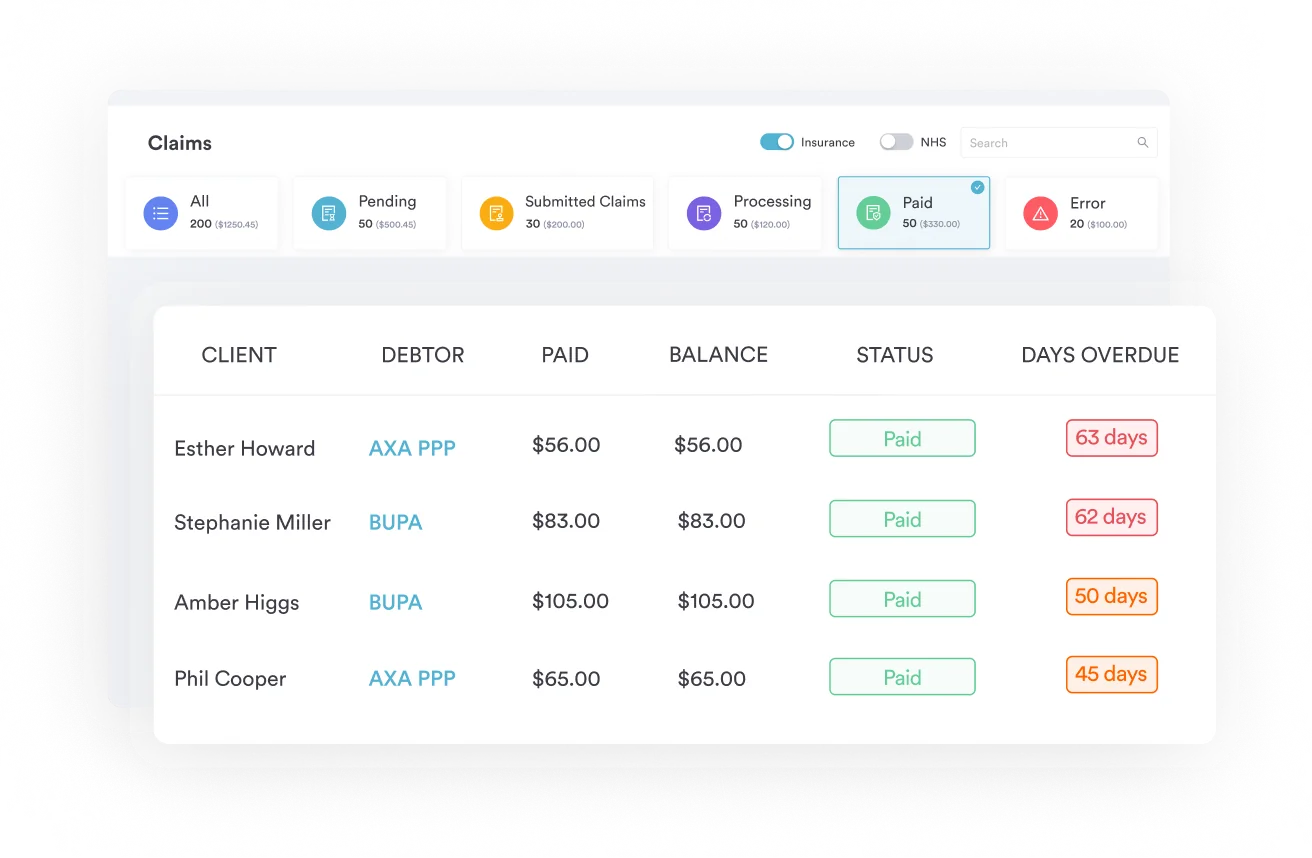

Pabau helps maternity and OB-GYN practices capture risk assessments, structure session notes, and validate claims before they are submitted.

H1003 is a prenatal education code, and reading it any other way is where the trouble starts. Once the descriptor is right, the remaining questions are practical ones. What does your state count as a unit, which modifier does it expect, and can your notes prove the session happened.
Those are workflow questions rather than clinical ones. Pabau gives maternity programs one place to hold the risk assessment, the education plan, the session notes, and the claim. To see how that fits your prenatal billing, book a demo with our team.

Billing substance use case management instead? Our guide to HCPCS code H0006 covers the code for alcohol and drug case management.
Denied for an unspecified mood code? Persistent mood disorder code explains why F34.8 avoids denials tied to non-billable parent mood disorder codes.
Coding generalized social anxiety? Generalized social phobia code explains when F40.11 applies instead of the unspecified F40.10 code.
Coding an OCD diagnosis? OCD coding guide explains how selecting the right F42 subcategory determines whether a claim processes smoothly.
Choosing the right stress code? ICD-10 stress codes guide covers how F43.0, F43.9, and Z73.3 differentiate acute and unspecified stress presentations.
H1003 means prenatal care, at-risk enhanced service; education. It pays for structured education given to a pregnant Medicaid member whose pregnancy has been assessed as at risk. The code sits in the H1000 to H1011 prenatal range of HCPCS Level II.
No. That description is a widespread error repeated by several coding sites. Alcohol and/or drug services; case management is H0006, and brief intervention per 15 minutes is H0050. Billing H1003 for a substance use service misstates what you delivered, which creates a recoupment risk at audit.
No. H-codes are HCPCS Level II codes designated for state Medicaid programs, and Medicare does not price them. A claim for H1003 sent to Medicare will be denied. For patients with both coverages, confirm which payer is primary before you submit.
That depends entirely on your state. The H1003 descriptor names no time unit, so each state Medicaid program defines one. Some pay per encounter, some count 15-minute blocks, and some bundle education into the H1005 package. Check your state Medicaid billing manual before setting a billing rule.
TH, meaning obstetrical treatment or services, prenatal or postpartum, is the most common. HD identifies a pregnant or parenting women’s program, HQ marks a group session, and TD or TE identify nursing staff. U1 to UD carry state-defined meanings. Requirements vary by state, so check the manual.
There is no national rate for H1003. Each state Medicaid program sets its own, and enhanced prenatal rates often sit in a program-specific fee schedule rather than the general one. Ask your state agency for the current schedule, then ask each managed care plan separately for its contracted rate.
Four elements carry the claim. You need a prenatal risk assessment that predates the session. You need an individualized education plan tied to those risk factors. You need a session note showing the date, the start and end times, and the topics covered. Finally, the provider’s credentials and NPI must match the Medicaid enrollment file.
H1002 is care coordination and H1003 is education. Arranging a referral, chasing a result, or linking a patient to WIC is coordination. Teaching the patient about nutrition, the signs of preterm labor, or breastfeeding is education. Record the two as separate activities so the coding choice stays obvious.



