CCSD code H4430: Examination of rectum under anaesthetic
CCSD code H4430 pays for the examination alone CCSD code H4430 is the UK private...

Last Updated: Oct 20, 2026
H0012 is the HCPCS Level II code for alcohol and/or drug services; sub-acute detoxification (residential addiction program outpatient).
Because each state writes its own rules, the descriptor is the easy part. Coverage, unit definitions, modifier requirements and rates all shift at the state line.
Let Pabau's smart automation suggest the right codes, reduce claim denials, and keep your practice compliant—effortlessly.
Automate repetitive tasks and focus on what matters most—your patients.
Reduce coding errors and ensure compliance with the latest regulations.
Clean claims, fewer denials, and faster reimbursements.
Powerful insights and reporting to help your practice thrive.
HIPAA compliant SOC 2 certified GDPR-compliant Trusted by 4,000+ clinics worldwide

HCPCS Code H0012 covers alcohol and/or drug services for sub-acute detoxification in a residential addiction program, delivered on an outpatient basis.
Medicare does not cover H0012. Payment comes from state Medicaid plans and some commercial payers, at rates each state sets for itself.
Missing modifiers such as HF, HH or SA and thin medical necessity documentation cause most H0012 denials.
F10.23, F13.23 and F19.23 are header codes. Each needs a sixth character before it can go on a claim.
Practice management software like Pabau creates and tracks insurance claims from the clinical record, so billing staff are not rekeying notes into a separate system.
HCPCS Code H0012 is the Level II billing code for alcohol and/or drug services. It applies to sub-acute detoxification in a residential addiction program, delivered on an outpatient basis. The Centers for Medicare and Medicaid Services (CMS) publishes the full official descriptor. It reads: Alcohol and/or drug services; sub-acute detoxification (residential addiction program, outpatient).
This code sits within the H-code series, which covers behavioral health and substance use disorder services that CPT does not classify. State Medicaid agencies assign and maintain H-codes. That is why coverage rules, unit definitions and reimbursement rates vary so much from one state to the next.
H0012 is a Medicaid code. Medicare does not cover H-series HCPCS codes as a rule. These codes exist to describe state-administered substance use disorder services that have no CPT equivalent. State Medicaid agencies create them for the populations they serve.
Commercial payer coverage varies. Some private insurers accept H0012 for outpatient detox services, while others require CPT alternatives or facility revenue codes. Verify payer policy before you submit, and read your state Medicaid fee schedule directly. Good medical billing compliance starts with knowing which payer governs the claim before the encounter, not after it.
No single national rate applies to HCPCS Code H0012. Individual state Medicaid agencies set reimbursement, so a provider in California will see a different rate than one in Ohio or Texas. The CMS Physician Fee Schedule does not apply here, since H0012 is not a Medicare-covered code. To find your current rate, go straight to your state Medicaid provider manual or fee schedule portal.
Because rates are state-specific, quoting a dollar figure would mislead you. What stays consistent across states is the billing unit structure.
Most state Medicaid programs bill H0012 on a per diem basis, so one unit equals one calendar day of sub-acute detoxification services. Some states use a per-encounter unit instead. Check your state’s Medicaid provider bulletin for the exact unit definition before you submit. Billing multiple units per day without prior authorization usually triggers an automatic denial.
Each state Medicaid agency sets provider eligibility for H0012 billing, not CMS and not the AMA. That said, certain provider characteristics come up consistently across most states.
Certified substance use disorder treatment programs, licensed addiction treatment centers and residential-license outpatient programs typically qualify. Individual clinicians working in those settings may bill under the facility’s enrollment number, depending on state rules.
Scope-of-practice rules vary by state. Confirm that the rendering provider type is authorized to deliver sub-acute detoxification services in your state before you submit H0012 claims under their credentials.
Sub-acute detoxification services need a supporting ICD-10-CM diagnosis code on the claim. The relevant codes come from the F10-F19 chapter of the ICD-10-CM classification system, covering substance-related and addictive disorders. The code you pick must match the substance involved and the clinical severity of the encounter.
One trap catches billers repeatedly. F10.23, F13.23 and F19.23 are header codes, not billable ones. Each needs a sixth character naming the withdrawal presentation: 0 for uncomplicated, 1 with delirium, 2 with perceptual disturbance, 9 unspecified. F11.23 and F14.23 are complete at five characters, because those subcategories carry no sixth-character split.
Pick the ICD-10 code that most specifically describes the substance and the clinical presentation. Reach for an F19 code only when no single-substance category fits. Some state Medicaid plans require the diagnosis to be listed as the primary diagnosis, so check your state’s sequencing rules before you submit.
Flag polysubstance cases carefully. When a patient is detoxing from several substances at once, the ICD-10 code should reflect the primary substance driving the episode. Payers deny claims where the diagnosis code does not match the clinical narrative in the treatment plan.
Most state Medicaid plans require one or more modifiers on H0012 claims to indicate the program type, the rendering provider, or the service context. Submitting without the required modifier is one of the most common denial triggers for this code. Modifier rules vary by payer, so confirm your state’s requirements before you apply any combination.
The table below maps common modifiers to their clinical scenarios, based on standard behavioral health HCPCS modifier guidance. Check it against your specific state Medicaid policy and any applicable managed care organization contract.
Medicaid auditors read H0012 claims closely, because sub-acute detoxification involves a level-of-care determination that has to be justified in the record. Thin documentation is the single most common reason these claims fail on post-payment audit. Every element below should be in the chart before the claim goes out, not reconstructed after a records request.
Behavioral health records also fall under 42 CFR Part 2, which governs the confidentiality of substance use disorder treatment records. Its disclosure rules are stricter than standard HIPAA. Check that your release-of-information process reflects both frameworks before any chart leaves the building.
H0012 denials follow predictable patterns, and a systematic pre-submission review avoids most of them. The errors below account for the majority of H0012 rejections across behavioral health billing teams. Reading each remittance advice against a list of medical billing denial codes tells you which pattern you are actually hitting.
Run a monthly H0012 denial review sorted by denial reason code. The same two or three reason codes tend to repeat month after month. Fixing the workflow step behind each one clears more claims than a full billing audit will.
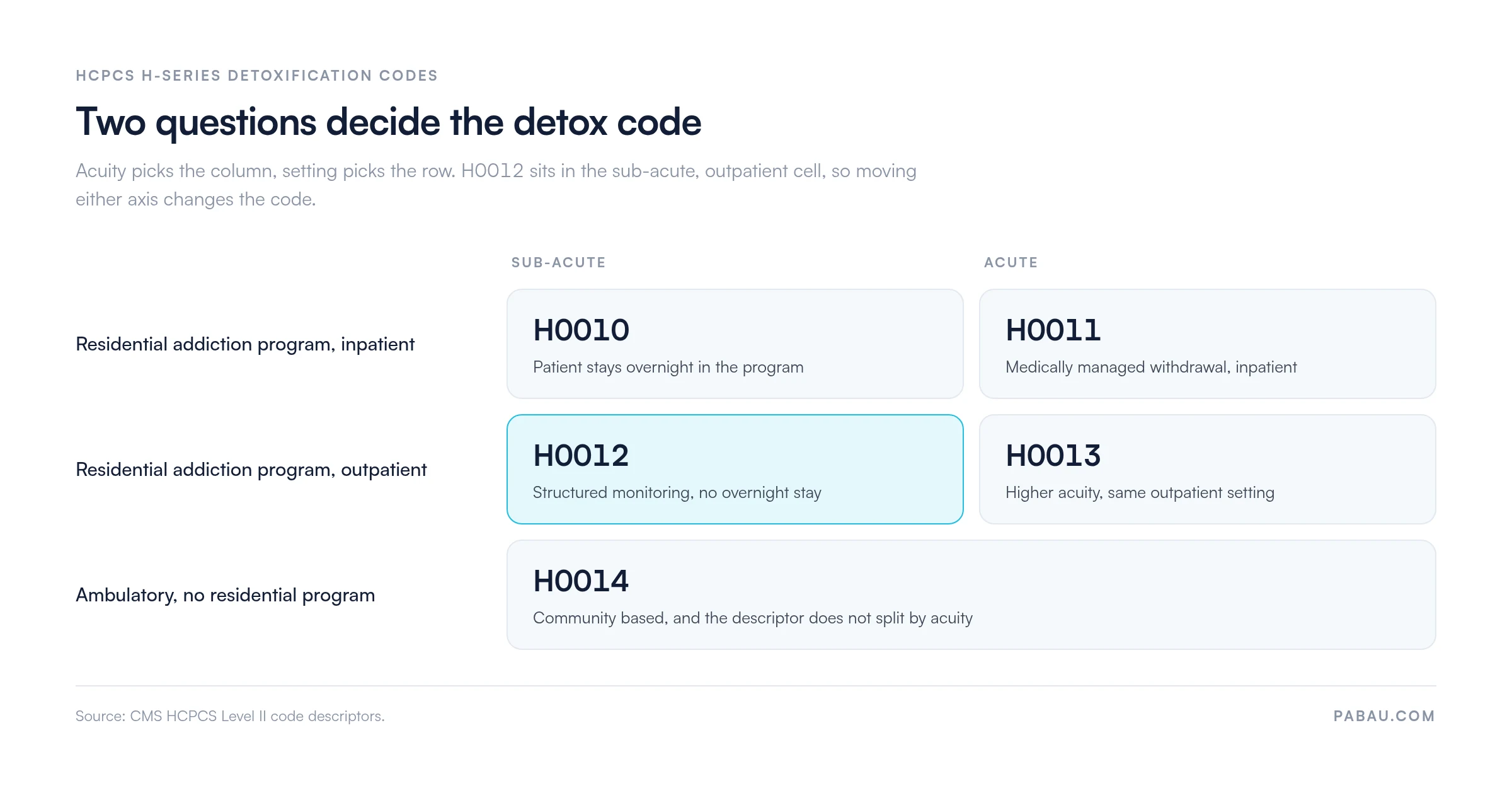
H0012 is one of several H-series codes covering the detoxification spectrum. Picking the wrong one is a common error, particularly when a patient moves between levels of care. See the AAPC’s HCPCS code reference for the full H-series descriptor set.
Two variables decide the code: acuity, and setting. Sub-acute means the patient does not need hospital-level medical management but still needs structured monitoring. Plot the five codes against both axes and the choice becomes a lookup rather than a judgment call. Setting decides other code families too: HCPCS code G0162 hinges on an RN managing a home health plan of care, not on withdrawal acuity.
Document the ASAM level-of-care determination, or your state’s equivalent, to support the code you picked if an audit follows.
Behavioral health billing teams usually work across three places at once: the clinical record, a spreadsheet tracking authorized units, and the state Medicaid portal. Every hand-off between them is a chance for the diagnosis, the units or the modifier to drift away from what the chart actually says.
Practice management software like Pabau keeps the clinical record and the billing record in one system. Pabau’s claims software for practices builds each insurance claim from the encounter the clinician already documented. Pre-submission checks run on the claim’s own fields, and the status comes back into the same system. Nobody has to chase a portal for an answer.
The documentation side matters just as much. Digital intake forms, progress note templates and treatment plan fields capture the required detail at the point of care. When a records request lands months later, the chart already holds what the auditor is asking for, so nobody spends a week reconstructing an episode.

Pabau builds each insurance claim from the encounter your clinician already documented, then tracks its status in the same system. Less rekeying between tools, and a chart that matches the claim when an auditor asks.

HCPCS Code H0012 covers a narrow service: sub-acute detoxification delivered on an outpatient basis inside a residential addiction program, paid mainly through Medicaid. The descriptor is simple. The billing environment around it is not.
State rate variation, modifier rules that move with payer contracts, and documentation that has to survive a post-payment audit all point the same way. Build the H0012 workflow around the chart, so every claim carries what the record already proves. The two checks worth making standard are the sixth character on the diagnosis and the modifier your state requires.
Keeping the clinical record and the insurance claim in one system spares your billing team the rekeying. It also keeps the two versions of the episode identical. Book a demo to see how Pabau handles behavioral health billing day to day.

Billing the inpatient version of the same service? HCPCS Code H0010 covers sub-acute detoxification when the patient stays overnight in the residential addiction program.
Patient needs acute withdrawal management? HCPCS Code H0013 covers acute detoxification in the same outpatient residential setting that H0012 uses.
Detoxing a patient outside a residential program? HCPCS Code H0014 covers ambulatory detoxification delivered in the community.
Unsure how to handle a claim denial? Denial codes in medical billing breaks down the most common denial reason codes and what each one needs to resolve.
HCPCS Code H0012 is a Level II billing code for alcohol and/or drug services. It covers sub-acute detoxification within a residential addiction program, delivered on an outpatient basis. Certified substance abuse treatment providers use it to bill Medicaid and select commercial payers. It covers structured withdrawal management that does not require acute inpatient medical management.
H0012 is covered by Medicaid, not Medicare. H-series HCPCS codes are created and maintained by state Medicaid agencies to cover behavioral health services that have no CPT equivalent. Medicare has separate benefit structures for substance use disorder treatment that use CPT codes or facility revenue codes rather than H-series HCPCS codes.
The most commonly required modifiers are HF for a substance abuse program and HH for an integrated mental health and substance abuse program. SA is required when a nurse practitioner is the rendering provider. State Medicaid plans may also require U-series modifiers with state-assigned meanings. Always verify modifier requirements in your specific state’s Medicaid provider bulletin before submitting claims.
Most state Medicaid programs define one H0012 billing unit as one calendar day of sub-acute detoxification services (per diem). Some states use a per-encounter unit instead. State rules also set authorization limits on the number of units per admission or benefit year. Check your state Medicaid provider manual for the exact unit definition applicable to your program.