CCSD code H4430: Examination of rectum under anaesthetic
CCSD code H4430 pays for the examination alone CCSD code H4430 is the UK private...

Last Updated: Oct 20, 2026
G0297 is the HCPCS Level II code for low dose ct scan (ldct) for lung cancer screening. CMS terminated it with effect from 31 December 2020, so it is no longer valid for claims after that date.
Let Pabau's smart automation suggest the right codes, reduce claim denials, and keep your practice compliant—effortlessly.
Automate repetitive tasks and focus on what matters most—your patients.
Reduce coding errors and ensure compliance with the latest regulations.
Clean claims, fewer denials, and faster reimbursements.
Powerful insights and reporting to help your practice thrive.
HIPAA compliant SOC 2 certified GDPR-compliant Trusted by 4,000+ clinics worldwide

HCPCS Code G0297 described a low-dose CT scan (LDCT) for lung cancer screening. It was billable for dates of service from February 5, 2015 through December 31, 2020.
CMS end-dated G0297 on December 31, 2020 and replaced it with CPT 71271 effective January 1, 2021, under CR 12124.
Some references date the switch to January 2022. In fact, that date belongs to a separate CMS instruction on cost-sharing, not to the code replacement.
Medicare requires Z87.891 or an F17.21x cigarette dependence code on the claim line. However, Z12.11 alone does not clear the NCD 210.14 edit.
The frequency limit is one screening per year with at least 11 full months since the last scan. Still, it is not a calendar-year reset.
Practice management software like Pabau holds procedure codes centrally, so a retired code stops reaching new claims.
HCPCS Code G0297 was the Medicare code for a low-dose computed tomography (LDCT) scan used to screen for lung cancer. In fact, it was billable for almost six years, until CMS end-dated it and moved the service to CPT 71271. Even so, coders still meet G0297 on historical claims, remittances, and audit requests.
The transition date matters, and it is widely published wrong. Specifically, G0297 was end-dated December 31, 2020, and CPT 71271 took over on January 1, 2021. However, several coding references and vendor code lists put the change a year later, in January 2022. Instead, that later date belongs to a different CMS instruction, covered further down this page.
This guide covers the code descriptor, the correct deletion timeline, and the crosswalk to CPT 71271. It also covers Medicare eligibility, companion code G0296, required ICD-10 codes, modifiers, reimbursement, documentation, and the denial codes contractors apply.
G0297 was a HCPCS Level II G-code. In practice, CMS uses that range for services it needs to pay for before the AMA CPT code set issues a permanent code. Unlike G0297, HCPCS code H0003 sits in the Level II H range, which state Medicaid programs define and price for behavioral health services. When CPT 71271 arrived in the 2021 CPT code set, CMS end-dated G0297 to remove the duplicate. As a result, every billing workflow that processed G0297 had to switch on January 1, 2021.
Medicare began covering LDCT lung cancer screening on February 5, 2015, under National Coverage Determination 210.14. G0296 and G0297 gave billers Medicare-specific codes while the AMA developed a permanent CPT code. The two codes did not reach the claims processing systems until January 4, 2016, so the first year of claims was submitted retroactively.
Transmittal 10906 is where the confusion starts. Specifically, its background section states plainly that G0297 was replaced with 71271 effective January 1, 2021. Meanwhile, the instruction it carries waives coinsurance and deductible on institutional claims. However, it is effective January 1, 2022 for dates of service on or after January 1, 2021. As a result, reading only that second date produces the 2022 replacement claim you will find on many coding sites. The visual below marks which of those two dates changed the code.
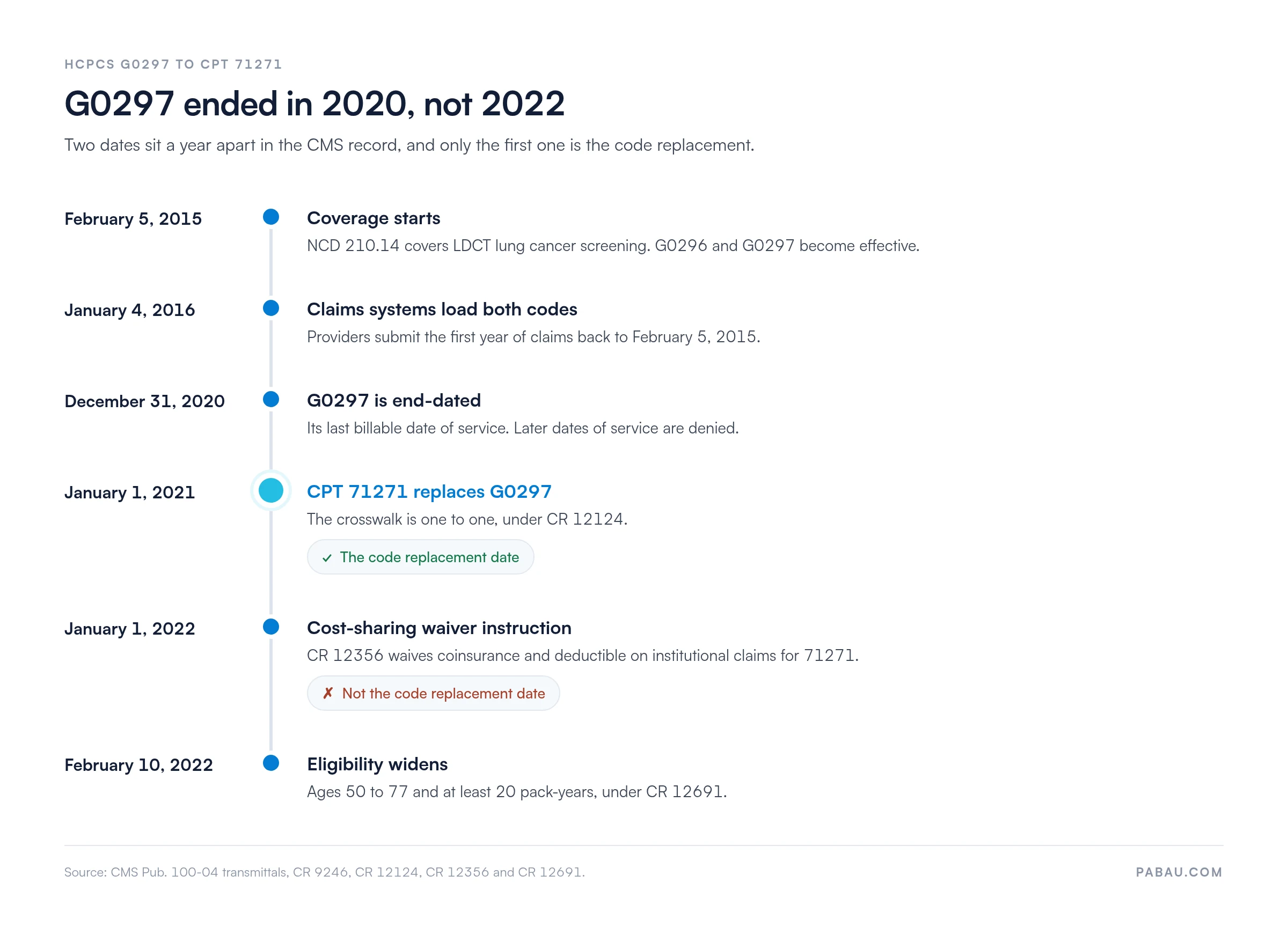
A claim submitted with G0297 for a date of service on or after January 1, 2021 is denied. By contrast, claims for dates of service from February 5, 2015 through December 31, 2020 remain valid under G0297. As a result, denial management work on this code is now limited to appeals, reopenings, and audit responses.
The crosswalk from G0297 to CPT 71271 is a direct one-to-one replacement. In fact, both codes describe the same procedure, the same patient population, and the same Part B preventive benefit. Still, only the code number and the issuing authority changed.
CPT 71271 also travels better outside Medicare. Many commercial payers never loaded HCPCS G-codes, so G0297 claims needed manual handling. For the current rules on the successor code, see our guide to CPT code 71271. The diagnostic chest CT codes 71250, 71260, and 71270 are not substitutes, because they describe diagnostic imaging rather than screening. For historical verification of a G0297 line, the AAPC HCPCS code lookup still carries the retired entry.
Medicare covers LDCT screening for patients aged 50 to 77 with at least a 20 pack-year smoking history. In other words, those are the current NCD 210.14 criteria, effective for dates of service on or after February 10, 2022. By contrast, every G0297-era claim was judged against a stricter set of rules.
Confirm all of the following before billing CPT 71271. However, a historical HCPCS Code G0297 claim is judged against the criteria that applied on its own date of service:
The upper age limit is the detail most often misreported. The USPSTF recommends screening through age 80, but Medicare stops at 77. A claim for a 78-year-old patient rejects on the age edit in the Common Working File, even though the patient meets the USPSTF recommendation.
Practices that never revisited their eligibility rules after February 2022 are still screening out patients Medicare now covers. For example, a 52-year-old with 22 pack-years fails the old rule and passes the current one.
G0296 pays for the counseling and shared decision-making visit Medicare requires before a patient’s first LDCT scan. It is a coverage condition rather than optional paperwork. In practice, the visit has to happen before the first screening and be documented in the medical record.
Record the G0296 counseling date on the screening order before the scan is booked. The NCD requires the counseling visit to come before the first LDCT scan, so a same-day pair invites a coverage challenge. Specifically, on RHC and FQHC claims, G0296 on the same date as another visit is denied as bundled under CARC 97.
A complete superbill for a new screening patient carries G0296 on the counseling date and CPT 71271 on the scan date. Therefore, both dates need to be visible to whoever submits the claim.
Medicare requires a tobacco-related ICD-10 code on the claim line, not a screening encounter code. Specifically, NCD 210.14 lists Z87.891 plus five cigarette dependence codes in the F17.21x range. As a result, a claim line without one of them is denied under CARC 167.
This runs against what many coding guides advise. Z12.11 describes an encounter for screening of the bronchus and lung, so it reads like the obvious first-listed code. It does not appear on the covered diagnosis list for this NCD, so it does not clear the edit on its own.
In fact, the requirement has applied to dates of service on or after October 1, 2015, and it did not change when 71271 replaced G0297. For instance, reporting Z12.11 alongside Z87.891 or an F17.21x code is fine. By contrast, reporting Z12.11 and omitting the tobacco code is what triggers the denial. Check code validity with the CDC ICD-10-CM search tool, and confirm the descriptor against our ICD-10-CM code index before the claim goes out.
Medicare allows one LDCT screening per year, and at least 11 full months must elapse after the last scan. In other words, that is not a calendar-year reset. For example, a patient scanned in March 2025 becomes eligible again in March 2026, not on January 1.
Sound revenue cycle management for radiology and pulmonology teams puts the 11-month check before the booking, not after the denial. For instance, confirming the last screening date at scheduling costs a few seconds. By contrast, reworking a CARC 119 denial costs a great deal more.
The screening service itself needs no modifier. Instead, modifiers appear on LDCT claims for two reasons: splitting the professional and technical components, and flagging patient liability when coverage is in doubt.
The difference between GA and GZ is money. Specifically, with a signed ABN and modifier GA, the practice can bill the patient for a denied scan. With GZ, by contrast, CMS assigns the write-off to the provider, so the practice absorbs the cost of the scan.
G0297 has no current payment rate, because it stopped being payable after December 31, 2020. By contrast, CPT 71271 is paid according to the setting, like other imaging codes. For example, physician offices and freestanding facilities are paid under the Medicare Physician Fee Schedule. Meanwhile, hospital outpatient departments are paid under OPPS through an ambulatory payment classification.
The professional and technical split follows the same logic. For example, a radiologist reading for a hospital bills 71271 with modifier 26 under the fee schedule. Meanwhile, the hospital bills the technical side on its own institutional claim.
Rates change each year and by locality, so look them up rather than quoting a national figure. The CMS Physician Fee Schedule Look-Up Tool carries the professional and freestanding rates. Meanwhile, OPPS Addendum B carries the hospital outpatient rate.
One rule holds across every setting. Coinsurance and the Part B deductible are waived on 71271, because it is an additional preventive service with a USPSTF Grade B recommendation. CMS still had to issue a separate instruction in January 2022 to make that waiver work on TOB 22X, 23X, 71X, 77X, and 85X claims. In fact, that instruction is the one so often misread as the code replacement date.
The documentation rules changed with the February 2022 reconsideration, and many coding references still publish the old list. Under the 2015 NCD that governed HCPCS Code G0297, the written order had to carry five named elements. By contrast, the current NCD asks only that the patient receive an order for LDCT screening.
Hold the following in the record for a claim submitted today:
Structured reporting is a coverage condition on the facility, not a payer preference. For example, a facility that reports nodules in free text fails an NCD requirement, whatever the claim looks like.
Paper intake and ordering workflows are where the pack-year number and the counseling date go missing. By contrast, digital intake forms that require a numeric pack-year field remove the most common documentation failure on this service. In short, a checklist tied to the order beats an audit after the scan.

Audit five LDCT claims from the past 90 days. First, check the G0296 date against the scan date. Next, check that the pack-year history is recorded as a number. Also, check that the claim line carries Z87.891 or an F17.21x code. Finally, check that the patient was 50 to 77 on the scan date. In short, most compliance failures on this service sit in one of those four places.
CMS publishes the exact reason codes its contractors apply to lung cancer screening denials. Reading the CARC on the remittance tells you which edit fired, so the fix becomes mechanical instead of guesswork.
Two of these never need to reach billing at all. In fact, the age check and the 11-month check both use data the practice already holds. In short, a high clean claim rate on screening work is mostly a scheduling discipline.
The G0297 retirement exposed an operational weakness. Specifically, billing teams working from static code lists had to update superbill templates and charge capture tools by hand. As a result, practices with no workflow-level enforcement kept submitting G0297 into 2021, until the denials told them to stop.
Practice management software like Pabau reduces that exposure by holding procedure codes in one place. For example, an administrator retires a code once, and every service template picks up the change. The same record supports the frequency check, because the system already knows when a patient last had the scan.
Sequencing is the other place software helps. When the G0296 counseling visit has to be recorded before the scan appointment is finalized, the ordering rule gets enforced at booking. A coverage condition becomes a step someone has to complete, rather than a denial someone has to explain later. In short, Pabau’s billing tools support cleaner claims management, submitting and tracking the claim from the same patient record.

Pabau’s billing workflow tools help radiology and preventive care practices track procedure code changes, verify eligibility, and submit clean claims for LDCT screening. See how Pabau keeps your claims accurate as codes evolve.

HCPCS Code G0297 stopped being billable after December 31, 2020, and CPT 71271 has carried LDCT lung cancer screening since January 1, 2021. If a reference dates the switch to January 2022, it has confused the code replacement with a separate cost-sharing instruction. In short, the crosswalk itself is direct, and the coverage rules moved across unchanged.
Three details cause most denials on this service today. First, the claim line needs Z87.891 or an F17.21x code. Second, the G0296 counseling date has to precede the first scan. Third, the 11-month frequency window is not a calendar year. Pabau’s claims management tools support procedure code tracking, eligibility checks, and clean claim submission, so coders work from current codes rather than last year’s templates. To see how Pabau handles a code transition like this one, book a demo.

Need a framework for medical billing compliance? Medical billing compliance covers the documentation and workflow standards that keep preventive service claims payable.
Want to reduce claim denials before they happen? Clean claim submission practices outlines the pre-submission checklist that prevents the most common denial patterns.
Managing revenue across multiple providers? Revenue cycle management fundamentals explains how to connect scheduling, documentation, and billing into a single compliant workflow.
HCPCS Code G0297 is an end-dated Medicare code that described a low-dose CT scan (LDCT) for lung cancer screening. Radiology facilities and ordering physicians used it to bill Medicare Part B for annual screening in eligible high-risk patients. It covered dates of service from February 5, 2015 through December 31, 2020.
G0297 is no longer active. CMS end-dated the code on December 31, 2020, and any claim with a date of service on or after January 1, 2021 is denied. CPT code 71271 is the required code for all current LDCT lung cancer screening claims.
CPT code 71271 replaced G0297 effective January 1, 2021, under CR 12124. CPT 71271 describes computed tomography of the thorax, low dose, for lung cancer screening, without contrast material. The eligibility criteria, frequency limit, and documentation requirements carried across unchanged.
Because they misread CMS Transmittal 10906. That transmittal waives coinsurance and deductible on CPT 71271 institutional claims, effective January 1, 2022 for dates of service on or after January 1, 2021. Its own background section confirms the code replacement happened on January 1, 2021.
G0296 is the HCPCS code for the counseling and shared decision-making visit Medicare requires before a patient’s first LDCT screening. Its date of service has to precede the scan date in the record. On RHC and FQHC claims, G0296 billed on the same date as another visit is denied as bundled.
The claim line has to carry Z87.891 or one of the cigarette dependence codes F17.210, F17.211, F17.213, F17.218, or F17.219. Without one of those, the line is denied under CARC 167. Z12.11 is often reported alongside them. It is not on the NCD 210.14 covered diagnosis list, so it does not clear the edit on its own.
Once per year, with at least 11 full months elapsed since the previous screening. This is not a calendar-year limit, so a scan in March is not covered again until the following March. The Common Working File edit is overridable, so a documented exception can still be paid.
For dates of service on or after February 10, 2022, patients aged 50 to 77 with at least a 20 pack-year history qualify. Before that date, the criteria were ages 55 to 77 and 30 pack-years, which is what applied throughout the G0297 era. In both versions the patient must be asymptomatic and either a current smoker or one who quit within the last 15 years.
G0297 remains the correct code on a claim for a date of service on or before December 31, 2020. New submissions for those dates now fall outside Medicare’s 12-month timely filing limit. In practice, the code appears today only in appeals, reopenings, and audit responses on claims already on file.