CCSD code H4430: Examination of rectum under anaesthetic
CCSD code H4430 pays for the examination alone CCSD code H4430 is the UK private...

Last Updated: Oct 20, 2026
G0288 is the HCPCS Level II code for reconstruction, computed tomographic angiography of aorta for surgical planning for vascular surgery.
Let Pabau's smart automation suggest the right codes, reduce claim denials, and keep your practice compliant—effortlessly.
Automate repetitive tasks and focus on what matters most—your patients.
Reduce coding errors and ensure compliance with the latest regulations.
Clean claims, fewer denials, and faster reimbursements.
Powerful insights and reporting to help your practice thrive.
HIPAA compliant SOC 2 certified GDPR-compliant Trusted by 4,000+ clinics worldwide

HCPCS Code G0288 covers reconstruction of computed tomographic angiography of the aorta, performed to plan vascular surgery.
G0288 carries no physician work RVU. Its 1.38 total RVUs for 2026 are practice expense and malpractice value only.
CMS classifies G0288 as a technical component only code, so modifiers 26 and TC cannot be appended to it.
Every claim needs a billable ICD-10-CM diagnosis code, and the four-character I71 aneurysm codes are no longer billable.
Pabau’s claims management software submits claims to your clearinghouse and checks required fields before each claim goes out.
HCPCS Code G0288 is the Medicare code for reconstruction of computed tomographic angiography of the aorta, performed to plan vascular surgery. CMS added the code in 2003 and it remains active for 2026.
The long descriptor is reconstruction, computed tomographic angiography of aorta for surgical planning for vascular surgery. It is published by the Centers for Medicare and Medicaid Services (CMS). This is a HCPCS Level II G-series code, so CMS maintains it rather than the AMA’s CPT editorial panel. Other letter ranges answer to other payers: HCPCS Code H0002 sits in the behavioral health series that state Medicaid programs, not Medicare, price.
One line in the fee schedule settles most G0288 questions. The code carries a work RVU of 0.00 and a PC/TC indicator of 3, which identifies a technical component only code. Modifiers 26 and TC cannot be used with it.
G0288 pays for the reconstruction, not for the CTA scan that produced the images. That acquisition is billed separately under its own CPT code, and confusing the two is the most common reason these claims are reworked.
The table below summarizes the core code attributes for quick reference. Verify active status against the current CMS HCPCS annual release before billing.
A vascular surgeon planning an aortic repair needs more than a standard CT scan. They need a reconstructed three-dimensional model of the aorta, showing diameter, angulation, branch vessel involvement, and the landing zones for a graft or stent.
Producing that model takes workstation time and trained staff. G0288 is the code CMS created to pay for those resources when the reconstruction is done to plan a procedure on the aorta.
G0288 is not used for routine diagnostic CTA of the aorta ordered to evaluate suspected disease. The surgical planning context is the defining clinical element, and it has to be visible in the record.
Medicare covers G0288 under the Physician Fee Schedule when medical necessity is established and documented. The HCPCS file assigns the code coverage code C, which means carrier judgment. Your Medicare Administrative Contractor (MAC) decides whether a given claim is reasonable and necessary.
No National Coverage Determination governs G0288. Local Coverage Determinations can, so check the LCD for the provider’s MAC jurisdiction before billing. Some MACs publish a covered diagnosis list that narrows the eligible patient population.
G0288 is priced from national relative value units rather than set locally by each contractor. For 2026 CMS assigns it 1.38 total RVUs. Multiplying that by the conversion factor gives the national amount before any geographic adjustment.
CMS set two conversion factors for 2026. Qualifying alternative payment model participants are paid at $33.5675, and everyone else at $33.4009. G0288 therefore pays $46.32 or $46.09 nationally before adjustment. The figures below come from the CMS relative value files for January 2026.
Use the CMS Physician Fee Schedule lookup tool to confirm the amount for a specific MAC jurisdiction before you set a charge.
The national figure is a weak planning number for this particular code. Almost all of its value sits in practice expense, and the practice expense index varies more across localities than the work index does.
Run the 2026 geographic indices across all 109 Medicare localities and the payment ranges from $38.98 in Arkansas to $64.67 in the San Jose locality. That is a 66% spread on a single code.
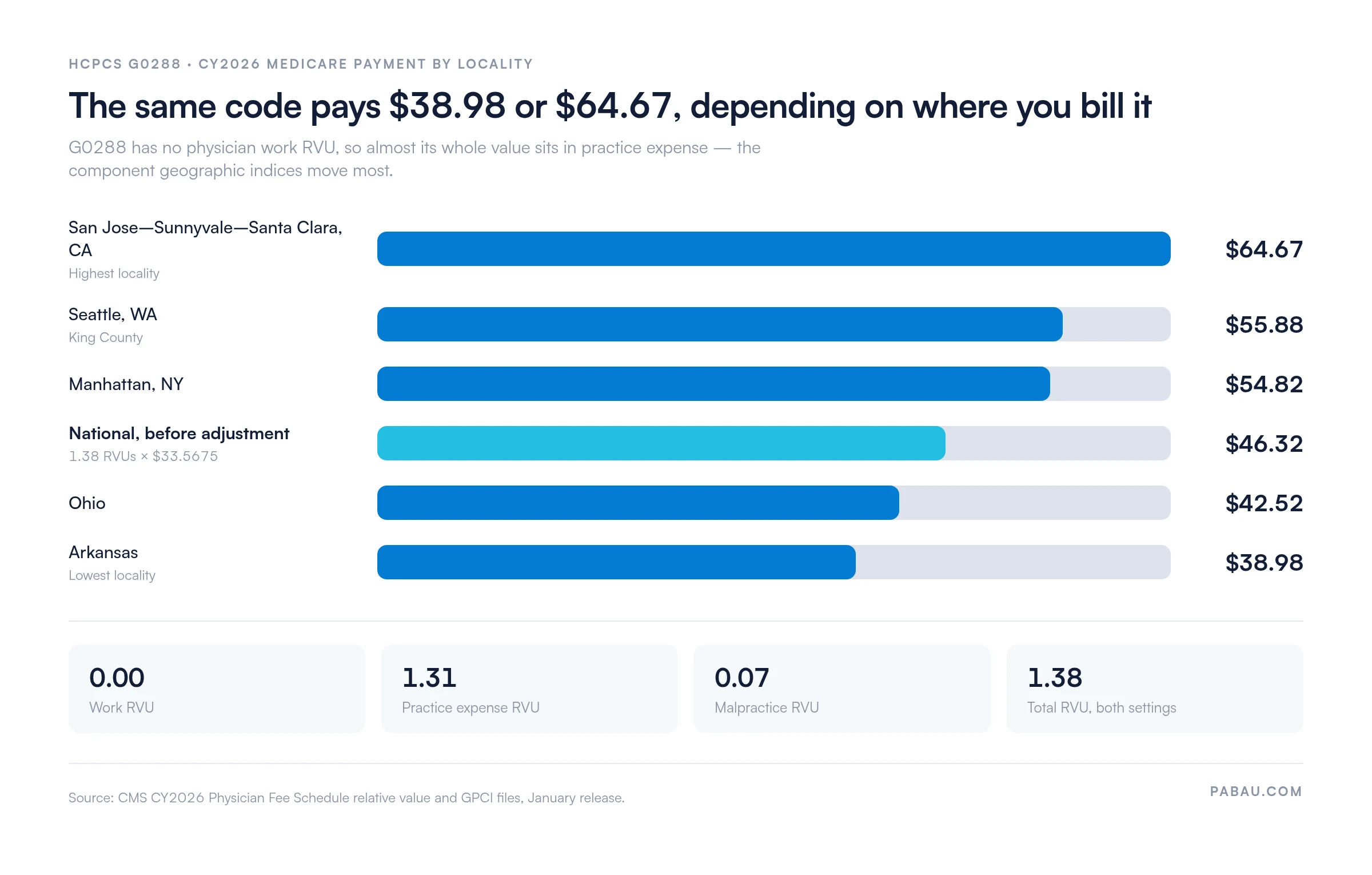
A charge master built on the national average will therefore be wrong in most localities. Pull the rate for your own MAC locality once a year, when the fee schedule updates.
G0288 has no facility versus non-facility differential. CMS publishes the same 1.38 total RVUs in both columns, so the payment does not move with the setting.
CMS also flags the facility practice expense value as not applicable. That flag means the service is rarely or never furnished in a facility setting. Where a hospital performs the reconstruction, the hospital bills it under the Outpatient Prospective Payment System instead.
Price G0288 from your own MAC locality rather than the national average. The 2026 geographic indices move this code from $38.98 to $64.67 depending on where it is billed, because practice expense carries 95% of its value.
Place of service (POS) codes tell Medicare where the service was rendered. For G0288 they do not switch the claim between a facility and a non-facility rate, because the code has only one rate. They still have to match the site of service.
Mismatched place of service codes are among the most common reasons G0288 claims are returned for correction rather than denied outright. A returned claim can be rebilled, but it delays payment and consumes billing staff time.
G0288 takes fewer modifiers than most imaging codes, because CMS treats it as a technical component only code. The two modifiers coders reach for first are the two that are never valid on it.
Modifier 26 on a G0288 line is the most frequent modifier error on this code. It comes from the habit coders carry over from CPT imaging codes, which do split into professional and technical components.
Every G0288 claim needs a supporting ICD-10-CM diagnosis code that justifies the surgical planning. The aortic conditions in category I71 account for most pairings.
Category I71 was expanded in the FY2023 update, effective October 1, 2022. The four-character codes I71.2, I71.3, I71.4 and I71.6 became parent headers at that point, so none of them is billable now. A claim carrying one is rejected as an invalid code.
The billable options sit one character deeper. Our ICD-10-CM code reference lists the full category, and the table below covers the pairings that come up most in aortic surgical planning.
Where the record does not specify a site, I71.9 is the fallback. It is billable, but a MAC covered-code list may exclude it, so reach for it only when the documentation genuinely supports nothing more specific.
Some MAC LCDs maintain a specific list of covered ICD-10-CM codes for G0288. A clinically accurate code outside that list is still a denial. Cross-reference the documented diagnosis against the LCD’s covered table before submission.
A clean G0288 claim starts with documentation that establishes three things. The clinical indication for the reconstruction, the surgical intent behind it, and the reconstruction work actually performed. Incomplete records cause most G0288 denials, even where the code and modifiers are correct.
Most G0288 problems fall into a small number of categories. Addressing them before submission reduces denial rates and rework time.
Check the quarterly CMS Correct Coding Initiative edit files before pairing G0288 with another imaging or post-processing code on the same date of service. The 3D rendering codes 76376 and 76377 are the usual culprits.
Choosing between G0288 and the CPT imaging codes is where most coders hesitate. The table separates the acquisition codes from the reconstruction codes.
Where a practice both acquires the CTA and performs the reconstruction, each service needs its own documentation for the date it was furnished. Practice management software like Pabau adds a mechanical check on top of that. Pabau’s software for billing teams validates required claim fields before submission, so an incomplete line reaches your biller rather than the payer.
Vascular billing teams usually work across three screens. The imaging record sits in one system, the charge entry in another, and claim status in a clearinghouse portal. A G0288 line goes missing in the handoff between them.
Pabau keeps the patient record, the invoice, and the charge in one place, so the reconstruction is billed from the same record that documents it. Its claims tools submit to your clearinghouse, run patient eligibility checks, and validate required fields before a claim leaves the practice.
Remittance advice comes back into the same system, so a G0288 denial lands against the patient it belongs to. Your billers then spend their time on the claims that need a person, instead of reconciling three exports.


Pabau submits claims to your clearinghouse, runs eligibility checks, and validates required fields before each claim goes out. Remittance advice comes back to the same patient record.

G0288 rewards precision in three places. It takes no modifier 26 and no TC. It pays one rate regardless of setting. And it needs a five-character ICD-10-CM code from the expanded I71 category.
The trade-off worth remembering is the locality spread. A charge master built on the $46.32 national figure will under-collect in high-cost localities and overstate expected revenue in low-cost ones. Pull your own MAC rate when the fee schedule updates each January.
For practices running volume through vascular imaging, the documentation habit matters more than the code lookup. Pabau’s claims tools submit each claim to your clearinghouse and check the required fields first, so fewer claims come back for correction. Book a demo to see how it fits your vascular billing workflow.

Need a framework for reducing claim denial rates? Denial management in healthcare covers the systematic approach to tracking, appealing, and preventing claim rejections across specialties.
Want to understand how clearinghouse submission works? Clean claim submission guidelines walks through the technical requirements that determine whether a claim processes cleanly on first pass.
Looking to improve your revenue cycle from intake to payment? Best medical billing software for US practices reviews the tools that support end-to-end billing workflows for surgical specialties.
HCPCS Code G0288 is used to bill reconstruction of computed tomographic angiography of the aorta, performed to plan vascular surgery. It covers the workstation time and staff resources the reconstruction consumes ahead of a procedure such as EVAR or TEVAR. It does not cover the CTA scan itself, which is billed separately under its own CPT code.
G0288 has one rate. CMS publishes the same 1.38 total RVUs in the facility and non-facility columns, so the setting does not change what the practice is paid. CMS also flags the facility practice expense value as not applicable, because the service is rarely or never furnished in a facility. Where a hospital performs the reconstruction, the hospital bills it under the Outpatient Prospective Payment System.
Billing G0288 requires a signed report documenting the reconstruction findings and how they inform surgical planning. It also needs a note from the surgeon or ordering physician establishing the planned procedure and the diagnosis. Finally it needs a billable ICD-10-CM code matching the documented aortic condition. A generic radiology report with no surgical planning language is the most common reason these claims are denied.
Yes. G0288 is an active HCPCS Level II code carrying status indicator A on the 2026 Physician Fee Schedule, so Medicare pays it separately. The HCPCS file assigns it coverage code C, meaning carrier judgment, so your MAC decides medical necessity case by case. Check the applicable LCD for your jurisdiction before submitting.