CPT Code 62284: Injection procedure for myelography
CPT Code 62284: official descriptor and procedure overview The American Medical ...

Last Updated: Oct 19, 2026
E0303 is the HCPCS Level II code for a heavy-duty, extra-wide hospital bed with any type of side rails and a mattress. Its official weight capacity is greater than 350 pounds, but less than or equal to 600 pounds.
E0304 is the same bed rated for more than 600 pounds, and E0301 is the version of E0303 without a mattress. Neither descriptor names a drive mechanism, so weight capacity and the included mattress decide the code. Medicare denials usually trace back to a weight missing from the medical record or an incomplete standard written order.
Let Pabau's smart automation suggest the right codes, reduce claim denials, and keep your practice compliant—effortlessly.
Automate repetitive tasks and focus on what matters most—your patients.
Reduce coding errors and ensure compliance with the latest regulations.
Clean claims, fewer denials, and faster reimbursements.
Powerful insights and reporting to help your practice thrive.
HIPAA compliant SOC 2 certified GDPR-compliant Trusted by 4,000+ clinics worldwide

HCPCS Code E0303 covers a heavy-duty, extra-wide hospital bed with side rails and a mattress, for patients over 350 lbs and up to 600 lbs.
E0304 is the same bed rated for more than 600 lbs, while E0301 and E0302 are the versions of E0303 and E0304 without a mattress.
Medicare Part B covers E0303 under the DME benefit when documented medical necessity criteria are met, administered by the regional DME MAC.
A patient weight missing from the medical record and an incomplete standard written order are the top two denial triggers for E0303 claims.
Practice management software like Pabau tracks each claim’s status and blocks submission until the required details are complete.
HCPCS Code E0303 describes a heavy-duty, extra-wide hospital bed with any type of side rails and a mattress.
Its weight capacity is greater than 350 pounds and up to 600 pounds. Under CMS’s HCPCS Level II coding system, E0303 sits in the E-series, which covers durable medical equipment (DME) supplied to patients in their homes.
The official descriptor sets no width figure and names no drive mechanism. Weight capacity and the included mattress and side rails are what define the code.
CMS maintains the HCPCS Level II code set and publishes updates quarterly. Unlike CPT codes, HCPCS Level II codes like E0303 are alphanumeric and do not require AMA licensing to use. Coders who need the current descriptor can check it through the AAPC HCPCS code lookup.
E0303 covers the heavy-duty bed frame together with its side rails and mattress, all on one claim line. The descriptor already includes the mattress and rails. Billing either one again on a separate line duplicates payment and triggers a denial or a claim edit.
E0301 and E0302 meet the same bariatric weight thresholds as E0303 and E0304. They differ only in shipping without a mattress. If the patient needs a separately billed support surface in place of the standard mattress, bill E0301 with the support-surface code rather than E0303.
Choosing between E0301, E0302, E0303, and E0304 comes down to two variables: the weight capacity needed and whether the bed ships with a mattress. All four codes describe an extra-wide, heavy-duty frame with any type of side rails. Using E0303 outside that 350 to 600 lb band is a coding error that post-payment audits will surface.
The most consequential distinction is E0303 vs E0304. Both include side rails and a mattress, and neither descriptor names a drive mechanism. E0303 applies when the patient weighs more than 350 lbs and up to 600 lbs. E0304 applies when the patient weighs more than 600 lbs. The grid below shows the order to ask the two questions in.
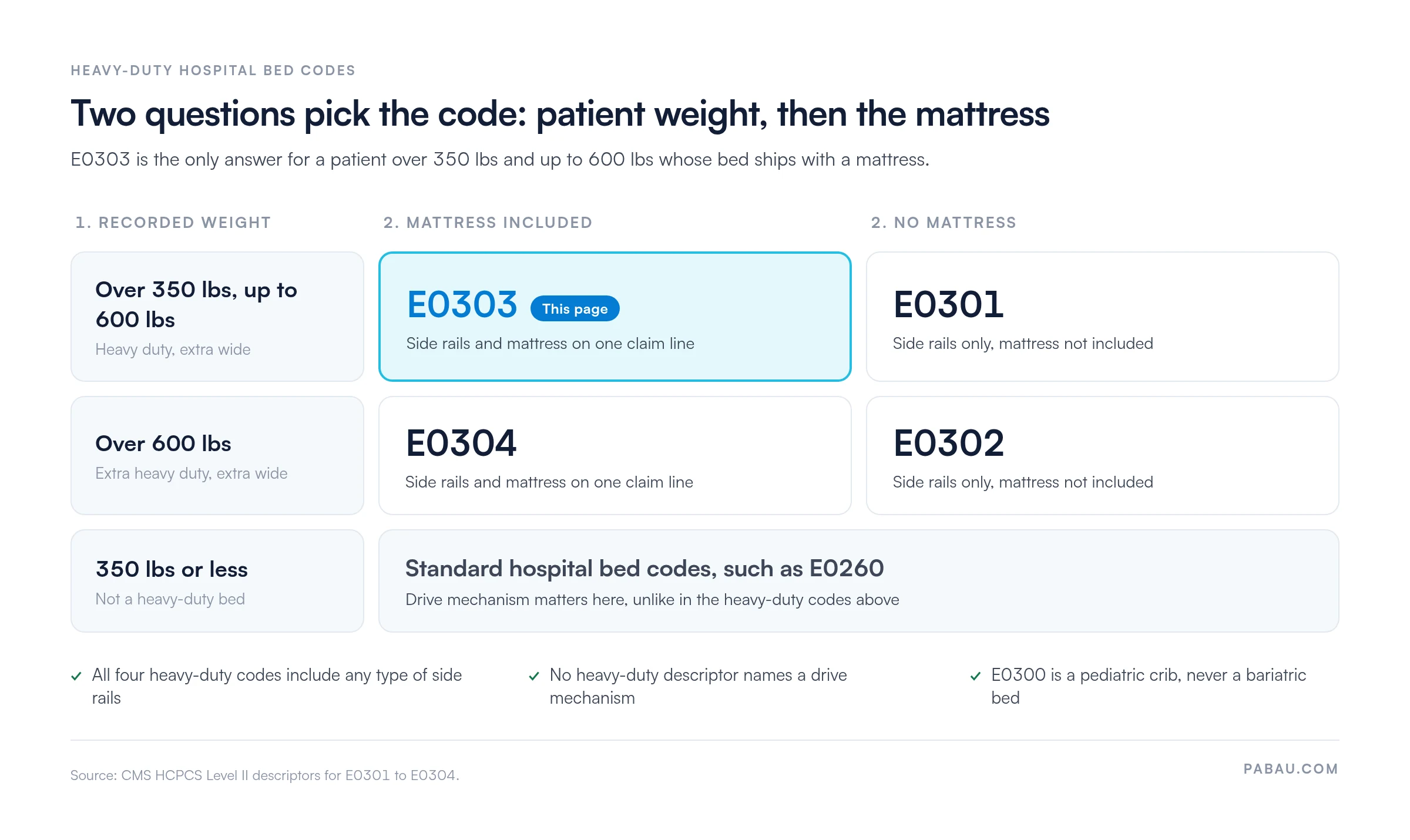
E0300 does not belong in this comparison. It is the code for a hospital-grade pediatric crib, fully enclosed, with or without top enclosure. It never stands in for an adult bariatric bed.
A patient at 350 lbs or less usually needs a standard code, such as E0260 for a semi-electric bed with side rails and mattress. Drive mechanism only comes into play in those standard codes.
Medicare Part B covers HCPCS Code E0303 under the DME benefit when the patient meets documented medical necessity criteria. The regional DME MAC administers coverage under the applicable local coverage determination (LCD) for hospital beds.
Two contractors currently administer the four DME MAC jurisdictions: Noridian (Jurisdictions A and D) and CGS (Jurisdictions B and C). Both apply the same national framework but may publish their own documentation checklists.
An E0303 claim can clear eligibility and prior authorization and still fail without the right clinical evidence in the record. Medicare’s core criteria for coverage include all of the following:
The national coverage determination for hospital beds (NCD 280.7) sets the broad framework, and the DME MAC’s LCD adds the detailed criteria. The active LCD in the patient’s jurisdiction is the document each claim is reviewed against.
Documentation for HCPCS Code E0303 must support every element of medical necessity before the claim reaches the payer. The file should be ready for a post-payment audit before the claim is ever submitted. Required documentation typically includes:
CMS discontinued certificates of medical necessity (CMNs) for dates of service on or after January 1, 2023. The order and the medical record now carry the medical necessity case on their own. Gather these documents before delivery rather than after a denial arrives. Retroactive documentation requests are a red flag in audits and rarely reverse a denial on their own.
CMS runs a prior authorization (PA) program for certain high-utilization Medicare DME items. Whether E0303 is on the required PA list depends on the active CMS program update. The list changes with each update cycle, so verify PA status with the regional DME MAC before submitting a bariatric bed claim.
The pre-delivery eligibility check should include PA status. If PA is required and not obtained before delivery, Medicare will deny the claim as non-covered regardless of clinical justification.
When prior authorization is required, the DME supplier submits the PA request to the regional DME MAC before delivering the item. The submission must include the physician order, documentation of the patient’s qualifying weight, the relevant LCD criteria checklist, and supporting clinical notes.
The DME MAC returns a decision within the timeframe CMS sets for the program. Expedited review is available when a delay could harm the patient. Provisional affirmative decisions mean the claim is presumed approvable if conditions remain unchanged at delivery.
Medicare pays for HCPCS Code E0303 under the DME capped rental program. The beneficiary rents the bed for up to 13 continuous months, after which ownership transfers to the beneficiary. Medicare pays monthly for all 13 months: 10% of the fee schedule amount in months 1-3, then 7.5% in months 4-13.
After ownership transfers, Medicare covers reasonable repairs. Replacement is covered once the bed reaches its five-year reasonable useful lifetime, or if it is lost or irreparably damaged.
Allowable amounts vary by location because CMS publishes the DMEPOS fee schedule by state, with separate rural amounts in some areas. Once payment arrives, the electronic remittance advice (ERA) tells the biller which rental month it covers. It also shows whether a co-insurance or deductible balance remains. Verify current figures against the CMS DMEPOS fee schedule, which updates each January.
Verify current E0303 fee schedule allowables against the CMS DMEPOS fee schedule before finalizing patient cost estimates. Rates shift January 1 each year, and a prior-year figure in a patient communication creates a billing discrepancy.
E0303 denials follow recognizable patterns, and each category points to a workflow problem you can fix at the source. The most frequent denial triggers for HCPCS Code E0303 include:
Sorting denials by their remittance denial reason codes shows which of these problems drives the most volume. A CO-50 (not medically necessary) denial points to a documentation problem. A CO-4 (modifier inconsistent or missing) denial points to a coding error.
The Medicare DME appeal pathway has five levels, and most suppliers resolve E0303 denials at the first two. The first three levels work like this:
The appeal file should attach a clean copy of the original 837 electronic claim alongside the corrected clinical documentation. A side-by-side of what was originally submitted vs. what the appeal adds shows the reviewer exactly which missing element has been supplied.
Error-catching claims management software that validates required fields and tracks claim status removes much of the manual checking behind these errors. Beyond system support, these coding practices reduce denial rates on HCPCS Code E0303:
A superbill workflow adapted for DME suppliers gets the referring provider’s encounter notes and diagnosis codes into the billing file before submission. Before the claim goes out, check every required field against the DME MAC’s submission requirements so it meets the clean claim standard.
The ICD-10-CM diagnosis codes reported on an E0303 claim must align with the active LCD for hospital beds in the patient’s DME MAC jurisdiction. Morbid obesity is the most common qualifying diagnosis, usually reported as E66.01 when it stems from excess calories. Check the current LCD’s diagnosis code list, which changes with each annual update.
Never report a diagnosis code that is not supported by documentation in the clinical record. Reporting E66.01 to support E0303 when the recorded weight is 350 lbs or less creates a fraud and abuse exposure that post-payment audits will surface.
Run an ICD-10 crosswalk check against the applicable DME MAC LCD before finalizing the diagnosis codes on an E0303 claim. LCDs list the exact covered ICD-10-CM codes for hospital beds, and any code not on the list is a near-certain denial regardless of clinical accuracy.
Suppliers billing DME juggle documentation status, rental months, and prior authorization deadlines for every bed on rent. Spreadsheets tend to lose that detail somewhere between delivery and month 13.
Practice management software like Pabau keeps insurer details on the patient record and pre-fills each claim from them. Validation checks run in the background and block submission until the required details are complete. Fewer E0303 claims go out missing a field the DME MAC needs.
Live claim status shows whether each monthly rental claim is pending, submitted, processing, paid, or in error. In the US, real-time eligibility checks and ERA posting run through Claim.MD.
For weight-management and bariatric practices, the patient record also holds the weights and practitioner notes that DME MAC reviewers look for. Book a demo to see how Pabau structures DME documentation workflows.

Pabau’s claims management software pre-fills E0303 claims from the patient record, checks required details before submission, and tracks each rental-month claim through to payment.

HCPCS Code E0303 is simple to select once two facts are confirmed before delivery. The patient weighs more than 350 lbs and up to 600 lbs, and the bed ships with side rails and a mattress. Weight capacity separates it from E0304, the mattress separates it from E0301, and the pediatric crib code E0300 never enters the decision.
The claims that fail usually lack one piece of evidence, most often a recorded weight or a complete standard written order. Capture that evidence at the point of care, and the appeal file never has to supply it. Book a demo to see how Pabau keeps the documentation behind every E0303 claim in one patient record.

Need to understand how claims move through a clearinghouse? Medical claims clearinghouse guide explains how electronic claims are validated and routed to payers.
Want fewer E0303 claims bounced back? What is a clean claim lists the fields payers check before they accept a claim.
Seeing the same denial reason every month? Denial management in healthcare shows how to trace each denial back to the step that caused it.
Looking to strengthen your revenue cycle documentation? Superbill preparation guide covers how to structure encounter documentation that supports clean claim submission.
HCPCS Code E0303 covers a heavy-duty, extra-wide hospital bed with any type of side rails and a mattress. It is for patients weighing more than 350 lbs and up to 600 lbs. The mattress and side rails are part of the code, so they are not billed separately. Accessories outside the descriptor, such as a trapeze bar, are billed under their own HCPCS codes.
E0300 is the code for a hospital-grade pediatric crib, fully enclosed, with or without top enclosure. It is unrelated to E0303, which covers a heavy-duty, extra-wide adult bed with side rails and a mattress. Billing E0300 for a bariatric bed is a coding error that leads to a denial.
Weight capacity is the only difference. E0303 covers patients weighing more than 350 lbs and up to 600 lbs. E0304 covers an extra heavy-duty bed for patients over 600 lbs. Both include side rails and a mattress, and neither descriptor specifies a drive mechanism.
Yes, Medicare Part B covers E0303 under the DME benefit when documented medical necessity criteria are met. The record needs a weight of more than 350 lbs and up to 600 lbs and a standard written order. It also needs a diagnosis supporting the positioning or mobility need. Coverage is administered by the regional DME MAC under the applicable LCD for hospital beds.
Whether E0303 requires prior authorization depends on the current CMS prior authorization program list, which is updated periodically. Always verify PA status with the regional DME MAC before delivery. If PA is required and not obtained, Medicare will deny the claim regardless of clinical justification.
No. E0303 already includes any type of side rails and a mattress. Billing E0305, E0310, or a mattress code alongside it duplicates payment and triggers a denial. If the patient needs a separately billed support surface instead of the included mattress, bill E0301 with the support-surface code.