CCSD Code B2710: Radical mastectomy including block dissection
CCSD Code B2710: Definition and clinical scope CCSD Code B2710 is the UK private...

Last Updated: Nov 13, 2026
C1888 is the HCPCS Level II code for catheter, ablation, non-cardiac, endovascular (implantable). Hospital outpatient departments report it under OPPS for the catheter used in procedures such as endovenous vein ablation.
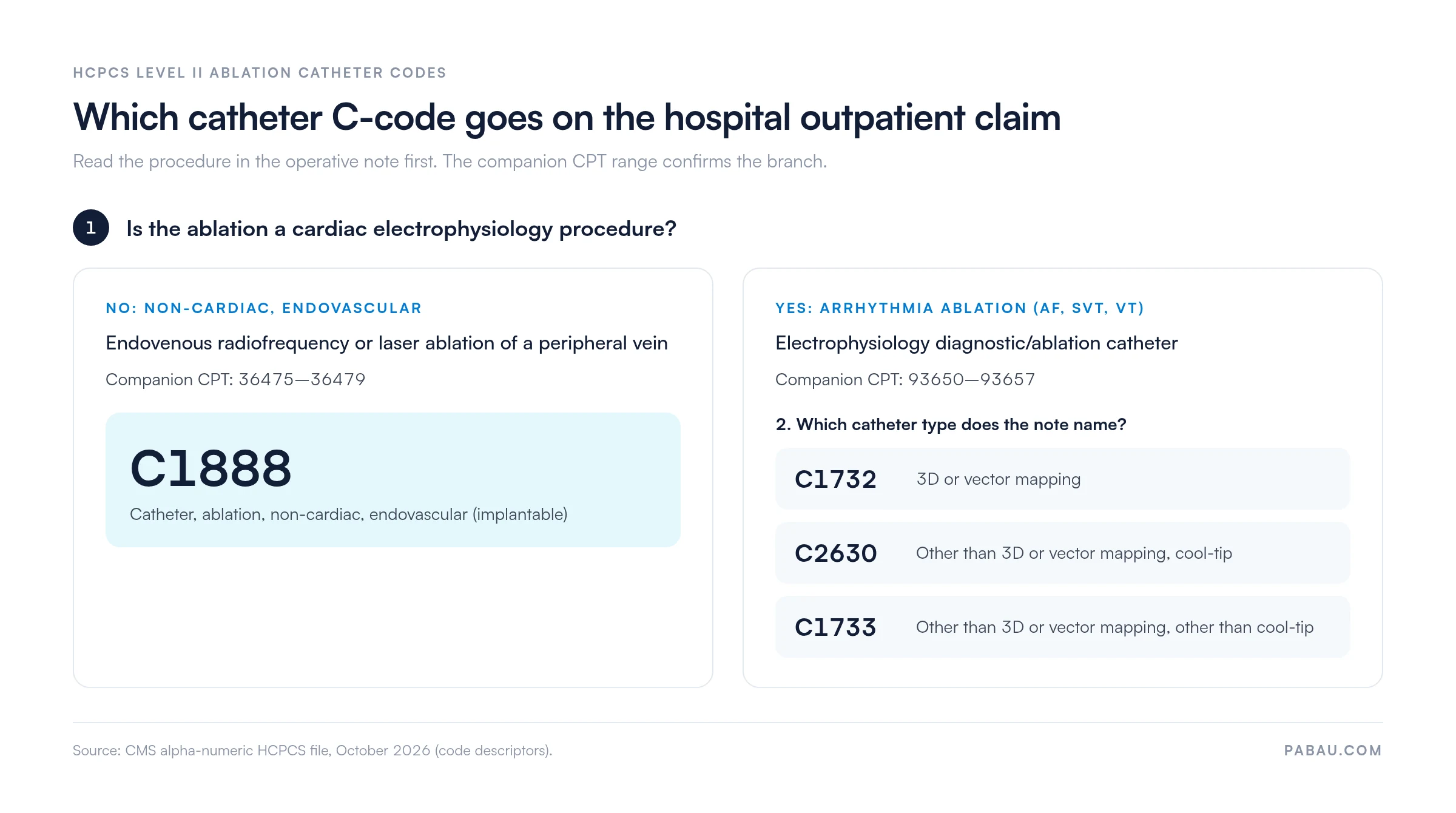
Reporting it for a cardiac electrophysiology ablation catheter, or the reverse, can cause the claim to deny. Cardiac EP catheters take C1732, C1733 or C2630 instead.
Let Pabau's smart automation suggest the right codes, reduce claim denials, and keep your practice compliant—effortlessly.
Automate repetitive tasks and focus on what matters most—your patients.
Reduce coding errors and ensure compliance with the latest regulations.
Clean claims, fewer denials, and faster reimbursements.
Powerful insights and reporting to help your practice thrive.
HIPAA compliant SOC 2 certified GDPR-compliant Trusted by 4,000+ clinics worldwide

HCPCS Code C1888 covers non-cardiac endovascular ablation catheters only. Cardiac electrophysiology catheters are reported with C1732, C1733 or C2630.
C1888 is billable only by hospital outpatient departments under OPPS. It cannot be reported in physician offices or under the ASC fee schedule.
Claims require a supporting ICD-10-CM diagnosis code and procedure-note documentation confirming device use, care setting, and medical necessity.
Endovenous ablation CPT codes 36475-36479 pair with C1888, while EP ablation codes 93650-93657 pair with the cardiac catheter C-codes.
HCPCS Code C1888 is the Level II code that hospital outpatient departments use to report a non-cardiac endovascular ablation catheter. The Centers for Medicare and Medicaid Services (CMS) keeps it active in CMS’s alpha-numeric HCPCS file as “Catheter, ablation, non-cardiac, endovascular (implantable).” C-codes like C1888 are device, drug and supply codes CMS maintains for the Outpatient Prospective Payment System (OPPS). However, they do not exist in the Medicare Physician Fee Schedule and are not payable in an ambulatory surgical center under its own fee schedule.
In short, the “non-cardiac” qualifier is the key distinction. It separates C1888 from the cardiac electrophysiology catheter codes C1732, C1733 and C2630, which are used for arrhythmia procedures. When a hospital outpatient department performs a vascular ablation, such as thermal ablation of a varicose vein, the catheter is reported with C1888. Meanwhile, the companion CPT code covers the physician’s work, while C1888 covers the device cost billed by the facility.
CMS publishes OPPS payment rates annually through the OPPS final rule and its addenda files. The 2026 fee schedule for HCPCS Code C1888 reflects the device’s Ambulatory Payment Classification (APC) assignment, payment indicator, and national payment rate. Device C-codes are also subject to OPPS packaging rules. So check the current addenda to confirm whether C1888 is paid on its own or packaged on a given claim.
Payment rates for C-codes shift with each OPPS final rule. For this reason, always pull the figures directly from CMS’s official HCPCS resources instead of third-party aggregators, because they may lag the latest quarterly update. In addition, neighboring device codes sit in our library of HCPCS procedure codes, each with its own billing guide.
C1888 covers ablation catheters used in non-cardiac endovascular procedures. The key uses are peripheral vascular and venous ablation. Of these, the most common are thermal ablation of incompetent saphenous veins and endovascular ablation of superficial or perforator veins. The catheter itself is the billable item, while the companion CPT code captures the physician’s work.
Included under C1888:
Excluded from C1888:
C-codes are CMS-maintained HCPCS Level II codes created for the OPPS environment. For that reason, HCPCS Code C1888 can only be billed by a hospital outpatient department submitting a claim under OPPS on a UB-04 (Form CMS-1450). As a result, no other care setting can use this code for separate payment.
In some cases, procedures take place at a provider-based clinic or satellite facility that bills as part of the hospital outpatient department. However, C1888 may still apply there, as long as the claim goes through the HOPD billing entity. So confirm provider-based status before reporting the code.
Documentation for a C1888 claim must link the device to a specific procedure done in the hospital outpatient setting. So a coder reviewing the operative note should confirm the five elements below before the claim goes out.
If even one is missing, the MAC has grounds to deny for medical necessity or incomplete documentation. For more detail, our guide to medical billing compliance covers the documentation standards that protect outpatient claims.
Pull the operative note and cross-reference the catheter’s brand name against the manufacturer’s catalog before coding C1888. If the note says ‘ablation catheter’ without stating non-cardiac endovascular use, query the physician for details instead of defaulting to C1888. Otherwise, a cardiac catheter C-code on a vein ablation claim, or C1888 on an EP claim, is an easy audit finding.
C1888 is a facility device code, not a procedure code. For this reason, it is always reported alongside the CPT code that captures the procedure work. For endovenous ablation of varicose veins, the most common companion codes are 36475-36479 (endovenous ablation). In other words, the CPT code captures the procedure work, and C1888 captures the facility’s cost for supplying the ablation catheter. Also, when a second vein in the same leg is treated, 36476 or 36479 joins the claim. Finally, report C1888 units per the facility’s units policy and the MAC’s guidance.
Under OPPS, CMS may package certain device costs into the APC payment for the companion CPT procedure. So always verify C1888’s payment indicator in the current CMS OPPS Addendum B before assuming separate payment. For example, when the indicator shows conditional packaging, C1888 earns separate payment only if the procedure it goes with is itself paid separately.
The error to guard against with C1888 is using it when a cardiac ablation catheter code is correct, or the reverse. Again, the “non-cardiac” qualifier is the dividing line. By contrast, cardiac electrophysiology ablation catheters, used for procedures such as atrial fibrillation ablation, carry separate C-codes with different APC assignments and payment rates.
Ablation for atrial fibrillation, SVT or ventricular tachycardia is cardiac electrophysiology. For those procedures, the catheter code will be C1732, C1733 or C2630, not C1888. On the other hand, when the note describes thermal or laser ablation of a peripheral vein, C1888 is correct. The companion CPT code is the fastest check, and the two-step decision below shows each branch and its code.
Every C1888 claim needs at least one ICD-10-CM diagnosis code that shows medical necessity. The Local Coverage Determination (LCD) from the servicing Medicare Administrative Contractor (MAC) decides which diagnosis codes support coverage. Because LCDs vary by MAC jurisdiction, billers should check covered diagnoses against the LCD in effect for the state where the HOPD is located.
Medicare prior authorization: As of this writing, CMS has no national prior authorization rule for outpatient endovenous ablation. However, individual MACs may still require it through their LCDs or as conditions of coverage. So always verify the servicing MAC’s current requirements before scheduling the procedure. Skipping required prior authorization is a denial trigger on its own, apart from the C1888 coding.
Also, our guide to revenue cycle management traces how diagnosis coding feeds claim submission, from medical necessity documentation through payment posting.
Denials for HCPCS Code C1888 cluster around a small set of common errors. In fact, most can be avoided at claim submission. The table below maps the most common denial reasons to their causes and fixes. In addition, our guide to the denial management process covers appeals workflows and the steps behind them.
C-codes like C1888 accept a limited set of modifiers. However, using the wrong modifier, or leaving out one the payer requires, is a denial trigger of its own, apart from coding the device correctly. So the table below lists the modifiers most relevant to C1888 claims.
Not every MAC accepts every modifier on every C-code. So confirm that a modifier fits, using the OPPS claims processing manual or the servicing MAC’s billing guidance, before adding it to a C1888 line. In addition, the guide to what makes a clean claim explains how modifier errors feed avoidable denial queues. It also sets out the submission standards that reduce first-pass denial rates.
Run a quarterly audit of all C1888 claims submitted over the past 90 days. Then pull the payment indicators for each claim date from the CMS OPPS addendum and check whether any were conditionally packaged. Packaged claims show no separate payment, but they are not denials. As a result, separating the two stops your team from working edits that already paid through the APC.
A vein ablation in a hospital outpatient department produces two claims. First, the hospital bills C1888 and its facility charges on a UB-04. Second, the physician’s practice bills the professional side of 36475 or 36478 on a CMS-1500. That second claim is the one a practice controls.
Pabau, the practice management platform we build, includes medical billing software that sends CMS-1500 claims through Claim.MD and checks patient eligibility before the visit. Also, where a MAC requires prior authorization, the auth code, dates and sessions sit on the patient’s case, and a warning shows when one is missing.
ERA remittances post back against each claim, so a denied professional line lands in one queue for your billers to work. Pabau submits and tracks the claim data your practice enters. However, the facility’s device line, C1888 included, stays with the hospital’s billing team.

Pabau sends CMS-1500 claims through Claim.MD, tracks prior authorizations on the patient’s case, and posts ERA remittances. Your billers work every denial from one queue.

Getting C1888 right comes down to two checks. The catheter must be non-cardiac and endovascular, and the claim must come from a hospital outpatient department billing under OPPS. Miss either one, and the line is likely to deny, no matter how correctly the rest is coded.
So build both checks into the coding step instead of the appeal. First, match the catheter code to the companion CPT range. Then confirm the payment indicator in Addendum B before you expect separate payment for the device.
Pabau’s claims management software lets practices submit CMS-1500 claims and track denials in one place. Book a demo to see how it handles the professional claims your physicians bill for each vein ablation.

Need a foundation in outpatient hospital billing workflows? Medical billing fundamentals covers how OPPS claims move from coding through payment posting.
Struggling with claim denials across your HOPD billing queue? Denial management in healthcare outlines the appeals process and root-cause analysis steps that recover denied revenue.
Want to understand how revenue cycle management connects coding to collections? Revenue cycle management explained maps the end-to-end workflow from eligibility verification through remittance posting.
Coding a cardiac EP catheter without mapping? HCPCS code C1733 covers the electrophysiology catheter that is neither 3D-mapping nor cool-tip.
Billing the first vein treated by radiofrequency? CPT code 36475 explains the companion procedure code that pairs with C1888.
HCPCS Code C1888 covers the non-cardiac endovascular ablation catheter used in a hospital outpatient procedure, such as thermal or laser ablation of a peripheral vein. It does not cover cardiac electrophysiology ablation catheters, which are reported with C1732, C1733 or C2630.
Yes, C1888 is a CMS-maintained HCPCS Level II C-code payable only under the Medicare Outpatient Prospective Payment System (OPPS). However, commercial payers generally do not recognize C-codes for separate device reimbursement and handle device costs differently in their own fee schedules.
The 2026 national payment rate for C1888 is published in the CMS OPPS Addendum B, released with the annual OPPS final rule each November. Because rates and packaging status change with each rule cycle, verify the current figure in the CMS OPPS Addendum B instead of a third-party aggregator.
C1888 is for non-cardiac endovascular ablation catheters used in peripheral vascular procedures. Cardiac EP ablation catheters used for arrhythmia procedures (atrial fibrillation, SVT, VT ablation) are reported with C1732, C1733 or C2630. The companion CPT code is the fastest check. For example, vascular ablation codes such as 36475 and 36478 pair with C1888, while cardiac EP codes 93650-93657 pair with the cardiac C-codes.
No. C-codes including C1888 are not payable under the Medicare Physician Fee Schedule. A physician office submitting C1888 on a CMS-1500 will receive a denial, because the code is valid only on a UB-04 submitted by a hospital outpatient department billing under OPPS. For outpatient billing compliance guidance, refer to the servicing MAC’s OPPS billing resources.