HCPCS code J3471: Hyaluronidase ovine injection billing guide
HCPCS code J3471: Descriptor, code type, and quick-reference data HCPCS code J34...

Last Updated: Oct 14, 2026
CPT code 36475 is the billing code for endovenous radiofrequency ablation of an incompetent vein in an extremity, first vein treated.
The descriptor bundles all imaging guidance and monitoring, so neither is billed separately. Vascular surgeons, phlebologists, and interventional radiologists report it when they close a refluxing saphenous vein.
Medicare pays roughly $850 to $1,100 for the procedure in an office-based lab. In a hospital outpatient department or an ambulatory surgical center, it pays roughly $245 to $300. Wrong place of service, thin duplex ultrasound documentation, and modifier errors cause most denials. This guide covers the 2026 fee schedule, ICD-10 pairings, coverage criteria, modifiers, and the records payers expect.

CPT code 36475 covers radiofrequency ablation of the first incompetent vein, with all imaging guidance bundled in.
Medicare pays roughly $850 to $1,100 in an office-based lab and roughly $245 to $300 in a facility.
Add-on code 36476 reports each additional vein treated in the same session and is never billed alone.
The code carries a 000 global period, so only same-day related services are bundled into the payment.
A duplex ultrasound showing reflux, a conservative therapy log, and a signed operative note must all pre-date the claim.
CPT code 36475 describes endovenous ablation therapy of an incompetent extremity vein using percutaneous radiofrequency energy. It applies to the first vein treated in a session. The AMA CPT code set gives the official descriptor. “Endovenous ablation therapy of incompetent vein, extremity, inclusive of all imaging guidance and monitoring, percutaneous, radiofrequency; first vein treated.”
The procedure targets venous insufficiency caused by reflux in the great saphenous vein, the small saphenous vein, or accessory tributaries. A radiofrequency catheter enters percutaneously under ultrasound guidance and is advanced to the target segment. Thermal energy is then applied to close the vessel.
Clinical indications include symptomatic varicose veins, chronic venous insufficiency, and venous reflux confirmed by duplex ultrasound. Reflux duration is typically 0.5 seconds or longer on standing. According to CMS Medicare Coverage Database article A52870, Medicare covers varicose vein treatment only after documented medical necessity and failed conservative therapy.
Medicare physician fee schedule payment for CPT code 36475 depends on the setting. Non-facility rates apply in an office-based lab (OBL). Facility rates apply in a hospital outpatient department (HOPD) or an ambulatory surgical center. The difference between the two runs to several hundred dollars per procedure.
These figures are national averages. The facility range follows a total facility RVU of 7.38 at the 2026 conversion factor of $33.4009. Geographic payment localities then adjust the amount through the Geographic Practice Cost Index (GPCI). Verify the current figure for your Medicare Administrative Contractor (MAC) jurisdiction with the CMS Physician Fee Schedule lookup tool.
Rates change every year with the CMS Physician Fee Schedule Final Rule, so treat the amounts above as planning estimates.
The non-facility rate is higher because the practice absorbs the overhead of the procedure room, the equipment, and the staff. In a HOPD or ASC the facility bills its own technical component, so CMS pays the physician only the professional component. For an OBL owner, the non-facility rate has to cover both clinical and facility costs. An OBL that bills POS 22 by mistake forfeits several hundred dollars on every procedure.
Every CPT code 36475 claim needs a supporting ICD-10-CM diagnosis code, and laterality is mandatory. The ICD-10-CM code set carries separate codes for the right leg, the left leg, and an unspecified side. Reporting I83.90 when the record names the treated leg is a common denial trigger.
Code to the highest level of specificity the documentation supports. If the duplex report names the right great saphenous vein as the treated vessel, the diagnosis code has to carry that laterality. Dropping it when the chart supports it is a preventable denial.
Medicare covers CPT code 36475 under Local Coverage Determinations (LCDs) maintained by individual MACs, including Noridian and Novitas Solutions. Coverage is never automatic. Three criteria have to be met before a claim is approved, and the supporting records must pre-date the date of service.
LCD criteria are MAC-specific. Noridian, Novitas, CGS, and Palmetto set slightly different thresholds for reflux duration and for conservative therapy. Check the applicable LCD for your jurisdiction before performing and billing the procedure.
Place of Service (POS) is one of the most consequential fields on a 36475 claim. The wrong code either triggers an outright denial, or pays the facility rate on a service that earned the non-facility rate.
Noridian Medicare has published guidance confirming POS 11 for OBL settings and POS 22 for HOPD. Payer policy can differ where an OBL sits inside a hospital campus or attached to one. Verify with your MAC before billing.
Modifier selection affects both payment and NCCI compliance. The scenarios that come up most often are bilateral procedures, repeat sessions, and distinct procedural services.
For bilateral procedures, check whether your payer wants modifier 50 on a single line or two lines with RT and LT. Medicare generally accepts modifier 50 on one line, while some commercial payers require the two-line format. The wrong format causes a technical denial even when the procedure was documented correctly.
CPT code 36475 sits in a family of vein ablation codes. They are separated by modality, by the number of veins treated, and by whether the code is primary or add-on. Knowing the family prevents under-billing when several veins are closed in one session.
CPT 36475 and CPT 36478 are not interchangeable. The modality used during the procedure decides the code. Both cover the first treated vein and both include imaging guidance. The difference is the energy source. CPT 36475 uses a radiofrequency catheter, and CPT 36478 uses a laser fiber at 980, 1320, or 1470 nm.
Medicare rates for the two codes are similar but not identical, so check the current year in the AAPC CPT code lookup. Reporting 36475 when a laser fiber was used misrepresents the service.
Documentation is where most 36475 denials start. Payers run post-payment audits on vein ablation claims, and one missing element turns a paid claim into a recoupment demand. The diagnosis specificity in the record also has to match what goes out on the claim.
Each of the following must be in the medical record before the procedure date:
The duplex study itself is a separate billable service. A bilateral duplex scan of the extremity veins is reported with CPT 93970, and a unilateral or limited study with CPT 93971. The order of these records matters as much as their contents, because each one has to pre-date the step that relies on it.
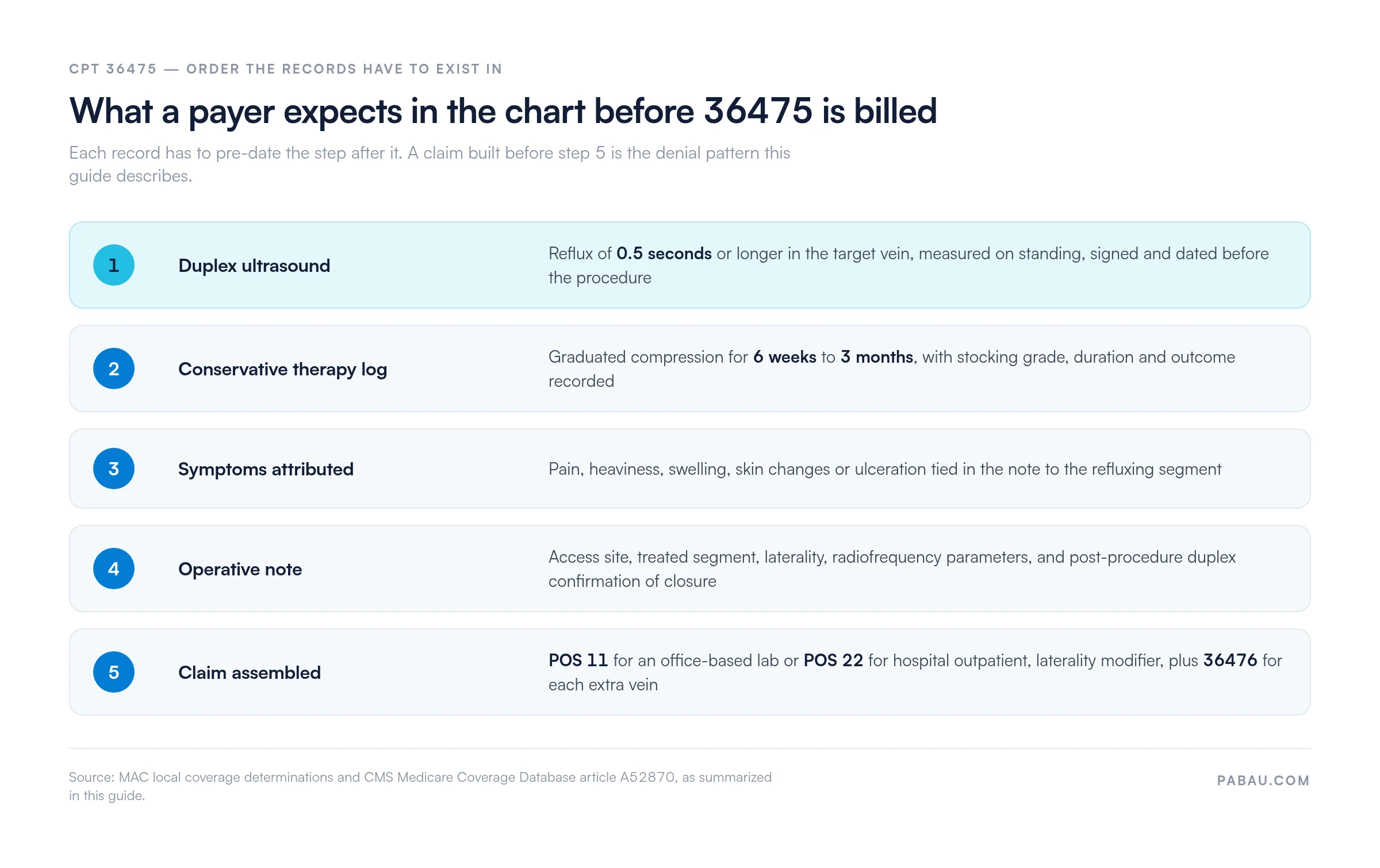
Review your duplex reports before procedure day. The most common audit finding is a reflux measurement that falls below the MAC’s threshold. The claim still went out with 36475 attached. Flag borderline cases between 0.4 and 0.6 seconds, and document the clinical context that supports treatment.
CPT code 36475 carries a 000 global period on the Medicare physician fee schedule. Bundling therefore applies only to related services performed on the day of the procedure. There is no 10-day postoperative window, so a follow-up visit the following week is billed on its own merits.
A significant, separately identifiable E/M service on the procedure date is reported with modifier 25. Modifier 24 has no role here, because it covers E/M inside a 10-day or 90-day postoperative period.
Prior authorization requirements vary by payer. Traditional Medicare does not require it for this code in most jurisdictions, but commercial payers and Medicare Advantage plans often do. Some payers want authorization for the diagnostic duplex ultrasound as well as the ablation. Verify with each payer before scheduling.
The pitfalls that come up most often on 36475 claims are these:
Vein ablation billing is rule-dense. POS-specific rates, add-on code pairing, bilateral modifier logic, and MAC-specific documentation thresholds all sit between the procedure room and the remittance. Each one is a place where a correctly performed procedure turns into an incorrect claim.
Practice management software like Pabau connects the clinical record to the claim, so the two cannot drift apart. Pabau’s software for vein practices scrubs each claim before submission and flags three things:
Documentation templates can be structured to capture duplex findings, reflux measurements, conservative therapy history, and operative detail. Those fields then map straight onto payer audit criteria, so the chart answers an audit before anyone asks.
For sessions that bill both 36475 and 36476, automated code pairing confirms the add-on never leaves without its primary code. Getting the claim right first time cuts resubmission cycles and shortens the wait for payment.
Build your 36475 documentation template so the treated vein, laterality, and reflux measurement populate straight from the duplex report into the operative note. When those fields come from structured data, the diagnosis specificity and the clinical narrative stay aligned, which is what an auditor checks first.

Pabau’s claims management software helps vascular and phlebology practices flag POS mismatches, modifier conflicts, and NCCI edits before submission. See how automated claim scrubbing and integrated documentation reduce 36475 denials.

The money on a 36475 claim is decided long before the catheter goes in. A duplex report dated after the compression trial will cost the claim. So will a POS digit that does not match where the procedure actually happened.
Set the documentation sequence once, inside a template, and the coding follows from it. Practices that do this answer far fewer MAC questions about reflux thresholds. They also rework fewer claims that were clinically correct all along.
Book a demo to see how Pabau scrubs vein ablation claims and keeps the duplex, compression, and operative records in one chart.

List Item #1
List Item #2
CPT code 36475 bills endovenous radiofrequency ablation of an incompetent vein in an extremity, for the first vein treated. All imaging guidance and monitoring are included in the code. It is the standard code for RFA of refluxing saphenous veins in varicose veins or chronic venous insufficiency.
The 2026 Medicare national average for CPT 36475 is roughly $850 to $1,100 in a non-facility office-based lab. In a facility setting, such as a hospital outpatient department or an ASC, it is roughly $245 to $300. Geographic adjustments apply, so check your MAC jurisdiction in the CMS Physician Fee Schedule lookup tool.
CPT 36475 covers radiofrequency ablation of the first incompetent vein treated in a session. CPT 36476 is the add-on code for each additional vein treated with RFA in the same session. CPT 36476 cannot be billed alone. It must always be reported alongside 36475.
CPT 36475 is for radiofrequency ablation and CPT 36478 is for laser ablation. The code selection depends on the energy modality used during the procedure. Using the wrong code for the method performed is a coding error, however similar the two procedures look clinically.
Prior authorization requirements vary by payer. Traditional Medicare generally does not require prior authorization for CPT 36475, but commercial payers and Medicare Advantage plans frequently do. Always verify with the specific payer before scheduling, as requirements change and vary by region.
CPT 36475 has a 000 global period, so there is no 10-day postoperative window. Only related services performed on the same date are bundled into the procedure payment. A separately identifiable E/M service on that date is reported with modifier 25. Modifier 24 does not apply, because it covers 10-day and 90-day global periods.