Inpatient billing cheat sheet
An inpatient billing cheat sheet is a quick reference for the codes and claim ru...

Last Updated: Oct 19, 2026
Billable Code Specific Code
83655 is the CPT code for lead; quantitative. It covers measuring the concentration of lead in a venous whole blood specimen, with the result reported as a number in µg/dL.
The code sits in the Chemistry subsection of the CPT Pathology and Laboratory section. It is the specific code for blood lead, so the catch-all metals code 83600 never replaces it. Every claim also needs an ICD-10 code that establishes medical necessity.
Let Pabau's smart automation suggest the right codes, reduce claim denials, and keep your practice compliant—effortlessly.
Automate repetitive tasks and focus on what matters most—your patients.
Reduce coding errors and ensure compliance with the latest regulations.
Clean claims, fewer denials, and faster reimbursements.
Powerful insights and reporting to help your practice thrive.
HIPAA compliant SOC 2 certified GDPR-compliant Trusted by 4,000+ clinics worldwide

CPT code 83655 reports a quantitative lead level in venous whole blood, measured by AAS or ICP-MS and reported in µg/dL.
Pair it with Z13.88 for screening, Z57.5 for occupational exposure, or T56.0XXA for confirmed lead toxicity.
Billing 83600 instead of 83655 for a blood lead test is a coding error that payers deny.
Medicaid EPSDT covers testing for children ages 1 and 2 with no cost-sharing, while Medicare needs documented medical necessity.
For adult workers, OSHA’s Lead Standard sets the retest interval, so each required test becomes its own 83655 claim.
CPT code 83655 is defined by the American Medical Association with the descriptor: Lead; quantitative. It sits in the Pathology and Laboratory section of the CPT codebook, specifically in the Chemistry subsection (82009-84999).
The code covers quantitative measurement of lead concentration in whole blood. Quantitative means the lab reports a number in µg/dL. That separates 83655 from point-of-care devices that only return a pass/fail or elevated/not-elevated result.
CPT code 83655 covers the quantitative measurement of lead in whole blood, regardless of the analytical platform used (AAS, graphite furnace AAS, or ICP-MS). All of these produce a reportable numeric concentration and map to 83655.
Four scenarios fall outside 83655’s scope, and each one is a common source of unbundling flags.
Blood lead testing follows a set clinical workflow, and each step leaves a record the claim depends on. A superbill that captures the ordering physician, the specimen details and the lab report is what makes the claim defensible.
The ICD-10 code is what establishes medical necessity for 83655. Use the CDC’s ICD-10-CM web tool to verify current code validity before submitting. The appropriate diagnosis depends on the clinical scenario.
Never use an unspecified exposure code when a more specific one applies. Payers cross-reference the diagnosis against the patient’s age, the ordering specialty and the frequency history. Z13.88 is the cleanest choice for a pure screening encounter. Z57.5 anchors occupational testing in adults.
CPT 83655 (lead, quantitative) is the specific code for blood lead measurement. CPT 83600 (metals assay, not elsewhere classified) is the fallback code used when no specific analyte code exists in the CPT codebook. Lead has its own specific code, so 83600 is never the correct choice for a blood lead test.
Using 83600 when 83655 applies breaks the AMA rule to always use the most specific code available. Payers flag this as an incorrect code assignment, which results in denial or a request for additional documentation. Some payers treat it as a potential unbundling issue if 83600 is submitted alongside other metal-specific codes.
Medicare Part B covers CPT code 83655 under the Clinical Laboratory benefit when the test is medically necessary. Coverage is not automatic for adult screening populations. The claim must be supported by a diagnosis code that establishes clinical indication, and the ordering physician’s documentation must reflect the reason for testing.
Reimbursement for 83655 is set annually by the Clinical Laboratory Fee Schedule (CLFS). Check the current national payment amount in the CMS CLFS files for the service year. Payment amounts vary slightly by Medicare Administrative Contractor (MAC) region. An insurance eligibility check before the encounter confirms active Part B coverage and any secondary payer rules.
After payment posts, review the electronic remittance advice for CARC and RARC codes before writing off any balance.
Before submitting CPT code 83655 to Medicare, document the specific risk factor that makes the test medically necessary in the encounter note. One sentence such as ‘patient reports occupational lead exposure’ or ‘child resides in pre-1978 housing’ often satisfies medical necessity. It also prevents the most common denial on this code.
Medicaid is the primary payer for pediatric CPT code 83655 claims. Its Early and Periodic Screening, Diagnosis, and Treatment (EPSDT) program makes lead screening part of well-child care. Under EPSDT, state Medicaid programs must cover blood lead testing for every enrolled child at ages 1 and 2. At-risk children ages 3 through 5 are covered too, with no cost-sharing to the family.
State Medicaid programs may have supplemental lead screening programs with state-specific billing requirements, including prior authorization thresholds or state-only billing codes. Check your state Medicaid billing manual before submitting. Frequency limits vary as well. Some states allow annual re-screening without prior authorization, while others require documentation of continued risk.
Blood lead claims are denied for a short list of predictable reasons. The table maps the five that come up most, with the prevention step and the appeal route for each.
Sort 83655 denials by root cause instead of working each one as a one-off. The CARC reason codes on a rejected remittance are decoded in our guide to claim denial codes. Scrub each claim against the five causes above before it goes out, so it clears payer edits first time.
Modifiers on CPT code 83655 claims are situational. A wrong modifier is a fast path to a payer audit, so each one below has a defined use condition. Compliance reviews should include a periodic check of modifier use against payer policies.
The most misused modifier on 83655 claims is modifier 91. Reserve it for a same-day, same-analyte repeat that is clinically necessary. The ordering physician must also document the reason for the second result. Applying it to routine follow-up testing on a different date creates an edit that can delay payment for weeks.
Most billing guidance for CPT code 83655 focuses on pediatric EPSDT screening. The occupational use case follows different rules and involves entirely different payers. OSHA’s Lead Standard (29 CFR 1910.1025) requires periodic blood lead monitoring for workers in covered industries, including construction, battery manufacturing, and smelting operations.
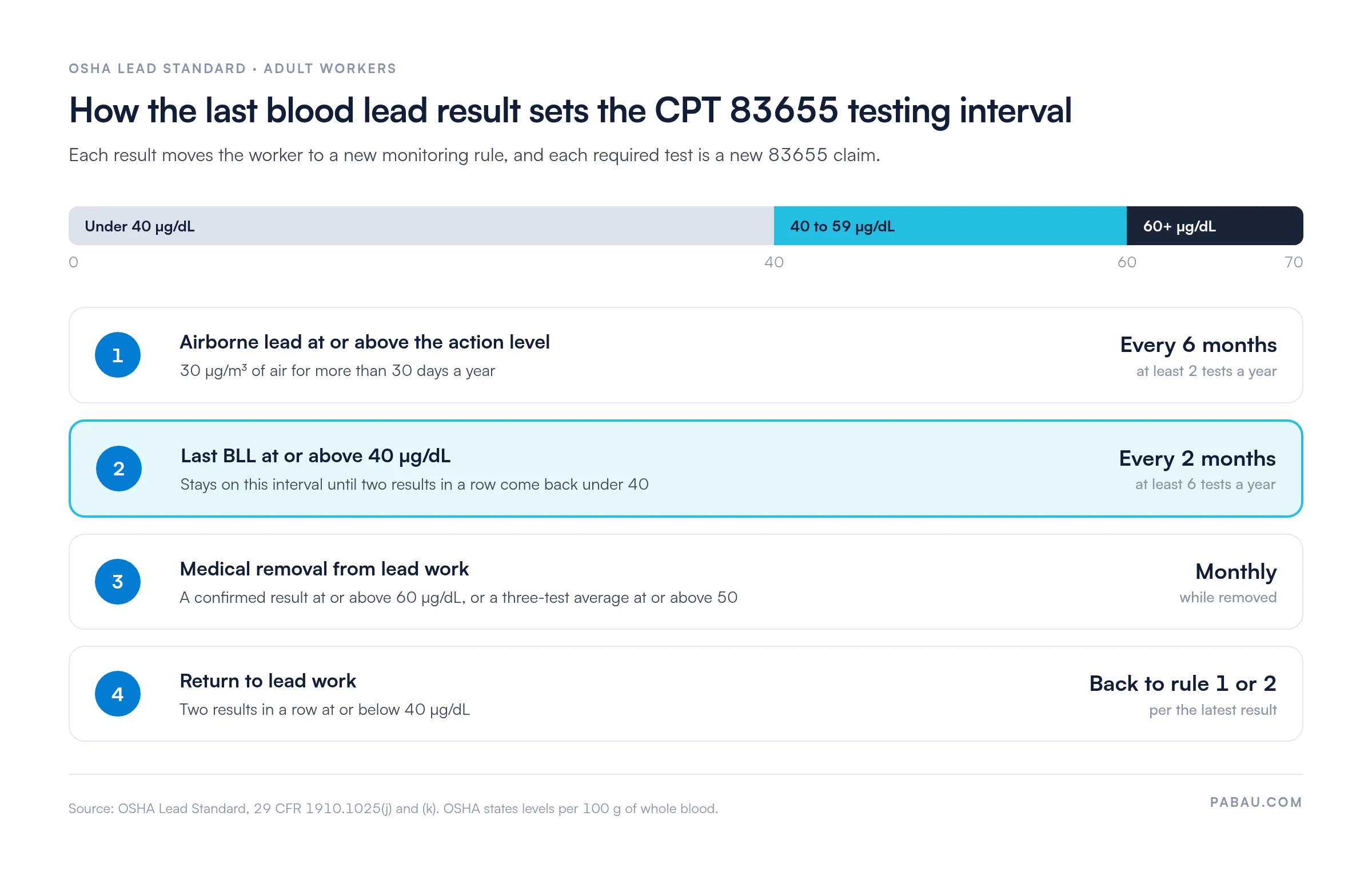
Under OSHA’s rule, the testing interval depends on airborne exposure and the worker’s last result. OSHA’s action level is 30 µg/m³ of airborne lead. A worker exposed at or above it for more than 30 days a year needs a blood lead test at least every 6 months. If the last BLL was 40 µg/dL or higher, testing moves to at least every 2 months. It stays there until two results in a row come back under 40.
Medical removal from lead work starts at a BLL of 60 µg/dL or higher, once a follow-up test confirms it. It also starts when the average of the last three results reaches 50 µg/dL. Testing runs monthly during removal, and the worker returns once two results in a row are at or below 40 µg/dL. The ladder below shows how each result moves a worker between intervals.
The employer is responsible for making sure the testing happens. That makes workers’ compensation or the employer’s occupational health carrier the usual payer, rather than Medicaid.
An occupational health panel can put one worker on a 2-month cycle for most of a year, and each test needs its own documented interval. Using claims software for practices keeps workers’ comp, commercial and Medicare Part B claims in the same workflow as EPSDT pediatric claims.
A practice billing 83655 usually works from three separate records. There’s the ordering note, the reference lab’s report and the payer’s remittance. When they sit in different places, a missing risk factor or a mismatched ICD-10 code only shows up once the denial arrives.
Practice management software like Pabau keeps the order, the diagnosis code and the lab result on one patient record. Through its Claim.MD clearinghouse integration, your team submits 837P claims, checks eligibility in real time and gets ERA files posted automatically.
Denial reason codes appear as soon as a remittance posts. Your billing staff can correct a Z57.5 pairing or an 83600 slip without parsing 835 files by hand, and spend less time chasing appeals.
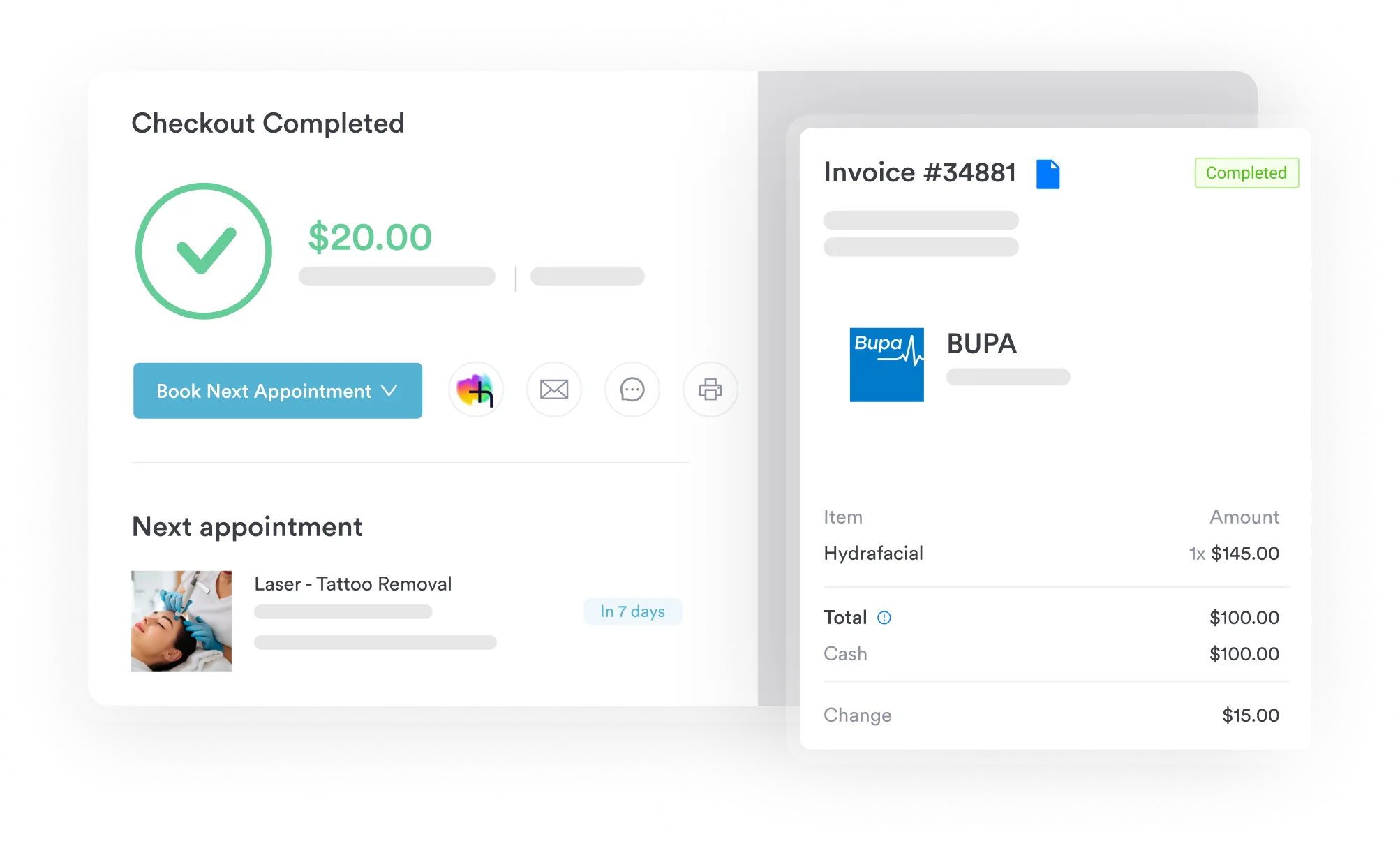

Pabau integrates with the Claim.MD clearinghouse to submit 837P claims, verify eligibility in real time, and show denial codes once a remittance posts. Your team stops parsing 835 files by hand.

Treat every 83655 claim as three checks before it leaves the practice. Confirm the diagnosis code fits the scenario, confirm the code is 83655 and not 83600, and confirm the note names the risk factor.
Adult workers add a fourth check. Match each claim date to the OSHA interval the last result set, because that interval is your evidence when a payer questions frequency.
Book a demo to see how Pabau keeps lab orders, results and claims together, so your 83655 claims go out right the first time.

Need to understand denial codes on your 83655 remittances? Denial management in healthcare explains how to categorize and systematically resolve denial patterns across lab and E&M codes.
Want a reference for the full medical billing process? What is medical billing covers the end-to-end workflow from charge capture to payment posting.
Submitting lab claims through a clearinghouse? 837 file guide breaks down the electronic transaction format used to transmit CPT claims to payers.
Drawing the specimen in-house? CPT code 36415 covers the venipuncture billing rules that sit alongside a send-out blood lead test.
Following up an elevated pediatric result? HCPCS code T1029 explains how the environmental lead investigation of a child’s home is billed.
CPT code 83655 covers the quantitative measurement of lead in whole blood, by any lab method that produces a numeric result in µg/dL. That includes atomic absorption spectrometry (AAS) and inductively coupled plasma mass spectrometry (ICP-MS). It doesn’t cover urine lead testing, qualitative point-of-care screening, or lead measured inside a heavy metals panel billed under a different code.
The Medicare rate for CPT 83655 is set each year by the Clinical Laboratory Fee Schedule (CLFS) and varies by MAC jurisdiction. Check the current national payment amount in the AAPC Codify CPT lookup or the CMS CLFS files for the service year. Rates change every January 1.
Yes, Medicaid covers CPT 83655 for every enrolled child at ages 1 and 2 under the EPSDT mandate, with no cost-sharing. Coverage extends to at-risk children ages 3 through 5. State programs may add requirements or frequency limits, so check your state’s billing manual before submitting.
CPT 83655 is the specific code for quantitative blood lead testing. CPT 83600 is a catch-all for metals assays that have no code of their own. Billing 83600 for a blood lead test breaks the AMA rule to use the most specific code, and payers usually deny it.
Modifier 91 applies when two blood lead levels are ordered on the same date of service and both results are clinically necessary. Modifier 59 applies when 83655 is billed alongside a heavy metals panel, to show the services cover distinct analytes. Modifier QW rarely applies, because quantitative AAS and ICP-MS methods are high-complexity and not CLIA-waived.
The most common reasons are a missing or unsupported ICD-10 code, billing 83600 instead of 83655, and exceeding a payer frequency limit without documentation. Testing at a lab without the right CLIA certificate and double-billing lead already inside a panel also cause denials. The denial table above covers prevention and appeals for each one.