

CCSD code G5100: Bypass of duodenum billing guide
CCSD code G5100 bills a bypass that leaves the duodenum in place CCSD code G5100...

Last Updated: Oct 16, 2026
37227 was the CPT code for femoral/popliteal endovascular revascularization in one leg with stent placement and atherectomy, angioplasty included when performed. CPT deleted it effective January 1, 2026.
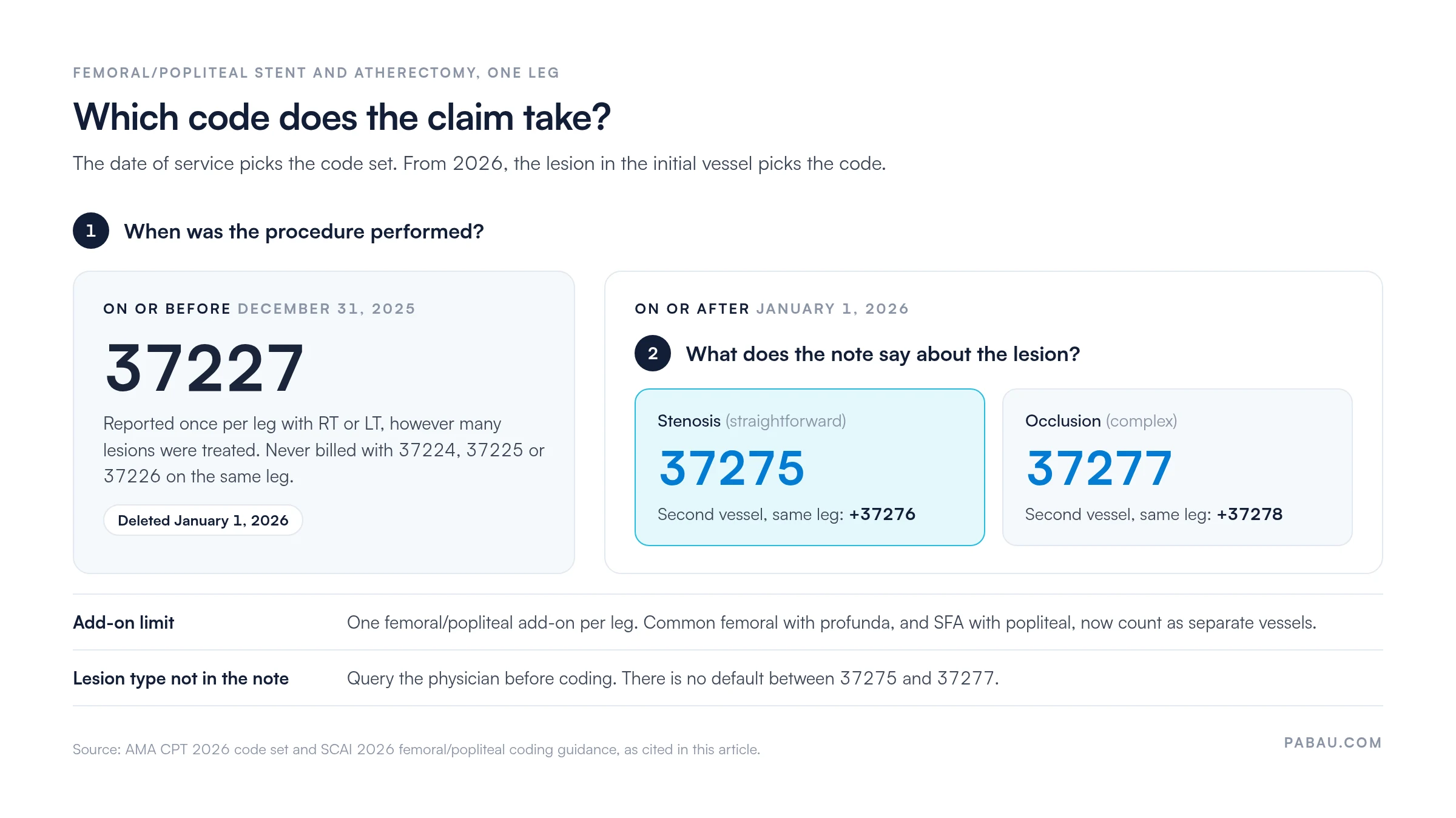
For 2026 and later dates of service, report 37275 for a straightforward lesion (stenosis) or 37277 for a complex lesion (occlusion) in the initial vessel. Keep 37227 for claims, appeals, and audits with dates of service before 2026.
Let Pabau's smart automation suggest the right codes, reduce claim denials, and keep your practice compliant—effortlessly.
Automate repetitive tasks and focus on what matters most—your patients.
Reduce coding errors and ensure compliance with the latest regulations.
Clean claims, fewer denials, and faster reimbursements.
Powerful insights and reporting to help your practice thrive.
HIPAA compliant SOC 2 certified GDPR-compliant Trusted by 4,000+ clinics worldwide

CPT code 37227 reported femoral/popliteal revascularization in one leg with stent placement and atherectomy, with angioplasty included when performed.
CPT deleted 37227 and the rest of 37220–37235 on January 1, 2026. For 2026 and later dates of service, report 37275 or 37277 instead.
Keep 37227 for claims, corrections, appeals, and audits with dates of service on or before December 31, 2025.
The femoral/popliteal territory counted as one vessel per leg, so 37227 was reported once per leg and never with 37224, 37225, or 37226.
The 2026 replacements split lesions into straightforward (stenosis) and complex (occlusion), so the operative note must now say which one was treated.
Practice management software like Pabau submits claims through its Claim.MD integration and tracks claim status, so a rejected deleted-code line surfaces quickly.
CPT code 37227 is a deleted code for endovascular femoral/popliteal revascularization with stent placement and atherectomy in one leg. The American Medical Association publishes its official descriptor.
Revascularization, endovascular, open or percutaneous, femoral, popliteal artery(s), unilateral; with transluminal stent placement(s) and atherectomy, includes angioplasty within the same vessel, when performed.
CPT deleted 37227 effective January 1, 2026. For 2026 and later dates of service, report 37275 for a straightforward lesion or 37277 for a complex lesion. Use 37227 only for services performed on or before December 31, 2025.
CPT deleted the whole 37220–37235 lower extremity revascularization family on January 1, 2026. It was replaced by 46 new codes, 37254–37299, grouped into four territories:
The deletion covered lower extremity arteries only. Venous stent placement sits in a separate code family, and the initial vein is still reported with 37238.
The new codes add a second axis that 37227 never had. Each service is split by lesion type. The Society for Cardiovascular Angiography and Interventions (SCAI) defines a straightforward lesion as a stenosis and a complex lesion as an occlusion.
No single code takes over from 37227 automatically. Pick 37275 or 37277 from what the operative note says about the lesion in the initial vessel. If the note does not describe the lesion as a stenosis or an occlusion, query the physician before coding.
The 2026 family also allows a second femoral/popliteal vessel per leg. Add-on codes 37276 (straightforward) and 37278 (complex) report stent and atherectomy in an additional vessel. SCAI guidance limits the territory to one add-on code per leg.
Intravascular lithotripsy in this territory now has its own add-on code, 37279, which SCAI says can be reported up to twice per leg.
Put together, a femoral/popliteal stent-and-atherectomy claim turns on three questions, answered in the order shown below.
Before 2026, 37224–37227 covered every endovascular treatment of the femoral/popliteal territory. The codes climbed in intensity, and you reported the single code that matched the most intensive service performed in that leg.
The other territories had their own codes. Iliac interventions used 37220–37223, and tibial/peroneal interventions used 37228–37231 as primary codes. Only the tibial/peroneal add-ons, 37232–37235, covered additional vessels, and none of them paired with 37227.
A patient could still receive codes from two territories in one session. For example, an iliac stent and a femoral/popliteal stent with atherectomy on the same leg were reported with a code from each family.
CPT treated the whole femoral/popliteal territory as a single vessel in each leg. That segment ran from the common femoral artery through the profunda femoris and superficial femoral arteries to the popliteal artery.
As a result, 37227 was reported once per leg, however many lesions were treated. If one SFA lesion was stented and a popliteal lesion had atherectomy with a stent, the leg still got one 37227.
If one lesion got only angioplasty and another got stent and atherectomy, 37227 still covered the leg. There was no femoral/popliteal add-on code before 2026.
When you audit a pre-2026 femoral/popliteal claim, count the codes per leg first. More than one code from 37224–37227 on the same leg is an overpayment risk, even when the lesions sat in different segments.
CPT code 37227 bundled the work of opening the vessel in one femoral/popliteal territory. You could not bill these components as separate lines for that leg.
Included in 37227:
Reported separately, when documented:
Separately reported diagnostic angiography usually needs modifier 59 and a clear note on why the study was needed. Check the NCCI edits for the date of service before submitting.
Pabau’s claims software for billers keeps these lines on one claim record, so the whole session is visible before the claim goes out.

Laterality modifiers were the most important ones on a 37227 claim. Modifier 59 or XS applied only in narrow cases.
For bilateral treatment, report each leg on its own line with RT or LT. Follow the payer’s policy on whether the second leg also needs modifier 59.
Before you resubmit or appeal a 37227 claim, match the modifier to the leg named in the operative note. A left SFA stent billed with RT will deny, and fixing it needs a corrected claim.
The operative note has to support both the stent and the atherectomy. If either one is missing, an auditor will downcode the leg to 37225 or 37226. For medical billing compliance, check that each pre-2026 note includes these elements:
For 2026 dates of service, the note needs more. It must say whether each lesion was a stenosis or an occlusion. It must also say which femoral/popliteal vessel was treated, since the common femoral with profunda and the SFA with popliteal now count as separate vessels.
Build these fields into the procedure note template, so they are captured at the time of the procedure rather than chased after a denial.
Medicare paid 37227 under the Physician Fee Schedule, which changed every year. Look up the rate for the year of the date of service in the CMS Physician Fee Schedule lookup. The 2026 schedule prices 37275 and 37277, not 37227.
Pabau’s Claim.MD integration submits claims electronically, runs eligibility checks, and posts ERA remittances. That helps you spot underpaid or rejected vascular lines from the same dashboard.
Prior authorization rules for 37227 were set by each payer and plan. When you appeal or audit a pre-2026 claim, pull the payer policy that was in force on the date of service.
Payers that require authorization usually look for proof of medical necessity. A typical packet includes:
An authorization issued under 37227 late in 2025 may not cover a procedure performed in 2026. Confirm with the payer whether it must be reissued under 37275 or 37277.
Most 37227 denials trace back to the seven causes below, and each one has a specific fix.
Look up each remark on the remittance in our denial codes guide. Then fix the root cause before resubmitting.
Vascular practices now work two code sets at once. Claims for 2025 and earlier still carry 37227, while every new femoral/popliteal case needs a 2026 code. Keeping them apart by hand across spreadsheets and payer portals invites rejections.
Pabau, our practice management software, keeps the patient record, the procedure note, and the claim together. Through Claim.MD, it submits claims to payers, checks eligibility, tracks claim status, and posts ERA remittances.
As a result, a 37227 line billed for a 2026 date of service surfaces as a rejection on the claim itself. Your team can recode it from the note and resubmit it without switching systems.

Pabau keeps claims, eligibility checks, and remittances in one place, so vascular practices can bill 37227 history and 2026 codes correctly.

CPT code 37227 is now a historical code, but it still matters for every femoral/popliteal claim with a 2025 or earlier date of service. Those claims follow the old rule of one code per leg, with no lesion-type split.
From January 1, 2026, the same procedure is coded as 37275 or 37277, and a second vessel can take an add-on. Update your note templates and charge lists now so the two rule sets stay separate. To see how Pabau keeps vascular claims moving through the change, book a demo with our team.

Need guidance on how clearinghouse submission works for vascular claims? Medical claims clearinghouse guide explains how electronic claim routing, eligibility checks, and ERA reconciliation reduce payment delays on interventional codes.
Want to understand how denial coding affects vascular reimbursement? Electronic remittance advice (ERA) breaks down how 835 files carry denial codes, so you can find and appeal rejected femoral/popliteal claims.
Looking for a broader framework for medical billing in surgical specialties? Best medical billing software for US practices reviews the platforms suited to high-complexity specialty billing, including vascular surgery.
Coding an iliac intervention in the same session? CPT code 37220 covers the iliac angioplasty code that sat alongside 37227 in the deleted revascularization family.
Want fewer vascular claims coming back? What is a clean claim walks through the fields a payer checks before it pays the first time.
CPT code 37227 covers endovascular femoral/popliteal revascularization in one leg with stent placement and atherectomy, with angioplasty included when performed. It applies only to dates of service before January 1, 2026.
No. CPT deleted 37227, along with 37220–37235, effective January 1, 2026. Use it only for claims, appeals, and audits with dates of service on or before December 31, 2025.
37275 and 37277 replaced it. Report 37275 for a straightforward lesion (stenosis) and 37277 for a complex lesion (occlusion) in the initial vessel. Add-on codes 37276 and 37278 cover one additional vessel per leg.
37225 covered femoral/popliteal atherectomy, 37226 covered stent placement, and 37227 covered both together. Each included angioplasty when performed. You reported only the single highest code for each leg.
No. The femoral/popliteal territory counted as one vessel per leg, so 37227 was reported once per leg regardless of lesion count. Treatment of the opposite leg was reported separately with RT or LT.
RT or LT identifies the treated leg and is required by most payers. Modifier 59 or XS applies only to separately reportable services, such as a justified diagnostic angiogram. Never use it to add a second femoral/popliteal code.



