

CCSD code G5100: Bypass of duodenum billing guide
CCSD code G5100 bills a bypass that leaves the duodenum in place CCSD code G5100...

Last Updated: Oct 16, 2026
Billable Code
74182 is the CPT code for magnetic resonance (eg, proton) imaging, abdomen; with contrast material(s). It covers post-contrast sequences only, acquired after an intravenous gadolinium-based contrast agent, across the abdomen from the diaphragm to the iliac crests.
If the technologist also ran a pre-contrast series, the exam belongs to 74183 instead. Code from the sequences the radiology report documents, and pair the claim with an ICD-10-CM diagnosis that supports medical necessity.
Let Pabau's smart automation suggest the right codes, reduce claim denials, and keep your practice compliant—effortlessly.
Automate repetitive tasks and focus on what matters most—your patients.
Reduce coding errors and ensure compliance with the latest regulations.
Clean claims, fewer denials, and faster reimbursements.
Powerful insights and reporting to help your practice thrive.
HIPAA compliant SOC 2 certified GDPR-compliant Trusted by 4,000+ clinics worldwide

74182 covers MRI of the abdomen with contrast only. If a pre-contrast series was also acquired, the exam belongs to 74183.
Modifier TC reports the technical component and modifier 26 reports the physician interpretation. A claim with neither modifier bills the global service.
Billing 74182 and 74183 for the same patient on the same date triggers an NCCI edit that denies the 74182 line.
Medicare fee-for-service has no dedicated prior authorization program for abdominal MRI, but most commercial payers and many Medicare Advantage plans require one.
Practice management software like Pabau holds a claim back until required details like authorization codes are filled in.
CPT code 74182 describes “Magnetic resonance (eg, proton) imaging, abdomen; with contrast material(s)” in the AMA’s CPT code set. It applies when the abdomen is imaged after an intravenous gadolinium-based contrast agent (GBCA) and the exam consists of post-contrast sequences only.
The anatomic scope of “abdomen” under 74182 covers the region from the diaphragm to the iliac crests. Organs typically visualized include the liver, pancreas, spleen, kidneys, adrenal glands, and abdominal aorta. Pelvic structures are excluded. If the exam extends into the pelvis, report a separate pelvic MRI code.
The three abdominal MRI codes in this family differ only by contrast protocol. Selecting the wrong one is the most common coding error in this group, and payers catch it during claim review.
Common mix-up: A technologist runs both pre- and post-contrast sequences, but the coder bills 74182 because the order sheet says “with contrast.” If both phases were acquired, 74183 is the correct code. The sequences performed and documented decide the code, as the decision below shows.
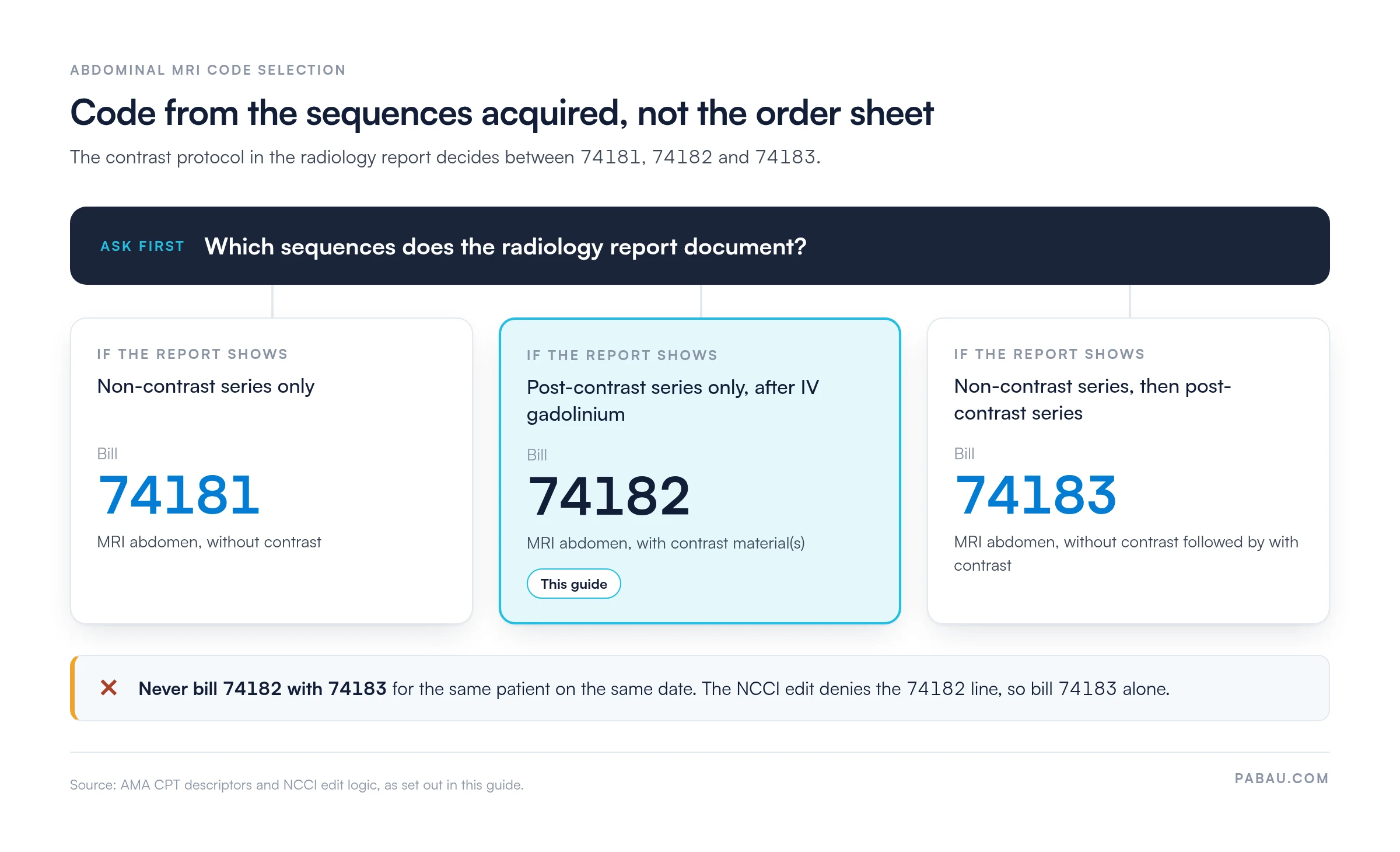
A 74182 claim requires documentation at three points: The ordering record, the radiology report, and the billing record. Missing any one of them is enough to trigger a medical necessity denial. Payers hold imaging codes to strict documentation standards because they treat abdominal MRI as a high-utilization service.
Payers cross-reference the diagnosis code on the claim against their Local Coverage Determination (LCD) or National Coverage Determination (NCD) for abdominal MRI. The ICD-10-CM codes below are among those most commonly accepted, but coverage policies vary by Medicare Administrative Contractor (MAC) region. Always verify against the applicable LCD before billing.
Using an unspecified code like R10.9 may trigger additional documentation requests from payers. Where a more specific diagnosis is established, use the more specific ICD-10-CM code to reduce prior authorization friction and denial risk.
How 74182 is billed depends on who owns the equipment and who reads the images. Getting this wrong produces the wrong payment and often a recoupment demand. Before sending the claim, confirm the superbill names the right billing entity. Getting the modifier right the first time is far faster than filing a corrected claim.
74182 carries a global period indicator of XXX on the Medicare Physician Fee Schedule (MPFS), which means the global surgery concept doesn’t apply. There is no postoperative period to manage, which simplifies the billing cycle compared with surgical codes.
Medicare reimburses 74182 through the MPFS. Rates vary by geographic locality and are updated each calendar year. The CMS fee schedule lookup tool gives current locality-specific rates for each modifier scenario. The figures below are approximate national non-facility rates for reference only, so verify current-year values before billing.
Rates in Alaska, California, New York metro, and other high-cost localities run meaningfully higher than the national averages above. Always pull locality-adjusted figures from the CMS MPFS lookup before setting fee schedules or projecting collections.
Run a quarterly Medicare fee schedule reconciliation for your top 10 radiology codes. Rates shift annually in January. A 5% rate drop on a high-volume code like 74182 compounds quickly across hundreds of studies. Pull updated locality-adjusted rates from the CMS MPFS lookup tool each November to set your billing team’s expectations before the new year.
Most commercial payers and many Medicare Advantage plans require prior authorization (PA) for abdominal MRI. Medicare fee-for-service has no dedicated PA program for this exam. Payer policies change with annual rulemaking and contract renewals, so check the requirement when the scan is scheduled.
CMS’s hospital outpatient department (OPD) prior authorization program covers a fixed list of services. That list is limited to cosmetic procedures, vein ablation, spinal neurostimulators, cervical fusion, and facet joint interventions. Diagnostic imaging is not on it, so abdominal MRI billed as 74182 needs no PA under Medicare fee-for-service.
The appropriate use criteria (AUC) program for advanced imaging was paused, then rescinded by CMS effective January 1, 2024. Medicare Advantage plans set their own rules, so confirm the requirement with the plan before scheduling.
Several related codes and modifiers appear alongside 74182 in radiology billing. Knowing when each is appropriate, and when it triggers an edit, prevents the most common modifier-related denials.
Laterality modifiers (-LT, -RT) do not apply to abdominal MRI. The abdomen is a midline structure billed as a single service regardless of which side of the abdomen is the focus of clinical interest.
No. Billing CPT 74182 and CPT 74183 together for the same patient on the same date triggers a National Correct Coding Initiative (NCCI) edit. Under NCCI bundling logic, 74182 is a component of 74183. When both pre- and post-contrast sequences are performed, 74183 is the correct and complete code, and a 74182 line on the same claim denies automatically.
Before coding, check what the technologist acquired. If the report shows a non-contrast series and a post-contrast series, the correct code is 74183, whatever the original order says. That check only works when the radiology report lists the sequences performed, not just the ordered protocol.
Most 74182 denial patterns repeat across payers, and each one has a specific resolution path. The claim adjustment reason code (CARC) on the denied line of your electronic remittance advice (ERA) tells you which bucket the denial falls into. A workflow that routes each CARC to the right resolution step recovers revenue that would otherwise age out.
Our guide to medical billing denial codes matches each CARC to its appeal pathway. Each payer sets its own appeal window, so work a denied 74182 line before that deadline passes.
Most 74182 denials start with an incomplete claim. The authorization number is missing, eligibility was never checked, or the code was copied from the order sheet. Practice management software like Pabau catches the first two before the claim leaves the practice. Its claims management software runs those checks in the background.

Pabau runs validation checks every time you go to send a claim, confirming details like membership numbers and authorization codes are in place. If one is missing, the Send button stays disabled until the claim is complete. A 74182 claim can’t go out without the PA number the payer asked for.
In the US, Pabau connects to Claim.MD, so your team can run real-time eligibility checks before the scan and submit claims electronically. Each claim moves through clear stages, from Pending and Submitted to Paid or Error, in a single dashboard.
ERA remittances post back into the same dashboard as the claim. When several 74182 lines come back with the same CARC, the pattern shows up in one place instead of spread across patient accounts.
The choice between 74182 and 74183 still rests with the coder reading the radiology report. Pabau makes sure the rest of the claim is complete by then, so fewer claims come back for reasons unrelated to the code.

Pabau holds each claim until authorization codes and payer details are in place, runs eligibility checks through Claim.MD, and tracks every claim to payment. See how imaging practices use it to cut avoidable denials.

The costliest mistake on CPT code 74182 is also the easiest to prevent. Check whether a pre-contrast series was acquired before choosing between 74182 and 74183, and bundling denials and corrected claims stop at the source.
The rest of the work happens before the scan. Confirm the payer’s PA rule at scheduling and pair the claim with the most specific ICD-10-CM code the report supports. Medicare fee-for-service won’t ask for authorization on this exam, but most commercial plans will.
Is your team still working 74182 denials that should never have gone out? Book a demo to see how Pabau stops incomplete claims before they’re sent.

Were both contrast phases acquired? CPT code 74183 explains how to bill the without-then-with contrast abdominal MRI.
Did the exam skip contrast altogether? CPT code 74181 covers MRI of the abdomen without contrast and its documentation rules.
Need to understand how clearinghouse submissions work? Claim.MD clearinghouse overview explains how electronic claims route from your billing software to payers and back.
Want the bigger picture behind each claim? Revenue cycle management fundamentals covers the end-to-end process from charge entry to payment posting.
Want to benchmark your billing performance? Best medical billing software compares the tools practices use to track denial rates, clean-claim ratios, and days in A/R.
CPT code 74182 covers magnetic resonance imaging of the abdomen performed with contrast material only, meaning the post-contrast sequences acquired after intravenous gadolinium. It includes image acquisition, contrast administration, radiologist supervision, and the formal interpretation report. It does not include pre-contrast (non-contrast) sequences, which move the exam to CPT 74183 when combined with post-contrast imaging.
74182 covers MRI abdomen with contrast only, meaning post-contrast sequences. 74183 covers MRI abdomen without contrast followed by with contrast, so both pre-contrast and post-contrast sequences were acquired in the same session. When a technologist performs both phases, bill 74183 alone, because NCCI bundling edits deny 74182 on the same claim.
Yes, for most commercial payers and many Medicare Advantage plans. Medicare fee-for-service has no dedicated prior authorization program for abdominal MRI, and CMS’s hospital outpatient prior authorization list doesn’t include diagnostic imaging. Requirements vary by payer, plan, and site of service, so verify with the insurer before scheduling the exam.
Commonly accepted ICD-10-CM codes include K76.9 (liver disease, unspecified), C22.9 (malignant neoplasm of liver), and K86.1 (chronic pancreatitis). R10.9 (unspecified abdominal pain) and N18.9 (chronic kidney disease, unspecified) are also common. Coverage depends on the applicable Medicare Administrative Contractor (MAC) LCD or commercial payer policy. Always verify the payer’s accepted code list before billing.
The top denial reasons are missing prior authorization and a diagnosis code not covered under the payer’s LCD for abdominal MRI. Others include the wrong code (74183 billed when 74182 applies, or vice versa), NCCI bundling edits from billing both codes together, and modifier errors. A common modifier error is billing global when the hospital owns the equipment. Each denial type has a specific appeal pathway based on the CARC on the remittance advice.
Required documentation includes a signed physician order specifying MRI abdomen with contrast and a radiology report documenting gadolinium administration (dose and route). The report also lists the specific sequences performed and the radiologist’s interpretation with attestation. The billing record must match the report, with the correct CPT code, any applicable modifier, and a supporting ICD-10-CM diagnosis code.



